
AI Bid Writing: How to Use AI to Win More Bids (2026 Guide)
AI bid writing uses AI to draft, refine, and structure bid responses faster while keeping accuracy high. Here's how to use AI to win more bids in 2026

Robert Dickson
RevOps Manager, AutoRFP.ai··12 min read
AI bid writing is not about letting a tool write the whole response for you. It is about using AI to speed up the repetitive parts, find the right content faster, and give your team more time to focus on strategy, compliance, and win themes.
With 65% of top-performing teams using AI proposal technology, it is clear that AI is becoming part of how stronger bid teams work. In this guide, we’ll show how to use AI across the bid writing process so you can respond faster, improve consistency, and increase your chances of winning.
What Is AI Bid Writing?
AI bid writing is the process of using AI to analyze bid requirements, draft and edit proposal responses, reuse approved content, and help teams submit stronger bids faster.
Analyzes bid requirements: You can upload an RFP, tender, security questionnaire, or bid document, and the AI can extract key requirements, deadlines, compliance needs, evaluation criteria, and response instructions.
Supports go/no-go decisions: AI can help teams review the opportunity, identify complexity, flag missing information, and decide whether the bid is worth pursuing.
Creates first-draft responses: Instead of starting from a blank page, AI can generate draft answers based on the bid requirements and your company’s approved content.
Reuses content from your library: AI can pull from past proposals, technical documents, policies, case studies, and approved answers to create more accurate and consistent responses.
Improves editing and rewriting: AI can refine answers for clarity, tone, structure, compliance, and buyer relevance, while keeping the response aligned with your brand voice.
Identifies gaps in the bid: AI can highlight unanswered questions, weak sections, missing evidence, outdated content, or areas that need input from subject matter experts.
Helps manage SME input: AI can route questions to the right experts, track blockers, and reduce the back-and-forth that often slows bid teams down.
Supports portal-based responses: Some AI bid writing tools allow teams to prepare, manage, and respond to bid questions more efficiently across tender portals and submission workflows.
Gives teams more confidence: AI can help review answers, flag low-confidence sections, and show which responses need human review before submission.
Here’s a video on how using AI in sales proposals, including tools like Claude, can help you. It may not be the best approach, but it gives you a good overview of what AI can do in the proposal process.

Video transcript
Transcript is auto-generated and may contain minor errors.
Have you ever wanted to use Claude to create your own custom word documents for sales proposals, RFIs, or other documents that you want to send to your prospects? I want to show you exactly how you can achieve this using Claude's brand new Claude skills. We're going to be creating a proposal just like this, completely AI generated, formatted to how exactly we want it, all based on the prospect's customer insights, so in relation to what they've told you in the sales proposal, their website, your website, and everything else you may want to include in this custom proposal for your prospect using AI. Let's jump into it. First, you can download this prompt and find it from the link in the description below, but this prompt is what we're going to be putting into our Claude project instructions to then be the basis of our document. So, you can see in this document in this prompt it has
the purpose, provides Claude with a role, and then a workflow to identify things like data sources. Here, if you've plugged in various MCPs, which are model contact protocol, or effectively integrations for AI into your other software, you can then have it talk to those tools to get relevant data. So, we use Grain for all our call recordings internally, but if you use something like Gong or other call recording software like Fathom, if they have an MCP available, you can connect it to Claude and have it then talk to that software for relevant discussions you've already had with your prospect for the sales proposal. So, first it identifies data sources. It also could be information from your CRM like HubSpot or Salesforce, and then it's going to research the prospect company. So, it might ask you for the prospect's website if it can't find it in the relevant information you've already provided, and it's going to look for relevant information about that prospect. It's then going to look at relevant case studies. A great proposal always talks about your customers and what they can achieve with your tool or
solution for the prospect that is relevant to that prospect. So, it's going to look for relevant case studies on your website. You can obviously provide it other information if you want if you It's not on your website, but it's going to look for case studies to understand your solution better. Then it'll look for current state information. So, this might be going through the call recordings and effectively looking for information about how the prospect currently works on there It's going to look for information on current state. So, that is how the prospect already solves the problem themselves. They might be an incumbent software or other solution they're using like an agency or something like that as well. Might be or they might be doing something a lot more manual. But effectively, hopefully through discovery and demonstrations and discussions you've had with the prospect, you would have a really solid understanding of their current state and that's what you're going to have here. So, that's step four. Step five, generate the proposal document. This is really cool. So, effectively skills you can either create your own custom skills or Anthropic have uploaded kind of base
skills to everyone's desktop instances. This is going to use the create skill that would already be in your instance especially on a paid plan. And then it's going to use that to create a which you can see here I've uploaded to Google Docs the finished thing, but you can upload it to Microsoft Word or any other kind of document editor as you see fit. It's going to look for consistent styling. Now, of course, you can go in and customize this prompt and or get AI I customize this prompt and have the styling be more specific to how you might do proposals. I've done it to how which is where I'm from does proposals. Then it's going to break that down and kind of present the finished document all AI generated to me that is really relevant to my company and relevant to the prospect and our solution for the prospect in the proposal. Then it will ask you additional questions have that if it can't find that information through the tooling and it will ask itself those questions to help kind of base it off of the document. Now, this is really cool. So, what kind of document is it actually going to create? So, we've looked at the steps that Claude will do to create the
document, but what is the document? And here, of course, you can go through and customize this prompt to make them all relevant for your proposals, but I've done something where it creates a cover page with relevant information, so that's what you can see here. I prepared by Where Software. It then does an executive summary. It creates a more information about understanding the prospect's business. You can see here, I've done Meridian Infrastructure Partners, which is just a made-up company for the example, but of course, this would be relevant for your prospect. Then it looks at current challenges. So, this is really cool. So, this would look at, for instance, call recordings or notes in your CRM or anything that you provided about the prospect's current challenges, and will weave that into the proposal to make it really relevant to the prospect. So, proposal cycle times and all these other kind of things that are relevant for this prospect in terms of their current challenges. And then here, you can see it's mentioned a number of stakeholders. So, Claude also then identifies and I've So, then Claude identifies some decision-makers and
mentions them in the proposal because they're who could be decision-maker, champion, economic buyer, exact sponsor, kind of different people in the sales process that you've talked to, and it's going to mention from those discussions and make that proposal very personalized and relevant for that prospect and whoever might be reading it. We also use in the prompt a good prompting technique, which is kind of Also, in our prompt, we use some prompt engineering skills. For instance, examples of good and bad, which the LM then understands better context around what kind of output it's trying to produce. So, here we have example of some bad framing, which might come across as like condescending to the prospect. You want to avoid that in our sales proposal. And then what good framing is. So, you can again update this prompt to make more relevant for your company, but it's a really good kind of starting point. Then you have challenge. Now we go to solution overview. So this is really cool. Based on your company and what Claude understands from your business and your solution, of course you can provide it more details, it's going to build out a solution overview and how your solution
is addressing those challenges for the prospect. And then finally kind of finish off with why why your company. What it's going to do there in the why company is it's going to look at kind of what your what the prospect is currently doing verse your solution and where the difference is and where the benefits are. Really powerful stuff. Then any relevant success stories and then look at implementation methodology, timeline, the team that'll be working with them. Then you kind of see it goes through and generates all these things in again in really nice formatting to my brand voice, colors, tone, and then generates that and provides a final output as well with the commercials and pricing. Of course you can provide things like a uh Notion or Google Drive link or PDF in your project that includes your pricing table and then kind of stand better in pricing. Or you can ask it to skip pricing and leave that for the rep to fill out. And then you can see there ROI and further information. So next step from here is you grab the prompt
then go to Claude desktop and this this is web browser we can do it in Claude desktop. Jump into your instructions and then paste the prompt in there. Also make any changes to the prompt that you would like. I've called out a couple of different things that you can make different I've called out a couple of ways you can customize this to make it more relevant for your business. First, you can add additional files. So I called out a pricing schedule. You could upload your case studies here as a PDF if you want and just add additional files as you would like that are relevant to what you would expect an AI to use to generate proposals. Could be a solution overview. It could be common pain points. Could be information about personas, industry analysis on the certain prospects industries that you sell to. So that's all going to be in your files. Then in your instructions, you can have Claude edit this prompt for you or you can edit it yourself and say, "Hey, when looking at case studies, look at this file." And so that way when the LLM goes to use these project instructions, it's going to know exactly what context it has to use from your project files for the relevant parts of
its output, its response, in this case the sales proposal. Then you can see here in instructions we can add tools. So I mentioned your MCP integrations or other integrations you might have with Claude. You can click here and add additional connectors. You can see we have a lot in our account, but you can add additional connectors here or have it to you can use recent web web search. I always use extended thinking. It uses more tokens, but it's very valuable. And then you can click there and say and turn on other tools. So if you use Gong for your sales recordings and transcriptions and you have the MCP enabled in Claude and you want it to use the relevant calls that you have with that prospect to generate the proposal, great. Connect the MCP tool, talk call it out in the prompt, use to do this X and Y, and then it's going to use that really efficiently and productively. So when you go into then create a Word doc, I've I've done one here and you really don't have to use too much. You can be like, "Hey, can you create me a sales proposal for this custom for this prospect?" That might be if you if you have Claude connected to your CRM, it could be of the deal opportunity. It could be an email if it
has connections to your calendar or emails and figure out those people or you can provide a longer prompt with a lot more information. And then effectively goes through, uses the project instruction prompt, uses the relevant skill for creating the document, and then it's going to output and present you with a file that you can then download or add or open in Google Drive. And that will download as you can see it's a file and this is what you're going to have left. So I just covered off how you can use Claude desktop or Claude to create a sales proposal with a lot of different ways you can do this. If not just for your sales proposals, but if you're constantly doing RFIs that are pretty stock standard, you could use it to help with that. It really thrives where either you're expecting a lot of the same responses and you can give it past context or you want really customized proposals or RFIs where you have the data available to give it to Claude. It's not going to do well if you can't give it any context, it's going to be very bland, a very basic proposal. Whereas if you can give it
information that is relevant to that prospect, then that will make the proposal just that much better. And of course, you can go through in a Word Doc or Google Google Doc and update it as you see fit. Thing I will mention, I've of course spoken about how you can use MTPs. Make sure you're on a paid plan with Claude and make sure you you have training turned off. Make sure you're working in line with your IT governance, that you're not accidentally sharing a bunch of prospect information and your customer data with an LLM and it's going into the model for training. So make sure that's all turned off and you're talking to your IT team if you have any questions about your specific use case. Awesome. Thanks. That's how you can use Claude skills to create sales proposals.
If you want AI that can support the full bid writing process above, AutoRFP.ai is built for that. Book Demo with AutoRFP.ai to see how your team can analyze, draft, edit, and submit bids faster.
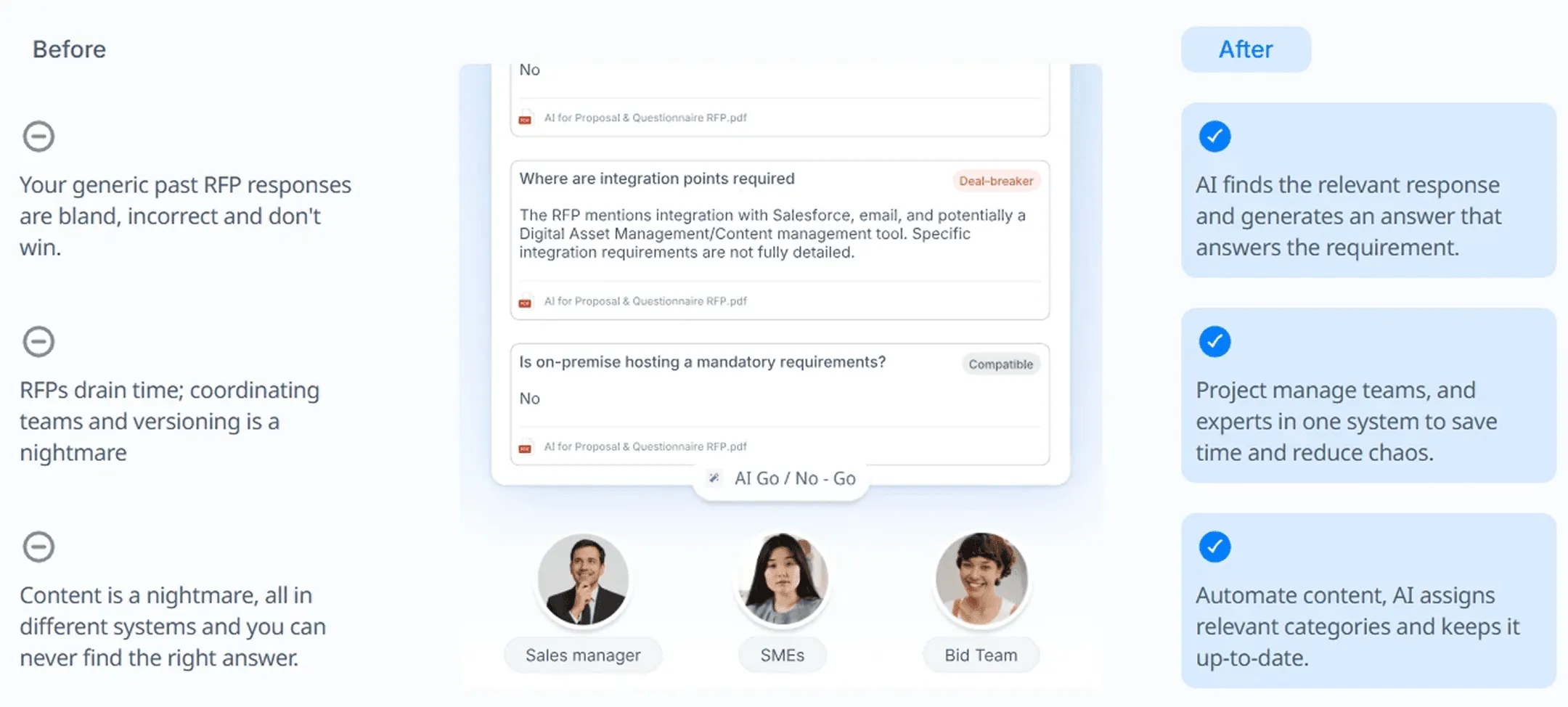
Where Generic AI (Like ChatGPT or Claude) Fall Short on Bid Responses
You can use generic AI tools like ChatGPT to help answer RFPs by uploading or pasting bid requirements, writing a clear prompt, and asking it to draft, rewrite, or structure your response.

Video transcript
Transcript is auto-generated and may contain minor errors.
Hey there. My name's Rob, and I'm from Auto RFP.ai. Today, we're going to be jumping into how you can use Chat GPT projects and the powers of Chat GPT's latest models to answer all of your requests for proposals, your requests for informations, requests for quotes, security questionnaires, and any expression of interest you might get from your potential buyers. Let's jump into it. So, here I'm going to create a new project. We're going to call that our RFP response project. And in this project, what are we going to be doing is pulling in all of our relevant company information, whether that be things like our policies and procedures, for instance, our business continuity policy. We're going to pull in other relevant information like our customer stories or case studies. We're going to pull in and most importantly, our past RFP responses. If you don't have any past RFP responses, potentially if you have other areas like your help documentation or
service documentations in relation to what kind of services or products you offer, that might be really helpful for kind of like functional or non-functional requirements that you might get in a request for proposal. All righty, let's jump into it. So, first we're going to start with instructions. Now, I've got one pre-planned here. And in an instruction, what that is is providing Chat GPT a lot of context and kind of like a master prompt that it uses in every single time it looks to answer any of our additional requests res- prompts in a chat. And so, it's really important to set up a master prompt or uh instruction here for success. So, what we have here is I'm giving it what part is it playing? So, it's a B2B SaaS sales professional cuz my fake company is a HR tech company in the US. We're an RFP manager and response writer, And its primary responsibility is to complete RFPs, RFIs, security questionnaires, and other relevant
information for this SaaS company. It's only going to be using official content provided and uploaded project files. So, I'm being really restrictive here in my instructions to really try to reduce the chance of hallucination. What I don't want happening is the AI to provide an incorrect response that it's made up on one of my RFPs. Of course, I'm going to be checking it before I submit it to the customer, but I want to make sure it's still pulling the information from the relevant files rather than just giving me kind of made up and hallucinated answers. So, I've provided a bunch of different prompts here and instructions to really make that less likely. Then, and then here, what I have is what kind of answers do I want ChatGPT to give? So, yes or no, one to two sentence explanations. I always like where it's, you know, yes, {comma} and then has information for that RFP. So, that's what I'm asking here. I'm going to click save, and I've just added that instruction to my ChatGPT
project. And you can see it here, and that's going to always going to use that when I'm going forward. Next, I want to add my files. Your files might be things in relation to your company like your company pro overview, your policies, your procedures, customer stories or case studies, and most importantly is your past RFP responses. So, if you've previously done RFPs or and proposals and so on, you want to make sure you're providing that information there. Again, make sure the information is timely, relevant, and don't provide too much here. Although I just said provide as much as possible, if you have too much, you're going to wait A, potentially hit the context window of the the token limit of ChatGPT when it goes to answer, and might not be able to look through all the documents, but B, it's actually more likely that you hit the limit that you can have in a project. But, start by giving it as much as possible, and then try to remove things if it's not as relevant for those
particular answers, or when you go to answer particular RFP, ask it to only refer to certain project files that are relevant for that RFP. So, here I'm going to add my documents. So, I have past RFP answers and business continuity plan, and I have a company document that's all really relevant for my request for proposals. So, I'm going to add that in, and then like I said, ChatGPT will be able to search those documents. Uh these are all in document .docx, they could be in PDF, PowerPoint, and so on, Excel, and it's going to then use that what I'm going to answer. And you can see there, there's my project files. Next, I'm going to be trying to answer a new RFP here. Can you help me answer this RFP? So, I'm going to add that file, and here's my fake RFP. This RFP is a fake library in the United States, uh and they're looking for HR tech,
specifically applicant tracking software, which is what my software, or fake software company, provides. Jumping in here, it's going to And you can see there, I haven't provided much of a prompt. Usually, if when I'm using ChatGPT, I provide a lot more information, but because I have those custom instructions and project files, it's using all that context when answering this particular information. So, even though this is quite straightforward, it's actually going to be looking through and then try to answer that information. It's now looking at You can see here, it's going through and analyzing. It actually did pick up that my fake RFP had two sheets. So, I've got a sheet for my non-functional requirements and a sheet for my functional requirements. And it's going to be going through here and answering that information. And there we go. It's answered that. So, let's have a quick look at it. So, I'll download that information.
Great. So, ChatGPT has gone through there that project instructions and looked to answer all of the Excel questions. So, jumping in here, we can see that it's completed the functional RFP responses. And you can see that I've kind of chatted through and asked it to have a look at all the relevant information. It's gone through and answered that information. And then I can kind of download those relevant CSVs. This one's a little bit confusing cuz I've had multiple tabs. So, it's kind of worked through all separately and then yeah, it tried to answer each one as it can. And you kind of see this information here. It's It's done pretty well. There's some pretty useful information. Uh and once I export that and pull it back together into a spreadsheet, I can have a look at what my functional and non-functional requirements look like. So, here I have my requirements. And you can see here it's kind of answered those different details. So, does my system support SSO integration with active directory? Uh yeah, it says it's a pre-built AD connectors are available. Um
whether this analysis is my fake customer, so whether this is correct or not, I'm not sure. So, I gave it some fake information to base it off. But, you can kind of work through it. And obviously, you would know your company best whether this information was actually correct. It hasn't really followed my instructions too well in terms of yes, {comma}. It's kind of just provided more generic description and comments. But, I can obviously go through here and answer those. Either way, it saved me a lot of time. It saved me from having to either A, manually go through and find those answers, or B, it saved me time from having to look back and kind of copy and paste between those responses. That's pretty good for a $20 a month subscription. Now, if you're doing anything larger than this, or if you want to save even more time, so I'm Rob and we're from AutoRFP.ai. We're an AI RFP software. So, you can kind of see here, we do everything that ChatGPT might be helping you with and a lot more. We have great collaboration
features, built-in trust scores, so you know how reliable that answer is, and not just and no project limit in terms of how many different content items you can have. You can load as many as you'd like. You can upload PDFs, Word docs, automatically answer and generate responses for you. We're trusted by some of the world's largest companies from startups to Fortune 500s, including software companies like Sugar CRM, Red Rover, or Fintech OS. And we're rated 4.9 stars and more on G2, Gartner, and other review sites. But, you can find out all about us at AutoRFP.ai. And if you're interested in learning more, you can of course book an online demonstration. I'm Rob from AutoRFP and I hope you found that run-through really interesting around RFP response with ChatGPT projects.
You can also use Claude to review longer RFP documents, summarize key requirements, and generate proposal answers based on the context you provide.

Video transcript
Transcript is auto-generated and may contain minor errors.
Hi there. I'm Rob from autoRFP.ai. In this video, we'll be covering how you can use Claude projects to automatically answer your request for proposals, your request for quotes, your request for information, due diligence questionnaires, and security questionnaires, all with the power of AI. Let's jump into it. So, what we've got here is our Claude project. How you create a project is have a page description go projects, create new project. And then once you've got your project, what we're going to be doing is adding in different project instructions and artifacts, which kind of like files to provide context to our Claude system to automatically answer our request for proposals. I was an account exec at a B2B SaaS company for over eight years, and I spent a lot of painful weekends manually doing RFPs. So, I'm really excited to see all your different LLMs and AI companies
like Anthropic, Google with Gemini, and of course OpenAI with ChatGPT, build out the ability to add additional files and context, and then wrap that in a project where it can remember and help answer our RFPs really effectively. So, I'm going to show you how. All right, next we're going to jump into project instructions. Really good tip here is you can actually use the LLM that you're using. In this example, we're going to be jumping on Claude Sonnet 4 from Anthropic. And with that, I can have it create the project instructions for me. So, jumping into my project instructions, you can see here it has context and role information all about the relevant self. In this case, you're actually a fake company I've created, which is an Apple pen tracking system called Talent Flow. You're a B2B SaaS consultant specializing in RFPs. Great. You're providing context to the LLM. What role
is it playing? What does it need to know? Our sales methodologies, marketing principles, persuasion. When we write a request for proposal, we're trying to say yes and fully compliant, partially compliant, or not compliant to the different questions. But we also want to persuade the reader that our solution is the best for their requirements. But here we have objectives. Really important is our positioning. But if you have information about your competitors, you can put that in your project artifacts. Make sure that when the court is doing that first run of your RFP response, it's thinking about competitive positioning. If you know which competitors are in that RFP process, specify it. Bias psychology, efficiency. All these things are really important with the RFP process. Then we have different information here regarding our pricing. I'll leave that to our sales team. And then here we have all our requests for information. So whether it's proof
points, security compliance, what to do for security questionnaires, and everything else. Really important also is our critical instructions. What's really important to the LLM when it's answering in this project, not to hallucinate. It doesn't mean it won't do it. But at least we'll give you a case that critically think and ensure that it's referring to our project artifacts and files before answering to make sure that's correct. Here we have all the other information that's kind of relevant for that instructions. So I'm going to save those instructions. Next is we're going to add our project knowledge, which are called artifacts. I'm going to upload that from my device. I have my talent flow information, business continuity plan, company documents, and a document around past RFP answers. This is the most important with our past RFP answers. So, if you have any previous RFPs that you've completed, make sure you're uploading that, whether it be a functional or non-functional, or past security questions, so that Claude
has your company information to pull from when looking to answer the RFP. I've also uploaded our kind of a company overview that has relevant information about our core product and services, our onboarding, our performance workforce analytics products, and everything else that's relevant. And then, we have our business continuity plan. Pretty common question is, "What is your RTO, RPO?" I've got that information there, and everything else kind of relevant there. So again, you can upload all those different information, whether it's your policies, your procedures, your company documentation, customer stories and case studies. Most important are those past RFP answers. Now that I've uploaded my project artifacts, I've got my project instructions, my Claude project is now ready to go. Really fun tip about your Claude project is you can actually make it available to everyone within your organization. You won't be able to see each other's chats necessarily, but everyone can then use the same project with the same
artifacts, the same project instructions, and therefore the same project knowledge to answer their RFPs collectively. It's a really powerful feature of Claude, and you can get started with that as well. So, let's actually go through. Can you help answer my RFP here for this library prospect? So, I've got a fake library that I'm going to be using to answer my RFP. So, let's jump in there. Claude has just answered those questions for us, and we can see here it's gone through, and it's attempted to create a CSV, which I can download and copy. It's a TXT. it's provided a summary to our response. Looking through here, it's got each of my requirements, and it's done an okay job. What's tricky about this one, I would say ChatGPT, which you can find in one of our other videos in the description below, it makes a lot easier to play with the data. I've then pulled that into a Google
Sheet, and we can see here it's answered each of those questions. It's done a pretty good job in relation to each of those different requirements. I would say it's it's it's okay. I would say it Is it saving me time kind of that manual RFP grind work that I'm doing? Yeah, it's saving me some time, but it's replaced it with some of the kind of uh manual work in then cleaning the data and making it easier to respond to. Although, when I use ChatGPT, which you can see in the the uh video in the description below, it was a lot easier to use the data. So, it's done okay. I love the Anthropic models. I use them daily for many different things, but here the way that it's presented back is going to take me a lot of effort to pull that together into my spreadsheet. But, it's done okay. I can still copy and paste and pull that into my spreadsheet, or from here I can copy and paste, or I can ask it for a different format, and it might provide a bit more help there as well. Now, if you're doing large RFPs, and you're finding that the LLMs are helpful and they're saving you a bunch of time
from having to manually copy and paste RFP responses, but you're looking for something a bit more fully fledged, well, I'm Rob from auto rfp.ai. So, we're an AI RFP software. You can find us at auto rfp.ai. We have effectively the ability to import all your RFPs, security questionnaires, due diligence questionnaires, whether it's PDF, Excel, Word Doc into our AI importer, and then once you import it in, that will come through and will automatically answer all those different questions with a variety of LLM's as well, not just a simple 4.0 step from ChatGPT or Sonic 4, actually using multiple LLM steps to answer those questions and give you the best response. Our re-ranker models will automatically try to find the best and most trustworthy sources in terms of your company data that you upload into our system for that information. And then you can have all your team collaboration relation as well, whether
it's approving and submitting different responses. We're trusted by companies all across the world, whether that's startups to Fortune 500's, including companies like Sugar CRM, Red Rover, and Fintech OS. And you can find out a lot more information on us, including kind of those different reviews we have from our happy customers at AutoRFP.ai. I'm Rob from AutoRFP, and hopefully that was helpful in how you can use Claude and Anthropic's project feature to automatically answer your request for proposals with AI. Thanks.
However, generic AI tools are not built specifically for bid management. They can help with parts of the process, but they usually do not manage the full bid workflow, content library, compliance checks, SME input, and portal response process in one place.
Generic AI tools:
Depend heavily on your prompt: The quality of the answer depends on how much context you provide, how clear your prompt is, and whether you remember to include every important requirement.
Do not automatically understand your approved content: Generic AI may not know your latest case studies, policies, product details, pricing language, security answers, or brand-approved messaging unless you manually provide them.
Can create inconsistent answers: If different team members use different prompts, the tone, structure, and level of detail can vary across the same bid.
May miss compliance gaps: Generic AI can help review a response, but it may not automatically track every requirement, unanswered question, missing attachment, or evaluation criterion across a full RFP.
Are not built for bid collaboration: Most bids need input from sales, legal, finance, product, security, and technical teams. Generic AI does not usually assign questions, chase SMEs, track blockers, or show who owns each response.
Do not manage a reusable bid content library: You can reuse answers manually, but generic AI does not always know which answer is approved, outdated, high-performing, or ready to submit.
May need more manual review: Because the AI is not connected to your internal bid data, your team still needs to check accuracy, evidence, formatting, compliance, and buyer relevance before submitting.
| Area | Generic AI tools like ChatGPT or Claude | Purpose-built AI bid writing tools |
|---|---|---|
| Best use case | Drafting, rewriting, summarizing, and brainstorming individual responses | Managing the full bid response process from intake to submission |
| RFP analysis | Can summarize requirements if you upload or paste the right content | Can extract requirements, deadlines, gaps, and compliance needs more systematically |
| Content reuse | Depends on what you manually paste into the chat | Can pull from approved content libraries, past bids, policies, and technical documents |
| Accuracy | Needs strong prompts and human checking | Can work from approved company knowledge and show which answers need review |
| Collaboration | Limited unless managed outside the tool | Can support SME routing, task ownership, blockers, and review workflows |
| Consistency | May vary by user, prompt, and session | Helps keep responses aligned with approved messaging and brand voice |
| Gap analysis | Can help if asked directly | Can flag missing answers, weak sections, outdated content, and incomplete evidence |
| Portal response support | Usually manual copy-and-paste | Some tools support bid portals and structured response workflows |
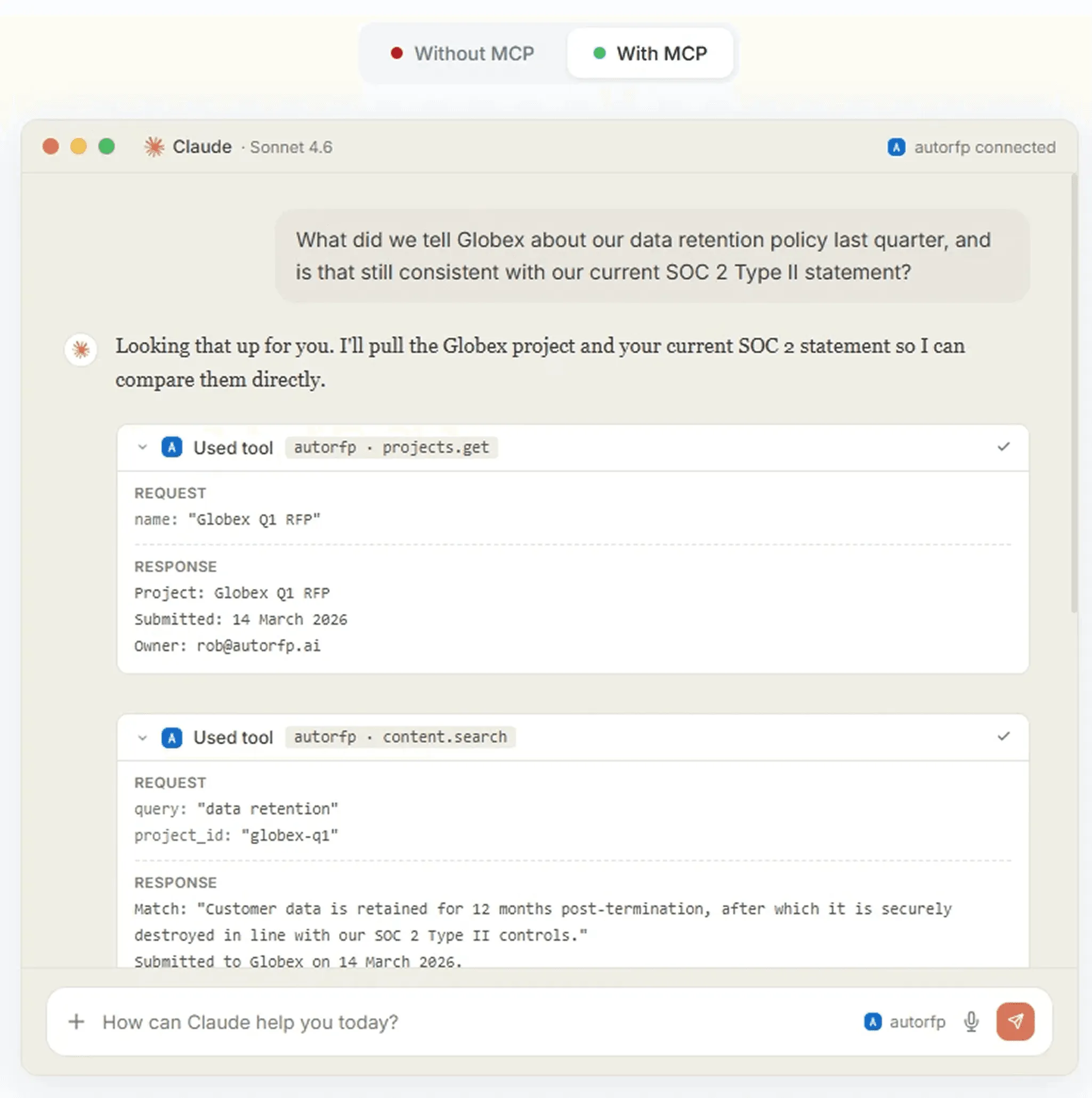
That is also why AI assistant integrations matter. Generic tools like ChatGPT and Claude become much more useful for bid teams when they can connect to approved projects, requirements, and content libraries instead of relying only on pasted context.
With AutoRFP.ai’s MCP server, teams can bring that bid knowledge into the AI assistants they already use, helping them search content, check contradictions, and work with live RFP data without switching between tools.

Video transcript
Transcript is auto-generated and may contain minor errors.
Really exciting session today demonstration of the brand new auto RFP agent jump into the new beta releasing later this month which will cover MCP connection. So that doesn't mean anything to you that's totally fine. That's what we'll cover today. And then we could talk a little bit about what's next, like what agents look like in the proposal, in the DDQ, in the bid space over time, and what this might look like all the way up to 2027 as things rapidly change. But I feel like the vision of what's possible with large language models and other types of AI is becoming more and more clear, how serious the effect is going to be, and how different responding to RFPs, DDQs, RFIs, and all of the above is going to be in the coming years. So at Auto RFP, we've spent a long time invested in this. We were founded straight after chat GPT, not even ChatGpt, just slightly before ChatGpt became available via the first API endpoint for the first usable OpenAI
model. And today we've taken that all the way through the product, worked with all the different model families and stayed across the evolution of the chatbot, the assistant, and now the agent. And really today is the time to I think release the agents like to the world and they've got to a level of capability now where they can be useful and not waste a lot of your time. So let's talk about the rise of the chatbot. We started with chat GPT being the very first and claude has become more and more important over time as well and widely adopted particularly in the proposal community as well and they are really quite simple still. So we started with the basic building blocks sometimes called primitance. The first one being prompts right everyone might remember prompt engineering being a big thing. I don't I don't know where that went. I do but it turned out to not be such an important part. So there was the prompt part where we just type stuff in the box. Maybe we even copy pasted from documents back then to get it inside of our prompt box and ask a question. Help
me write this. Help respond to this question given this context and then paste it in below. And that's where it started. And then we started to go, oh no, I don't want to copy paste things from all of these different files, right? I do want to be able to add entire documents. And we started with being able to upload 20 pages and then 100 pages. And Gemini has far exceeded that. Some of them are still, hey, this document's too big. You're not allowed to upload it into the context window. So there was the context part. And that's still even a constraint today for certain models. Then we have the tools. So they started to come out. Probably the first one was web search, right? When they started to release that, we saw that with Chach and Bing back in the day, there was like an integration there and more and more we saw Claude release web search and then of course Gemini being backed by Google has amazing web search and eventually releasing deep research as well. So let's not just call one tool once. let's use deep research where we can call web search a 100 times a 100 different ways
and over time look at 400 different websites. So that deep research was it was a huge expansion into what's possible with tools. Some of them will also have things like create image where it asks a different model to create an image or it maybe does research or yeah different aspects. And then finally more recently there's been all the buzz around MCPS the model context protocol and that is just a standardized format of connectors similar in a way I guess to APIs but but quite different so that just allows the agents and chat bots etc to easily connect with systems and that's a really wellsupported ecosystem now with over 17,000 public connectors available. So those are the four core primitives that we see in our chat bots and in really any agent today. Even things like uh artifacts, right, where it's generating documents are really just using a prompt and then calling a tool to create a document. Projects are
really just having preset prompts with some preset context and some tools all in one place, easily accessible and ready to go. So not necessarily like a feature or a new building block, but just bringing these together in different ways. And even more recently something like skills, which is just bringing prompts, context, tools, some files, different things like that, and bringing it into one big block so you can easily install things like skills. So there's some great skills for web design, for example, that pull in prompts and context of how you should best go about designing the landing page, for example. And that's all out of the box. So we started in this very generic place and now catch GPT and claude can do so many amazing things. You can rely on them for all sorts of tasks. But what we have seen more and more is the move over to specialized agents. And one of the largest markets for this is the software development market. The models are extremely powerful at software development. It's also easy to tell if a AI model has failed or not
when it comes to software development. Sometimes the test either passes or it fails. It generates a result or it doesn't which is not at all really similar to what we have to deal with proposal. What is actually going to cause me to win here? What is truth? And much much harder questions. So the software development focus made a lot of sense for all of the big providers. And what they eventually figured out was we probably want a specialized set of prompts of tools of context. We want special systems here that are going to be way more performant when it comes to that particular use case. So if we look broadly at Claude and Claude Code, recently Claude Code did a bit of an oopsie and released all of their source code by accident. Not advisable, but it really gave the industry a lot of insight into how those bleeding edge tools work under the hood. And if we compare them of what we might know about the Claude client and similar clients
like it to something more specialized, a more specialized agent like Claude code, we have a whole different level of complexity to this. So where Claude might just take you through three steps like you ask a question, it thinks about it, it generates an answer, Claude code has upwards of 10 different steps and that's built off software best practices, right? It's built by engineers who are thinking what is the best process. Oh, it's not just to ask and then think and then generate code, right? It's to plan. It's to search all of the current code that exists and identify how we've done things in the past. Let's not reproduce code that already exists. Let's try and leverage it again. There's a lot of different best practices just like any particular segment of the economy or white collar work that needs to be thought about there to turn it from an average developer or maybe someone who hasn't developed really anything at all to someone more senior with the skills frameworks mental models in order to produce good code. So that's the same with tools, right? Where a basic tool
like web search or research or a few other things, Claude code has a lot of very specialized tools that allow it to search tens of thousands of files very quickly at the same time which is needed in that particular use case. It has a lot more opinions. Quarter is often regarded as the model or at least the client that has like the best prompts. So you get really nice writing from it. You still get m dashes and things like that, but you might not get as many robust this, robust that. It's not X, it's Y type responses from it. In clawed code, you have very specific opinions. It will even get to the point of don't say this or don't use this tool, do this or don't use this coding approach, use this exact coding approach. So, it tries to overcome many of the challenges even with the state-of-the-art models, but they still fail on these tasks. So they've basically put it inside of the tool as part of clawed code to work around that. It's also got special loops in it that go okay if I fail how do I try again? And also it's able to work
with users and files. So, it's got a much more clean interface of being able to actually work with the user in their workspace because it assumes a semi-professional person that is aware of some software development practices is able to install a certain install claude code but also work within a development environment. So, it's specifically built for that use case, making it a lot faster to work with than if you were trying to copy paste all of the code in and out of claude. With Clawude code, it's actually doing that instantly for you. can edit hundreds of files at the same time if it needs to. And then on the skills side, Claude comes out of the box with very few skills where if you use Claude code even out of the box, it's going to have 11 plus preset skills ready to go. So basically, if I log into Claude, it can technically build software. It can do it reasonably well, but Claude code is just on an entirely different level in terms of the quality, in terms of the level of automation and kind of hands off the wheel. So you can think of this as like maybe Claude can give you some driver
assist on the road where Claude code is much more moving towards fully autonomous driving, right? And there's a huge delta between those two. And these specialized agents are having far superior results. So we're seeing things like if I was to go into to claude itself and go make me a new landing page for auto RFP, it comes up with this which is yes technically a landing page. Whereas if I go with a tool, a specialized agent in this case, Lovable, which really focuses on user interface design and shipping code, when I put that same prompt in, it's navigated to our website, it's taken our brand assets, and it's produced a better result. So, if I'm to jump in, they technically both completed and created landing pages. It might be impressive if I've never seen a landing page before. I've never created one before myself, but as someone who knows a little bit about code and what marketing websites should look like, Lord has given me raw code that's not ready to publish. There's no
built-in security check. It's made up those brand colors, hasn't really got those from anywhere, and even the buttons on the website that it provided don't work in the first instance. But interestingly enough, it does have better copywriting when compared. Whereas Lovable on the other hand had really high quality code compared to Claude. It was instantly ready to publish on the web. So I could just click a button and that would go straight out to a website. It automated a security audit off the back of it. It was actually matching the existing brand colors and the buttons actually work. Right? So when it comes to these two things like if I'm in a hackathon or I need to make marketing sites for a living like Claude is going to be useful if I'm playing around with the concept. But if this is my profession, then lovable is definitely going to be the way that I go there. And this has been true. So across across the chat, like we've got a lot of generic chat bots for the Geminis, the Chachts, the Claudes, and more recently, Open Claw has been a huge kind of hype cycle around that.
Really interesting ways that it incorporated new tools, more skills, more memory into the client, but still kept a fairly general use case where it can really do anything. And then more and more not just across coding but also other areas I think thin AI is a good example within the customer success space but we're seeing a lot of different kind of coding agents that are working very well and then to tie it back to our space here proposals like what really is there there's really not much and it's because it takes so much time to develop this kind of skill set and these massive companies have been very focused on doing it for the generic the coding they may ever produce a specialized proposal agent. So that is exactly what we intend to do is put massive amount of resources across our client base into building truly the best agent in the space. A hypers specialized one that sits on the cutting edge with the clawed codes the lovables of the
world but for our specific use case by incorporating these building blocks and entirely new but also very focused on our use case way to provide the best results. So that's something that we've been doing and putting a lot of work into really since we started the foundations have started have been built but more recently being able to put them all together in one place so that we can really show what's possible now that the model layer is ready. So if we just think about the agents and how they interact specifically in our space is with a generic agent you're probably experiencing a generic tone and style. It's very hard to collaborate with 20 plus subject matter experts inside of a chat GPT thread. Virtually impossible. It doesn't really respect formatting. Sometimes I'll ask Claude to like edit this existing document and it will just make me like a new HTML document or like some random markdown file that I need to copy paste. It's very limited in the context that it can search. So even with
a lot of new connectors, they're using keyword search. So, it's really struggling to find different content that it needs to respond. Even though I've technically connected it to Google Drive and I've technically connected it to Confluence, it's just unable to find that because like me, it's just typing keywords in, hoping for a match, not finding anything, and then taking it back to me to deal with. And it's quite slow, right? So, you've got these models now that are impressive but very slow with their thinking modes and such. And then there rather than having easy tools that are built for specific use cases, they've got very generic tools. So even something like Claude, it doesn't necessarily have like native document editing. It actually edits the documents through writing code. So it takes a long time because you're writing an entire script in the background just for you to edit two words in a word document. So very slow and it can also be very manual. And I said those are like some of the main drawbacks is there's many more of just the generic agents at the moment. So what we wanted when we were building the proposal agent was
something that learns the tone style win themes and and captures that over time that's super easy to use with multiple users at the same time. Can 20 people use 20 different agents at the same time on the same document? How can we get it to respect your templates, respect your formatting? How do we have it just be able to search across thousands or tens of thousands of files, documents, integrations that actually find what you need? And then how do we just have it instant so it's just natively editing documents? There's no waiting for code and how do we connect this with all of your different systems in a safe way as well. So what we built with in the foundations of our approach much like any other client and the open claws and the chachi pts of the world first we started with the models love the openclaw approach where you can bring in any model that you want what we have done in our infrastructure is we have partnered with each of the major providers in the most secure way possible so we're talking
about open AI we were able to work through Microsoft Azure's open AI service with zero training on data and then provide the latest and greatest model there GPT 4.5 and then with AWS we're able to provide secure version of Opus 4.6 six and then with Gemini the Google we've got Gemini 2.5 flash so basically a foundation of how do we get enterprise ready models with zero training and also hosted in Europe if you need it there in the US or Australia where you need it there and build that into the foundation and we don't want to be stuck with one model family we want to be able to easily switch between for different use cases because the use cases within our space are so varied sometimes you just need to do a quick search. Sometimes you really need deep reasoning. Sometimes you need taste and style more than anything else. And unfortunately, there's no real model to rule at all at the moment from our benchmarking. So bringing these different things together really gets people to the cutting edge, gets to the
best available models for different use cases. We're able to stitch them together in very interesting ways. The next thing is the context. So integrating the model with our existing integration layer. So that's where we connect into 15 plus systems like Confluence, Google Drive, SharePoint, things like that and then actually recreate a lot of that content in system so they can be easily searched. So rather than Claude that has to go out and search by keyword, we're able to use a very powerful and faster AI search inside of our platform to find content across all of those different systems. Meaning that we're not having to upload files. We're not having to rely on the keyword search, but we're getting way faster results and we're getting way more specific context in that context window to make sure we're getting the best results. Finally, as well, the tool piece from the base layer. So, we wanted the best-in-class web search and scraping.
So, we wanted to be able to go into websites, documents, particularly for driving customer insights. We wanted to be able to access as many websites as possible. go as deep into those websites as possible so that our customers can research their prospective clients and take that insight into their response. Because as we know, it's one thing to have a fast draft these days of all of the basic answers. That's great. But where we want the agent to go is take it a step further, research this particular customer, pull in more context, and help me win this thing by providing a more bespoke, a more insightful response. And then finally, the connector layer. So we did a lot of work actually on the like enterprise security side because MCP is still a very early standard. So there's huge risks in some of the connectors. For example, you might connect GitHub to the system so that you can search so that the system can search through GitHub and maybe there's interesting context there that you need for your particular use case. But at the same time, a lot of MCPs will allow you
to delete things in GitHub using their MCP or create things that they maybe shouldn't create. an agent still can't fully be trusted. So, we wanted to build a secure approach to deploying MCP that allows our customers one to define which MCPs their users are actually allowed to select and then having a readonly first approach where we really heavily recommend that you only use it for context. So from searching from these different systems, although also allowing our customers to do rights, which means things like Google calendar. I'll get into a few more use cases later, but basically not only do we want to bring you the models in that fashion, we want to be able to give you these cutting edge or sometimes even bleeding edge technologies in a way that's safe. So that is some of our engineering time as well. Cool. And then finally, the prompting as well, right? Like that is a basic part of it. But this is going to be huge as it evolves is much like claude code. How
do we start to develop more and more specialized prompts in the back end? How do we start to identify as a customer base where the gaps are in these different models and then can we give it explicit instructions to not do that and build that up over time. So much like legacy SAS players where it was just like we we write a feature for one person and everyone gets it. I think this is going to be amazing for agents as well where we write one prompt, we write one skill and then everyone gets the unlock from that. So there's going to be a huge amount of resources deployed there as well to basically build out the many necessary prompts and skills and etc on the back end that inform the agent and how it approaches response. Great. That's enough of my ramble and we will jump in to some real examples of the agent. Cool. I'll just jump straight into the platform here for those not familiar
with auto RFP. Just quickly, what we're looking at is a live project. So, we're inside of the project view. The project has already been drafted. So, there's already been an AI agent worked through all the content, find what it could generate the best response as it possibly could out of the box. Great. That's what we're looking at is this draft. And here I've got some questions that are form part of this particular RFP. In this case, we're doing a little something a little meta. We're doing a RFP for proposal software. So they've got some questions around the security of the platform, around the implementation of the platform, our service level agreement, all of those questions you might have for a vendor like us stepping through that. So first thing here is we've got some questions on data residency and it searched our content library and then provided these basic responses which is all we had in the content library at the moment. It's as specific as it got. So our objective here is I know that this is an important aspect for this particular prospective
customer. they are in this case we can say they are enthropic and we want to be able to customize this further to focus on their demands right we don't want to be talking about Sydney Australia or Frankfurt Germany if their only focus is United States-based hosting and we want to make sure that our certifications and everything mirror exactly what they need and that we're highlighting that as part of our response so we're not just putting all those context in a box we're actually being responsive or even better we're being insightful when providing our response So this is where one of the many surfaces the agent is available in but probably the primary one dayto-day is within the actual tool itself I can simply open the agent on the right side. So, it's here with me in the application. And then below I can see much like a chat GPT type interface, I've got the ability to type in a prompt. I've got the ability to attach any files that I
would like and send this message. And then I also have our specialized tools that we've developed like our web search that integrates very specifically to yeah search multiple different pages, scrape their context, even access sometimes things like PDFs and etc. We've got content here which allows us to search our content library. So all of the context in the system and the systems that we're integrated with very quickly. We also have the edit tool. So again, rather than having to basically just talk with this bot and then copy paste it into the interface, how can we start to give the agent the exact same tools that I have access to? So I've got access to edit this document. Why can't the agent just do it for me? So I'll switch that on. And then finally, the ability to document. So, not only can it edit the response that I'm going to give to the customer and insert it back into their file, but it has the ability to build out documents or artifacts or
addendums, attachments, whatever you want to call them. It's able to generate new documents like a service level agreement, like a security overview, whatever we might need, it's able to do that. And it's only able to do that in a generic way that it thinks is best. It's able to do that in different proposal formats and different branded templates and we'll step through all of that. So let's start with this example here. So I've got a number of different questions. I can select the questions that are in scope and this is defining the context. So I could work with the entire project and all questions throughout it or I could work with just specifically these security related questions. So I might start there and work on some data residency stuff to try and take this to the next level. So first thing I'll do is type in do some research on anthropics data residency requirements on the web. So I'm just going to see if it can find anything about where they host their different options. Maybe they've got different
APIs. And great, it's already been able to jump in very quickly there, find data residency on the claude API docs. And it's also found their internal trust center and being able to pull from there. So in this case, just to be clear, Enthropic, we're saying that this is an example prospective customer. So we're researching them and then we've got some context here. Great. So now that I know that, I'm going to say, yeah, we should probably update these responses to be more responsive to their needs. And based on this, it does look like they will want maybe US hosting. So we should align with that and their security requirements. So let's do that and let that run. The agent will think about that and then of course it has access to that edit tool. But we don't want the agent just randomly making edits without us seeing them first of course. So here is another part of the interface where much like what they have accessible in the coding type agent, we've got this in our workspace so that we can actually see what it's recommending. So I can see
here it's refactored quite a bit of this and it has gone and actually what we previously had is this little list here of all of the different places weighted pretty equally. It's gone through and said great our primary hosting region is in Oregon, United States. Great. So our other available regions also include and then just highlighting four clients requiring EU only hosting. Great. So it has tailored that a little further much more serious about US-based hosting now. So I can accept that change. And here it's even put in some stuff about bolding the different requirements that they that aligns with them and then yeah talking about how we align with their industryleading standards including those held by anthropic. Awesome. Great. So now I've just taken that from basic generic response there to something a little bit more high level. But maybe I remember on the call with the customer before they sent over this questionnaire actually the chief information security officer might have wanted a little bit more detail than that. Then I could even take this to the next level and ask
create a brief and highle overview document of our security approach and US hosting option for their CISO. So now past just researching it, providing me that context, and then applying that edit within the response, it's going to go even a step further and generate a document here based on all of that research and putting it all together. So again, it could do further research into our content. We could ask it to research the web more or whatever we really need and then put those building blocks together. And here you can see a very simple preview of the document on the right. with different headings, subheadings, formatting options, images, tables, and I can actually edit this document. So unlike some generic clients where I actually can't edit the underlying document, I just need to reprompt the AI, I can actually just jump in here and screenshot things and add them straight in even to the point of maybe I want to insert a table or something like that and start to work that way. And what's nice about this is although this is very
simple and high level here I was to build this whole thing out might be more interesting but ultimately what I will do is I will export this into a template. So it's not going to come out in a generic kind of AI slot based template but in anything that I've uploaded. So here for example only I've added three different types of branded documents we might do. So, I've added one called branded attachment just for no real fancy headings, just straight into the context. I've got one that is a branded one with a cover, right? So, like an auto RFP cover and then a more structured type document. And then even an RFP cover letter, right? Might include CEO's signature or something with an overview and populate with the client's name and then have aspects of the artifact or the document we're building here. So in this case I can go for a branded cover. Click export and then that will simply get the document ready and download it. It's straight for me to preview. So
cool. It's downloaded right there. And then I've got that already open in here in Google Docs just so we can quickly jump through. So here this is the branded template. It supports anything that's in in Google Docs or Word document formatting. So it can be quite complex. And then here you can see great it's got the it's got the cover table. It's got all of our fonts, colors, headings, etc. And then it's gone ahead and actually exported all of that different response material into a document ready to go further edits if I want to work in my Google Docs workspace if I want further or I could just use that and attach it directly to the proposal, send it to them, whatever I want to do there. So that's a really quick example of just one of the different use cases. Another use case could be something like an implementation plan is like a constant struggle for a lot of people where you need to make a more bespoke document for that particular customer. Be it an implementation plan, be it an approach, be it your assumptions,
whatever that might look like. So here they say provide a realistic implementation timeline and playbook for an organization of 500 employees. And then what RFPs come through? It's just being not like the base model has just found the stuff that we've provided for this in the past and put that there. But we know we want to work on this and develop something a little bit more detailed. So let's say in this case that we're going to be really hands-on with Enthropic and that's what we've put forward to them. So let's say rewrite the full roll out based on research of Enthropic's office locations and one week deployment per office. So here rather than just using one tool at a time, it's actually able to go through search the web. So it searched entropic office locations, it's found all their office locations across a few sources there and then automatically suggested an edit updating our roll out from the really short one to hey here's all of your offices and here's all the rollouts. So doesn't require me going to
a bunch of pages, copy pasting all of the different office locations and then going back to the RFP document and working that in or prompting an AI and then having to do that, right? It's just simply done. And then on top of that, I can just to show off add create a full implementation document 600 words or more with a table of rollout dates based on an assumed May 30th, 2026 kickoff date. Right? So now model's able to reason and go great. So if it's May 30 30th kickoff date 2026 then we can roll all of this through the different dates and then I'm going to make a document for that in our format maybe even an implementation specific branded format and here we can see great the implementation plan for anic got all the team training etc. And then we've got our different dates for the actual deployment post those first few steps. Here's what the actual office kickoffs and end dates will look like as well as
the required resources, some of the key risks, etc. So I could go look, yep, that looks great or maybe I want to do some further research whether it's entropic or in our internal content. Right? So if I had more content, I could go search the implementation we did for open AI, right? And then that will actually go through and be able to search the content, etc. So yeah, then apply that. So that's another kind of quick example of what's possible there. To round this out, we can also have something as simple as the service level agreement. So again, can pop that open and say create a document for the SLA, nice table and 200 300 words.
So it just allows me to get away from yeah having to manually create new document, copy paste all of that workflow and just makes you move so much faster and honestly like gives me at least the willpower to go that extra step that step that you might not otherwise take with tight deadlines and provide that extra document that they ask to attach optionally to give a more detailed implementation plan rather than just paste the generic thing in there and expect to win. We know that from our win rate report earlier this year, the number one difference between the people with that win over 50% and those that win under 50% is the amount of customer insight, is the amount of responsiveness to their particular requirements. So this is basically how you achieve that without having to hire more people, double down or start spending all of your Sundays adding that. So here the next big step is integrating
that with a far broader range of tools. So we've got all the core stuff in there now which is great but the next immediate step what we have in beta now and will release this month is the MCP connectors. So again MCP allows us to connect to yes 17,000 now different servers. Most applications these days support an MCP server where we can connect. So that could be simple organizational context. So there's an MCP for Slack for example that allows us to search through maybe different threads where you keep some information or some context. Maybe you've even got different Slack threads for certain customers that are going through the RFP process. You could keep the agent in line with that and it can get its updates from the chat. Confluence and notion are also supported which takes us past the native integrations that we have out of the box already in auto RFP and gives us a few extra tools to be able to search further and do more interesting things as well as Jura and
many more. Then you've got the customer context parts. This is really exciting because it allows us to do things like search the opportunities context in Salesforce, in HubSpot, in Microsoft Dynamics, in any system that supports the MCP protocol, which is most will be able to have the agent go, hey, actually look up this customer, what were their pain points, what are potential wind themes that could work here, and actually work that into the response, which will be an absolute game changer. And that's the same with call transcriptions as well. So can connect Gong is a common one and there's so many others that are supported by MCP really all of the major ones at this point. So not only can we get the customer context from the CRM we can also go hey look at every meeting we've ever had with them highlight all of the critical requirements that they mentioned find them in this document and tell me which ones they are so I can jump in there further or whatever creative prompt you can come up with to work that context in. really interesting stuff as well is
going past just reading and using as a context layer and starting to use it as a project manager. So things like realizing during the bid that I actually need to create some time to do the implementation plan. What I could do very easily as we step through is go hey I need some time with implementation manager X. Could you schedule that in my Google calendar and provide them a quick overview of what we're going to be talking about? And of course, it's looking at the RFP. So, it can take all of the required context that they talk about implementation, take that into a Google calendar invite, and actually write that invite and send it to the person and give you that feedback directly within the tool. So, that's just like incredible things that we can do. And I think we'll develop more and more of that natively into the tool, but that gives you a starting point. You can prompt it and do that. I think some of our vision around this that I'll talk about more is that we want it to be able to automatically do these types of tasks and take more actions for you where it makes sense. There's also so many industry or
customer specific connectors that might exist. There's great registries online where you can search. So if you search MCP server list, you'll have a bunch of different websites that index them all. There is in a financial services regulatory context. There's FINRA where I can search things like broker check and so many other information sources and pull anything from a form ADV all the way through to other things in a software context. You can do amazing things as well. You can integrate with yeah jurors of the world about your product road map or linear if you use that tool even things like GitHub where if you are someone who has access or could be authorized to access the actual application code it's really interesting because you can answer really technical questions without the need for one of your subject matter experts to search through all of the code themselves and find a particular answer to your question. you might be able to get a great first draft there and then assign them in as a reviewer after doing kind
of the hard work for them. And then there's different research contexts whether you're in healthcare and something like PubMed articles might help you sell or maybe there's look at any academic research to do with this particular painoint that they're accessing and pulling in that context. So, I think we'll see a lot of companies get huge amounts of competitive advantage by connecting interesting information sources and then building that into their workflow to be more accurate, but also much more informed than their competitors. It's impossible for a bid manager, for a pre-sales engineer, for whoever to know everything about everyone and to have the 20 hours to do all of the customer research and understand their space, etc. But the agent can give you just so much leverage to come more informed to a deal than virtually anyone else on earth at the moment. And I think really now is the time to to make use of that in your win rates while this isn't a commodity but actually something new. And yeah, again 15 17,000 plus public
servers. And let's touch on this a little more. So here we have our organization settings integrations. We have all of our different content integrations and everything that we've done to date. And what we'll have here is our agent MCP servers. So this is where the admin of an account can log in and then actually add an MCP server. So we're basically whitelisting the sources in which they can have access to. So here we've got some native ones just so you can click on them and get started. But again, we support over 15,000 of these on the MCP standard. So you can just click add a custom server and that will have your Salesforces and everything else of the world right there. You put in the URL and it will start the login process. Really nice benefit of MCP is that we don't have to go and integrate with a thousand different APIs, 15,000 different APIs.
We can simply do that one connection and you can connect to anything. And just to show you that flow here, I'll go ahead and delete. Actually, I'll keep this. I'll keep this. So, let's say I add the connection. I would go through maybe click Slack here and then sign into Slack and connect it. What that will show me is a list of all of the tools that makes available. So here we've got grain which is similar to gong for those not familiar. It's a meeting recorder at its most basic. So here right we've given the agent the name of the tool a description of what it is the meeting recordings and transcripts right and we can give it access to different tools. So is the AI allowed to list my meetings or not? Is it allowed to fetch meetings that I've attended? Is it allowed to search companies that I've met with? Is it allowed to so many different things like list the open deals that I'm working on? And by default here, we've only given it read access. So, it's actually safe. You can go in there and make sure that if someone logs into auto RFP and they authorize something like a
gong or a grain. It's not just going to come in and start to fetch deals or create collections or do anything crazy. It's just going to be able to read and do things that are useful and that make sense in this context. So that's something we spent some time on there. And then what that means is that every user when they actually log into auto RFP will have the different tools available. So here not only the document tool and the edit and everything we've been through, but actually we've got the linear tool turned on here and then grain not connected where I could click on grain and then connect that for myself. So really cool thing about MCP as well is it will respect my permissions. So within GitHub, within linear, within Confluence, that user and their agent will only be able to use whatever they're actually authorized to use. So that's a huge benefit of our type of approach versus just one MCP connector that connects all of your information as an admin and then anyone
can go willy-nilly and search all of the meetings in the company. This will just search that individual's users meetings, what they've been shared. So now that we've got that an interesting one and just one example of many here is that I can now go to a question let's say about the road map. I can open my agent and with the linear tool already active here, I can go through and have it search our linear. And knowing that this prospect is maybe super interested in our reporting road map and all the different things we're working on there, it can search our linear search all the different road map items and then actually put that together for me and then provide that in the response. So we'll give that a second. Interesting thing about the linear agent as well in particular is it can actually talk to a linear agent. So, we're already having agentto agent
discussions in some of these integrations. Cool. So we can see here it's actually gone through and then it's got all of our reporting enhancements and it's got great here's our insights redesign we're going to be doing this and that and I go look rather than get into that level of detail maybe yeah let's just make a summarized road map document with a table for the reporting elements Cool. Now I've got that and we can go. Okay, cool. So rather than maybe responding in line here, let's go update the response to refer to that. attachment. Cool. So now rather than having that respond in line, we're going look that's
maybe a little bit big. Maybe it exceeds the word count. It should be an attachment or something like that. Great. So a detailed road map of our reporting initiatives plan items is available in the attached summarized reporting road map which is exactly what it will be downloaded as and then eventually attached. And I've done that across a number of different prompts here. But there's nothing stopping a user as well from doing something like this. where I can go firstly search linear for this then do this and you might even have workflows where you want those compound elements first search Salesforce for this then consider this then do web research then update the relevant responses with requirements that that interact with that context so cool it's able to go through there and do that all in one foul swoop that is the foundation and really the first release of our AI agent. So, we're just getting started here. This is the absolute V1 and we see the future of
this as working with the top winners on Earth, our customers and others to build skills directly into the platform based off our research findings. So things like customer insights, how can we really understand how to do those best, how to respond in different types of RFPs and respond the best way and have that data backed and work on that with domain experts so that our platform builds from all of that collective knowledge automations as well. So not just triggering the agent for these different use cases by talking to it and working backwards and forwards there, but actually building it throughout more and more of the process. So using it to automatically triage RFPs to the right people to flag conflicts as they appear or even near the due date. Can you please have a final check and then suggest changes 3 days out from the due date. So you not even having to prompt anything but it actually coming to you, maybe even sending you an email, a Slack message going, "Hey, it's due in 3 days. So I did a final check. Looks like this
is missing. Could you jump in and help me respond and finish that off?" And then a lot more tools. We want to get to the point where the agent has access to all of the same tools as a human. So that means assigning users, maybe as editors and reviewers, maybe exporting the files and checking the export, doing all of those types of actions that you can within auto RFP like flagging content, updating it, etc. And really getting all of that to the agent over time so that you can act through your agent rather than just being able to act through the user interface. And then there'll be the concepts of ambience and really interesting and we've got some really interesting thoughts around how this applies that we might not share at this stage because they are that interesting. But things like being able to forecast what users are working on. So, if you're working on a bid and you're making a certain type of change, maybe you're updating something from first person to third person, we see you do that a few times. Can we automatically trigger the
agent to suggest how that should happen across the rest of the document for you automatically without it being annoying? So how can it just be sitting in the background always thinking always working with you like a colleague but you not having to jump in there and think about how it could be useful but it itself taking the responsibility for that and jumping in where it makes sense. So that's some of the stuff that we're actively exploring and working on today. And then I think broader than that when we think all the way out to 2027 I think by then the need for a proposal agent and this is more broadly as well is it should have onetoone context and the ability to commit actions just like a human user inside of the platform. It should have every feature, every tool. It should be super heavily customizable. You should be in a way to create like a basic version of some of your subject matter experts. Here's the kind of tools that they would have or rely on. And here's their approach and really here's how they think. And I would like you, the agent, to come in and think like
them and work as hard as you can before bringing them in. And I'd like you to learn about your colleagues in your team, maybe in that subject matter expert unit. And maybe assign them when you don't know the answer or follow up with them if they're going to be late to a request. Like, how can we start to hand off ownership or not not ultimate ownership, but really a lot of responsibility to the agent to follow up things and help us keep on track. And we'll also do things like every good agent has really specialized memory and memory will be I think very hard to do in the proposal space in a good way. So I think we're going to want a very specialized type of memory that we will develop as part of the agent as well. So similar to open claw had a lot of innovations there. We'll need to look into similar innovations but I think they'll be in a completely different direction. We will also need completely new user interface paradigms. So we're already starting to explore what happens when certain processes or certain types of questionnaires can be entirely
automated. What does that even look like for a user? Because then I don't necessarily need to log in and look at it like I need to do this or that. How do we prioritize humans time to the highest leverage things? Like we're learning that just copy pasting stuff and doing basic admin work isn't going to help the win rate. And there's so much more that you need to be doing as the bar raises and raises. So we need you to be able to allocate your time differently and think about how you do that to actually stay ahead of your competition. And that will require a lot of work to be automated and that will require a lot of different user interfaces where you still trust the ultimate automation. So I think we started and we've got a we've got the trust score type UX um which we yeah which we started and built that is now becoming more widely available across the industry which I think is great but I think we're going to need even more transparency even more specialized types of interfaces to display that and for you to understand how the agents are working and where you're most needed. So
yeah, it's going to be a really exciting time, but I definitely see this space much like software engineers and if you've seen the graph recently where they have the software engineering hiring is actually going up when everyone said it would completely collapse and go down. I think we'll see something similar here is huge amounts of leverage come to the fold for us in the proposal management space or in knowledge management in general because we're going to be doing amazing things within our tools that previously weren't really part of our role will be huge return on investment and an important part of a more important part even I would say of our organizations going forward. Thank you for coming through that. I hope that was useful that there's some takeaways there and at least giving you a glimpse into the future of what this looks like what you might be thinking about whether you're an auto RFP customer and you'll actually be able to use a lot of this tomorrow whether you're using Claude or generic chat bots but you can still think and integrate some of this into your approach or even other platforms I I gen genuinely hope you you got something out of this today and yeah you can log join
like more topics about MCPS where agents going and etc. I'd be really happy to answer any questions on anything. Yeah. Related to agents, of course, the product, where we see this going, MCPS or otherwise. >> We did get a question through the chat, which I believe that you responded to just now, but do you foresee a connector to Confluence? >> Yeah. Yeah. So, auto RFP already has a connector to Confluence like natively in the content. >> Oh, sorry. I got some feedback vendor. >> And then on top of that, yes, the Confluence MCP is also supported. So yeah, not only one but two Confluence integrations will be available and yeah, you'll be able to see the different use cases. One will be in the agent and one will just be in the nature of how auto RFP responds. When is this available? And Angela asks, so the agent will be live tomorrow. you will have a notification about it and how to enable
it because we're still allowing you to self opt into this process if you're not quite ready for the for the agent power or want to try it out first. So, it will be in your organization settings, feature flags, agents, you'll be able to turn it on tomorrow. That will give you everything including the documentation and then MCPs will be out later this month after we test it a little more with customers. But also, please feel free to reach out to me. If you've got a burning desire to join the MCP beta, then yeah, please reach out. We can turn that on for you and you can be at the cutting edge of it and help us work through that as well. Yeah. Yeah. There's like longer form proposal specific questions. Yeah. So, it's interesting with the longer form stuff. I guess it depends on the nature of those documents. I think what we saw some of today is like being able to work with larger documents as artifacts and then attach those in. And then yeah, a lot of the examples inside of our demo account today were very short sharp answers. We can do slightly larger than that, but we're certainly not doing the types of RFPs that you
would see in like the construction industry, facilities management, architecture, that kind of thing where it's very long form. That's not our specialty at Auto RFP, but yeah, we're going to be working with partners and actually sharing some of our IP with people in the space so that they can build that out in other industries as well. Um, cool. And then, yeah, it's interesting, Maurice, on the visuals side of things, charts, elements, and others. So, what RFP does allow for the upload of images into the actual responses themselves. And a really interesting aspect of MCPs is there's MCPs that allow you to actually generate images whether that's an image model or whether that's something that builds diagrams and etc. So that's just something that we're starting to see is like you can ask an MCP to generate a diagram and then on depending on the MCP you could access that diagram and bring it into auto RFP. So I think we'll be exploring ways to automatically bring it back into auto RFP but for now I think
you will be able to do interesting things around at least creating the diagram and maybe getting it from its source and plugging it in. So yeah I think visuals charts and elements uh directly in our sites and PowerPoint's also interesting. I think PowerPoint also has an MCP. So I'd be interested to see yeah can like what a prompt would do. Please create a a PowerPoint with 15 slides about this RFP response and see how it does. But yeah, these are all all things that we need to test out and more and more as the different use cases become common, we will build them out more natively. So turn a prompt into a single button and build skills around something to ensure you get the best results. Any other questions? Yeah, feel free to pop them in the chat. But know our session has ended for today. So really appreciate everyone's time. Have a great rest of day and yeah, look forward to seeing you on the next one. If you're not currently a customer and you want to
dive more into this, you can sign up, step through a demo. Otherwise, yeah, invite you to try this out. Looking forward to customer feedback. And again, just the beginning of what's going to be an exciting era of agents. No, thank you. Have a good day all. Bye.
How to Use AI for Bid Writing Step by Step
Here’s how to use AI in bid writing to analyze requirements, draft stronger responses, reuse approved content, and review your proposal before submission.
1. Upload and Dissect the RFP
The first step is to upload the RFP, tender document, security questionnaire, SOW, or procurement file into your AI bid writing tool.
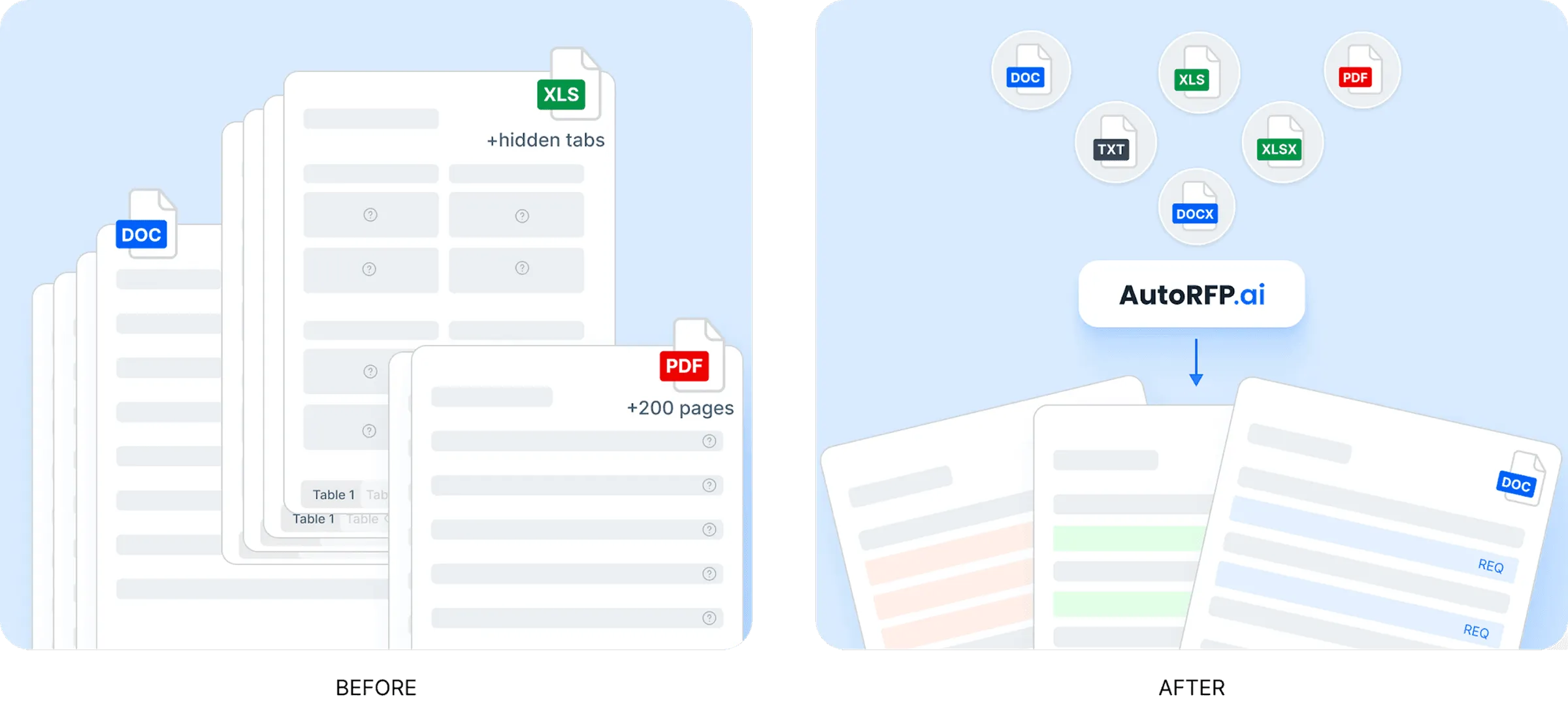
AI can review the document and extract the key information your team needs before writing begins, including:
Mandatory requirements
Submission deadlines
Evaluation criteria
Pass/fail conditions
Required attachments
Pricing instructions
Compliance requirements
Questions that need a direct response
This gives your team a clear view of what the buyer is asking for, what must be answered, and what cannot be missed.
In a tool like AutoRFP.ai, this process can turn long documents, spreadsheets, and portal questions into structured requirements your team can track and respond to more easily.
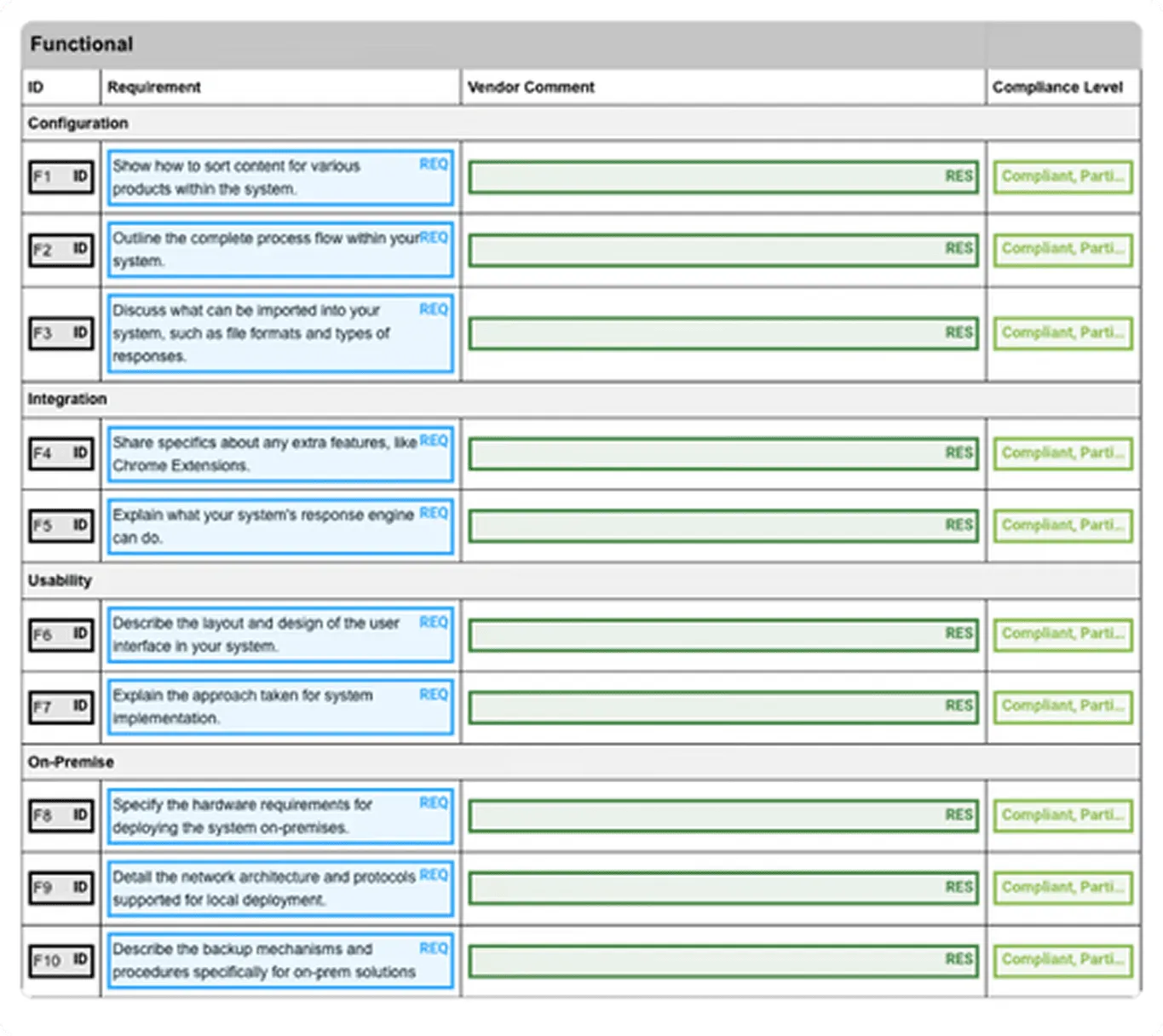
Pro tip: Do not start writing before the RFP is fully understood. Many weak bid responses happen because teams miss scoring criteria, submission rules, or must-have requirements at the start.
2. Run a Go/No-Go Review
Once the AI has extracted the requirements, use it to support your go/no-go decision.
AI can compare the bid requirements against your company’s capabilities, capacity, previous experience, certifications, and risk areas. It can also flag deal-breakers, unclear clauses, or requirements that may need clarification from the buyer.
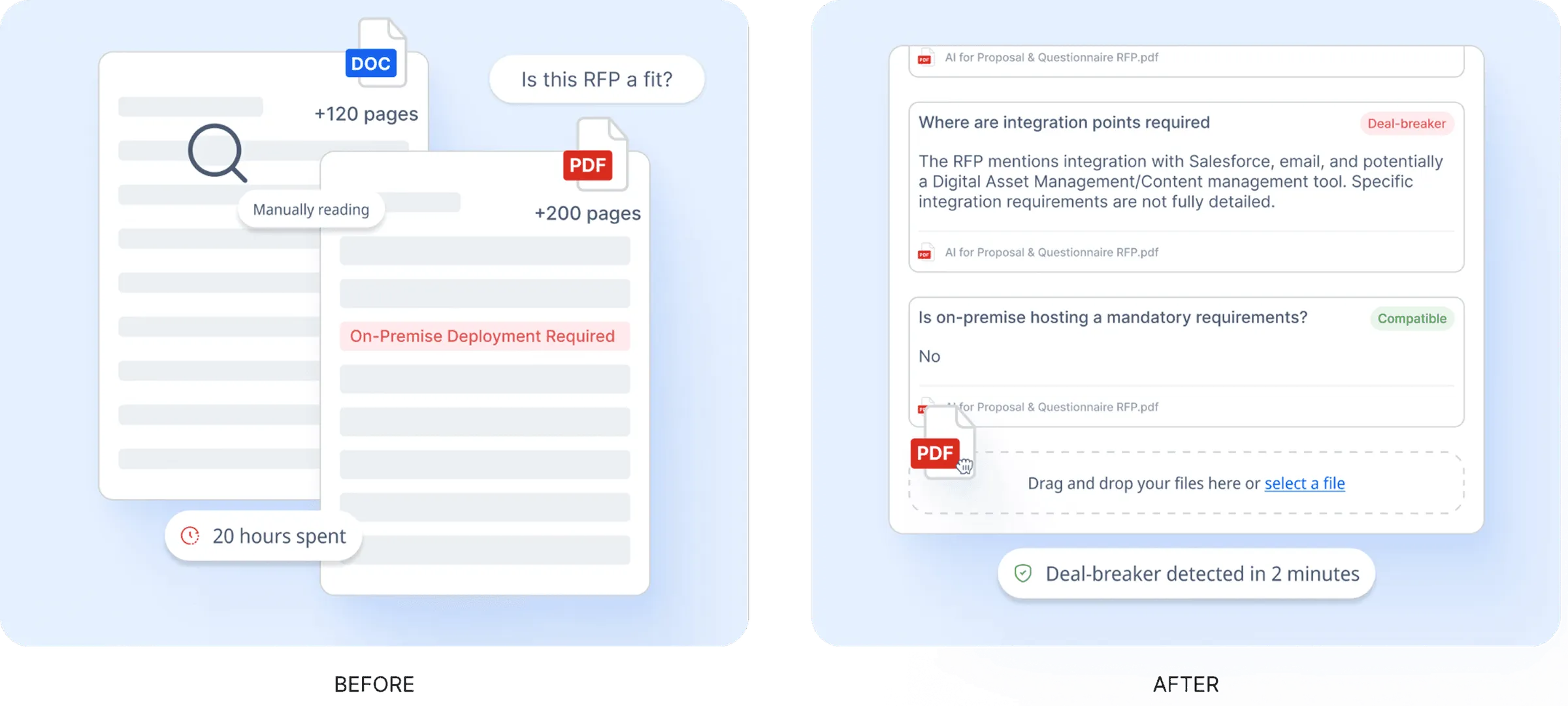
AI can help you assess:
Whether you meet the mandatory requirements
Whether the timeline is realistic
Whether you have the right evidence and case studies
Whether any compliance gaps exist
Whether the opportunity fits your bid/no-bid criteria
Whether the bid is worth the time and resources required
This helps your team avoid spending days on opportunities that are unlikely to be a strong fit.
Side note: AI can support the decision, but it should not make the decision alone. Your sales, legal, delivery, finance, and leadership teams still need to review the commercial and strategic fit.
3. Create the Proposal Framework and Supporting Documents
After deciding to bid, use AI to create the proposal framework and the supporting documents your team needs.
Instead of asking AI to write the entire proposal at once, use it to build a structured response plan that follows the RFP requirements. This can include the response order, section headings, compliance matrix, executive summary, cover letter, implementation plan, or other documents required for submission.
AI can help you create:
A proposal outline based on the RFP instructions
A compliance matrix mapped to each requirement
An executive summary tailored to the buyer’s priorities
A cover letter that reflects the opportunity and your win themes
An implementation plan based on project requirements
Branded DOCX or PDF documents using approved templates
This is where a tool like AutoRFP.ai’s Project Agent can help turn project context into polished documents. Instead of formatting everything manually in Word, teams can generate documents using approved content, uploaded templates, and the requirements already extracted from the RFP.
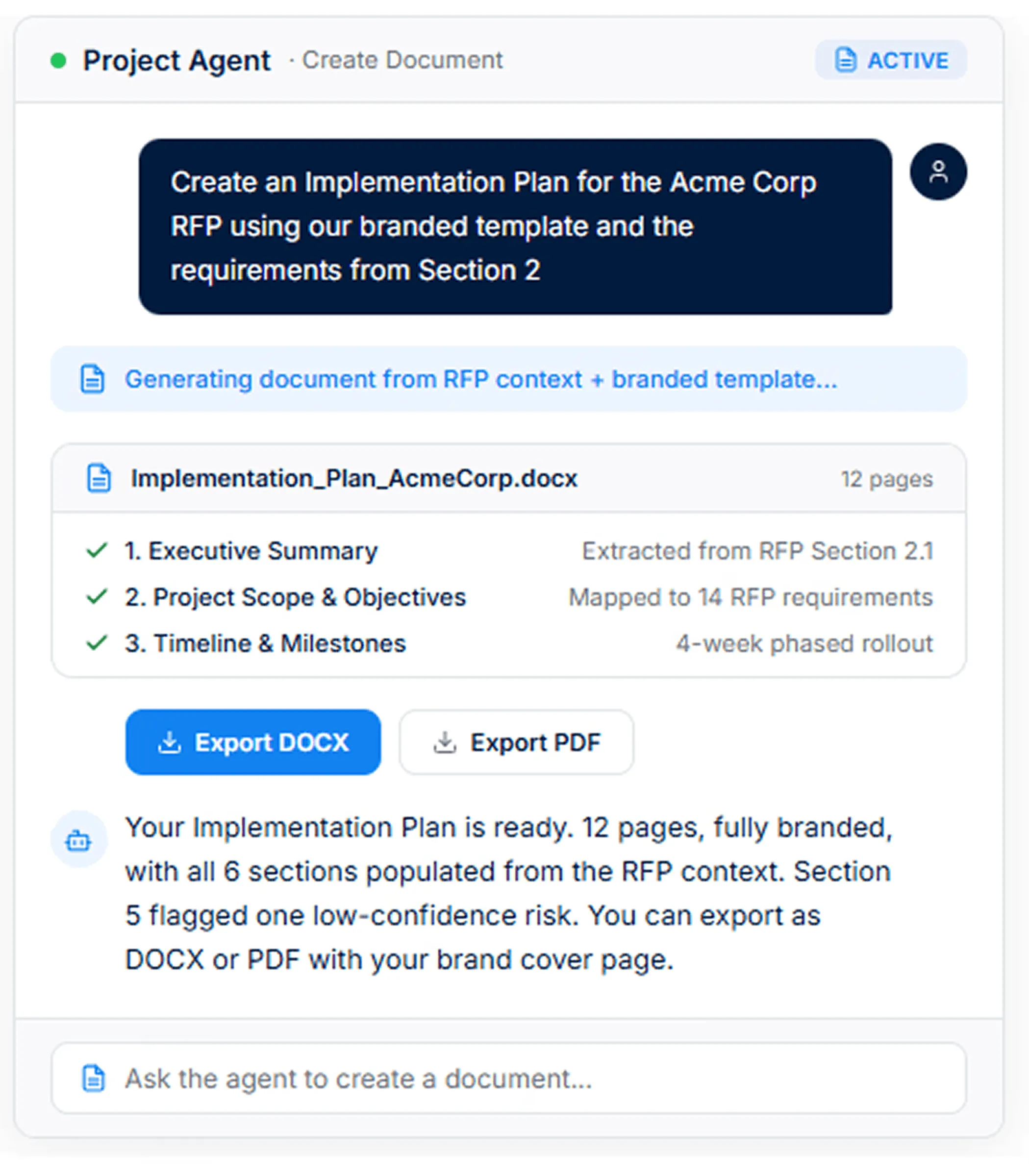
Pro tip: Use AI to create the structure and supporting documents, but make sure every section still maps back to the buyer’s instructions. A polished document is only useful if it answers what the RFP actually asked for.
4. Search and Reuse Approved Content
Next, use AI to search your content library, past proposals, technical documents, policies, case studies, and approved answers.
This is where AI becomes much more useful than manual copy-paste. Instead of searching old folders or asking different team members for the latest answer, AI can find relevant approved content based on the requirement.
AI can help reuse:
Previous RFP answers
Security and compliance responses
Product or service descriptions
Implementation methodology
Case studies
Company policies
Technical documentation
Pricing or SLA language
For example, AutoRFP.ai can pull from approved content libraries and prior proposals, helping teams reuse stronger answers while keeping responses consistent. Instead of starting from scratch, writers can work from content that has already been reviewed, approved, and used before.
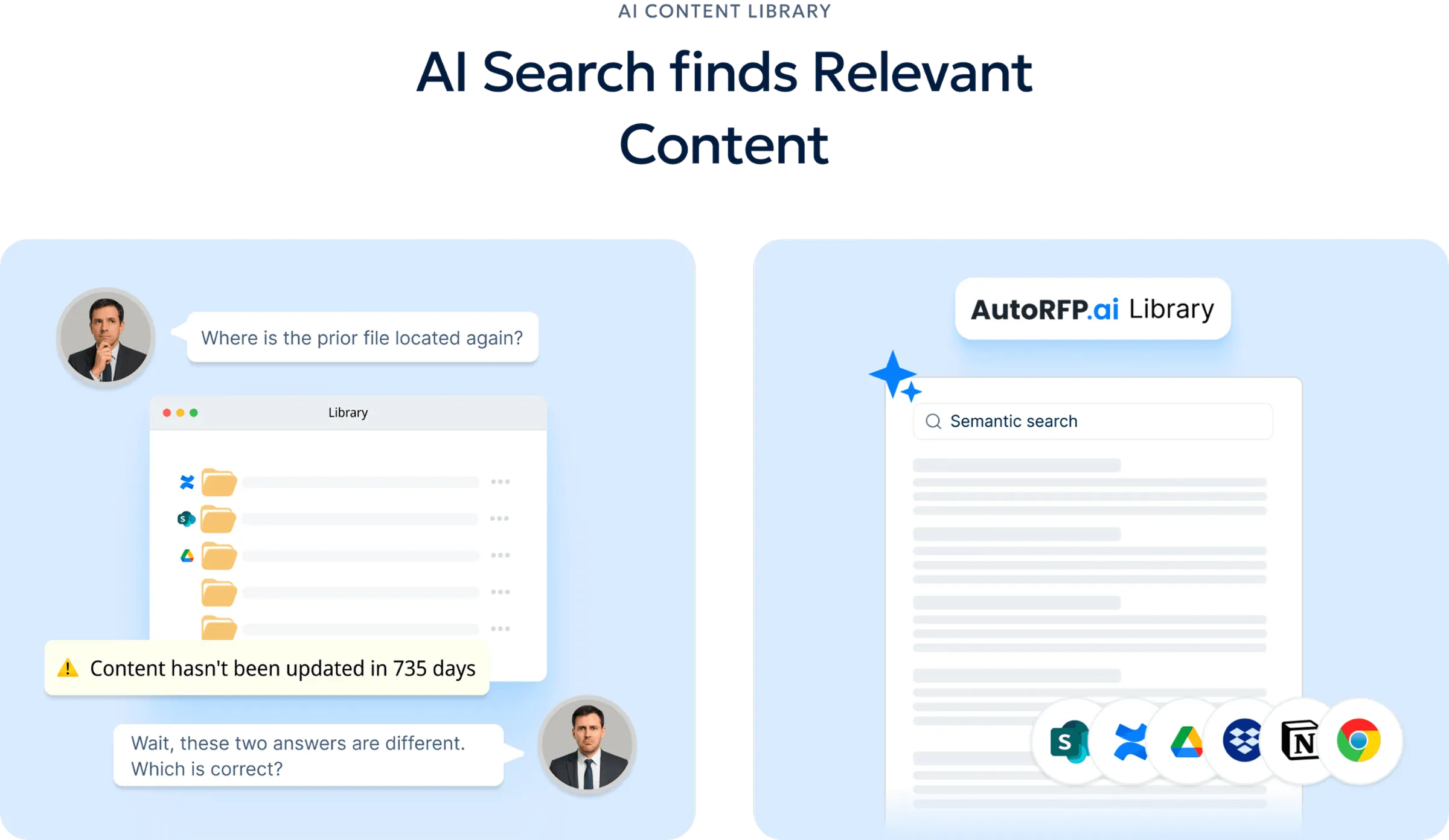

Video transcript
We will dive straight in. So today's webinar is covering how winning teams set up content libraries hosted by me, Jasper Cooper co-founder and CEO of AutoRFP. Did many years in, in the RFP mines myself so this topic is a really interesting one to dive into. A particularly complex one, and one that I guess there's no real content online about this of a reasonable quality. There's a lot of like high-level blog articles, but nothing that gets into the nitty-gritty of how this set, how this is set up at different companies around the world. So today, just a bit of housekeeping. Webinar's recorded, so we'll s- share this out after. There'll be an email follow-up. All of the materials that we cover will be shared as downloads and slides as well. Chat in Zoom there, and then we also have a dedicated Q&A panel, so that'll be great. If you do have q- questions, then drop them in there. We'll try and address them as much as we can at the end. But our goal is today that you walk away, every individual on this call, customer, partner, competitor, whatever, you walk away with something actionable.
This was sparked from the research that said that it wasn't AI use that necessarily determined whether someone was going to be in the high win rate cohort versus the low win rate cohort when it comes to RFPs won. Customer insight was the strongest and we're talking a little bit about that, but ultimately, it's actually content automation is what we're gonna focus on today. So whether you use AI or not content automation rate was more important than that difference between winners and losers per se. Today's agenda, we're going to diagnose that. Set down what is that maturity curve? Where maybe do you sit on it? And what's actionable today for you immediately to move up the knowledge architecture maturity curve? Then, how do you build against that? So we'll give you some blueprints, some resources explain some of the important concepts there, and then ultimately talk a little bit about automation how that's achieved, and ultimately what the future of this also looks like. Today, would love to have a quick idea of what chats people are on at the moment.
So every team globally has deployed or is deploying a chat at this point. ChatGPT Enterprise, through Claude, through Gemini, through Copilot. Would love to get an understanding of what chat endpoints people Quite a bit of Copilot. Reasonable amount of Gemini in there. Claude. Okay, we've got a, we've got a pretty even mix. Okay now the Claude's really coming in. Yeah, Glean in the mix as well. Cool. We'll touch on, we'll touch on Glean today a little bit as well. So everyone's deploying these. And then the next question I have is understanding where people are at on the knowledge architecture maturity curve. So quite a mouthful, but the first level there would be tribal, right? It's just in people's heads, in different docs. There's not even really a formal place where knowledge should be stored or even a topical place where this type of knowledge should go here or this type of knowledge should go here. So that's where really every organization starts one day, and then you end up getting multiple tools and fixes for this, right? So some information might need to be in SharePoint, some information might make sense to be in Confluence or Notion or a tool like that.
So it's in multiple places, and you've got some idea of where it is, but it's not necessarily anyone's owning that tool or content within it, so it could be duplicate, it could be stale. Then we've got level three which is you have known sources for things. So it's known in the organization that the technical documents should sit in Confluence and all of the commercial stuff should be in these folders in SharePoint. There's some idea of an owner, great. So the… there's a person on our engineering team who looks after this content. There's someone on our legal team that looks after this. And there's some sort of cadence to that. So they're meant to keep it up to date, and it's meant to be reviewed at least every three months, every six months that kind of thing, or they're updating it live as things change there. So that would be a level three known sources, as we're calling it here. Then you get into structured knowledge bases, where it gets a little bit more nuanced, where you start to think about categorization, hierarchies dimensions, we'll also cover today, but basically organizing that
content a little bit differently. So it can maybe even sit across different sources. So it might sit across SharePoint, it might sit across Confluence, but you've got an idea of the categorization. And that's not just something that kind of has been applied based on rule of thumb and over time, but something that someone's actually thought about and been structured in a good way, the terminology's been thought about and et cetera. So that's where you'd be at level four a structured knowledge base. Then we get up to semantic knowledge base. So where not only do you have everything underneath that and you've structured it, but on top of that, you are doing a semantic search across it. So we'll talk a little bit about that as well. If you're not across semantic search, don't worry we'll break that down a little bit. But that would be the next level being able to not just have that information structured, but also be able to AI search across it. And we'll also be talking a little bit about like level six and where we see level seven going today because ninety plus percent of organizations
right now are on the semantic layer and putting the chatbot on top of that. So we'll step through how quickly you can get there, what that actually looks like and then we'll progress on to six and seven. I think a lot of people on this call probably at least at level four, but interested if you, yeah, drop in the chat what kind of levels people think they're at, or maybe if you think you might be at a level six or seven, you can place that bet now. So as you throw those in the kind of key problem that's always existed in the industry is one question, three answers, right? And this has just been true probably since the start of civilization. You ask one question like, "Do we support single sign-on?" Or "Do we have a support team in Europe?" Or whatever that looks like. You ask that one what is meant to be a simple question, and you end up with three plus different answers, right? So if I ask, "Do we support single sign-on?" I'm gonna get something from our marketing site maybe that says, "We connect with the three major providers." No idea which ones.
Wrote that a while ago. So I don't know, maybe I'm asking specifically about do we support Google sign-on and marketing's not being very helpful there. So then I search again and there's some developer documents on… It's a work in progress that's upcoming in a release. It's okay, great. I can ask the owner of that document. Oh, that's just a scoping document. I'm not sure if that went anywhere, right? It's just internal. Great. So back into the beehive and I can find another document. Yes, we support all of Google's SSO options, including advanced provisioning, blah, blah, blah. And then I look into that. Oh, that salesperson that wrote that was let go for lying, right? So there's so many different problems across all of this different content, right? And then we ultimately end up in a Slack thread or on Teams messaging someone probably too senior to be dealing with me. And they come back, "I said this in the last company all-hands. We've put everything in X system now." They link you, and then you go, "Great," "can we add this to a content library, or can we have some sort of process in order to stop this from happening going forward?" User leaves the channel or you never get a response.
So it's been a real problem because knowledge is such a vast thing. Really any white collar type company, the real thing you're doing is buying and selling knowledge. That's a lot of it. So for one person or a small team of people to be able to manage the knowledge of an entire organization is a, is an impossible feat nearly by definition. But obviously that's what the session today is about is how do you tackle that the best you can and how are the best in the industry actually doing that? So that, that broken process comes down to things like thinking that you can resolve this via constantly building a library forever, constantly working on it, or constantly next quarter, we're going to fix it up we're gonna continue expanding it, we're gonna keep growing it, et cetera. By growing it forever, it becomes an infinite task to maintain. The bigger it is just like a code base the more lines of code you write, the worse it gets over time from a maintenance burden perspective. The same… So that's the maintenance burden, and then constantly chasing subject matter experts as well. So your subject matter experts more often than not are not going to be
knowledge base management experts. That's not what they do. They do something else. Maybe they support your customers directly. So maybe there's a customer support or help guide system that they provide content into or client portals or client documents. There's places that they are working that is not necessarily meant to be a knowledge base or used for that purpose. So by definition of asking for them to come into our environment and contribute there, that's making it hard for them, and that means that they might not participate, therefore, we're constantly chasing up the subject matter experts to get them to do this double entry chore as they see it, which is not their primary job. So puts us between a rock and a hard place for sure. And the economics of this is just against us, right? Is that content management has an infinite long tail. So when I receive a, RFP, DDQ, security questionnaire, whatever it is, there's always the head of usage. There's always all of the stuff, the eighty/twenty, where a lot of this stuff is gonna get used over and over and over again. It's great. Probably should maintain it, continue to improve the level of that content.
But then, of course, you have the long tail, and it is infinite, and we just see more and more questions every year tacked onto that long tail. One one year it's like a bunch of ESG questions. Next thing it's AI, security, et cetera, and it just keeps building, right? And that long tail really will go forever. Some people have very different procurement questions to others so that long tail just keeps spreading out. So that means by definition, we also have a point of diminishing returns when it comes to actually managing that content. So in our context, we've worked with teams that have quite literally had a million-dollar budgets for managing content alone. So not even just the RFP team, but the people managing the content, they're spending a million dollars on their salaries to get this done. And then not really able to crawl, like crawl this cliff. After a certain point of time, it just doesn't matter how much money or people you put on the problem, there's no way to resolve it fully to 100%. That long tail is always gonna be unmaintained, so you need to find a solution for what do you do when things on that long tail are out of date.
You need to be able to make a trade-off there rather than thinking that you can continue to push it all the way to the end of the long tail So a question is how do winners actually approach these challenges? Because fifty to eighty percent of every response like across the market is still has some level of bespoke response in it. People aren't just auto-filling RFPs. They're trying to get an angle. They're trying to add customer insights, et cetera. And that really is the game now. A lot of the boilerplate automation you can do. So yeah, how do you make it more bespoke is one thing, but also the reason that they're doing a lot of bespoke when you dive into the research is because there's a lot of this long tail element to it. So the winners, so people that have a higher win rate are in that cohort are more likely to have a higher automation rate as well. So there is a correlation between those that have fixed this problem and have a higher win rate. So it's not that people that have a higher automation rate are losing more because they've got a structure that copy-paste.
No, they're actually winning more because they've got their content in such a way that it is actually highly reusable and of a high enough quality that, A, they can trust it so they can approve it quickly, but B, their customers are receptive to it, more receptive than they are to their competitors' content even those like losing the opportunities. So I'll jump in, but the truth is contextual and temporal is an important element. So to understand that there is no such thing as a single truth. There are many contexts. Truth can change based on a context. Maybe you're selling in one region where something is true, and then you're selling in a different region and actually something else is true. Maybe you're selling one of your products or services and the answer is yes for this, and you're selling a different product or service and the answer would be no. So it isn't like you can just have one question, one answer, and it can be as simple as that. You need to think about that contextual element, and there also needs to be the temporal element. Things change from yes to no over time and back to no.
So they… You need to be aware of that and that things change. So it's less about trying to build that single source of truth and more about thinking about who's gonna ask a question, in what context they're gonna ask it, how and how often are they gonna ask it when. But let's get into the more tangibles. So the first thing to do in any exercise of building a great knowledge architecture is just understanding first and foremost, really zooming out and thinking about where the truth could be. And really zooming out here. So public-facing documentation, there's obvious stuff like the marketing site, help documentation, like sales documents that you're sharing. Those are things that external parties that review your RFPs or your DQs, et cetera, already have access to, so they might even validate against it. So if those sources are gonna be used by your customers anyway, definitely something to consider using as part of your RFP response process. Also, you wanna think about maybe there's sources like SEC filings in some cases, or maybe you're part of a listed organization and there's annual reports that come out.
Maybe there's even internal board reports that you might not share externally, but could be a great source of infor-- of information. So really collect all of those. Same with the internal only. Are there different knowledge bases that different teams use for different things that are hidden away that you might not know of? Is there an internal roadmap system? So it's not really content as you think about it generally, but it is, maybe Asana has your roadmap upcoming items, things like that, that you're often relying on but you haven't thought about knowledge or content. You haven't thought about it through that lens before. And then finally, customer context, right? So things like meeting transcriptions are super common these days. Joining, transcribing it all, where does that ultimately go? And then, of course, your customer relationship management system and other systems that sit around the customer context, which is generally very separate to information that might span your organization and products. So map that out, and then also share that map with other people on the team so you can see if you've got any gaps, if you've missed anything So once we
know what those sources are, a few examples here, you've got to think about a little bit what they actually contain. What value is in there, and maybe is there risks inside of that information as well that we wouldn't wanna ever pull through to an RFP response or would actually just cause more problems than solutions? Also, how authoritative is it? So is there a true source of truth for certain things? And for certain things there is, and for certain things there aren't. For example, maybe there's security policies, and ultimately everything in your organization should come back to those policies. That means your source of truth would be your security policies, but maybe you have a second layer on that, which is your security frequently asked questions, right? That are meant to be in sync with those policies, but policy is the ultimate source of truth. So you can think about it through layers. So for example, maybe for our roadmap that is stored and managed in real-time and linear, and then we update that in SharePoint, and then maybe provide that to customers externally via Notion. So we can think about that in its various different layers.
And then finally, the different contexts. So even within one of these sources, we wanna start to map out the different areas. Is the US team using something different to the UK team? Are they storing their answers in different places? Is different products happening in different places? And this is quite a big task, but once you start to map out all of these systems and think about it at this abstract level without trying to apply instantly start with the solution and actually just define the problem first, this will give you a really great map of all of the different sources that are available to you and a lot of the thinking and context around them. So a few tips on what's actually dangerous what you wanna keep out. Things like stale knowledge. Generally find there's a huge drop-off point after the twenty-four month part where it can hurt more than it helps. And that is because you're trying to cover the long tail, of course, for for a very long time, and you might wanna source those other answers out. But generally, depending on the organization or depending on the type of information, things that are twenty-four months old can be more
often than not incorrect or even have a very high, wrongness rate per se. Maybe twenty percent of the time that you're getting one of those previous answers, it's now out of date. And even though that's your most recent source on the matter, it is no longer correct. So it's just thinking about it through those lens, like which sources would actually be up to date? What kind of date schedule makes sense for each of those sources? Maybe Slack, it should be very recent, or Teams, it should be very recent versus other sources that are much more authoritative. And then hyper bespoke materials. So a lot of teams, they want to boil the ocean, upload absolutely everything. But you also wanna watch out for things that were really once-off. They were built for one customer. Maybe this type of document was tried but never widely adopted by the team. You really wanna archive that and take that out of the loop, because if you end up with all these different types of documents, all those different types of knowledge, all of this knowledge legacy in the architecture, it makes it more complex than it needs to be, and it brings up specific information that's just simply no longer true or just hyper contextual and shouldn't
really be reused outside of that context. So your largest enterprise customers, for example once off, if they're ten times bigger than your next biggest customer, that's the kind of thing I would start to think about separating out. And then internal noise, language, and jargon. So if you are gonna pull context, particularly from internal communication tools or think about that, you really wanna be careful about the channels that you pull through, what kind of content actually lives in there across a long history of it. And other edge cases are things like, let's say you actually sell a legal product or a security product or something like that, and you also internally have legal or security policies. AI, in particular, is gonna have a hard time reasoning about what is external and what is internal. So you really wanna reason about that up front and have very clear lines there and even call-outs going, "Hey, for us as a company we really need to make sure that we're separating these concepts external and internal because it's confusing."
So now that we've got that and to think through that authority, you have your authoritative sources, we can think about those fallback sources, and then there's very specific sources. So that's the three buckets you can put them in Cool. So next, let's talk about organizing the content. So now we have a really good idea of all of the different sources that we need to organize, what's included in them, level of authority, some of the risks of bringing that kind of content in. And next thing we wanna do is organize that. And conceptually, that could be very simple. So let's like use a case here. So let's say you're a software company, you've got two products, and you sell into two major markets. And you can maybe try and map this to your own company and what might fit. So let's say they're two-- they have two products. They have a security platform they sell, they have a legal platform they can sell, and they sell it mostly in the UK and the US, but it's also
maybe just broadly available globally And most of the time they are selling just the same products over and over. But there is two modules within each product, which means under certain circumstances they might just sell one product, slightly changing their answers in some cases. So this would be pretty typical of a very simple organization. Many of you on the webinar today I know have, tens of different products at least, and tens of different markets in which you operate. So it's much more complex than this. But let's just imagine it's this simple example just to show you how off the rails even this can become. So simple enough, right? And this is the system and the con- the concepts that are really failing the industry at the moment is that we would just take these two products, right? And then we would start by putting them in in that's product A legal, product B security. And then under that we have our categories, and then we have maybe subcategories, and we have our two modules that are rarely used, but we'll put them in the hierarchy here Then you deploy this and you'd start to get questions.
What about stuff that's country-specific, right? So it's only true in the US or the UK. If we're constrained in this kind of model, then we need to start adding folders. We need to add one for contracts US, one for insurance US, but also, of course, for the UK and for insurance UK. So now we've expanded and we've added a bunch more folders for each of those modules. Could be tags depending on what system you use, but basically you're adding a bunch of different options there. And then you go, but there's a lot of stuff that just applies globally, and I don't want to put it in the US and the UK folder for each module. So then you start to create, okay we're gonna need global folders in that case for everything. So then let's add those in there as well. And then by the end of even this very small exercise, you have quite a complex hierarchy or categorization with many different folders. And if I want to filter to content that's relevant maybe to selling both products in the US, I now have to tick, eight different options and select that content to go forward.
So this kind of applies in different ways, right? It's complex even just to visualize or think through. It's complex if you're trying to move to a self-service RFP or DDQ model where you expect end users to jump into the system, simply select what they need to sell, and then generate the responses based on that content. So it's really adding that huge level of complexity. So a lot of the migrations we do, we end up with people moving from systems where they've done this, and they have immense hierarchy, sometimes a thousand tags, sometimes two hundred different categories and subcategories, one-dimensional, and then it basically looks like this. And then you get really hard questions like, "Oh, we're adding a new product. Does that mean I need to add four more categories?" Yes, in that kind of approach you would. Do I need to duplicate content if it's the same across two, two different products? Yes, you would. Would you… What happens if you start to sell when I sell these two products together, actually, just when that's a possibility we have a special
feature that you get when you buy both. That's also quite difficult to do. So there's just so many different issues with that old model of just having, just thinking about things through categories and subcategories only. So one of the concepts is you break your categories from one dimension down into multiple dimensions. So what that basically looks like is before you would have a list, and these would be stacked vertically here, but you'd have product A, and then you have all the different folders we've created, and then product B, and then all of the different folders there that we've created. What is much cleaner is rather than having all of these 12 is simply creating two different dimensions. So one you have it based on region, and then one you have based on the products. And this allows me to do some pretty interesting things. One, it's a lot less complexity, so there's way less options here in total. It means it's less clicks, it's m- less training, it's less
understanding, it's less terminology. It's less everything. And what that allows me to do is now have that content, rather than save it in a very specific place, I can basically use it inside of this hierarchy and use UK and insurance. So let me explain that a little better. So to make use of this kind of hierarchy, you wanna think about concepts a little differently than you might have in the past. So you don't just wanna store information necessarily in one location or one folder, but actually think about it in multiple. So rather than before we had contracts UK or insurance UK here, we can actually use this type of dimensional hierarchy to select UK and contracts at the same time. So it's very clean 'cause then I can click on UK, I can see all my UK content. I can click on contracts, and I can see all my contracts content. But then if I wanna make it specific to UK contracts, I simply select both, right? And then you can visualize that. So that's really the power of having many selected rather than just
thinking about it in a classical folder structure like you would maybe in, in a Google Drive, where you put it in one fi- you put it in one folder only. Then I know that I need all of these different folders with all of these different combinations. Rather than that, I could simplify that hierarchy and have that single piece of content available in multiple locations. The next thing is not constraining yourself to just categories and subcategories, but actually going all the way. So having multiple different layers of nuance just gives you more flexibility on certain things. So for example, if you go down to a state level in the US, you might wanna go global and then North America and then United States and then California. You don't wanna try and suppress that and end up with global and then North America hyphen United States then North America hyphen United States hyphen California, right? You wanna actually do that like that. And then finally, the thing you can do with these hierarchies that I think
is lesser thought of is when you have a hierarchy, a lot of people think about saving it at the end point. So for example, if I see a hierarchy like this, I would save my content maybe under California, and then I'd have to have every other state. But what we've found is way more optimal and just easier to conceptualize is you have information saved at the higher levels as well. So you can just save information, the entirety of the United States, North America or global, and you really try and push all your information up. So you go, look, a majority of our information applies at a global level. There's some information that should sit at North America, and then very tiny parts of information that sit at the very specific California level. So this gives you the highest leverage on your content with also a very simple hierarchy On the other side of this, so those concepts give you some time with… It takes a-- it can take a while to get your head around this, but this kind of fundamental change is something that unlocks a lot of opportunity for you to be able to manage, yeah, much more complex content much more easily and
simply once, once you've unlocked that. Then on the other side of things, don't build structure you don't need yet is a huge call-out. So don't model what you don't sell is another great one, particular to the RFP case. If you're not actually coming up against a problem, don't start to build out folders or hierarchies or tags or whatever type of system you're using. It's really good advice from people with extremely large content libraries to not build it out before you need it, but instead actually lean way too simple and then build it up over time. So here, we just start with one folder and then go great. It actually does look like we need to split it into two markets. Great. Do that over time, and then budgeting the time for that upfront as well. So rather than doing one massive project where we're gonna figure everything out, we're gonna optimize it all and think about everything we're doing in the future today, be realistic about it, keep it super simple, come up against those things, and then build them and split test and iterate over time.
It's a hard thing about hard things is getting that done. Cool. So in, in that type of setup, that means that you can add new products by simply adding another category to that hierarchy there. You don't have to duplicate content because now you've got that concept of saving it under multiple places, tagging it with multiple things at the same time. Doesn't just need to be in one place. And if a law is passed or something changes, you can just add that very specific next level, next layer down. You don't have to restructure the whole thing. It grows and adapts with you much more easily that way if you don't constrain yourself. And it solves a lot of other issues that happen downstream as your content library grows and changes over time Terminology also super underrated in terms of thinking about this. So you want to name things in a way that's accessible to other people. Generally, as a content manager, as a bid manager, et cetera, might have
been at the organization a longer period of time, but you might also just know a lot of the terminology. Assume that a lot of people in the organization don't know that terminology, and you can mu- much more closely stick to things like marketing terminology and more common internal terminology. So when you build a hierarchy that looks something like this on the left, that's not going to be great. It's not gonna be accessible. It's gonna make it harder for your SMEs. It's gonna make it harder for everyone to engage with, even though it might be easier for you. So think about that and try and make it as plain and obvious. Like this is the real hard thing here, is that simplicity is much more difficult than complexity to achieve inside of content management. So try and make it super plain, super obvious. Try and use words that already exist in the real world and are very commonly used. Try and lean away from acronyms. Try and lean away from niche terms that might be used by company insiders, but not by new joiners that are trying to navigate your content
great. So to, to recap there, you can then categorize each of your sources by dimension as well. So when you think about SharePoint, you can't just put that in one big kind of area in your brain, right? You wanna go maybe by space, by page, by Notion folder, by Notion page. Whatever those systems are, you wanna think down to that level. Which ones apply to what? So maybe we've got a UK pricing page. Great, we're gonna put that in region UK, and maybe that's for our security product. Let's put it there. And same for this, and same for this. So we can make sure to think about that at a more granular level. And it really m- some people maybe think that, "Oh, this entire space is to do with this." Really look at the space, look at the pages contained within it. Make sure that what you think is within a particular content area actually is. Do those quick audits, double-check your work And then finally, the defining ownership and review cadence. This is a super hard one, but some good rules of thumb here are
that ownership by team is better than ownership by individual. So seen many times where you assign an individual as the owner of content, and then of course, that individual changes roles, leaves the company, other things, and they basically can't update that content anymore. And you don't necessarily know. Some people find this out even years later, "Oh, HR never told me that this person left the organization, therefore, all of my content has been out of date for two years," right? So you want to assign it to teams, to functions, not to individuals. So that's a really great step when you think about ownership and building out those structures. Those don't even have to be real teams within your organization's hierarchy. They can just be the way that you think about it from a content perspective. Obviously better if it's super simply mapped to the organization's hierarchy and set up and your internal team names, but more often than not, it doesn't. So then you need to have some sort of abstraction where you go, these people on maybe these different teams can own this content.
And it's also great to have not just one owner on that team, but actually multiple owners on that team. Yes, both for them changing roles, but also just to have higher capacity. So if I need to review all the security documents every year, maybe it's much nicer to spread that workload across three SMEs rather than just the one and kind of make that fairer across a team. Then you've got your review cadences, and you wanna make sure that they make sense per topic. See a lot of companies do things like, "Oh, we'll just do it every year," or, "We'll do it quarterly." You don't wanna do it arbitrarily. You wanna think about what actually changes quarterly, and let's do it quarterly there where it matters. What is the risk of making that quarterly every six months? What is why are we doing it annually? Things like that. You wanna make sure that each different content area or different sources are treated in a different way to take pressure off your SMEs as much as possible, where that's important and really thinking about that. But then also on the flip side of things, making sure you have the most accurate up-to-date information where that is really important.
And then finally, having the concept of once-off knowledge. A lot of knowledge is disposable. It just simply shouldn't exist after its expiry date. So making sure that you treat knowledge that way. You don't arbitrarily go, "No, this is gonna review annually." You go, "No, look, this is going to end then, and we're probably not gonna use it from then on out. So by default, I'm gonna expire it, reducing the size of my overall content library, and therefore the maintenance burden." One of the resources we'll have to wrap on this and give you really actionable next steps is the RFP content library checklist. So it'll take you through these examples of, yeah, mapping out your sources, selecting owners, et cetera, et cetera and driving up this part of the maturity curve as fast as you can. So that's level four complete. That's a lot there. So knowing your sources and their authority, mapping your content in, defining the owners and reviewers, creating these flexible dimensions and hierarchy and sharing that understanding with your team as well. So once you've found the sources, share that with the team to fill gaps.
Once you've defined the hierarchy, share that with the broader team to find gaps, maybe ways to simplify terminology, et cetera. More often than not, you really wanna try and guide those outs- external collaborators that you're bringing into the process, not on how to make it more complex and add things, but actually how could I try and simplify things or cover more things under a simpler setup. So that's how you can bring those other teams in while setting expectations that you've got a particular objective in mind. Cool. Now we'll move on to, great, we've done all of that but it's still very hard to find things, it turns out. So even if we're maintaining all of our content, it's up to date, but there's still a lot of different content sources. It's constantly flowing through. How do we actually find things in all of that noise? So that's where we get into semantic knowledge bases. So this is sometimes just referred to as AI search. But let's talk a little bit about it. So different systems that you use will have different search technologies.
So something… if you use Notion they have a very high-quality AI search. So that means that you can put a query into Notion. They've got the new agents. You can type in there. It's searching by meaning. It's very easy to find things in Notion relative to maybe if you've ever had the pleasure of searching like a Google Drive or a Confluence, a lot harder to find things. And then finally other systems which may not really have any semantic search or be built for search at all, but you're using them. So maybe things like Slack, it can be very hard to find things in or email, et cetera. Some systems don't have semantic search at all but will actually, yeah, have… require very specific keywords or even filters and things like that, making it near impossible to pull the data out of. So this is one of the key problems with actually finding things in an organization is all of these different search technologies that you're having to rely on across sources. So that's where it's but my Claude fixes this, my ChatGPT, my Copilot
fixes this 'cause I've integrated my Notion, my Google Drive, my Confluence. I've got it all set up. So it's connected with everything. It's got the little green ticks there. We're good to go, right? But no, that, that's unfortunately not how it works. It is in this case for Notion, right? If it's got a great search technol- technology and their connectors use that, then that's awesome. That's gonna provide good semantic search results. But a lot of the tools that exist and, the thousands that are available now via MCP but also direct connections are going to vary quite a lot. So although some of your knowledge, as we've discussed, might be in a system like Notion, maybe a lot of it is inside of a system like Confluence, and we don't just want the AI to search Notion all the time because that's how it most easily finds things. We want it to find the right source, right? The most up-to-date, et cetera, et cetera. And it might not even be able to find that source at all if we're just relying on the tools themselves. And this is quite the gap at a lot of companies right now doing these large
scale deployments, and it's the next wave of those deployments is sending teams out into the world to try and figure out how to solve this because some companies are having great success with this approach immediately based off their stack. Others are having a very hard time. They have basically amplified the problem they already had. People are getting wrong answers, sending them to customers at scale. It's causing issues. And those those problems aren't easily surfaced, right? The AI chatbot's just coming back and Claude or ChatGPT's going, "Yes, we do this. Yes, we do that. Yes, we do this." And it's not necessarily true or in context of the question. And it's also very slow. So finding people sitting there and researching and it taking even longer for Claude to load away in the background on that, searching Notion, then keyword searching Drive, then finding another keyword and then putting that in, and it's just very laborious. So- those are the two different kind of search types is, yeah, a basic keyword search and a semantic search, which searches on meaning using AI, which is incredibly powerful.
And basically to recap there, some people are running this their AI agents on top of a, just a keyword database, which is making it easier to find things in a way, but also it's not capturing all of their knowledge or reconciling it correctly. Semantic saves a lot of time and is able to pull all of the results much more reliably. So if you're on a keyword search-based system, you might wanna consider something like building those keywords that are important to your organization into prompts or into skills. So basically giving the AI, "Hey, here are the keywords that you would need to search in Drive to more accurately find and surface things," so it's not spending so much time doing that, and it's able to, not all of the time, but hopefully more often, pull up the right content by searching the right keywords. So giving it that, and then also on the system side of things, taking more time to standardize terminology and using more keywords across your, for example file names.
That might be a really helpful one to add that new layer on top of. And then on the semantic layer, there's things you can do implement Glean, and Glean has some great technologies around embedding and basically turning some of these applications which don't have the greatest search and actually enabling a semantic layer on top of them, so they're much easier to search. And similar technologies are being worked on, don't know how good they are or not, but across things like the Microsoft Graph to embed the knowledge there across the 365 suite. So moving that from keyword and then giving you a semantic layer on top of that. So that's super useful for your agents. But the thing at the end of the day is, yeah, so the AI is not created equal, right? You can add your AI on top of a structured semantic database. You can have much, much better results than you are with your AI on top of a disjointed set of databases, some of them relying on keywords and some of them not. And I believe this is one of the core things that makes it so when we survey people, the AI use, just as a tick on or off binary, is not a differentiator in
terms of your win rate because people's experience with AI, depending on that foundation, is very different, right? Some of them are sitting there for five minutes for an answer to a simple question, getting what they think is a hallucination. Others are nearly immediately getting the right answer directly out of their system. That's a very different ultimate outcome using the same technology. On our search project and how we did this for AutoRFP customers at a technical level is we built integrations with every major knowledge source, so like Confluence, like SharePoint, like OneDrive, et cetera. And rather than rely on their search technology, we actually replicate the content within a specialized semantic data lake. So basically, we take that knowledge that has not been searched in the best way it can be, pull that across into our own managed infrastructure with the AI search, and then we can unify that.
So great, now when our agent goes and looks at that information, it's no longer going, let me search." It's just doing one search, and the information it gets back is actually unified. So it looks more like this. I can plug in the chat into AutoRFP. It's already built those connections and synced in the content recently. And then another benefit of having that single tool, that single interface or single database is that you get the structure and hierarchy as well. So you're not just getting different kinds of setups from different kinds of tools. The AI is seeing one unified approach to structure, and that makes it a lot easier to reason with because if it's looking at, okay, I've got this document from Drive that's in these subfolders, and then I've got this in Notion and these and this in Confluence in this area, and they do have conflicting information, that can be quite hard to resolve for a human, let alone a large language model trying to work with all of that context. So by keeping the context clean and on one kind of layer or, having similar
terminology between those systems, that will help the AI reason better through those more challenging answers. So yeah, ultimately what that looks is you can have that one connector and turn that on versus having all of these connectors. So if you can build something like that's great. And yeah, Glean and others provide a similar semantic layer more broadly and horizontally across an organization. So yeah, a lot of approaches to that Also dropping a workbook there to just talk about the content searchability how you can set that up, and particularly if you're working with some keyword systems, how you might rename files and establish structures there to get better results. Either, you're actually just searching things in Drive and you just wanna find some things for those of you that are doing that manually on those platforms all the way through to, yeah, you've got agents plugged in, it'll make it easier for them to search as well so that's the semantic database layer complete. So unifying all the sources, searching by meaning now and embedding those
pieces of content across the dimensions. One question now can return that, that answer. So we're most of the way there. Now it gets quite interesting. So now the agents can definitely find, a lot of the time, the relevant information. What is hard is conflict resolution, where it gets a little bit tricky. So you have all the content, but which is correct between different contexts? And how people went at this for a while is they were building AI systems that check the conflicts The problem was, is that there is so many conflicts, right? There's technically a pricing conflict, let's say, every time you send out a new proposal. Maybe you've given a different discount rate, et cetera. Has the pricing model changed? Do we need to check that? Do we need to adapt that? Technically, every year we say last year, now everything needs to be two years ago every year that progresses. So there's just a lot of different conflicts that come up. So then we don't wanna surface those ones necessarily, but
we wanna surface certain ones. You end up with this infinite queue where the AI is raising a bunch of issues to you, and then you're manually resolving them. So that is, is quite a struggle. And you're clicking, yeah approve. And again, it's that infinite long tail. So this conflict resolution queue could be infinite. And you can kinda chip away and try and automate that the best you can. But what we've moved towards and where we think it's going is the rational knowledge base. So not only having that semantic layer where we can search things, but actually codifying in the agent in the way that it searches, in that search pipeline, how it should think about the different sources that it's pulling from, how it should prioritize, and how it should actually resolve those automatically. Which way it should lean on, on different tasks. So things like, "Hey, this source is most recent," of course, is like the most basic version of this. And then you've got which source is most authoritative, and then
which source is most contextual. So how do we start to work that into that agent layer that sits on top of the semantic layer? And how can we make that more and more accurate, more and more trustworthy, so it knows who's asking, in what context, and when, and can actually provide that ultimate answer? So I'll just quickly jump in here. So we have the hi-hierarchies but this is where we get to these types of settings. So things like, okay, when we sell different products, do we wanna filter by that so the agent is only seeing things that are relevant in that context to that particular product? Probably. When we sell in different regions, do we wanna do that? Maybe not. Maybe the agent is allowed to prioritize stuff from the UK over the US, but we don't mind using US content where no UK-specific stuff exists.
So basically building in these different concepts actually into the agent layer and having it prioritize automatically for us and resolve things. So here, for example, it's going to prefer the, Correct region for that customer, therefore it is gonna use that answer. And that might even override things like, okay, this one is one week more recent, there's no factual conflict but we are going to use the older one in this case because it is from the correct region rather than just simply the most recent one looks correct. So it can start to understand that a little better and on the fly. And rather than having to tell the agent absolutely everything about our organization, how we do everything, giving the agent that kind of context at the exact time it needs to resolve that type of conflict. And then the different priorities of content as well. So maybe your content library is the number one thing, you always want that to weigh very heavily versus past projects versus documentation.
Or maybe you want your documentation to be the absolute source of truth, no conflict should survive that, versus previous projects, you really don't wanna weigh on those. You just wanna use your previous responses to things as the long tail to try and pull things out, but you don't want to rely on it or weight them if you don't have to at all. So rather than sitting in that kind of perpetual queue and approving conflicts that may never come up, how can we give the reasoning to the agent so it can do that on the fly, but then we can get it eventually to show it's working. For example, how it came to that and ultimately what it resolved to, and start to build trust with the agent under certain conditions. So to do that yeah, if you're a customer, you can configure that and we work with you on that. But also you could build a skill and start to codify some of these decisions so it can think about not just how to search, but actually when you get results, think about think about resolving conflicts in this particular way
Great. The learning loop won't really touch on this today, but the learning loop's an important part of capturing more content going forward, so not necessarily content management. But of course, you want some sort of loop where the agent can draft, you can edit it as a human, you review it, you approve it, and you actually want that saved back. So you don't wanna just let all of the content that you're generating day in and day out go. You wanna be capturing that as much as you can, bringing in that most recent information as soon as possible And finally, the future level. Like, where does this ultimately go? So where we see this, one of the changes that I think is coming down the pipe here is automated content management and separating different concerns. One that can definitely be managed by AI and one that is still remains the competitive edge. So we recently released snippets, which is basically like variables, right? Variables that you can insert into responses. So a really simple one is like employee count or assets under management
or how many offices you have. And those are updated once and then populated across, hundreds or thousands of different responses so that fact stays consistent. But what we're going to see there is agents that sit on top of these facts and actually maintain them for you. Things that are very straightforward. So we have an AI routine, whether that's in platform, in ChatGPT, in Claude, wherever that sits, then it can be updated. So we're gonna allow these to be updated via MCP, and then that allows it to go live in all of the responses immediately. So no longer do you have a subject matter expert log in and having to do that, but you're actually setting up these autonomous kind of workflows, routines on behalf of your subject matter experts that pulls from the places that they work in. So examples of that could be maybe rather than ask your HR team to always update the employee count, we can trigger when there's a new hire in the HR system, automatically update the employee count, but maybe also create a new profile content item based on their resume, 'cause we need that content as
well, rather than have HR send it to us and us upload that into the system. Or maybe someone leaves, can we automatically archive their profile from the system to ensure we're immediately not using that going forward? So these things are very bespoke and very different organization to organization. But now with all of these different connectors and MCPs, these things become possible. Not just an agent that kind of blindly looks at conflicts coming through the system and flags a bunch of things, but actually, no, this is the source of truth. This is exactly where it goes. I'm not gonna make a mistake. This has been a tested, repeatable process. We're gonna approve it, and we're gonna trust it to do that. And it can take so much of that really monotonous labor that is content management off the table and remove all of these things, just leaving us to work on the edge of content management. How do we put our most recent differentiators in? How are we positioning ourselves in market? How do we make sure this speaks to our brand, our tone, our voice, et cetera? Oh a lot to go through there. Thanks for listening to my, my, my rant and rave through that.
I hope that there was a few kind of unlocks through there, and that you can take this presentation home with the recording as well. Step through it, see if there's different lenses or models or learnings that you can apply from us talking to hundreds of bid managers working across the Fortune Five Hundred and startups and everywhere in between. And we'll send over those free down- those free downloads. If you, yeah, more interested to learn about how this could work for your organization, if you haven't already, you can book a demo. And if you're a customer already, you can reach out to your account manager and step through any more of this as well, of course. But otherwise, yeah, happy to thank you for your time and answer any questions for those on the call Yeah, it's a great question. So a few questions here. How do you get buy-in for the investment necessary when it is yeah, when it's technically defined as overhead? So the return on investment calculations for this is interesting, and the thing is that this is not an additional cost.
There's already a cost that you pay every day, so I think it's calculating that cost. Trying to calculate how long are people spending at the moment trying to answer questions or trying to find that content. You can probably calculate that. So maybe you do a simple survey. How many minutes per day to blah, blah, blah? What are the main things that make it difficult for you to do your job? Blah, blah, blah. Then you could times that rate by, hey, this many minutes per day, this many dollars per hour. This is our current investment in people finding answers. Boom. That's number one, the existing cost. There might be an opportunity cost associated with that as well. Maybe this is salespeople, so we're gonna get a return from them spending their time working and meeting with customers rather than searching around our knowledge base. So we can get that cost, we can get that potential opportunity, so that's the two kind of first CFO numbers there. And then we can take that, and we can put together a case of what we're looking to invest is 100 hours, whatever it looks like, in content management. We expect that even if this had a 10% reduction in the amount of time
it took to get answers, then that is a positive return on investment. So basically putting it in those numbers because there's always a cost of what you're doing today, so it's about reducing that Any other questions, you can pop them through. Best practice for applying concepts into a system that's already in use. Yeah that's a really good one. So one for that is you can take your current content map. I would think definitely make sure that you've already completed the steps that we went through earlier around mapping the sources and everything out like that outside of your current library. Make sure that you've captured that and thought about that. And then you can think about what that future state is and then migrate to it over time. So I'd always have a stepped process for that, like particularly starting with simplifications, because those are usually the biggest unlocks is what can we delete?
What can we merge together? What can we simplify? Start with simplification and then build out from there. But definitely a phased approach. But yeah, it can always be helpful to zoom out before you start undertake that kind of project, figure out where you wanna get to, and then break that into stages to make it easier. And yes, absolutely, we'll share the deck. You'll get a email within the next day with this entire presentation so you can download it and share it with anyone else Any other questions, pop them through. Otherwise, we can call it a day, and we'll let everyone get back to work. But appreciate your time. Thank you all Thanks all. Have a good rest of the day
5. Generate First-Draft Responses
Once the AI understands the requirements and has access to approved content, use it to generate first-draft responses.
The purpose of this step is not to create a final submission instantly. It is to remove the blank-page problem and give your writers a strong starting point.
AI can draft responses based on:
The exact question asked in the RFP
Relevant approved content
Past successful responses
Your company’s tone of voice
Required response length
Buyer priorities
Compliance requirements
In AutoRFP.ai, AI-generated drafts can be supported by approved sources and trust scores, so reviewers can see which answers are more reliable and which ones need deeper human review.
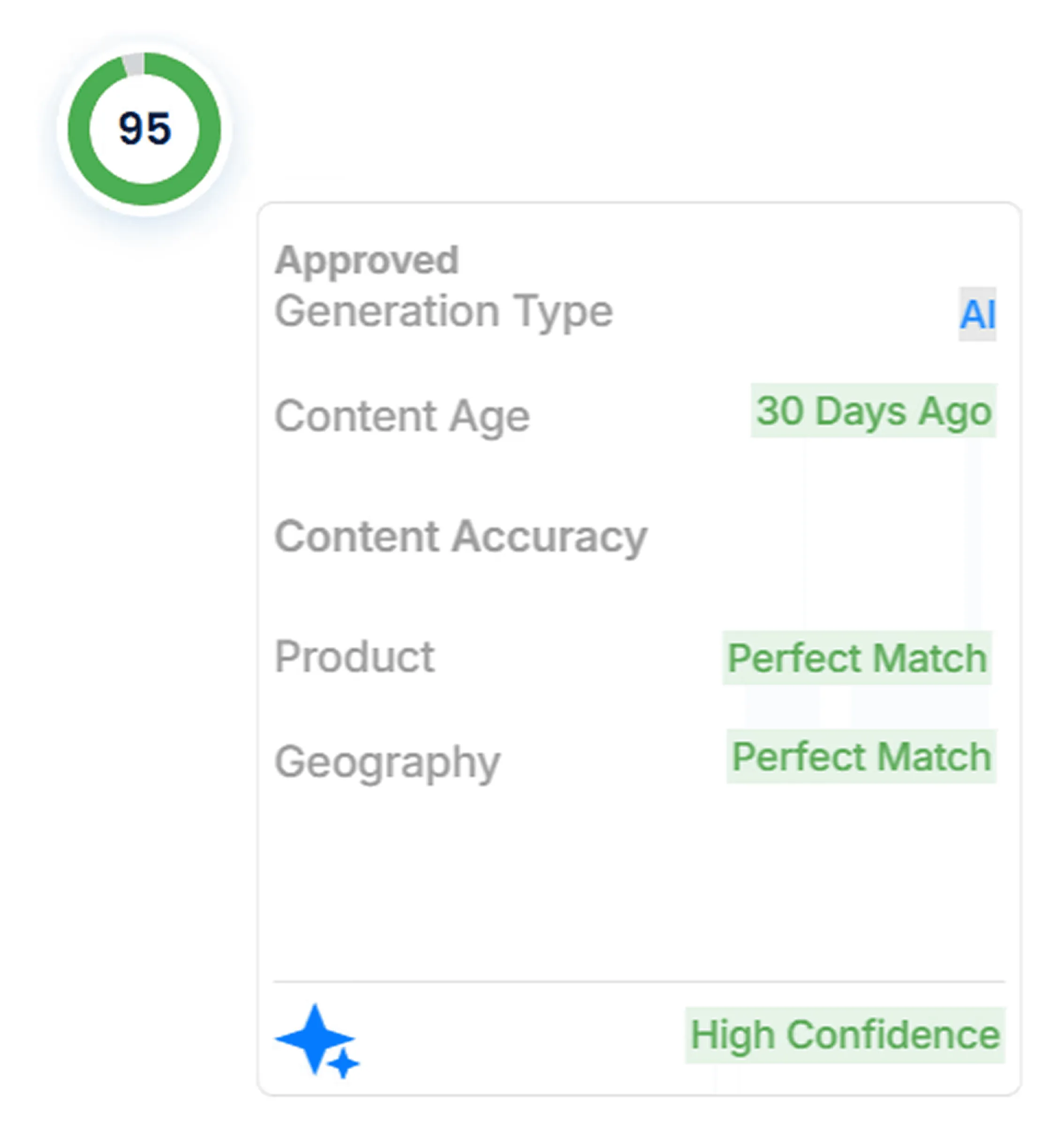
Pro tip: Never let AI invent case studies, metrics, certifications, or client results. Feed it real evidence, then use AI to place that evidence in the right part of the response.
_“In working with over 200 companies moving to an AI First Approach, we’ve learned that the real advantage isn’t simply automating content. It’s what teams do with the time they get back. The winners use it to invest in their processes and provide more insightful responses.” _- Jasper Cooper, Co-Founder and CEO of AutoRFP.ai
6. Edit, Strengthen, and Align the Responses
After the first draft is created, use AI to improve the response section by section.
AI can help rewrite answers for clarity, reduce word count, improve structure, remove vague language, and align the response with your brand voice. It can also help weave in win themes, such as faster implementation, stronger compliance, lower risk, better support, or proven experience.
AI can help with:
Rewriting weak or generic answers
Making technical answers easier to understand
Adding approved evidence and metrics
Tightening long responses
Improving tone consistency
Translating responses for multilingual bids
Applying win themes across multiple sections
This is where tools like AutoRFP.ai’s Project Agent can be especially useful. Instead of editing every answer one by one, teams can ask the agent to apply win themes, check tone consistency, strengthen responses with evidence, or rewrite sections based on project context.
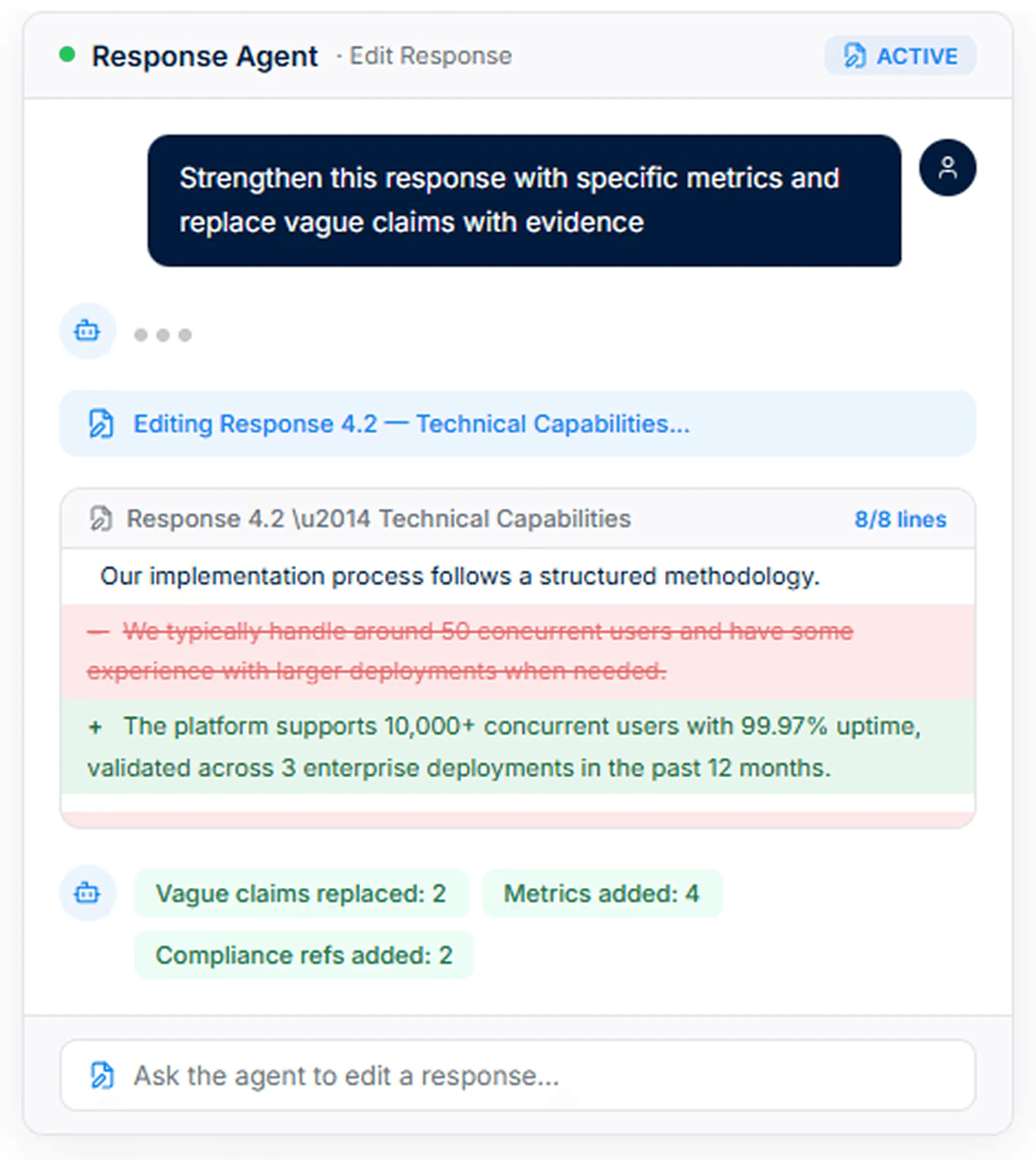
Side note: This is also where human judgment matters most. AI can improve the writing, but your team should still check whether the response is accurate, persuasive, and specific to the buyer.
7. Route Questions to SMEs and Track Progress
Most bid responses need input from multiple people, including sales, product, finance, legal, security, delivery, and technical teams.
AI can help reduce manual coordination by routing questions to the right subject matter experts, tracking section ownership, sending reminders, and showing which parts of the bid are still blocked.
AI can help teams manage:
Who owns each section
Which answers are waiting for SME input
Which requirements are complete
Which responses need review
Which blockers may affect the deadline
Which sections still need approval before submission
This is especially useful for large RFPs where teams are working across different documents, spreadsheets, portals, and internal systems.
AutoRFP.ai supports this kind of workflow by helping teams manage assignments, track progress, and keep everyone aligned in one place.
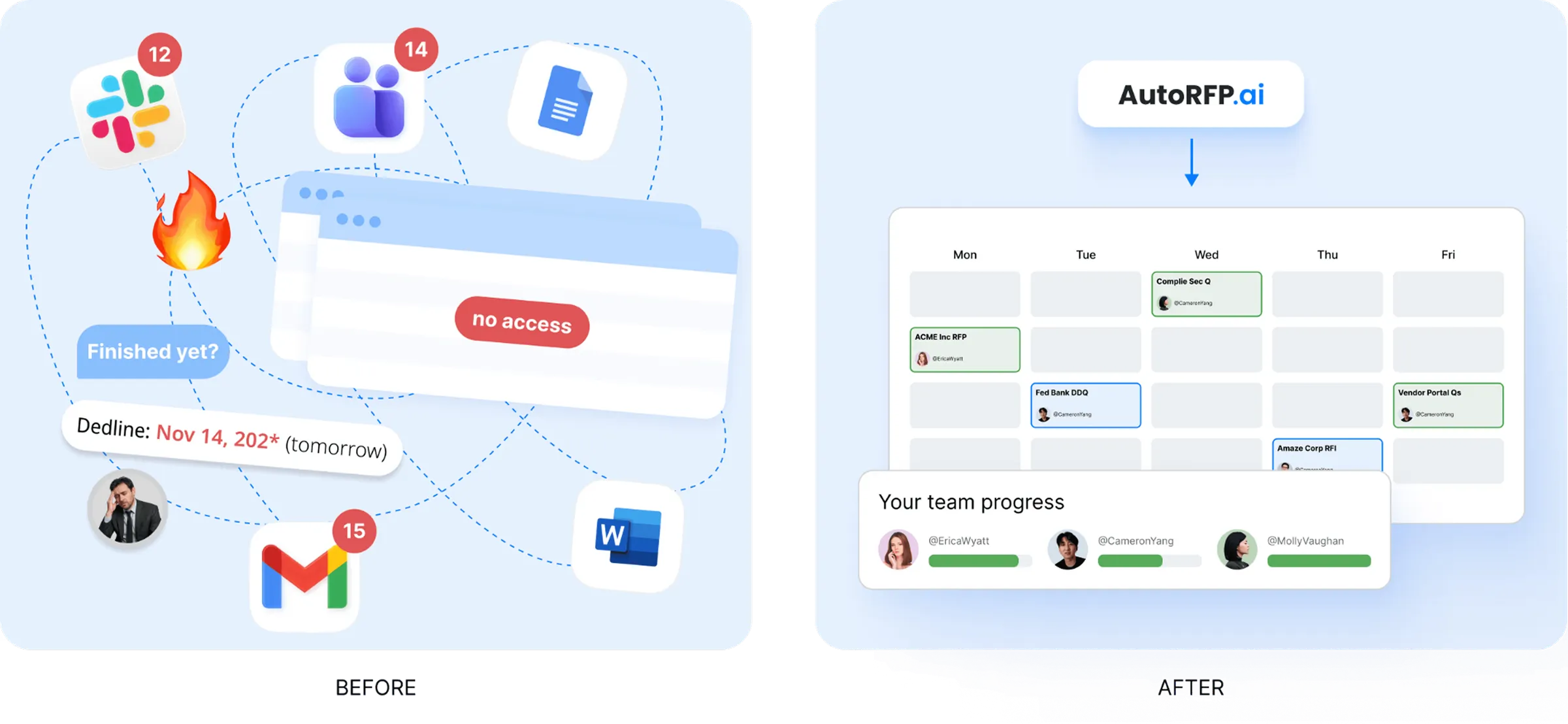
8. Run a Final Compliance and Gap Review
Before submission, use AI to compare the final draft against the original RFP requirements.
This helps catch missing answers, weak sections, contradictions, outdated content, unsupported claims, and formatting issues before the buyer sees the proposal.
AI can review for:
Unanswered questions
Missing attachments
Compliance gaps
Contradictory answers
Weak evidence
Inconsistent tone
Outdated content
Requirements that were not fully addressed
A final AI-assisted review gives your team another layer of quality control before submission. With AutoRFP.ai, teams can check responses against requirements, review confidence levels, and identify sections that need more work before the proposal is finalized.
Pro tip: Use AI for the final review, but keep a human approval step before submission. The final bid still needs commercial, legal, technical, and editorial sign-off.
9. Use RFP Gap Analysis to Improve Future Bids
After the bid is completed, use AI to spot recurring gaps across your RFP history.
For example, if your team keeps marking the same requirements as “non-compliant” or “partially compliant,” AI can show whether those gaps are affecting deal value, win rates, or future pipeline.
AI-powered RFP gap analysis can help you identify:
Requirements you fail most often
Compliance gaps that appear across multiple bids
Product or security gaps that may be costing deals
Patterns that should be shared with product, legal, security, or leadership teams
With AutoRFP.ai, teams can turn completed RFP data into strategic insight, showing not just what was missed, but which gaps are repeatedly blocking revenue.
Pro tip: Review RFP gap analysis regularly, not only after a lost deal. Repeated gaps are often signals for product, compliance, or positioning improvements.
AI Bid Writing Templates That Actually Work
AI bid writing works best when your team has the right prompts, checklists, templates, and workflows behind it. The resources below can help you prepare your content library, qualify better-fit opportunities, improve response quality, and move faster across the bid process.
1. Content Library Audit Spreadsheet for RFP Teams
A content library is only useful for AI if the content inside it is accurate, current, and easy to retrieve. This audit spreadsheet helps RFP teams review every Q&A pair against the factors that matter for AI-powered bid writing, including ownership, review status, AI readability, staleness, and usage frequency.
Use it to:
Identify outdated or ownerless content
Spot answers that may contradict other approved responses
Score content based on AI readiness
Prioritize which content needs review first
Generate a library health breakdown for your team
It also includes a ready-to-paste AI prompt that can run the audit automatically, making it easier to clean up your library before relying on AI for drafting.
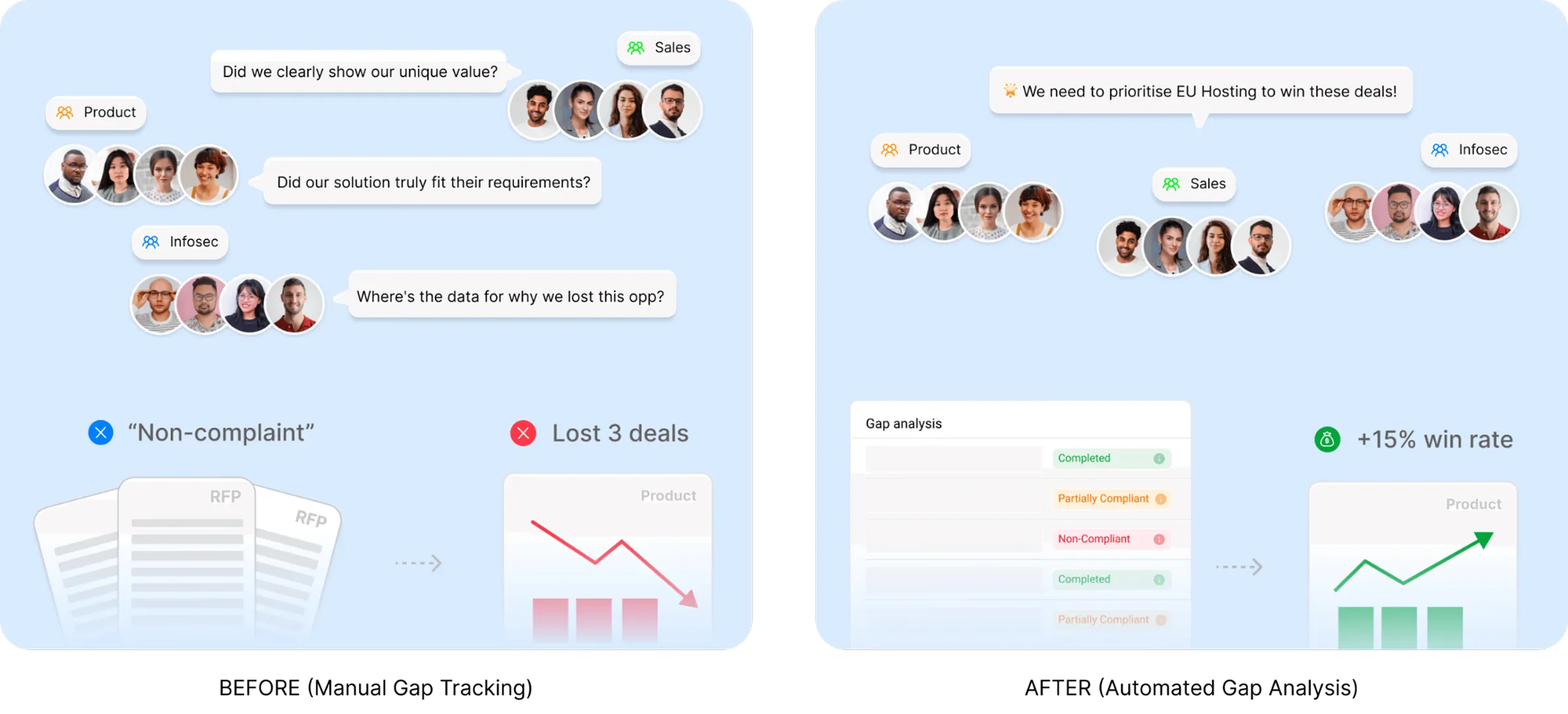
Download the complete spreadsheet
2. Content Library Checklist: Is Your Library Ready for AI?
Before AI can reuse your approved content well, your library needs the right structure. This checklist helps proposal teams assess whether their content library is organized, governed, and ready for AI-assisted response generation.
Use it to review:
Content ownership
Review cycles
Folder and topic organization
Permissioning
AI readiness
Retrieval quality
Content ranking and transparency
This is especially useful before rolling out AI bid writing across a larger team because it helps you fix the content foundation first.
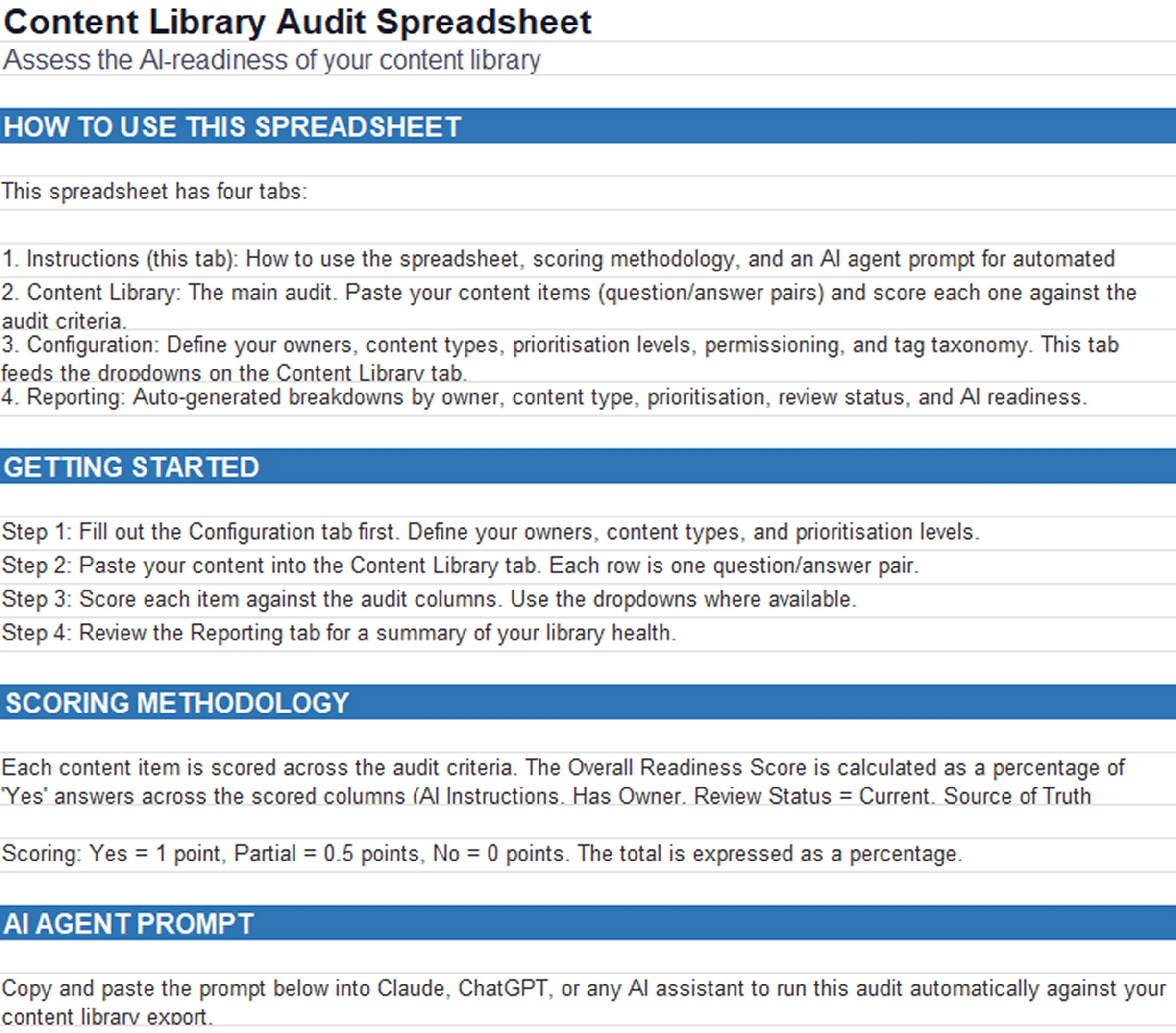
3. AI Go/No-Go Agent Skill
Not every RFP is worth pursuing. The AI Go/No-Go Agent Skill helps teams review tender documents and get a scored recommendation based on fit, risk, mandatory requirements, and deal-breaker criteria.
Use it to:
Upload RFP documents for analysis
Score the opportunity across key evaluation areas
Flag red flags such as hosting restrictions, legal issues, or mandatory certifications
Get a clear go/no-go recommendation
Identify possible win themes if the bid is worth pursuing
This helps teams avoid wasting time on poor-fit bids and focus their energy on opportunities they can realistically win.
4. RFP Automation Claude Cowork Project Instructions
For teams using Claude as part of their RFP workflow, these cowork project instructions help turn a general AI workspace into a more structured bid response environment.
Use it to:
Run go/no-go analysis
Extract requirements from tender documents
Build a compliance matrix
Draft first-pass responses
Work from connected CRM, content library, and team systems
This is useful for bid teams that want a more guided way to use AI across qualification, requirement extraction, and early response drafting.
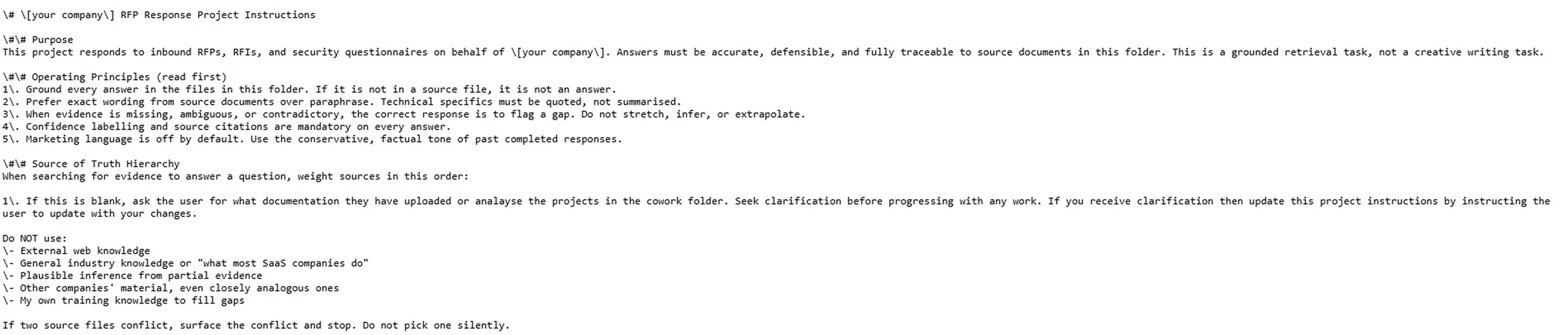
Download the complete RFP Automation claude cowork project instructions
5. Claude Prompt for Sales Proposals
Sales proposals often slow teams down after a strong discovery call. This prompt helps turn prospect details, call notes, or CRM data into a structured proposal that is ready for review.
Use it to:
Summarize prospect needs
Turn discovery notes into proposal sections
Structure the offer clearly
Create a formatted proposal draft
Reduce manual writing time for sales teams
This is useful for sales-led proposal workflows where speed matters, but the proposal still needs to feel specific to the buyer.
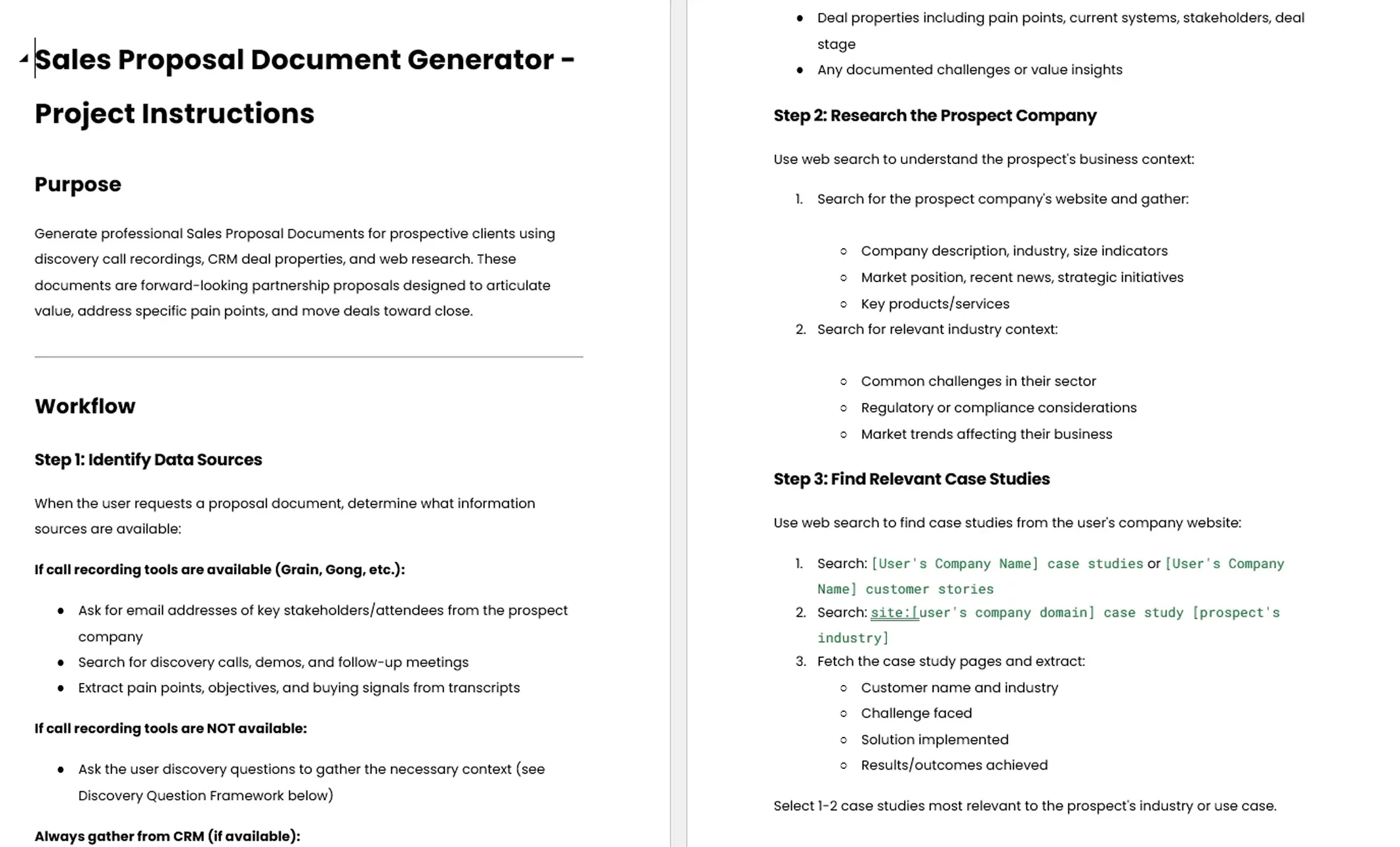
Download the complete Claude Prompt for Sales Proposals
6. AI Go/No-Go Prompt for RFP Tender Analysis
This prompt helps teams analyze an RFP before committing resources to the response. Instead of manually reviewing hundreds of pages, teams can use AI to assess the tender against clear go/no-go criteria.
Use it to:
Analyze the company fit
Review the tender requirements
Identify risks and red flags
Check whether the opportunity matches your strengths
Generate a recommendation with supporting evidence
This gives bid managers and sales leaders a faster way to decide whether to pursue, pause, or reject an opportunity.
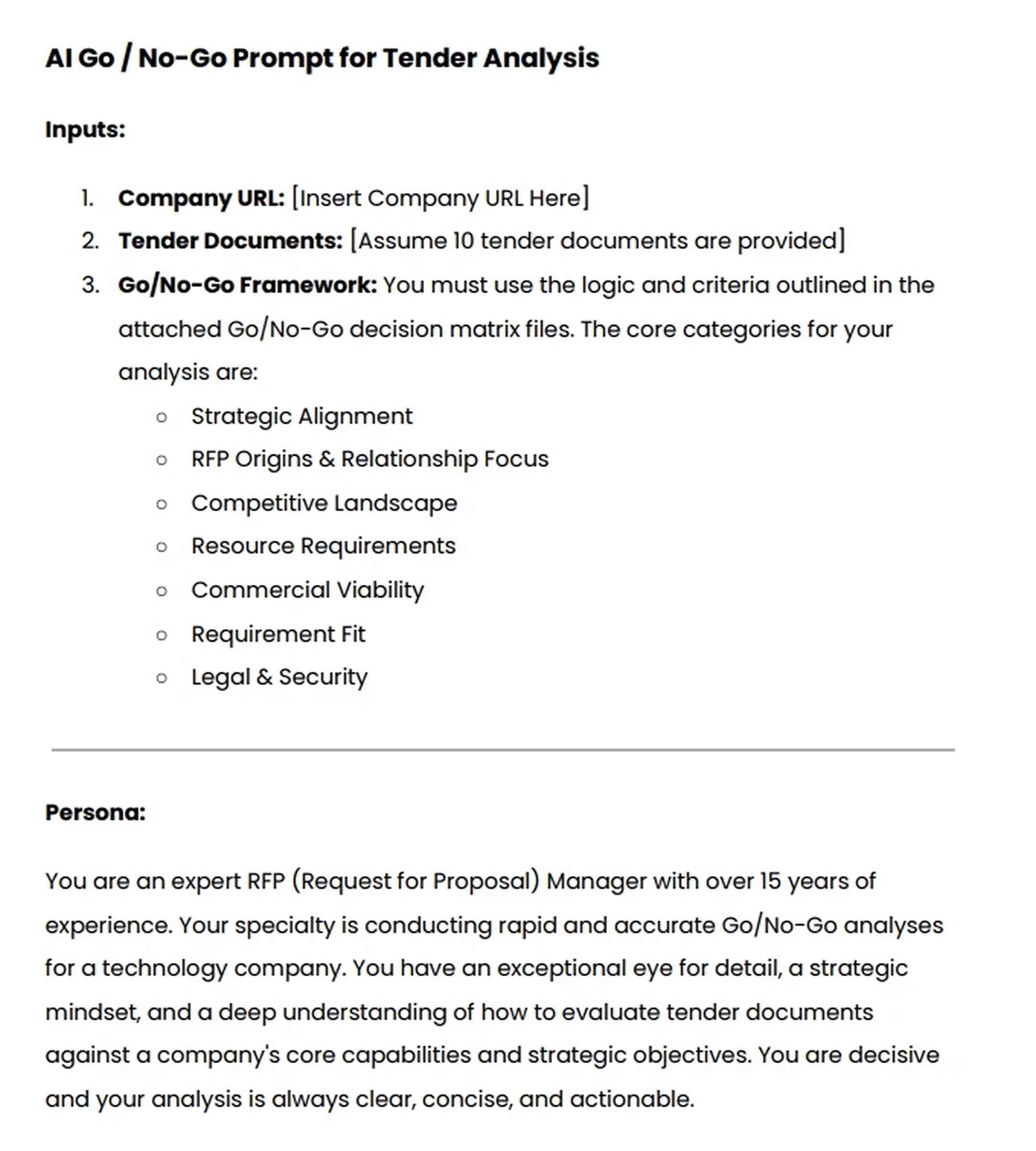
Download the complete AI Go/No-Go Prompt for RFP Tender Analysis
7. 101 ChatGPT Prompts to Improve Your RFP Bid Quality
This prompt guide gives bid teams a wider set of AI prompts for improving RFP, RFI, RFQ, and other response formats. It is designed for common proposal tasks, from drafting and rewriting to reviewing, strengthening, and polishing responses.
Use it to improve:
First-draft responses
Executive summaries
Win themes
Compliance answers
Tone and clarity
Section rewrites
Review and quality checks
It is a practical resource for teams that want more control over how they use AI during the bid process, especially when working under tight deadlines.
Together, these AI bid writing resources help teams move beyond basic prompting. They support the full process: preparing your content library, qualifying the right opportunities, drafting stronger responses, improving quality, and making AI more useful across the entire bid workflow.
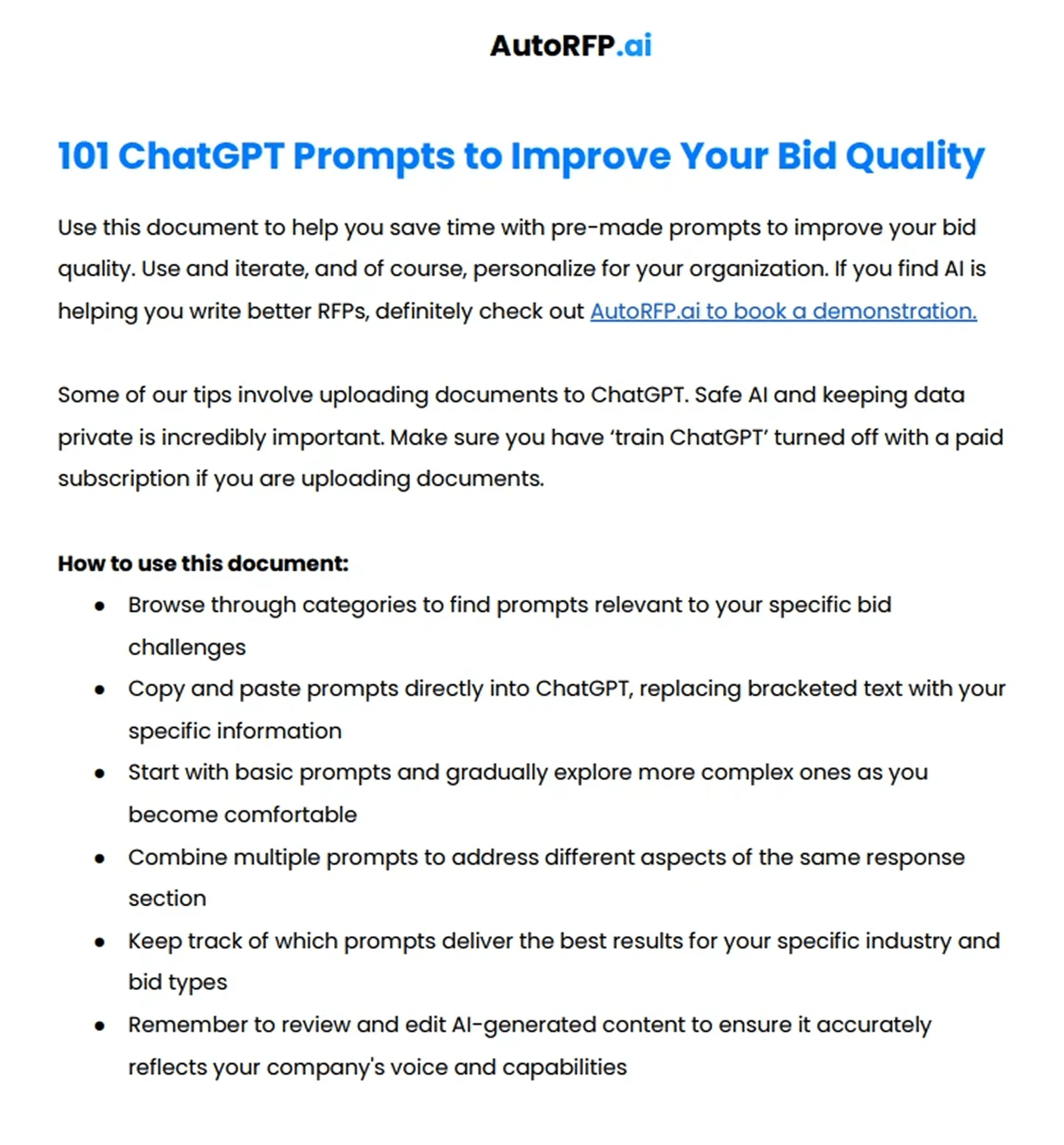
Download 101 ChatGPT Prompts to Improve Your RFP Bid Quality
How to Pick the Right AI Response Tool for Bid Writing
These are the main decision factors to consider when choosing an AI response tool for bid writing:
| Decision factor | What to look for |
|---|---|
| Bid volume | If your team only answers a few bids a year, a lighter AI writing workflow may be enough. If you manage frequent RFPs, RFIs, security questionnaires, or tenders, you need a tool that can scale drafting, content reuse, review, and collaboration. |
| Level of AI nativeness | Look for tools built around AI from the start, not legacy systems that simply added AI later. AI-native tools like AutoRFP.ai can use semantic search, approved content, source-backed drafting, and confidence scoring instead of relying only on keyword matching. |
| Content library readiness | The tool should help you reuse approved answers, track outdated content, show source material, and keep your library current. AI is only useful if it can retrieve the right content at the right time. |
| Types of bids handled | Check whether the tool fits the work your team actually does, such as sales RFPs, security questionnaires, government tenders, compliance-heavy bids, or technical proposals. Different bid types need different levels of structure, evidence, and review. |
| Regulated industry and audit needs | If you work in security, finance, healthcare, government, or enterprise SaaS, choose a tool that supports traceability, source visibility, audit trails, permissions, and data protection. You need to know where each answer came from and who approved it. |
| Team size and collaboration | Smaller teams may need speed and simple drafting support. Larger bid teams need section ownership, SME routing, reminders, reviewer workflows, and progress tracking so responses do not get stuck across departments. |
| Integration needs | The right tool should fit into your existing workflow, including CRM, Slack, Teams, content libraries, procurement portals, document storage, and AI assistants. This reduces copy-paste work and keeps bid data connected. |
| Review and quality control | Look for features that help check compliance, identify missing answers, flag weak sections, surface contradictions, and improve tone before submission. AI should help your team review better, not just write faster. |
Write Winning Bids Faster With AutoRFP.ai
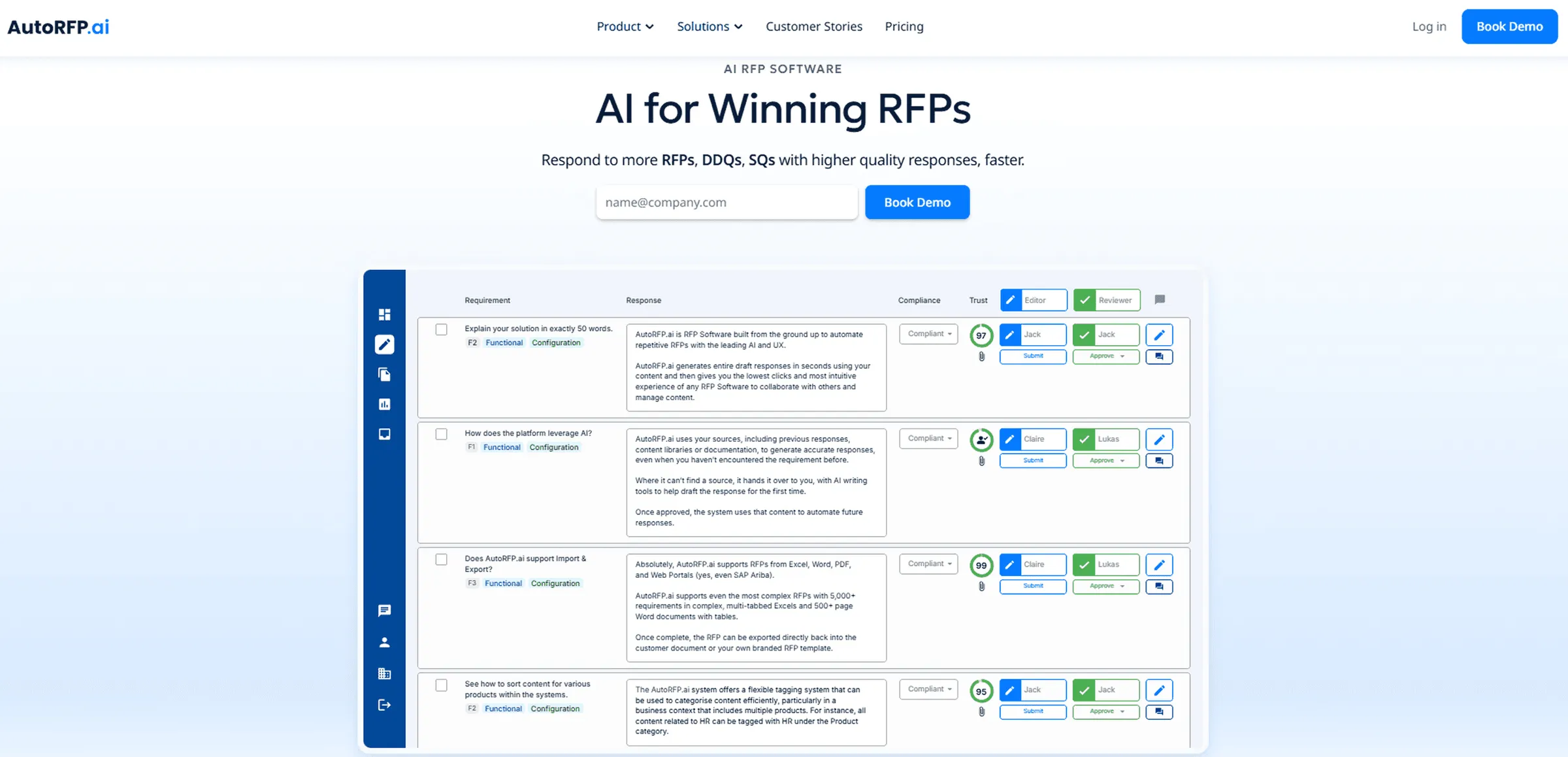
AI bid writing works best when it helps your team move faster without losing accuracy, control, or compliance. AutoRFP.ai brings the full bid response process into one AI-native platform, from requirement analysis and go/no-go reviews to approved content reuse, first-draft generation, SME collaboration, compliance checks, and post-bid gap analysis.
Instead of relying on scattered documents, manual copy-paste, and disconnected AI prompts, your team can work from trusted content, source-backed answers, confidence scores, and structured workflows built for RFPs, security questionnaires, and complex tenders.
Book Demo with AutoRFP.ai to see how your team can write stronger bids faster.
Frequently asked questions
Can AI Write A Complete Bid Proposal?
AI can help draft large parts of a bid proposal, but it should not replace human review. Bid teams still need to check accuracy, compliance, pricing, technical details, win themes, and buyer-specific context. The best use of AI is to speed up first drafts, reduce repetitive writing, and give SMEs more time to review strategic sections.
How Should Bid Teams Review AI-Generated Responses?
Bid teams should review AI-generated responses for factual accuracy, compliance, tone, source quality, and alignment with the buyer’s requirements. Every answer should be checked against approved content, technical documents, pricing information, and RFP instructions before submission. AI can create the draft, but the team is still responsible for the final response.
What Are The Biggest Risks Of Using AI For Bid Writing?
The biggest risks are generic answers, unsupported claims, outdated content, incorrect technical details, and responses that do not match the buyer’s exact requirements. Teams can reduce these risks by using approved content libraries, source citations, SME reviews, and clear prompts that include the buyer’s context, evaluation criteria, and win themes.
How Does AutoRFP.ai Generate RFP Responses?
AutoRFP.ai’s AI Response Engine searches the content library by meaning rather than exact keywords. It uses approved content, past winning responses, and company documentation to generate first drafts with trust scores, so reviewers can see how reliable each answer is before refining it for the buyer.
How Can AutoRFP.ai Help Teams Reuse Approved Bid Content?
AutoRFP.ai helps teams find and reuse approved answers, case studies, technical documents, security content, and past RFP responses from one content library. This reduces copy-paste work, keeps responses more consistent, and helps bid teams avoid rewriting the same answers across every proposal.
