"No Bid" in the Proposal Process: Meaning, Criteria & Impact
Learn what a “no bid” means in the proposal process, why companies decline RFPs, the criteria used in go/no-go decisions, and how to improve win rates.

Robert Dickson
RevOps Manager, AutoRFP.ai··5 min read
Sometimes the smartest proposal you can send is… none at all. In busy bid teams, “No Bid” can feel like quitting or leaving money on the table, so people push ahead with every opportunity, even when the fit is weak, margins are thin, or the timeline is a nightmare.
The result? Burned-out teams, rushed submissions, and a pipeline full of low-probability, low-value bids. A clear, confident no-bid decision is not about saying no to revenue; it’s about saying yes to focus.
In this article, we’ll unpack what “No Bid” really means, why companies choose it, and how to build a practical go/no-go framework. You’ll see the benefits of a deliberate no-bid strategy, key considerations before you decline, best practices for handling no-bids with stakeholders, and common mistakes teams make.
We’ll also look at how modern RFP automation tools can surface the right criteria and data to support better, faster, no-bid decisions.
Understanding the Concept of “No Bid”
Here’s what the term really means, why teams choose it, and how it affects everything that happens next in the proposal process.
What is a ‘No Bid’ in the Proposal Process?
A ‘No Bid’ in the proposal process refers to the decision of a company not to submit a bid for a particular project or opportunity.
It is a strategic decision made after evaluating factors such as project requirements, the competitive landscape, the cost-benefit ratio, and resource availability.
Companies may choose not to bid for several reasons, including a lack of expertise, insufficient resources, or a project that does not align with their business goals.
Why Companies Choose a ‘No Bid’ Decision?
Companies submit a ‘No Bid’ when they decide that pursuing a specific opportunity is not worth the time, cost, or risk. Instead of bidding on every RFP, they assess each one against their capacity, expertise, profitability, and strategic fit within RFP bidding.
A well-judged ‘No Bid’ helps protect win rates, margins, and team bandwidth by focusing only on opportunities they can realistically deliver and win.
“Let’s be real, saying ‘no’ to an opportunity feels wrong. It feels like you’re turning down potential, revenue, or momentum. But honestly? Most teams don’t lose because their proposals were bad. They lose because they said yes to something they were never set up to win.” – Heather Kate Warrender, Founder & Principal Bid Consultant at OPAL Bid Consultants
Common reasons for a ‘No Bid’ decision include:
| Reasons | Description |
|---|---|
| Lack of capacity or resources | The company doesn’t have enough people, time, or equipment to deliver the project properly. |
| Limited expertise or experience | The scope falls outside their core strengths, making it difficult or risky to meet the client’s expectations. |
| Poor strategic or business fit | The project doesn’t align with their business goals, target market, or long-term direction. |
| Unfavorable terms or conditions | Companies may decline to bid if the project requirements or contract terms are unfavorable or do not align with their business objectives. |
| Weak cost-benefit ratio | The expected profit doesn’t justify the effort, the bidding costs, or the delivery risks. |
| Highly competitive landscape | If competition is fierce and the chances of winning the bid are low, companies may decide not to invest time and resources in bidding. |
| High risk profile | Commercial, delivery, legal, or reputational risks outweigh the potential benefits of winning the project. |
Impact of ‘No Bids’ on the Proposal Process
When a company decides to submit a ‘No Bid’ in the proposal process, it can have significant implications. One of the key impacts is the allocation of resources.
By choosing not to bid on a project, the company can free up resources to focus on other opportunities that align more closely with their strategic objectives. Another important impact is the potential damage to the company’s reputation, especially if stakeholders perceive the decision as a lack of interest or capability.
In addition, ‘No Bids’ can influence the overall competitiveness of the proposal process when fewer companies participate.
Key impacts of a “No Bid” decision are:
| Impacts | Description |
|---|---|
| Resource allocation | It frees up resources so the company can focus on opportunities that better align with strategic goals. |
| Reputation | It may affect the company’s reputation if stakeholders misinterpret the decision as a lack of interest or capability. |
| Competition level | It reduces the pool of potential competitors, which can impact competition levels and potentially lead to higher prices for the client. |
“A strategic no-bid can save resources, protect win rates, and sharpen your focus on the deals that truly matter. Saying “no” isn’t giving up; it’s choosing to compete where you can win. Bid professionals should feel empowered to challenge the default “yes” and ask: Is this the right fit?” – Ben Hannon, Recruitment Director at Bid Solutions
The Go/No-Go Decision Framework
The Go/No-Go decision framework is a simple way to qualify opportunities before you invest valuable time and resources. Instead of reacting to every RFP, you use a structured scorecard to decide whether a proposal is genuinely worth pursuing.
At its core, the framework uses weighted scoring across key qualification factors such as fit, profitability, capacity, and win probability. Each factor is scored on a 1-5 scale, Yes/No, or Low-High, with category weights adjusted to reflect your organization’s priorities.
There are several criteria and decision logics you’ll need to apply before and after you score an opportunity, and let’s look at what they are.
Before You Read the RFP Document
Use these three criteria as a quick pre-screen to avoid spending hours on a document you should never have bid on in the first place.
1. Strategic Alignment
Strategic alignment is your first filter: Is this the kind of customer and opportunity we actually want?
At this stage, you’re not checking detailed requirements yet. You’re looking at things like:
| Scoring factor | What to evaluate |
|---|---|
| Strategic value of the client | How strategically important is the client? |
| Future opportunity potential | Whether there is real growth potential beyond this one RFP. |
| Market penetration value | How much does it help your market presence (new region, new vertical, or deeper penetration in a target segment)? |
| Ideal customer profile | How closely does the account fit your ideal customer profile? |
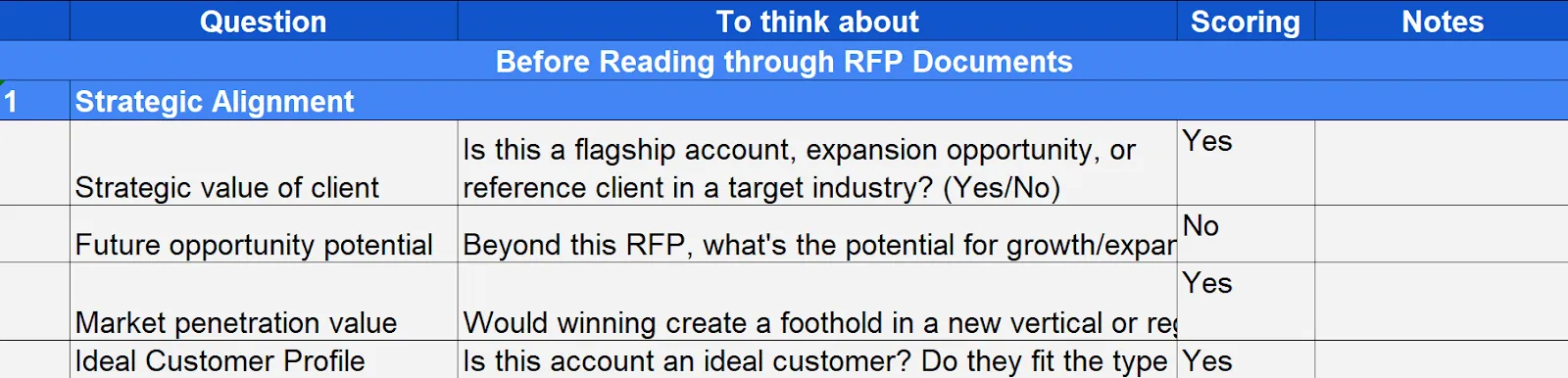
Example of a scorecard for strategic alignment
2. RFP Origins & Relationship Focus
Once you know the deal is strategically interesting, you look at where the RFP came from and how strong your relationship is.
Here you’re really asking: Are we entering this as a true contender, or just as another name in a tender?
You consider things like:
| Scoring factor | What to evaluate |
|---|---|
| RFP source | How the RFP originated (unsolicited/public vs something your team helped shape). |
| Relationship strength | The depth of the existing relationship (from “no prior contact” to a well-established, trusted partner). |
| Executive sponsorship | Whether you have executive sponsorship or a senior champion who will fight for you internally. |
| Inside knowledge | How much insight do you have into their decision process and politics? |
| Reverse RFP influence | How strongly you influenced the requirements before the RFP was issued. |

Example of a scorecard for RFP origins & relationship focus
Pro tip: Score higher when you have relationships with decision-makers, helped shape the RFP, or received it through a warm introduction, and score lower for unsolicited RFPs from unknown organizations.
3. Competitive Landscape
Look at the market around you: Can we realistically stand out in this competition?
Here you’re thinking about:
| Scoring factor | What to evaluate |
|---|---|
| Incumbent status | Whether you are the incumbent or trying to unseat an existing vendor. |
| Competitive intelligence | How clearly do you know who else is bidding and what they’re strong at? |
| Competitive advantage | Where do you genuinely outperform those competitors for this specific customer? |
| Differentiation clarity | How clearly can you articulate that unique value? |

Example of a scorecard for competitive landscape
Pro tip: Score higher when you have clear competitive advantages, know who you’re competing against, and lower if you struggle to explain why you’re different.
After You Review the RFP in Detail
If the opportunity passes the quick pre-screen, then it’s worth reading the full RFP and applying more detailed criteria.
4. Resource Requirements
Once the opportunity passes the initial criteria, you need to ask a blunt question: Do we have the people and time to do this properly, without jeopardising everything else?
Here you’re looking at things like:
| Scoring factor | What to evaluate |
|---|---|
| Team bandwidth | Can your proposal, sales, and delivery teams realistically take this on alongside other priorities? |
| Timeline and decision process | Is the decision path clear, with milestones you understand, or are you working into a vague, shifting deadline? |
| Access and communication | Will you get meaningful stakeholder access, or is it a closed, minimal-feedback process? |
| Content and SME effort | Can you reuse strong existing content, or will it require extensive customization and limited SMEs? |
| Deadline and effort-to-value | Is the deadline realistic, and is the effort proportionate to the contract’s potential value? |
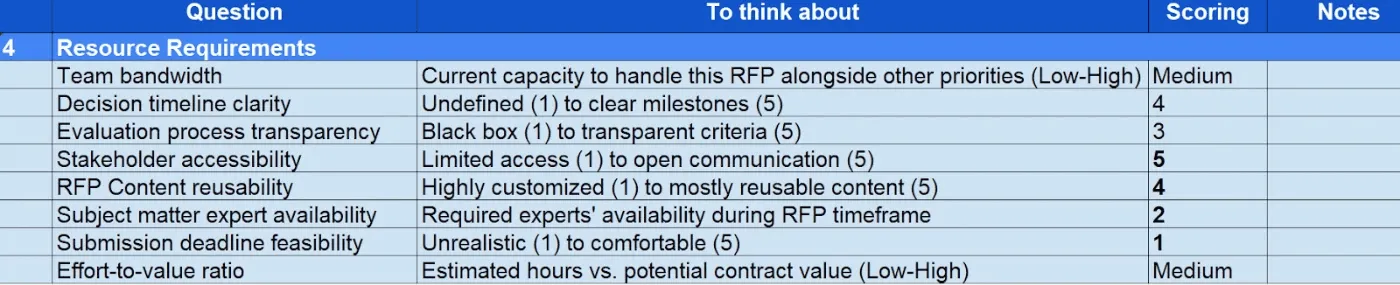
Example of a scorecard for resource requirements
Pro tip: If the team is already stretched, the process is opaque, SMEs are unavailable, and the RFP demands a ton of bespoke work, the resource requirements score should be low.
5. Commercial Viability
Next, you test whether the deal makes financial sense. A big logo with a weak commercial profile is still a risky bet.
Here you’re asking:
| Scoring factor | What to evaluate |
|---|---|
| Budget transparency | Is there a clear, realistic budget for your type of solution? |
| Budget allocation | Is funding already allocated, or is it still a “nice to have”? |
| Pricing flexibility | Are pricing and terms flexible enough to structure a win-win deal? |
| Contract term potential | Is this a short-term contract or a longer-term partnership opportunity? |
| Payment terms | Do the payment terms support healthy cash flow, or add too much risk? |

Example of a scorecard for commercial viability
6. Requirement Fit
Requirement fit is how well your solution aligns with what the RFP is asking for, both technically and operationally.
You’re looking at:
| Scoring factor | What to evaluate |
|---|---|
| Technical fit | How closely do you match the core technical requirements and integrations? |
| Non-technical fit | How well do we cover non-technical needs like training, support, and governance? |
| Level of customization | Can we deliver this with the standard configuration, or does it need heavy custom work? |
| Implementation complexity | Is implementation straightforward and familiar, or complex and high-risk? |
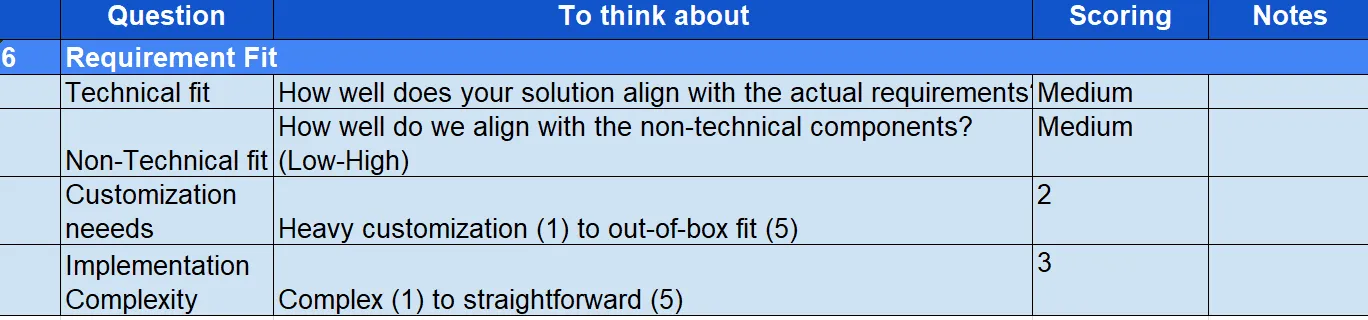
Example of a scorecard for requirement fit
Pro tip: A high requirement-fit score means you can tick most of the must-have boxes with your standard offering and predictable implementation. If the design leans on significant custom work and complex roll-out, the score should trend lower.
7. Legal & Security
Finally, you need to check whether the legal, regulatory, privacy, and security requirements are realistic for your organisation.
Questions here include:
| Scoring factor | What to evaluate |
|---|---|
| Contract terms | Are the contract terms broadly acceptable, or too one-sided on liability and penalties? |
| Legal and regulatory obligations | Are the legal requirements routine for our counsel, or unusually complex? |
| Compliance requirements | Do the required regulations and frameworks match what we already comply with? |
| Privacy expectations | Can we meet their data privacy demands on residency, retention, and access? |
| Security controls | Do we already meet the requested security standards (encryption, access control, monitoring, incident response)? |
| Certifications | Do we hold the mandatory certifications they ask for, or would we be bidding without them? |
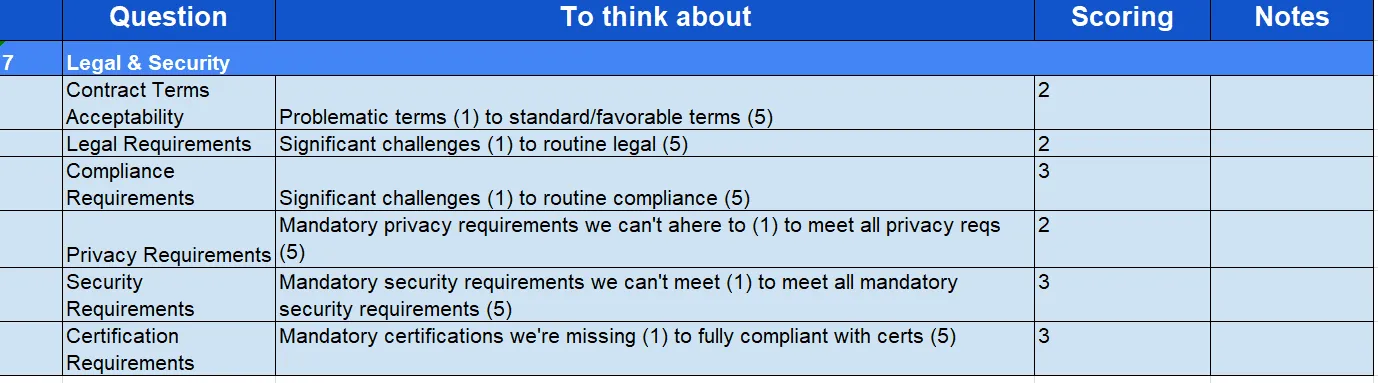
Example of a scorecard for legal and security
Pro tip: If your legal or security teams see too many red flags or major gaps in certifications and controls, that’s a strong signal to downgrade the score or move towards a no-bid.
Turn Your Criteria into a Simple Go/No-Go Score
Once you’ve scored each criterion, you don’t want the framework to become another spreadsheet no one trusts. A common approach is:
Score each criterion from 1 to 5
1 = very poor fit
3 = acceptable / borderline
5 = strong fit
Apply weights (%) to what matters most for your business (for example, strategic alignment and commercial viability might carry more weight than the competitive landscape)
Calculate a weighted total and use clear thresholds, such as:
80%+ = Strong Go
65-79% = Go with conditions
50-64% = Executive review required
Below 50% = No-Go
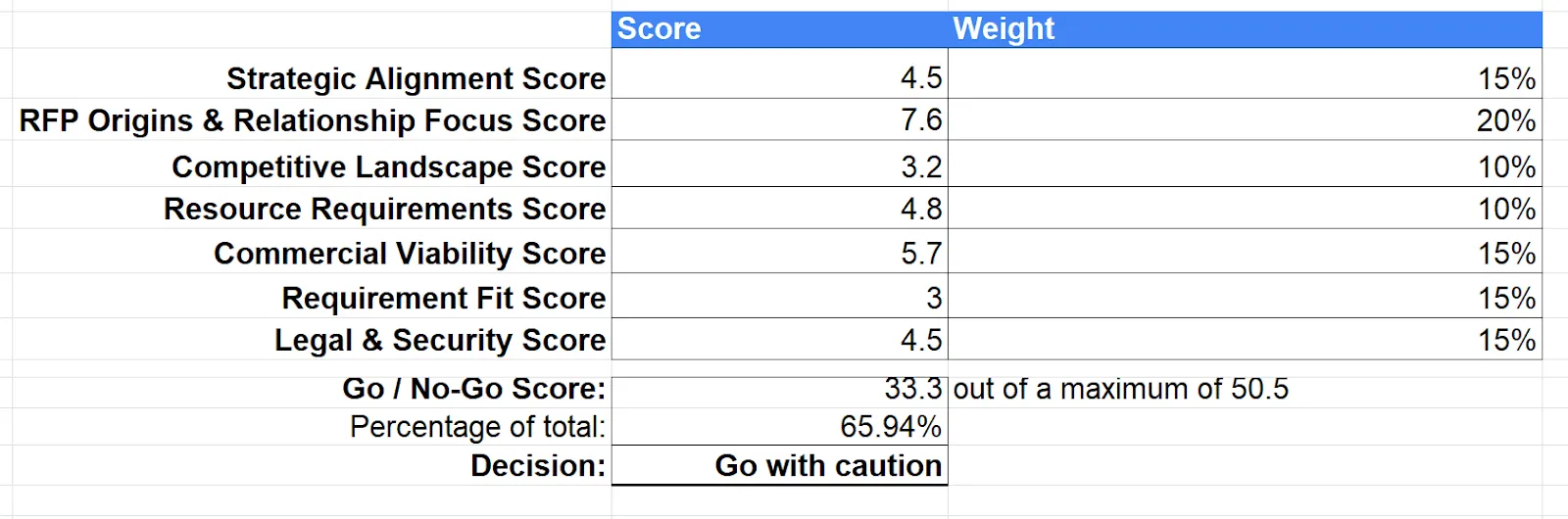
Example of Go/No-Go score summary with weighted criteria
Instead of starting from a blank sheet, you can use a pre-built Go/No-Go template from AutoRFP.ai, with all the criteria, questions, and scoring logic. Just adapt it to your process, enter your scores and notes, and the model generates the decision instantly.
Use AI to Run Your Go/No-Go in Minutes
To analyze tenders faster and more consistently, you can let an AI assistant do the heavy lifting for you. The flow is simple:
Open an AI assistant like Gemini or ChatGPT.
Upload the RFP or tender documents.
Upload your logic and criteria matrix (you can use the complete scorecard above).
Paste the AI Go/No-Go prompt below, created by RFP experts with 15+ years of experience, and let the AI generate a full analysis in minutes.
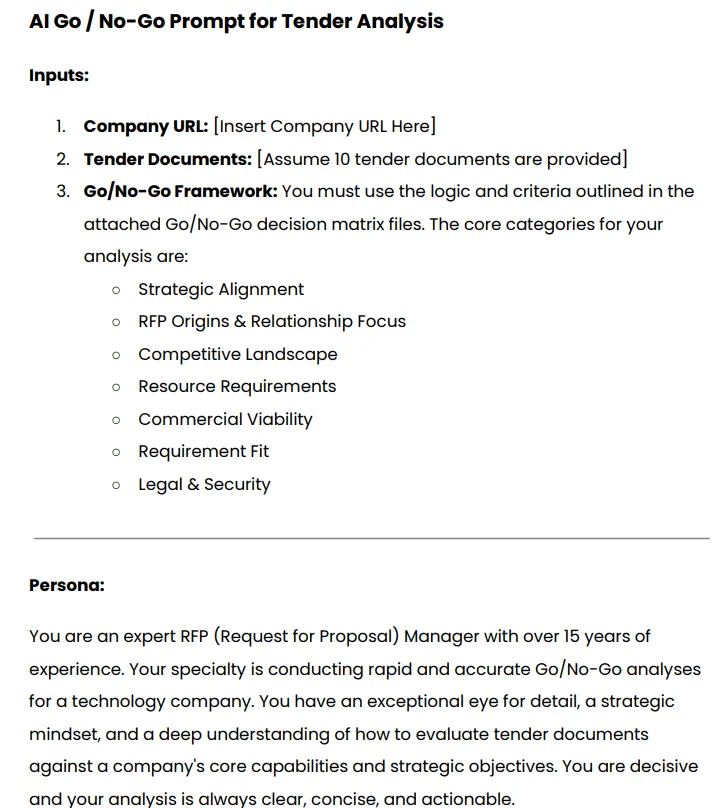
Download the complete AI Go/No-Go Prompt
If you prefer to follow along visually, there’s also a video below that walks you through each step in more detail.

Video transcript
Transcript is auto-generated and may contain minor errors.
Hey, have you ever wanted to use Gemini for your AI go no go analysis? We're going to jump into it today using Gemini to do our tender analysis to understand if we want to bid on this tender or not. I'm going to be using Gemini Flash 2.5 Pro which currently available on the paid Gemini plan. Uh, and we're going to be looking at a tender actually from the Australian government. Uh, so this one specifically is the ATO, the Australian Tax Office. And interestingly enough, this tender is for a coding assistant. So like an AI coding software SAS application. I use an AI coding SAS application that I love to use every day and that's cursor. So we're going to look at cursor who have an enterprise plan. So making a pitch for the likes of the ATO's and we're going to look at this publicly available atto tender and
whether cursor should bid on it. So we're going to be using our AI go no go analysis tool with Gemini. So let's jump into it and and wait until the end because the results of the AI go nogo analysis may actually surprise you. So, first of all, um I've got this prompt, and I'm going to leave a Google doc uh or page where you can download this uh prompt and then customize it for your business down in the description below. Uh but of course, um you know, I you can customize to your heart's content. When we're prompting, it's really important to a make it contextual to our business, which is where we have the inputs here. So, I'm going to enter the cursor URL. Uh we have our persona. So effectively that's telling the Gemini flash 2.5 what you know what kind of uh person is going to be what skill set should it have what context should it have when it answers this question in this case it's an expert RFP manager uh then we have
our context and objective so what are we asking the prompt effectively to do what are the instructions and then what should the output be so from this case I want a comprehensive document detailing against my red flags or amber flags or green flags around whether cursor should bid on this tender or not. So, I'm going to just, you know, copy and paste that prompt, chuck it in here. Then, uh, really cool thing is I'm actually going to turn on deep research. So, deep research is a tool readily available in a lot of your uh common LLMs whether that's uh Gemini as I'm showing here, Chat GPT or Claude. Gemini's deep research can be used not only to search the web but also search your documents. So, with Gemini, you can upload up to 10 documents. And for this, I'm actually going to be using my own go nogo
template. The go no-go template. Again, I'll chuck a link in the description below where you can download that from our website at autoirfp.ai/d downloads, but effectively this will have information. And this is my go no-go framework. What I'd recommend is downloading the template, changing the go no-go framework uh to make it more relevant for your business as needed. But it's a good starting point. Uh for for instance, this really focuses on RFP origins and relationship. uh it looks at resource requirements from our team and then effectively it gives you a scoring matrix and depending on that scoring matrix matrix should tell me whether we should proceed or not uh as well and it has all the different information you can like play around with your hearts content it's just an Excel spreadsheet um but really useful for your go no-go decision framework all righty so jumping back uh I've turned my deep research on and now I'll upload my documents from drive. And so
here are my tender documents. Uh just clicking shift, I'm just going to select all the relevant ones. I can only upload maximum of 10 documents. So I'm actually going to upload the original tender documents, not the indenments. We'll up upload those later. So I'm going to insert those documents. And there's one other document I want to add from my drive. And that actually is that go no-go decision template. So now I have my go no-go decision template. I've got my atto documents uh for the tender and I've got my prompt of what I want Gemini Flash 2.5 Pro to do for my AI go no-go analysis strap in it's pretty cool what you're actually going to see here as well all my tender documents and it's deep researchers on but before I submit this I want to make sure here in the prompt that you can download below is I'm going to update this information so uh tender documents uh see attached As you can see, I've attached them. And in terms of the company URL, well, here
I just want to make sure I I'm just going to enter cursor here. This is a AI coding assistant tender for the Australian tax office. And you know, in this example, we're being cursor. I do not work at cursor. I work at autofp.ai. But for my example, I click submit. And then what I really like about Gemini is it's going to provide a research plan for my AI go no-go analysis. So with that plan, it'll provide a lot of details in terms of the steps it's going to take to try to answer my prompt. And then I can actually edit that plan if I'd like to. And here we have our plan from Gemini. So clicking through I can go through I can read this information. First it's going to browse the cursor docs and all the information regarding cursor. It's going to go and analyze all the tender documents and then it'll make its way through and start to answer my go no-go questions. So, what I recommend here again is a edit the analysis template, the go no-go decision
template. Make that really relevant for your company and when you decide to bid or not to bid for tenders uh and RFPs. And then second is uh in this prompt, make sure you update what questions you're asking. if there's any specific questions like red flags you want for cursor. It might be well cursor doesn't do uh on premise hosting. So want to make sure that's flagged and then uh there's the information and then I can click start research and Gemini flash is going to start doing our AI go no-go analysis. All righty. I've given it some time. time it probably took oh jeez uh maybe about 10 minutes all up which is what you expect for the deep research uh especially for something that goes through you know 10 different tenor documents probably hundreds of pages and uh uses the organizational context that we provide it in the website of cursor to then run a go nogo analysis against that go no-go decision template. So jumping into it, uh before I show kind
of the output, what you have here for deep research is you can look at the thoughts. And so this kind of explains or at least in some cases LMS do hallucinate their thoughts, but in this case we can hopefully trust it and see that what it kind of looked to and what it did uh in completing that analysis. So it looked at the different websites. It then uh looked at the research uploaded folder files and then use that against the decision template to then try to provide an overall go no go as well. Here are the sources it used. Again, it can refer to those Google Drive documents I provided which is really powerful for that Gemini has such a good integration. Obviously, probably no surprise with Google Drive. And then scrolling up here is our analysis. So Gemini has provided an AI go nogo analysis based off the ATO tender documents for an AI coding assistant which we've mocked up as cursor.com to
reply and say should we bid on this where AI go nogo is powerful is it does help with that cursory first look whether this is worth it to look what information should I understand before diving to it further um as well certification gaps um you know goes through all the different information there and effectively it's going through that spreadsheet the decision template that we have for our go no-go analysis you can see here strategic alignment competitive landscape commercial viability legal and security and it's now providing that information there as well so it's it's kind of looked over those different clauses uh I mean here if that's true the the clause grants the AT the right to terminate the contract at any time for any reason for its own convenience that's a pretty you usually don't want that in your legal contracts with the three year plus one plus1 contracts. That's pretty rude. Uh but yeah, anyway, you can have a look at that and uh obviously make up your own mind as well for uh the different information. Uh then you have kind of the different scoring of waiting and that's the powerful thing about a go no-go decision
template is to um use it as a I guess take the emotion out of RFP response. You might have an enterprise AE salesperson run up to you and say I have to bid on this RFP. we have to do it. Uh and if you kind of boil it down to just numbers and what the scoring is, then you can make a more informed decision hopefully without the emotion of that uh as well. Uh and then so it kind of does that scoring for me that I provide in the spreadsheet. And then that's why it's a no-go is because the weighted score was 44.3%. Uh and so told me to go not go for it. I can actually then expand on this. And in the drive there's actually three indentments. And so uh I'll say uh please find attached I'm typing here. Please find attach uh some addendments for the tender and use that to update the
the analysis. So and that's a great thing. You have this chat. You might have Q&A later. You might have addenments. might have uh mistakes in the original tender that are provided to you and with that chat history you can then come back to it and provide additional documents to then do the further analysis with the context of your original. Now with uh LLMs you will uh hit like a token limit for that. For instance I I believe Gemini's token limit is around 1 million uh for Gemini 2.5 Flash Pro. Uh so it's a very fast model but effectively it's going to start start forgetting the original context that you provided. Uh and so you need to be cautious of that. It's good for initial we think of this AI go no go analysis initial cursory first look. It's it's not going to be our full in-depth look. Effectively it's it's saving me time of places I need to look at uh and so on before we kind of get into it. So I it's not going to replace the human to do the go no-go. This is going to help uh help the human do the
go no-go as well. Hope that this video was really useful for you on how to do an AI go nogo analysis with Gemini Flash 2.5 Pro. Uh you can use this for all your tendering needs. Uh make sure to still have the human in the loop. AI can hallucinate. And then final just that last privacy and security uh comment on making sure that the training is turned off. This is a that you're using a paid subscription. Do not upload private RFPs into an LLM because that maybe then you send into uh training data uh without you make sure that the training is turned off. You're paying for your subscription uh as well. Uh, and then yeah, this one, my example is a public tender, uh, but you can, of course, uh, use it as well. So, I'm Rob from Auto RFP. Uh, we're actually an AI RFP software. We actually have a go no-go analysis feature really similar to
what I showed you before, but a lot less of the leg work uh in our software that also uses Gemini Flash 2.5, which is why I had a lot of confidence that could kind of handle the large documents that you would often find in tenders. So yeah, if you're interested, find us at auto rfp.ai. You can pick a book a demo and learn more about us as well. I thanks.
Benefits of Using a No-Bid Strategy
Let’s look at how a clear no-bid strategy actually protects your team, your win rate, and your bottom line.
Higher win rates: Focuses time and energy on bids where you have a genuine chance of winning, instead of chasing every tender or DDQ that lands in the inbox.
Cleaner pipeline: Keeps your forecast full of realistic opportunities rather than long-shot noise, making revenue projections and prioritization easier and more credible.
Better team efficiency: Reduces context-switching and busywork so account executives (AEs), presales, and the RFP manager can spend more time on discovery, strategy, and deal coaching.
Protected presales capacity: Stops specialist engineers from being dragged into low-quality bids, keeping them available for top-tier opportunities and customer-facing work.
Better-quality proposals: Give your core bids more time to think, resulting in sharper narratives, tighter answers, and stronger win themes.
Stronger governance and learning: Creates a documented, defensible trail of decisions and improves your Go/No-Go criteria with every no-bid.
_“Every proposal you develop represents an investment. Bid/no-bid discipline maximizes return by increasing the quality and relevance of each submission. Time and money are spent where there’s a higher chance of success, improving profitabilit_y.” – Mark Pickett, Planning Committee Member at NDIA.
Key Considerations for Submitting a ‘No Bid
Before you decide not to pursue an opportunity, here are the key factors you need to consider.
Assessing the Project Requirements
When assessing the project requirements, it is crucial to thoroughly analyze the scope, objectives, and deliverables, understand the client’s needs and expectations, and identify any specific technical or functional requirements.
Additionally, it is important to evaluate the timeline and budget constraints to determine whether they align with the company’s resources and capabilities. By conducting a comprehensive assessment of the project requirements, companies can make informed decisions about whether to submit a bid or pursue other opportunities.
Evaluating the Competitive Landscape
This analysis can help identify potential competitors and their capabilities. When evaluating the competitive landscape, it is important to consider the strengths and weaknesses of other companies in the industry.
One way to assess the competitive landscape is by conducting a SWOT analysis, which stands for Strengths, Weaknesses, Opportunities, and Threats. This analysis provides a comprehensive view of the market and helps inform decision-making.
In addition to the SWOT analysis, it is also beneficial to gather market intelligence. This includes researching competitors’ past performance, market share, and customer feedback.
By understanding the competitive landscape, companies can position themselves strategically and make informed decisions about whether to submit a bid. Incorporating structured bid management practices at this stage helps ensure decisions are data-driven and aligned with long-term business goals.
Pro tip: It is important to regularly update the competitive landscape evaluation, as market dynamics and competitors’ strategies may change over time.
Analyzing the Cost-Benefit Ratio
This analysis helps in determining whether the project is financially viable and provides valuable insights for decision-making.
One important aspect is conducting a thorough cost-benefit analysis, which involves evaluating the potential costs and benefits associated with a particular project.
To conduct a cost-benefit analysis, several steps can be followed:
Define project goals and objectives.
List down alternative scenarios.
Identify and schedule benefits and costs.
Quantify and assign monetary values to the identified benefits and costs.
Calculate the net present value and return on investment.
By following these steps, organizations can better understand the cost-benefit ratio and make informed decisions about project feasibility and profitability.
Considering Resource Availability
Resource availability determines whether a project succeeds or fails. It is crucial to assess whether the necessary resources, such as skilled personnel and equipment, are available to execute the project effectively and ensure its smooth execution.
To evaluate resource availability, companies can use various methods, including:
Conducting a thorough analysis of the current workforce and their skill sets.
Assessing the availability of specialized equipment or technology required for the project.
Considering the availability of external resources, such as subcontractors or consultants.
By carefully considering resource availability, companies can make informed decisions about whether to submit a ‘No Bid’ and avoid taking on projects they may not have the capacity to deliver.
Best Practices for Handling ‘No Bids’
These best practices will help you handle no-bids confidently while protecting relationships and team bandwidth.
Maintaining Professionalism in Communication
Maintaining professionalism in communication is crucial for establishing trust and credibility with clients and stakeholders. It involves using clear and concise language, active listening, and a respectful tone.
Effective communication can help avoid misunderstandings and conflicts, and foster productive collaborations. Here are some key practices to maintain professionalism in communication:
Use professional language and avoid jargon or technical terms that may confuse the recipient.
Be mindful of the tone and manner of communication, ensuring it is polite and professional.
Respond promptly to messages and inquiries, demonstrating respect for others’ time.
Keep confidential information secure and only share it with authorized individuals.
Side note: Effective communication is not just about what you say, but also how you say it. It is important to be mindful of your words and actions to create a positive and professional impression.
Providing Constructive Feedback
Feedback should be clear, concise, and objective, highlighting areas where the project requirements did not align with the company’s capabilities or strategic goals. When providing constructive feedback on a ‘No Bid’ decision, it is important to focus on the specific reasons for not submitting a proposal.
One effective way to structure the feedback is by using a bulleted list, outlining the key factors that influenced the decision. This provides a clear and organized format for communicating the reasons behind the ‘No Bid’ and allows the recipient to easily understand the rationale.
Pro tip: When providing feedback, avoid criticizing the client or their project. Instead, focus on the company’s internal considerations and limitations that led to the decision.
Here is an example of how the feedback can be structured:
Insufficient resources available to meet the project timeline
Lack of expertise in the specific technology required
Project budget constraints that make it unfeasible
Strategic misalignment with the company’s long-term goals
By providing constructive feedback, companies can maintain positive relationships with clients and leave the door open for future opportunities.
Building Relationships for Future Opportunities
It is important to understand the four basic building blocks that can help create better relationships in negotiation situations.
These building blocks include trust, communication, collaboration, and mutual respect. By focusing on these key elements, companies can establish long-lasting partnerships that can lead to future opportunities.
Continuous Improvement and Learning
Leveraging innovations such as AI for Bid Writing can help teams refine proposal quality, reduce repetitive tasks, and improve decision-making accuracy, demonstrating how technology can support continuous learning. Continuous improvement involves constantly seeking opportunities for enhancing efficiency and effectiveness.
Key practices for continuous improvement include:
Regularly evaluating processes and identifying areas for improvement so companies can streamline their operations and achieve better results.
Implementing a culture of continuous improvement to encourage employees to proactively identify and address issues, thereby increasing productivity and customer satisfaction.
Using a structured approach to track and measure improvement efforts, such as setting specific goals, collecting relevant data, and analyzing the results.
Quantifying the impact of improvement initiatives so organizations can make informed decisions and prioritize areas that require further attention.
Gathering qualitative feedback by encouraging open communication and soliciting input from employees at all levels which can provide valuable insights and ideas for improvement.
Creating a supportive and collaborative environment fosters a culture of learning and innovation.
Implementing a table for presenting structured, quantitative data can help visualize improvement trends and progress over time.
Using a bulleted or numbered list can effectively communicate steps, qualitative points, or a series of related items.
Continuous improvement is not a one-time event but an ongoing journey towards excellence. It requires commitment, dedication, and a willingness to embrace change.
By continuously learning from past experiences and seeking new opportunities for improvement, organizations can stay competitive and adapt to evolving market demands.
Common Mistakes Teams Make With No-Bid Decisions
Here are some of the most common pitfalls to watch out for with no-bid decisions:
Treating every opportunity as a “must bid”: Teams chase any RFP with a famous name, even when there is no relationship or real fit. This pulls hours into bids you were unlikely to win, overloads presales, and starves higher-probability deals of attention.
Ignoring capacity and presales bandwidth: AEs say yes to every RFP without checking who will write, review, or provide the solution. Presales engineers juggle multiple complex bids at once, quality drops, deadlines slip, and burnout increases.
Skipping early no-bid decisions: The team starts drafting, building content, and chasing clarifications, then withdraws when risk or misfit becomes obvious. Most of the effort is already spent, but there is no submitted proposal to analyze or learn from.
Treating “no bid” as a failure, not a decision: People avoid recommending no-bid because they fear being seen as negative or unproductive. Poor-fit deals remain in play, and the culture rewards bid volume over focus, margin, and judgment.
How AutoRFP.ai Supports Better The Bids You Do Submit!
A solid Bid/No-Bid process helps you choose the right opportunities. Once you’ve said yes, the next challenge is putting together a bid proposal that actually wins, and that’s where AutoRFP.ai helps you deliver standout responses.
With AI-generated answers, an auto-update content library, and unlimited collaborators in one workspace, your team can finally stay focused on winnable work.
We’ve used AutoRFP.ai to win 50+ successful bids and plan to continue using it into the future for all bids that come through. – Jake Phillpot, CEO of Workforce
