
What is RFP Management? Process, Challenges & Tools
Transform your RFP process with modern management that centralizes collaboration, automates content creation, and delivers data-driven insights to improve efficiency and win rates.

Robert Dickson
RevOps Manager, AutoRFP.ai··5 min read
Your team is stuck chasing files, reformatting content, and hunting down unresponsive experts before every deadline. RFP management streamlines this chaos, organizing the entire proposal process from review to submission.
This guide reveals key bottlenecks and shows how AI-powered platforms automate tasks, boost efficiency, and help you win more deals.
What RFPs Are and Why They’re Important
A Request for Proposal (RFP) is a formal document organizations issue to potential vendors, inviting them to submit detailed proposals outlining how they can meet specific requirements. If you’re new to the process, it helps to first understand the RFP Meaning and how these documents shape the way businesses evaluate and select vendors.
Think of it as a detailed questionnaire where buyers list their requirements and vendors have to demonstrate how their solution meets every single one. The stakes are high because these documents influence your company’s revenue.
As Alex McPhail from EXA Consulting Group puts it: “Proposals are unlike anything else you do in business. If you have a thousand mandatory requirements where you have to get all thousand right, if you get 999 right, you’re out. It’s that simple.”
What is RFP Management?
RFP management is how you organize everything that happens between receiving an RFP and submitting your responses, and strong RFP technology is what turns that organization into a repeatable system.
You’re coordinating people across departments, tracking deadlines, maintaining content that answers common questions, and ensuring every requirement gets addressed properly. Without structure, you end up with duplicated effort, missed deadlines, and inconsistent messaging that hurts your chances of winning bids.
When your RFP management process works well, your team knows exactly who does what, where to find approved content, and how to collaborate without stepping on each other’s toes. The simplest way to lock that in is to automate the RFP process so owners, deadlines, and drafts update themselves.
The RFP Management Process

Video transcript
So you've just received an RFP. Maybe it's the first time you're doing it. Potentially you're an experienced bid manager, and you wanna understand what is the RFP management process, like process, challenges, and how do you win these highly competitive and challenging bids? In this video I'm gonna show you through the exact RFP management process, challenges, share with you some data in relation to winning bid teams and how they win these complex bids that can really elevate your business. Let's jump into it So why does RFP management matter? An RFP or request for proposal is when a large organization, let's say an enterprise with 10,000 staff, or federal government body wants to procure products or services. Where RFP management matters is we surveyed with between AutoRFP.ai and Stargazy over ninety-seven bid professionals in our twenty
twenty-six proposal win rate report. You can find the link below if you wanna have a look yourself of the proposal win rate report. In this report, we found that fifty-one percent of teams without content automation sit in the low win cohort. So in our RFP management video today, we're gonna go into content automation. We're gonna talk about how ninety-four percent of high win teams use joint collaboration with their subject matter experts, not having the subject matter expert drafting. And where this all matters is the median shortlist rate. So the rate of which your RFP makes it to the next stage and isn't disqualified is sixty-three percent for high win teams versus thirty-eight percent for low win teams. So the teams that have very strong RFP management processes and structure, not only are they winning more, but they're making it through the RFP process to the next step almost double or triple the rate of other teams with content automation, joint collaboration with SMEs, and a lot of other things.
So let's jump into it. But before that, I wanted to leave you with this quote: " Most teams lose RFPs because their system is perfectly designed to produce the results they currently achieve." That was in the Proposal Win Rate report from Christina, the founder of the Stargazy community, a bid manager community, and that really stuck with me, is that if you have a poor system for your RFP management and response, you are setting yourself up to fail, which is why RFP management and systems and processes matter a lot more than heroic efforts one-off bid that you spent, hours and hours fine-tuning. But actual process and repeatable ways to win will get you and your business more revenue than just the one-off effort of trying to win a random bid. And finally, sixty-five percent of the bid teams that win the most
use AI proposal tech, which is what Audirfp.ai is and where I'm from. So what is RFP management? RFP management is how you organize everything that happens between receiving an RFP and submitting your response. Think about it could be everything from when you first discover an RFP on a public tender notice board. Let's say it was for a public tender notice board. Receiving an RFP and submitting your response. It involves people, content, and process. So what is the RFP management process? It starts off with a kickoff meeting. When you see it or you receive that private or public RFP, think about who needs to be involved. Get executive stakeholders on board quickly, especially if it's a very highly competitive and commercial bid. What is the response strategy? How are we going to make our response best fit for the evaluation criteria to win the RFP? Draft and assign. Who is doing what section?
How are we going to complete those sections? And overall, what does a great first draft look like? That is where AI can help the most. Review and submit. Who gets final say on the pricing and commercial? Who gets final say on legal? Who gets final say privacy, security, and compliance measures? Make sure that's clear from the start, and be ready when you have your first draft and everything is ready to be reviewed, that it can be submit cleanly to the right people at the right time. Audit and analyze. Something we don't do often enough in bid management is think about how could we do better with this bid? What feedback can we do, and how can we improve for next time? Which leads into that next one, continuous improvement, and that is the difference between a one-off effort and a systematic approach to RFP management and bid response that will get you to win bid after bid versus just that random one bid that you were lucky to get. An effective kickoff meeting does not just rehash to everyone
exactly what the RFP is saying. It is about establishing clear deadlines, where we talked about who is going to submit each answer each section, who's gonna draft each section, who's going to review each section. That's where you wanna have all those people there to establish clear deadlines for each of those contributors. Then you should already have somewhat of an understanding here, but this is where you can kinda lean on the people in this meeting to develop win themes. A win theme is what is your clear competitive advantage or way that you are going to structure your response with persuasive writing, with clear customer stories, that will get you the win in this RFP. For instance it could be an enterprise that cares a lot about security and privacy, and it could be based in the EU, is looking for a vendor who meets certain requirements. And you could be the only vendor, and you may know that you're the only vendor who meets the high-level requirements in relation to security and privacy, and you believe that's a competitive advantage for your company and for this bid.
Overall make sure that you plan all your supporting documents, so everything that the final submission should include. And you can use like an RFP checklist. We've got a pre-submission checklist in the links below. But you can use a pre-submission checklist to make sure, again, all of that is taken care of when you go to submit. And then assign a single project owner who drives accountability. This would often be a bid manager or at least, or a project manager, someone who is keeping an eye on all the deadlines. Clarification questions is an often overlooked part of the RFP process that can really help you understand that buyer and should be used every time. What you don't wanna be doing is submitting a question for the sake of submitting a question. Don't ask something that is very clear in the RFP. That could reflect negatively. But do think of some useful questions, that you can submit back to the buyer that will, help understand their current solution better and what they're currently doing. Map requirements to identify capabilities.
You could look at, for instance, there could be Moscow ratings, there could be mandatory nice to have, must-have, and so on. But each of those requirements you can compare to, evaluation criteria, and you can look at where do you stack up. But every single one of those requirements, where do you stack up just at a first glance? Even better is that step is in your AI go, no go or your go, no-go process before you even start to bid on, start contributing resources. You've already seen if you're actually a good fit for this bid before jumping headfirst. Build a response plan with section owners, deadlines, and review cycles. We discussed that just before. And decide your competitive angle before writing a single word Now, drafting response and assigning owners.
So this is where we actually start to write. So each of the reviewers and writers they begin to work. Use real-time collaboration so multiple people can work simultaneously. You never wanna have a bid that only one person can access at a time. That's not very conducive to strong teamwork. Pull from your your content library for common questions instead of writing from scratch. So at the start of the video, I mentioned how a strong content library often underpins a winning bid team, and here is the time that you can use that. So if you have pre-filled answers or approved answers in regulatory environments that you can pull from readily to answer common requirements, then this is where you use that. Make sure, though, you're not just mindlessly copy and pasting. Make sure that where appropriate, you're weaving in that win theme throughout the RFP and bid response. AI tools, and this is where a company like and product like ours, AutoRFP.ai, really shines, is generating that first draft.
AutoRFP will demonstrate a first draft in a matter of seconds from a blank RFP document and it'll leverage your content library for that, really speeding up the RFP response time, increasing participation rate, and giving you more time to write even stronger and better responses. So it goes into kind of like an AI feedback loop to continuously improve your responses. That can be one part tooling, and tooling can be one part of your RFP management process and response process that can really underpin a winning strategy. Some larger bids and structured processing involve a different colored reviews, where it goes through multiple and sequential reviews of different sections for relevant people. One trap around reviewing is making sure that the value of the bid and that win theme isn't lost through people's opinion. If you have ten different people review a section, you're gonna have ten lots
of different feedback and potentially some of them are contradictory or some of them are the same. But you wanna make sure that, of course, you're applying feedback if they're experts in that space. But you as the editor or project owner of that section should ensure that the win theme and what makes that a winning bid isn't lost. That's the review trap And finally, just before you go to that final review, run your pre-submission checklist, spelling, grammar, compliance, consistency and so on. And again, in the description below, we've got our pre-submission checklist that you can download for free, and that can be part of your winning process. Finally, we've now submitted that RFP. So some kinda top-level metrics that you should track is your stages the bid goes through. How many do you not bid for because it wasn't a good fit? That's a good thing to measure. Make sure there's endless opportunities, but you wanna bid what actually makes sense. The ones that you bid for, what were the outcomes of those b-
The ones that you bid for, what are the outcomes for those bids? Was it won? Was it lost? Did you withdraw? Did you stop the bid because of resourcing issues and never submitted it? Next level, once you have that data in terms of the status of your bids , is what were the size of the bids and what was the cost of the bid? That's a really tricky thing to measure. There's some great resources out there around cost of bid, but effectively you wanna make sure that these bids are profitable. So if there's a ten percent chance on a ten million dollar bid, but it costs two hundred grand to bid, that's a really tough one to make. And then also make sure that, you wanna make sure, in a good system or a good AI RFP software like AutoRFP or other software out there in the RFP software market, should automatically be using your responses that you're working on and add them into your library and intelligently store that and categorize that content so it can be used for next time. That's where it's really important to consistently write better and
better, and your content library kind of builds over time, and your systems are set up to produce better results as your company gets, makes bid management and RFP response and the management, RFP management process a competitive advantage of the company And finally, continuous improvement. So it's really not out there to ask for feedback, whether that's a private enterprise bid or if it's government bid. Often this may even be posted publicly. But you wanna make sure you get feedback on the bid, and not just on the bids that you win, but the bids that you lose are sometimes more important. You may unearth that you shouldn't have bid on that in the first place, that it wasn't a good fit from the start. You may realize a flaw in your RFP management process and where something needs to be sharpened up for next time. And continuous improvement in your RFP management process implementing that will just kinda make it better and better every time, and that's what really helps companies go from winning the occasional RFP worth a million dollars
to consistently winning million-dollar RFPs and substantially growing the business's footprint in the enterprise so what are some of the common RFP management challenges? Outdated systems and bottlenecks. Thinking about that process is where is the most amount of friction? That could be following up people to review. So you're always having to message them and be like, "Hey, can you review a section? This was due yesterday." It could be that your content lives in ten different systems. You can never find the right answer. It could be technical docs. It could be SharePoint. It could be Google Drive or whatever. And then and then content library paralysis. So if forty percent of saved references may reference outdated information, no one has the full data to update them. Now, here's some best practices to help you win RFPs consistently and land those million-dollar contracts. Automate the repetitive work. AI has come so far and can help out in particular places of the RFP management process.
Whether it be automating the repetitive work of a first draft and finding the relevant information out of your content library, AI is incredibly strong in that. AutoRFP.ai customers consistently get eighty percent plus AI first draft rate off their existing content, and you wanna make sure that standardized templates. Centralize everything, so it's easy to find the right and source the right information. Cross-functional collaboration, multiple people can edit at once. Reviewers it's easy for someone to review. It's an easy-to-use system. You don't want some clunky software that they have to log in, and an SME can never use it, and therefore, they hate having to help you on an RFP. And track performance metrics automatically. Every time you are moving through your CRM or your relevant software, these opportunities that the bid software is also updating, or at least your bid process data is there. Automating routing questions to the right SMEs, so you don't have to think about who should this go to. Real-time progress tracking so nothing falls through the cracks, and automatic importing of different documents to get a really high level of AI first
draft, and trust scores telling you which answers need human review. So the AI is doing a lot of heavy lifting. That's kinda what AI RFP management looks like is the AI is taking care of that manual work, and the human is coming in to ensure that the win themes are strong, that the pricing is competitive, and that evaluation criteria are met, and they're going to win that bid. All right. What I wanted to leave you with today was a live demo of just the project management capabilities with an AutoRFP.ai and how that can help your RFP management process. So looking in here, we have an RFP project. You can see here that already forty-five of my responses have been submitted and reviewed, nine have been, nine have been submitted but not reviewed, and there's still fourteen left drafted. So I can quickly click into my Drafted, see what ones are left left need to be edited, and then I can look after those as needed. So I can click into my fourteen draft and see, okay, we're still waiting for someone here to to submit those, and I can go in, submit, and make changes. So it's a very easy kinda multiplayer capability, seeing where everything's at.
Can go to my Project Overview and see that the project is due in five days. This is everyone who worked on that project, when it's due. My first draft was highly AI automated, ninety-seven point one percent draft. And overall we have sixty-two percent exceed compliance, thirty-five percent fully compliant, and I can quickly see what response is partially compliant and understand why that's partially compliant and kinda review that. By just having one look and a couple of clicks, I can see, against the evaluation criteria, what responses need to be improved or where we're potentially weak on this competitive bid before having to really do a lot of work. I can see project attachments and everything else going into this bid. And so that's what a project overview dashboard for a competitive bid looks like. If you wanted to have a look at AutoRFP and give it a try, you can go to our website autorfp.ai. Here, you can have a look and learn more about our product and everything else that kind of goes into it and what kind of automation rates our customers are achieving with autorfp.ai. And you can also book a demo to spend time with our team, and in this demo, they'll
provide a really guided walkthrough of the platform, help understand your business, and see really if it's a good fit or not. Thanks. I'm Rob from autorfp.ai. Hopefully, that was helpful in relation to your RFP management process. See ya.
The RFP management process breaks down into six clear phases that take you from initial RFP analysis through final vendor selection.
Step 1: Hold a Kickoff Meeting
You gather everyone involved within 24 hours of receiving the RFP. Review the requirements together, identify which sections need technical experts, and establish clear deadlines for each contributor.
During that meeting, you should also discuss your win themes and plan supporting documents such as your RFP cover letter, which sets the tone for your proposal and communicates your key differentiators right from the start.
Your win themes might include faster implementation timelines or superior customer support infrastructure. A healthcare tech company responding to a hospital RFP might emphasize their HIPAA compliance track record and 24/7 clinical support team, while a logistics software vendor might highlight real-time tracking capabilities and integration with existing warehouse management systems.
Step 2: Prepare Your Response Strategy
Now you dig into requirements and build your game plan. Read the entire document front to back rather than just skimming for highlights.
The clarification phase is critical. If a financial services RFP asks about “data security measures,” you might ask whether they need specific certifications like SOC 2 Type II or if they have requirements around data residency in particular geographic regions. These questions show expertise and help you tailor your response precisely.
Step 3: Draft Responses and Assign Owners
Assign writers and reviewers to specific sections. Tools with real-time collaboration let multiple people work simultaneously without version control nightmares.
Automation makes the biggest difference here since instead of manually searching through old files, platforms like AutoRFP.ai instantly generate draft answers using your organizational context and past responses.

Video transcript
Did you know the average RFP can take thirty-two hours of manual grueling work? Now, in this video, in under ten minutes, I'm gonna show you how you can use AI RFP automation to drastically reduce the amount of time it takes to get to a first draft for your RFP, DDQ or security questionnaire using AutoRFP.ai. Sick. Let's jump into it. So at AutoRFP, we're an AI RFP software automation platform, across the globe with hundreds of customers using our software every day, battle-tested AI to help you automate RFPs. First, what's the problem? So an RFP or request for proposal or due diligence questionnaire or security questionnaire is a pain felt across all industries, whether it's construction, software, technology, finance, healthcare, anyone selling
to government or private businesses. And these glorified question and answers take hours and hours for people to complete, for them to win new business. It's a crucial part for your business to win enterprise and government contracts, which really help you grow sustainably and quickly. But when you go to bid on one, you are met with the RFP. Average response times are thirty to forty hours, usually involve five to eight people, seventy percent of content is reused but hard to find, and the average win rate across all industries is only forty-three percent. So you're spending hours with uncertainty that you may win, which is where efficiency and writing better responses, leveraging AI helps you win more faster. Now, looking into RFP automation, you have a number of options.
You can pick up a legacy RFP software. They've been around since the late nineties. They brought software to the RFP problem. Effectively, a glorified question and answer bank, like a database. You upload Q&A pairs, and then they try to use keyword matching to find the most relevant to then help you answer questions that you get in your new RFPs and tenders. You can also do AI builds yourself. So you might use ChatGPT or Claude, and you can see our other videos about how you can potentially use them. But effectively, you hit a ceiling where it's hallucinating, it's taking more time now to fix things than it should, and just doesn't have enough context to find the right answer most of the time. Or you can choose an actual AI native leader like AutoRFP.ai. Built from AI from the get go and have built the engine around zero
hallucination, multimodal architecture to leverage the latest models across all your major providers, library-less approach, so it doesn't take a lot of time to maintain the system, really high automation rates and enterprise security built in from day dot. So why do teams choose AutoRFP.ai? The reason is your knowledge is always current. We integrate with over twenty different systems, and we pull in from all your various file management and different software to make sure that your data is always up to date, and you don't have to maintain it across multiple different places. We're most accurate in the category because we leverage the different models, including specialized re-ranker models, embedding models, search models, and your large language models where they're best. And our team of over fifteen software engineers and AI engineers make sure that this is battle-tested, evals are correct, and it produces the correct answer based off your source context. And it's one platform for every stage of the RFP journey, from intake to new RFP
to AI-powered go/no-go to drafting to reviewing and using agents to review and update your RFP response, translation to collaboration across SMEs and different team members, ensuring that they can easily collaborate in an easy-to-use platform, and then exporting as well. Let's start with the AI native auto library. This is the core of the platform where your different content sources and past projects and up- and web scraping all live in the one place and- Any question that comes up, whether it's in an RFP or a team member asking the question, can be automatically answered with trust-based scores, specific semantic search, and ensures that the correct answer is found and used to then answer and generate an appropriate response. Then effectively, you upload a blank RFP.
The AI-powered response engine then automatically generates responses, translates it and everything to have the correct answers. Then your team can very easily edit, review, integrates with Slack and Teams, and everyone's notified on project deadlines. Now, I've spoken enough. Let's jump into the actual product, and you can see AI RFP automation from the start. We start by creating a project, which is a new RFP. We've got our portal agent that can scrape your requirements from web portals like SAP, Ariba and others, automatically ingesting those answers into your AutoRFP.ai instance, and then automatically drafting responses for you to easily enter back into the portal. Or you can upload a zip that contains a PDF, Excel, Word doc of your RFP and import that into the platform.
First we have our AI go, no-go. This ask different questions of your RFP based on your company context to ensure that should we actually bid on this RFP before we start it. It'll automatically grab out key details and link it to our CRM via our integration with Salesforce and so on. And here it's answered each question, and you can see it has confidence levels, it has trust built in, and you can then look back and see where the original source and what, for instance, table or other information. Our AI importer automatically selects every requirement, child requirements, dropdown pick lists response cells, everything else that's required for that RFP. We can manually change it if needed, but it automatically pulls that in. Then we can choose what content from our library or just choose every content, and our intelligent tagging and hierarchy system will make sure that the most relevant content is used for that response. And then I can create my project.
Next, the AI response engine then automatically starts sourcing the correct content from your auto library, re-ranking and finding the most relevant information, using that to then draft, redraft, and edit responses vi- with AI, and then provide those responses back to you in matter of seconds. And you can see here my thirty or so requirements automatically being filled out across the entire project. It's chosen the relevant pick lists, and each one of these have trust scores that I can understand further where this came from. It also has our AI-powered feedback score, and this is where AutoRFP is different to other systems. We don't wanna just help you source the correct answers. We wanna help you write better responses. And this goes into our feedback loop, where as you use the platform and write better responses, the AutoRFP system learns from those responses, and continually, your responses get better to help you win more faster.
Here we can do inline comments, so I can notify my team and so they can jump in, get notifications. I can submit, approve, add attachments, and everything else I can do in this platform. Finally, we have our project overview, which is our project management HQ for this particular RFP, making sure everyone understands deadlines. You can send reminders out to team members and just know when something needs to be completed by and when completed by and who is completing it, making sure that your RFP response is submitted on time and you're not faced with five PM Friday deadlines, calling someone to make sure you can get the correct answer to the correct question that's our short introduction to AutoRFP.ai. There's a lot more in RFP automation and AI RFP software that you can learn but feel free to reach out to our team. We'd love to provide a detailed demonstration to you so you can understand if this is a good fit for your business Already, AutoRFP.ai is in forty-four-plus countries across the globe with hundreds
of customers across different industries like technology, finance, and healthcare, and our customers are winning more faster. One of our customers like Shana Sweeney from SugarCRM won fifteen of their top twenty-five enterprise customers using AutoRFP.ai. They're using AI RFP automation to win more today, and it's a competitive advantage for their businesses. Our pricing is incredibly transparent. You can find more information on our website, to get in touch with our team, head over to our website, AutoRFP.ai. Book in a demo today and learn more and see if we can help you win more faster.
When Workforce.com needed to handle complex, multi-product RFPs while expanding globally, they used AutoRFP.ai to automate 80% of customer question responses in first drafts. This doubled their participation rate and helped them win over 50 bids worldwide with multilingual support in 50+ languages.
Step 4: Review and Submit Your Response
Verify every mandatory requirement is addressed. Check that formatting matches customer specifications whether they want Excel spreadsheets, Word documents, or responses through online portals. Make sure your answers use the prospect’s terminology and maintain consistent messaging throughout.
Your win themes should appear naturally throughout the response.
If your differentiator is implementation speed, weave that into multiple sections: mention your 30-day deployment timeline in the project plan section, reference your pre-built integrations in the technical requirements area, and highlight your dedicated onboarding team in the support section.
Use our Pre-submission RFP checklist to make sure you have everything ready to submit. From spelling and grammar to consistency across the response.
Step 5: Audit and Analyze Your Bids
After submission comes the learning phase.
Which sections took longest? Where did you struggle to find accurate content?
For example, your commercial team spent six hours answering pricing questions because your standard pricing structure didn’t match the prospect’s requested format. That insight tells you to create flexible pricing templates for future responses.
Common Challenges in RFP Management
Your team hits the same walls repeatedly when managing RFPs manually.
Time-Consuming Manual Work
The average time teams spend crafting a single RFP response is about 24 hours, which multiplies to thousands of hours annually when you’re handling hundreds of RFP responses per year.
That’s over two full-time employees just writing responses.
You’re copying content from old files, reformatting answers to match new requirements, and manually tracking who’s working on what. This grunt work drains time from activities that actually require human creativity and strategic thinking.
FintechOS cut their RFP response time by 60% and achieved 4x faster generation after switching to AutoRFP.ai, which freed their experts to focus on strategic initiatives instead of repetitive writing.
“AutoRFP.ai is saving more than 60% of the time allocated before using the tool. The stakeholders involved can allocate this time to more strategic tasks.” – Mihai Popa, Bid Manager at FintechOS.” – Mihai Popa, Bid Manager at FintechOS
Outdated Systems Creating Bottlenecks
Legacy tools weren’t built for how teams actually work today.
You’re juggling email threads, shared folders, and standalone documents. Three people accidentally edit the same section simultaneously. Your product team updated the roadmap last month, but your sales engineer is still using the old version from a folder saved six months ago. The prospect receives outdated information that contradicts what they heard in sales calls.
Content Library Maintenance Paralysis
Some organizations give up entirely on maintaining libraries because the overhead becomes overwhelming.
Your company launched a new integration with Salesforce three months ago, but 40% of your saved responses still mention the old manual import process. Updating all those responses takes a full day that no one has available.
Want to see how automation solves these challenges? Check out how AI-driven tools are changing the game for bid teams.
Best Practices for Effective RFP Management
You can transform your RFP management process from chaotic to competitive with the right approach. To make this shift more effective, it helps to follow established RFP best practices that guide how to structure RFP responses, collaborate efficiently, and improve your overall win rate.
Implement Automation Throughout Your Workflow
Platforms like AutoRFP.ai automatically learn from each approved response. When you submit a proposal, that content immediately becomes available for future responses without manual library maintenance. Your answers improve over time as the system builds on what works.
MedeAnalytics faced fragmented, manual processes plagued by format chaos and “herding cats” project management. After adopting AutoRFP.ai, they achieved 75% automation on 1,000+ question security questionnaires and eliminated 100% of administrative overhead.
Quick win: Start by identifying your five most frequently asked RFP questions. Create strong, approved responses for these and use them as the foundation for your automated content library.
Use Standardized Templates for Consistency
Templates maintain your brand voice across all submissions. They also speed up development because your team fills in customized details while structure and branding remain consistent. A complete RFP toolkit with cover letters, executive summaries, and Q&A templates makes this even easier to scale across teams.
Your company overview, leadership bios, and compliance certifications stay formatted perfectly while you customize the solution description for each prospect’s unique needs.
Centralize Communication and Document Management
You need one source of truth for all content. Stop managing RFPs through email threads and scattered files. Use a platform like AutoRFP.ai where everyone accesses the same live document and can see progress updates in real-time.
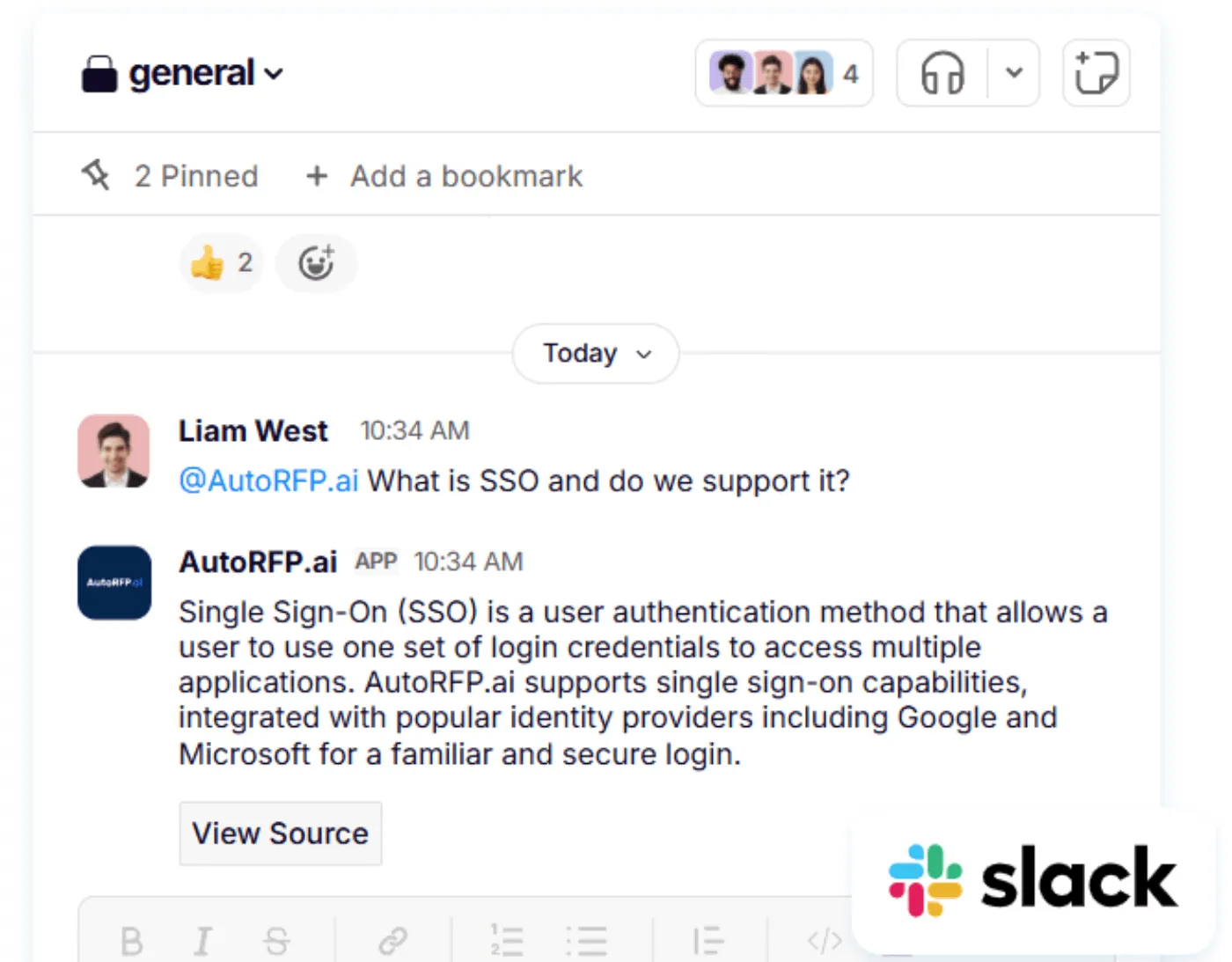
Connect your RFP management system with Slack for notifications, Salesforce for prospect context, and Google Drive for document syncing.
Encourage Cross-Functional Collaboration
Real-time collaboration means multiple people work simultaneously without conflicts. Your pricing analyst updates cost structures while your technical writer polishes the executive summary and your security officer completes compliance questions, all in the same document at the same time.
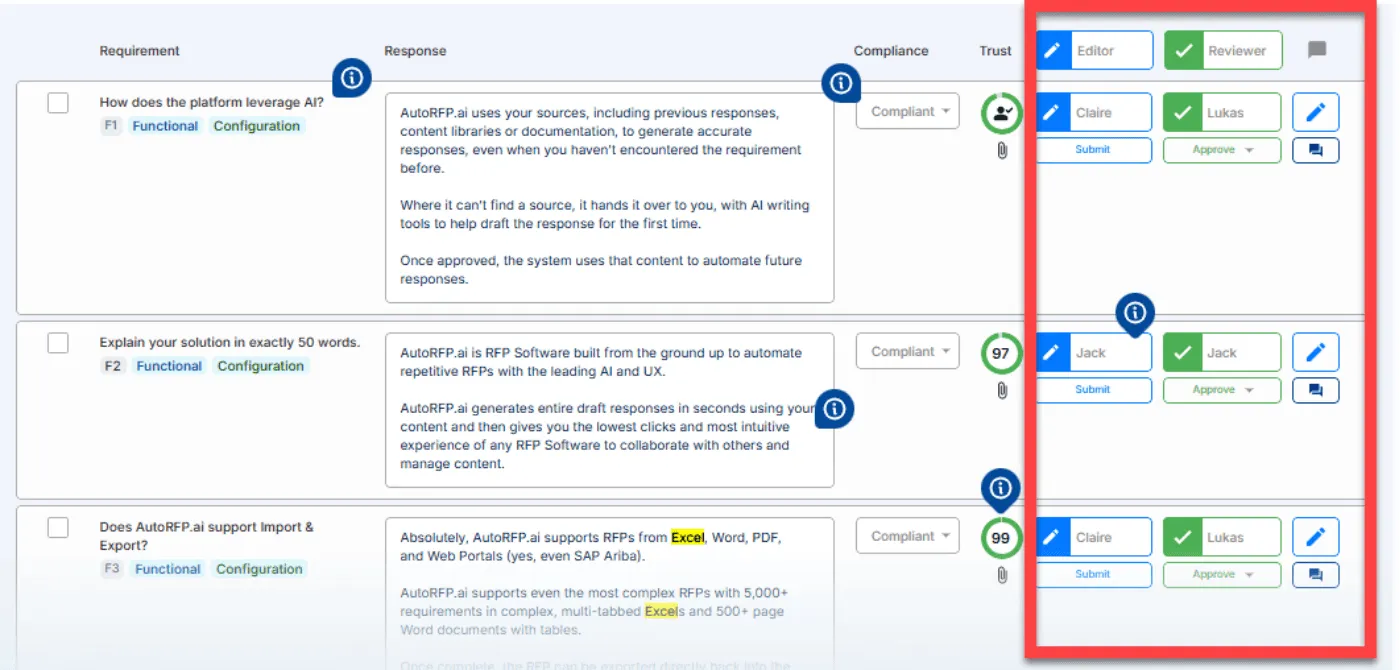
Comments and feedback stay attached to specific sections rather than getting lost in email threads.
Track Performance Metrics Consistently
You can’t improve what you don’t measure. Monitor these key performance indicators to assess your RFP management effectiveness:
Time savings: Reduction in hours spent per RFP response
Response volume: Number of RFP responses submitted
Win rate: Percentage of bids or proposals that result in a contract award
Next stage rate: Percentage of RFPs where the deal progressing to the next stage
Pipeline influenced: The dollar value of sales pipeline influenced by your RFP process
Team collaboration: Number of contributors per response and reduction in bottlenecks
Compliance: Reduction in errors or omissions in submitted responses
Customer satisfaction: Improvement in prospect feedback on RFP response quality
Use this data to identify which sections consistently take longest and where you need better RFP content management to support future responses. Measure win rates and pipeline influenced to demonstrate your RFP process value to your organization.
You can try AutoRFP.ai to help your team cut response time, boost win rates, and keep every proposal on track.
Benefits of Using RFP Management Software
Modern platforms deliver measurable improvements in speed, quality, and success rates while reducing the stress that comes with tight deadlines.
Automated Content Creation and Assembly
Advanced RFP management platforms leverage automation to streamline content creation and assembly:
Template libraries with pre-approved content for common questions
AI-assisted response generation that maintains brand voice and accuracy
Content repositories that make past responses easily searchable and reusable
Dynamic document assembly that pulls from multiple sources
Version control systems that track RFP changes and maintain compliance
These RFP tools dramatically reduce the time required to create high-quality proposals while ensuring consistency across submissions.
Collaborative Workflow Management
Modern platforms transform RFP responses from an individual burden to a coordinated team effort:
Centralized dashboards showing task assignments and deadlines
Real-time collaboration tools allowing multiple contributors to work simultaneously
Automated routing of questions to subject matter experts
Progress tracking and notification systems
Approval workflows with designated reviewers and sign-off processes
This collaborative approach ensures that the right expertise is applied to each section of a proposal while maintaining visibility throughout the process.
Analytics and Performance Insights
Data-driven decision making is a hallmark of modern RFP management:
Win/loss analysis to identify successful response patterns
Content performance metrics showing which responses resonate with evaluators
Team productivity and contribution tracking
Response time analytics and bottleneck identification
Competitive intelligence gathering through bid history
These insights allow organizations to continuously refine their approach based on actual results rather than assumptions.
Import and Export Flexibility
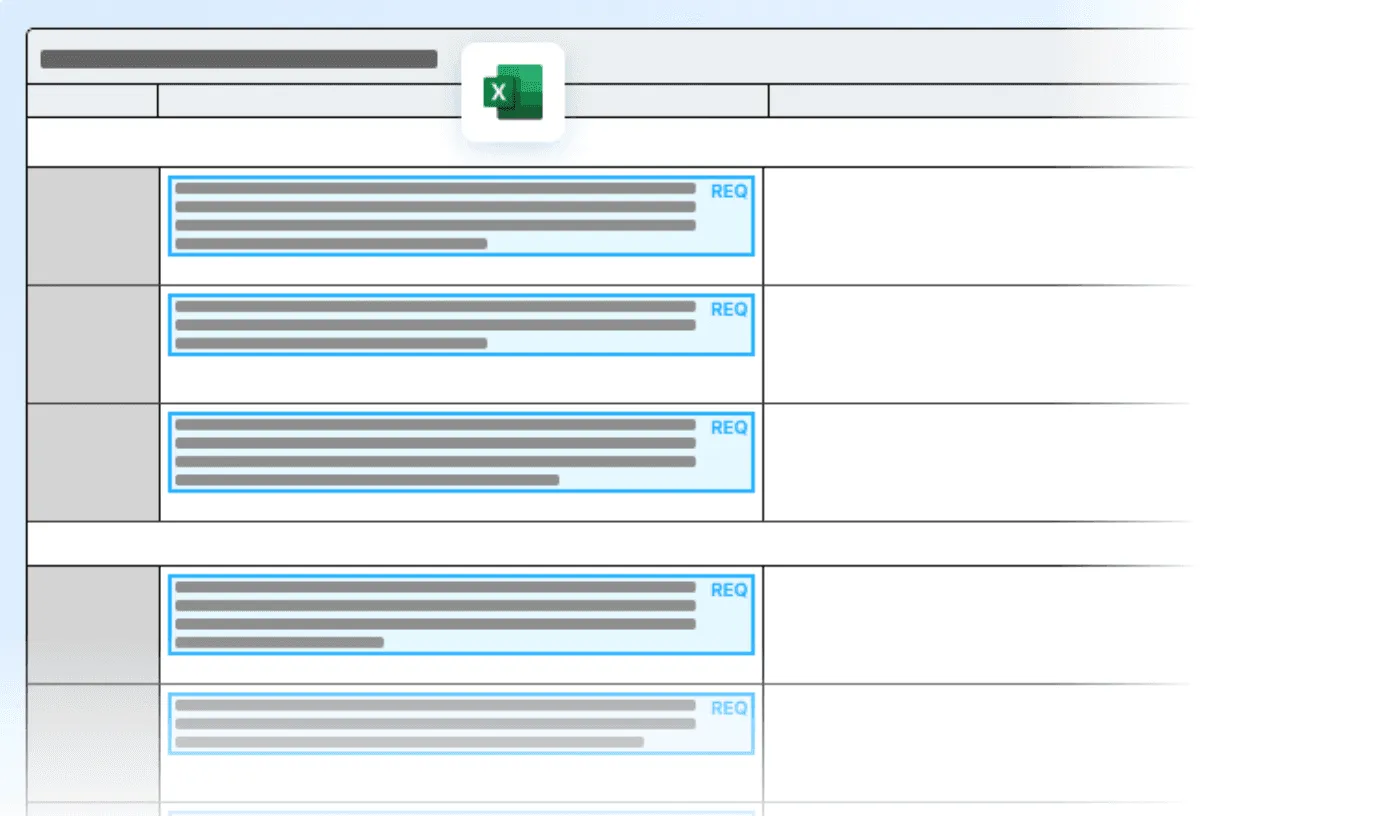
Quality platforms import Excel spreadsheets (even complex multi-tabbed workbooks), Word documents with tables, PDFs, and online portal questionnaires. The system automatically detects structure and maps questions to the right sections.
AutoRFP.ai even offers a browser extension for completing responses directly in online portals like SAP Ariba, so you work wherever the prospect requires without awkward copying between systems.
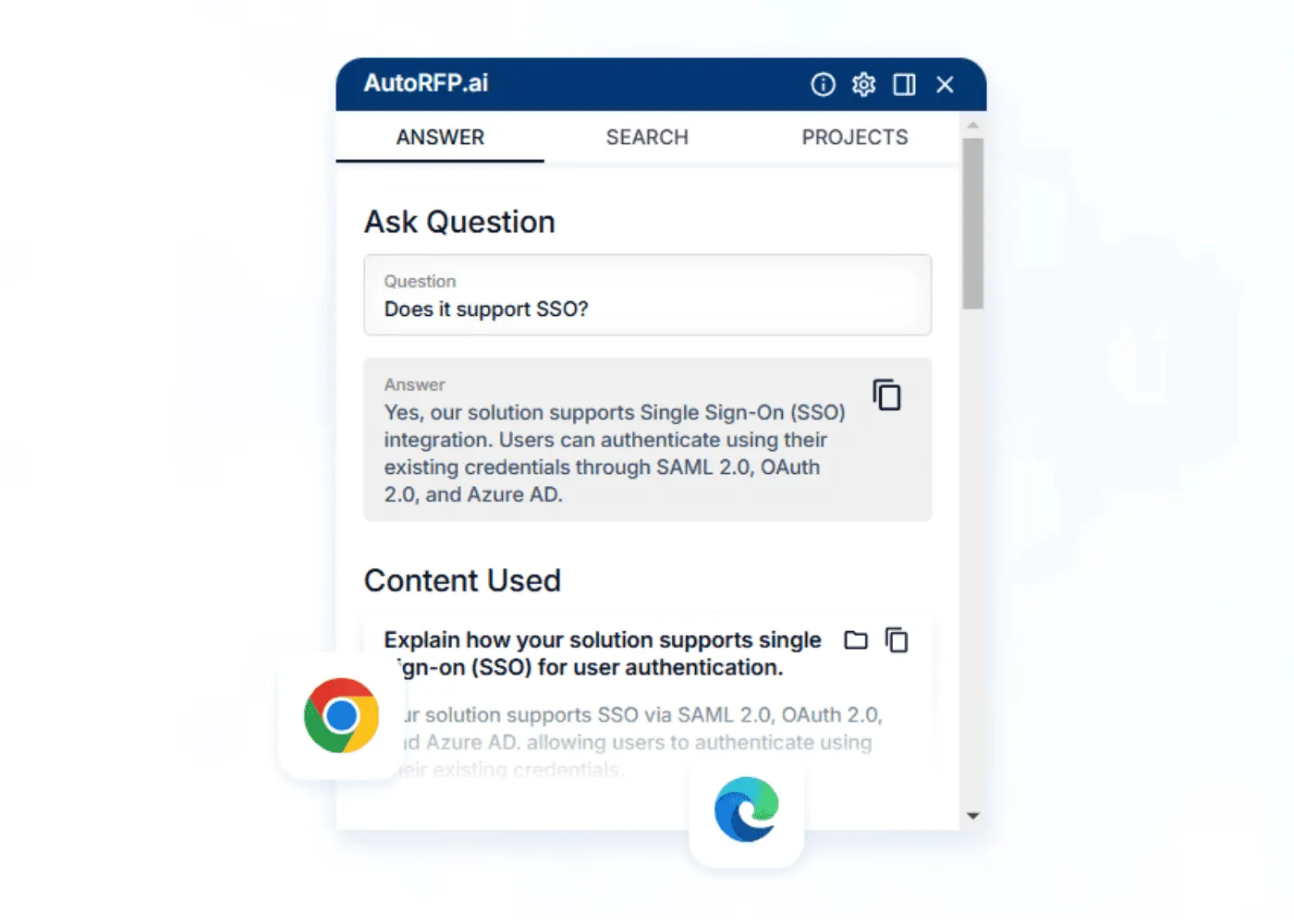
Say your prospect uses a custom procurement portal with 300 questions; the extension lets you access your content library and AI-generated responses right within their interface.
Enhanced Security and Privacy Protections
Your responses contain commercially sensitive information. Enterprise-grade systems provide ISO 27001 and SOC 2 certification, regular penetration testing, and regional data centers for data sovereignty.
Critical consideration: Many providers train their AI models using your customer data. AutoRFP.ai never sends your data to public AI models for training, so your content remains exclusively yours with zero use in model training.
How to Choose an RFP Management System
Selecting the best RFP software determines whether your team actually uses it or abandons it after two months. Evaluate based on capabilities that address your specific pain points.
AI Automation Quality and Trust Scores
How accurately does the AI generate first-draft responses? Some platforms simply retrieve stored answers - AKA glorified search functions. You want systems that actually write tailored responses using multiple sources and adapting to specific requirements.
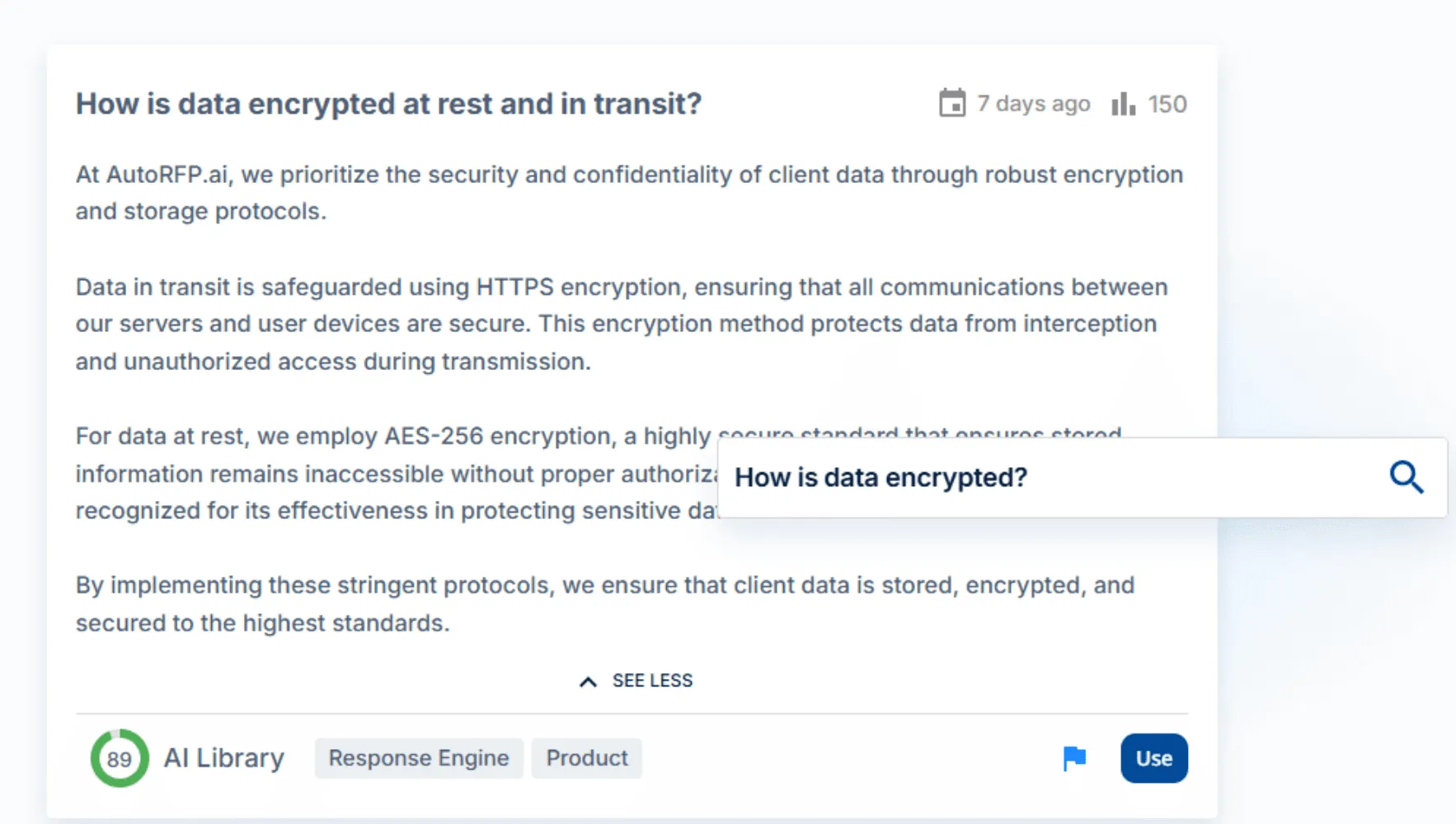
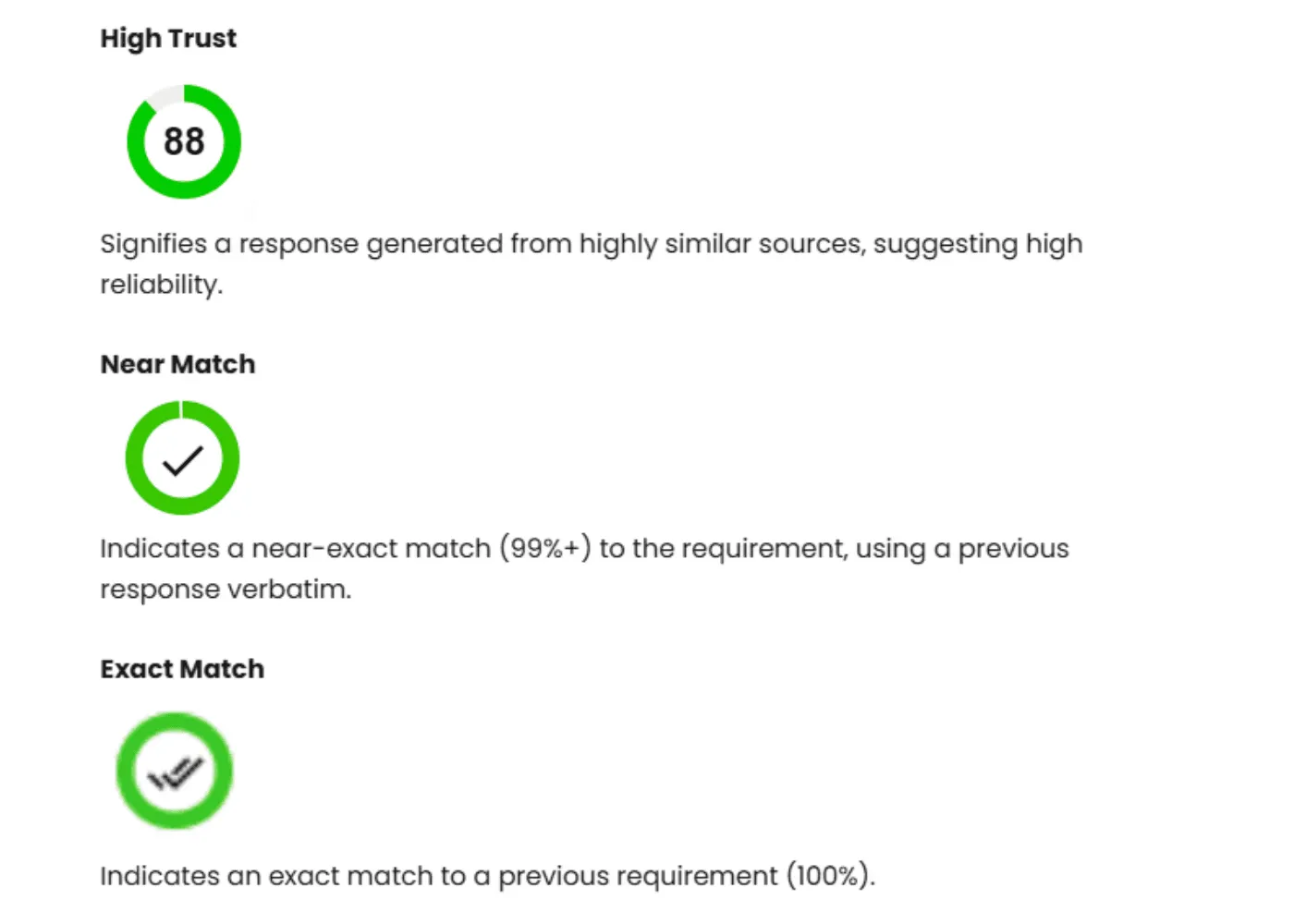
AutoRFP.ai provides transparent trust scores showing exactly where the system found supporting information, so you’re never submitting blind guesses. A trust score of 90 means the AI found strong supporting content in your approved responses, while a score of below 30 flags that the response needs human review and refinement.
You can learn more about building an effective content library to support your automation.
Explore how creating a detailed machine learning RFP can help your team structure smarter, AI-driven proposal strategies from the start.
Integration with Your Existing Tech Stack
Does the platform work with tools you already use? You don’t want another isolated system requiring manual data entry. Look for native integrations with your CRM, communication tools, and document storage that enable automatic project creation and context syncing.
AutoRFP.ai connects with Salesforce so new RFP projects appear automatically when opportunities reach the response stage. It syncs content from Google Drive and SharePoint, ensuring your AI responses always use the latest product documentation.
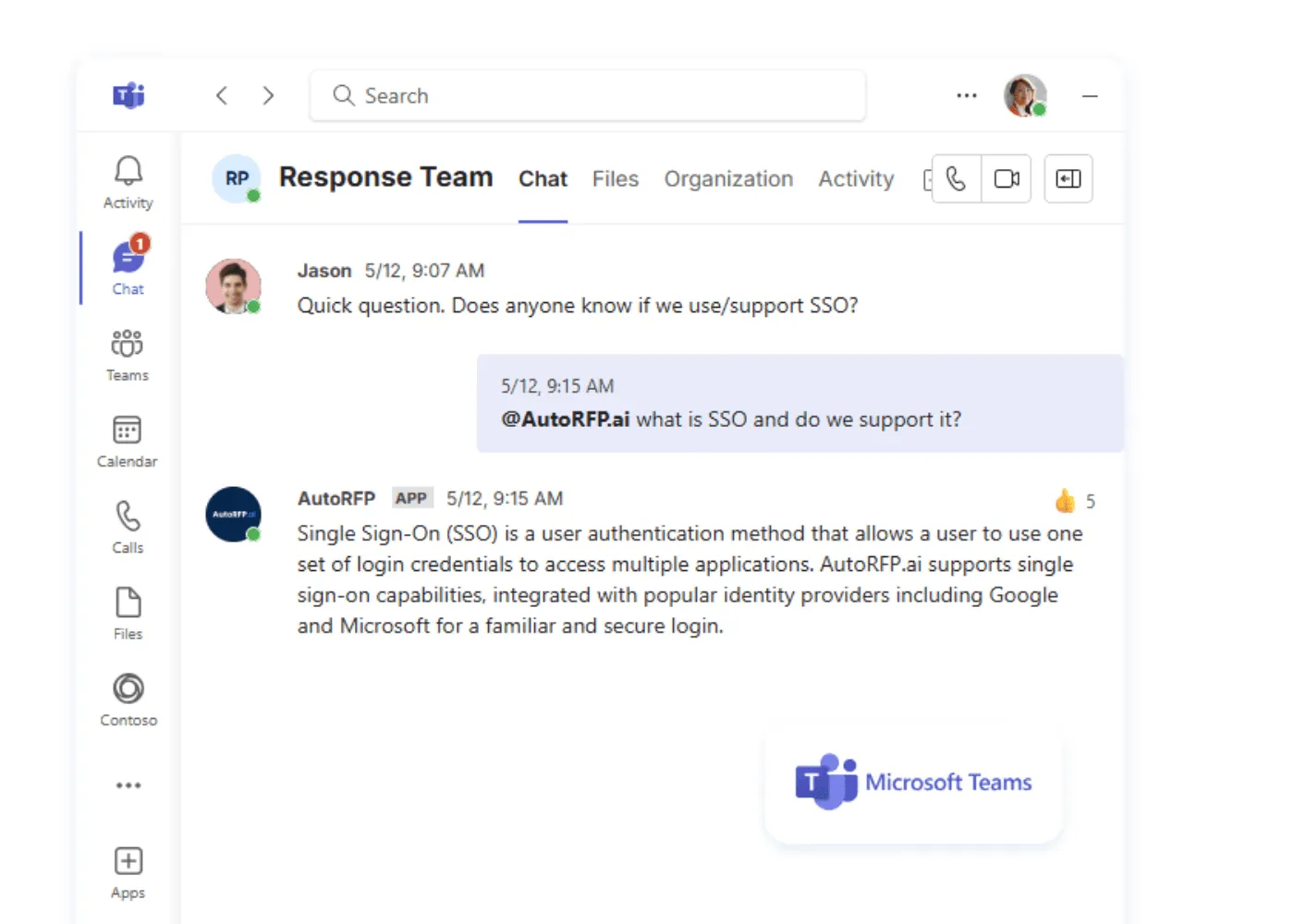
Notifications through Slack and Teams mean subject matter experts answer questions from their preferred tool without logging into another platform.
Support for Multiple Formats and Languages
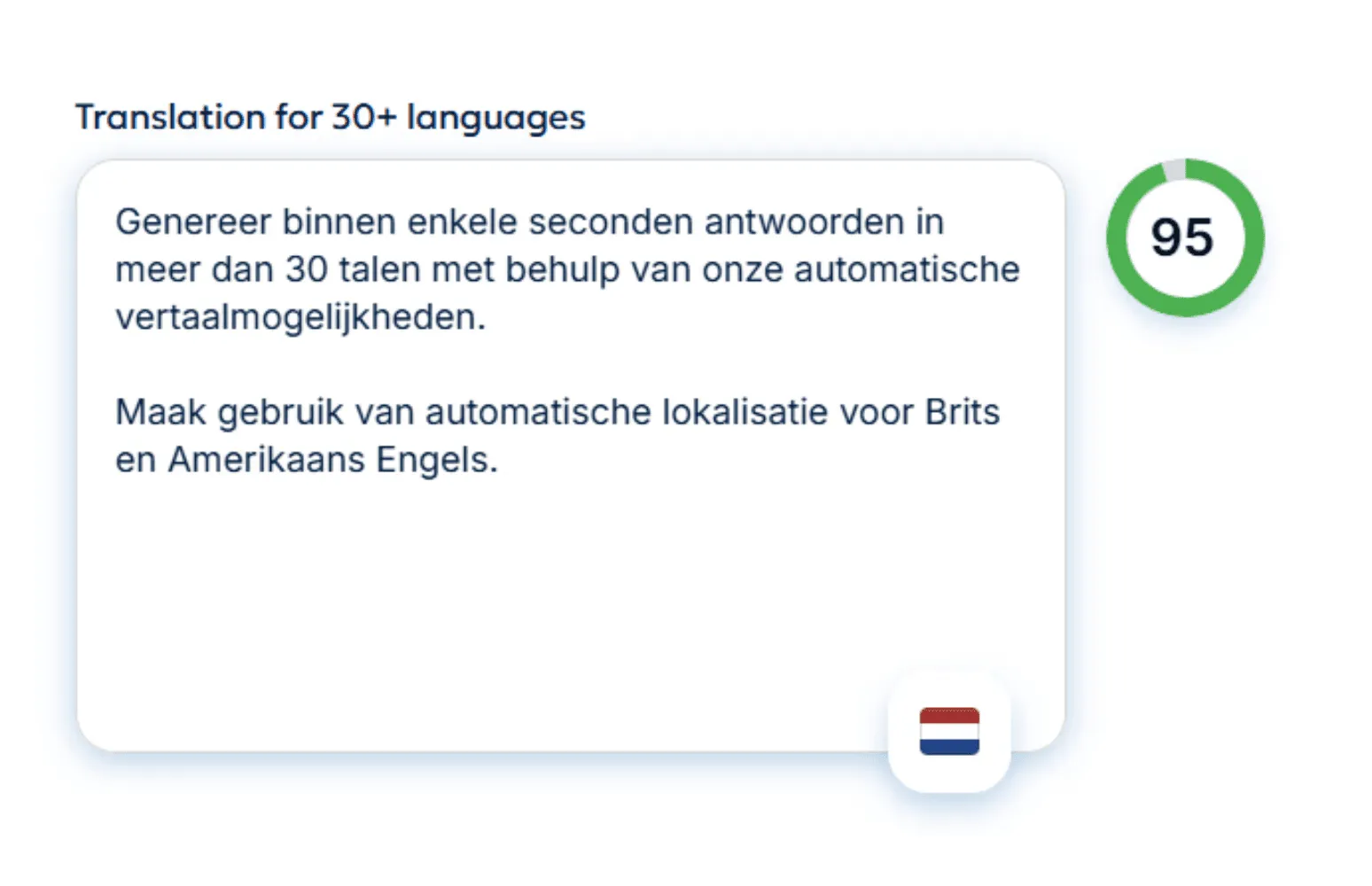
If you operate globally, multilingual capabilities become essential. Can the platform respond in 30+ languages using your content regardless of what language that content is stored in?
AutoRFP.ai handles even the most complex RFPs: 5,000+ requirements in multi-tabbed Excel sheets and 500+ page Word documents.
The automated translation generates responses in over 30 languages and localizations, letting you bid on international opportunities without maintaining separate content libraries for each language.
The Role of AI in Modern RFP Management
Artificial intelligence represents the most significant advancement in RFP project management technology, transforming how organizations approach RFP evaluation, and responses
For teams looking to explore real-world applications, an AI RFP writer offers a closer look at how this technology streamlines proposal creation, enhances accuracy, and improves win rates.
AI-Powered Response Generation
Modern AI capabilities go far beyond simple template filling:
Natural language processing that understands the intent behind questions
Content generation that maintains brand voice and technical accuracy
Automatic tailoring of responses based on the specific requirements and evaluation criteria
Suggestion of relevant case studies, statistics, and differentiators
Quality and compliance checking to ensure responses meet all requirements
These capabilities dramatically reduce the time required to create high-quality proposals while ensuring consistency and compliance.
Intelligent Content Management
AI enhances how organizations manage their knowledge assets
Automatic categorization and tagging of content for improved searchability
Identification of outdated or underperforming content that needs refreshing
Smart recommendations of relevant content based on RFP requirements
Automatic updates to content libraries when new information becomes available
RFP Translation and localization capabilities for global proposal teams
This intelligent approach to content management ensures that bid teams always have access to the most relevant, up-to-date information.
The Future of RFP Management
With around 78% of companies already using AI in at least one business function, the RFP management process is also rapidly shifting toward autonomous, AI-centric workflows.
Expect AI to generate custom graphics, create data visualizations tailored to specific requirements, and produce video responses for RFPs that request multimedia submissions.
Predictive analytics will forecast which opportunities you’re most likely to win before you invest significant time. Systems will analyze your past performance, competitive positioning, and prospect fit to suggest whether pursuing a particular RFP makes strategic sense, essentially supporting a more data-driven approach to your RFP go no go decision process.
The bottom line is the future belongs to organizations that adopt AI-first RFP management systems now. Early adopters build competitive moats through superior knowledge management, faster response times, and higher win rates that compound over time.
Automate Your RFP Responses and Save Hours
Modern RFP management software transforms the process from manual busywork into strategic advantage. Start by evaluating your current process: how many hours does your team spend per proposal? What percentage goes to searching for content versus strategic thinking?
Then explore automation options. See how platforms like AutoRFP.ai generate complete drafts in seconds using your organizational context.
The best way to understand the impact is to book a demo and bring an actual RFP from your pipeline to see how much time you’ll save.
