
2026 RFP Project Management: Optimize & Win More Bids
Manage RFP responses efficiently with structured workflows, clear timelines, and smart tools. Improve coordination, cut delays, and submit strong proposals.

Robert Dickson
RevOps Manager, AutoRFP.ai··12 min read
Most RFP teams don’t lose bids because of bad writing. They lose because their project management process collapsed under pressure.
Treating bids like revenue-critical projects means clear roles, realistic timelines, governed content, and structured reviews. Done right, it makes all the difference between a reactive team pulling all-nighters and a repeatable engine that consistently delivers better proposals in less time.
This guide shows what derails RFP performance at scale, what high-win teams do differently, and how AutoRFP.ai plugs in.
What is RFP Project Management?

Video transcript
Transcript is auto-generated and may contain minor errors.
Hey there. My name is Rob and I'm from auto rfp.ai. We're going to jump into what is an RFP or request for proposal. We're going to be breaking down all the different terminologies around an RFP and the different terms you might come across when selling your software or services and products. We're going to be jumping into a couple of examples that I've built up around what an RFP might look like in an Excel spreadsheet, what it might look like in a Word document. Then I'm going to be covering off all kind of different information in relation to what your RFP response might look like with an executive summary as well as a guide I can share with you on how you can provide a checklist to make sure you're answering an RFP with all the necessary information. So what is an RFP? Well, it's when a buyer, let's use the example
of say a government agency, let's say a local library and a county in the United States, wants to procure some new HR applicant tracking software. Doesn't have to be software though. It could be construction for a new building, archival services, products, and various different things. Request for proposals are used all around the globe for large organizations to procure products and services. In this example, our library is going to approach the market. That's a reverse auction. It's when, let's say in this example, the library is going to come up with all its different requirements, whether they're functional, non-functional, different attributes in relation to the company. As a library in a government, I might have different procurement guidelines I'll have to follow. And effectively, as the buyer of these product or services, in my example, it's a I'm a buyer of HR
tech, I'm going to approach multiple suppliers. So, I'll go out to all the different suppliers, reach out to them, and say, "We've prepared a request for proposal. We'd like you to respond. You have 2 weeks to respond to our RFP, and from there, we over the next 3 months, we're going to be running our full procurement cycle to purchase new applicant tracking software." Before we jump into all of that, let's just quickly cover some of those other topics around terminology for an RFP. So, we've got an RFP, which we've just covered as a request for proposal, where there's different requirements that a buyer goes out to market to have the suppliers answer. We've got a request for information, which is a lot more broad, but usually we don't As a buyer, they wouldn't have fully fledged requirements. It's You're more going out to market saying, "Hey, can you provide information about your solutions? We're not quite sure what
exactly we're looking for." We've got a RFQ, which is more just around request for quote. So, it's really on the pricing side. So, we're saying, "Hey, provide a quote for your solutions to us. These are our requirements and what solution we're looking for, and therefore, you should be able to create a effective quote, provide that to us." And you're still going out to this the buyer is still going out to multiple suppliers in most cases for this. You've got a security questionnaire. Not quite Usually, it's in the procurement cycle, but it's not necessarily to do with an RFP. The IT or security team at this organization has to provide a bunch of questions to any supplier that comes on board for that buyer they have to answer for them to be able to procure their software, services, or the products. DDQ is really different and I've just left it there cuz it's common for managed investment funds and finance and DDQ is a due diligence questionnaire.
It's a bit different to an RFP but we'll cover that in another video. So, we've got an RFP with all our different requirements. It might look like this. They'll have different numbering and IDs for each requirement, different categories, and then provide the requirement if it's an Excel spreadsheet and here's one that I've prepared. It will then provide information as to the vendor, where they can provide a response, and any kind of additional comments or attachments they wish to provide. So, as a buyer, I'm going through and kind of talking to the different stakeholders within the business of what these requirements should be for for us and then I'm providing that to the vendor, the supplier to answer. Here's an example of RFP in a Word document. So, this one will have other different information and here I'm actually playing as a grocery store looking to procure a HR onboarding and digital workforce platform. So, here it's got information regarding our
company, what our challenges are, what our strategic goals are, and then I'll have all the information here usually in a table within the Word document to answer that information. So, here are my requirements. It has to integrate with our background checks and everything else. And you can see that all that information there in that request for proposal. And usually this would be the size of a request for proposal. So, you can see from the size of the document for the buyer, takes a lot of effort to create this and as a seller it takes a lot of effort to answer it. Even though there's a lot of effort on both sides, it matches up and puts in writing what the buyer is looking for and what the seller is selling and so it can generally provide a really good match between those two things. So when you're going to answer your RFP, we actually have a lot of great resources that you'll find in the description below and for instance, here's our RFP executive summary template. This is a really good template
which you can download for free via our website at auto rfp.ai. Here we'll provide an example of how you can write that executive summary because it's important when you're answering an RFP, you might have the completed security questionnaire or word document RFP, but you still want to try to sell. An executive summary is a great way to really succinctly provide competitive differentiation and different information around your your company and your solution as to why they should choose you in relation to the RFP and here we have different templates you can provide as well. When you go to submit your RFP, if you are doing an RFP, here we have our ultimate pre-submission RFP checklist again that you can find at our website at auto rfp.ai and here you can download for free and this is an entire checklist that you can use to really make sure that you're fully having all the information required for an RFP when you go to submit. So make
sure it's been reviewed by the team, what you're looking to what are the requirements and document and finalization, submission readiness, making sure you're submitting it on time not the night before and all the other information you can find here in our pre-submission RFP checklist. So really quickly, that was what an RFP is. It's a request for proposal where a buyer usually a large organization but not always is going out to market with a list of their requirements and then the market, i.e. the sellers, can then answer that RFP, provide it back to the buyer so they can run their procurement process. Thanks. That was Robert from AutoRFP.ai.
RFP project management is the end-to-end process of organizing, coordinating, and executing a response to a Request for Proposal. It treats the bid as a project with defined scope, contributors, dependencies, deadlines, and a quality bar that must be met before submission.
How is this different from simply preparing a response for an RFP? Writing is just one aspect. RFP project management refers to everything that makes that deliverable possible:
Deciding whether to bid in the first place (Go/No-Go qualification)
Assigning sections to the right contributors with hard internal deadlines
Setting project timelines that account for review cycles, not just the submission date
Coordinating SMEs without letting them bottleneck the draft
Managing content sourcing, version control, and compliance checks
Running a structured final review process and approval before the clock runs out
An RFP response is a structured deliverable with real commercial consequences. Treating it like a project, with the discipline that it implies, is what separates teams that consistently win from those that consistently scramble.
Main Challenges of RFP Project Management As Businesses Scale
More products, more prospects, more concurrent bids, more stakeholders: these are all elements that complicate RFP management as organizations grow. Here are the five main challenges that cause coordination and performance to deteriorate.
Challenge #1: No Single Owner, No Accountability
When RFP responses are owned across sales, pre-sales, and marketing with no dedicated proposal manager, accountability dissolves. Sections get missed. Reviews happen late. Submission becomes a patchwork of tones, assumptions, and inaccuracies stitched together under deadline pressure.
The 2026 Proposal Win Rate Report found that 14% of Low Win teams have no dedicated bid role at all. This points to structural failure. Ownership is a pre-condition for winning.
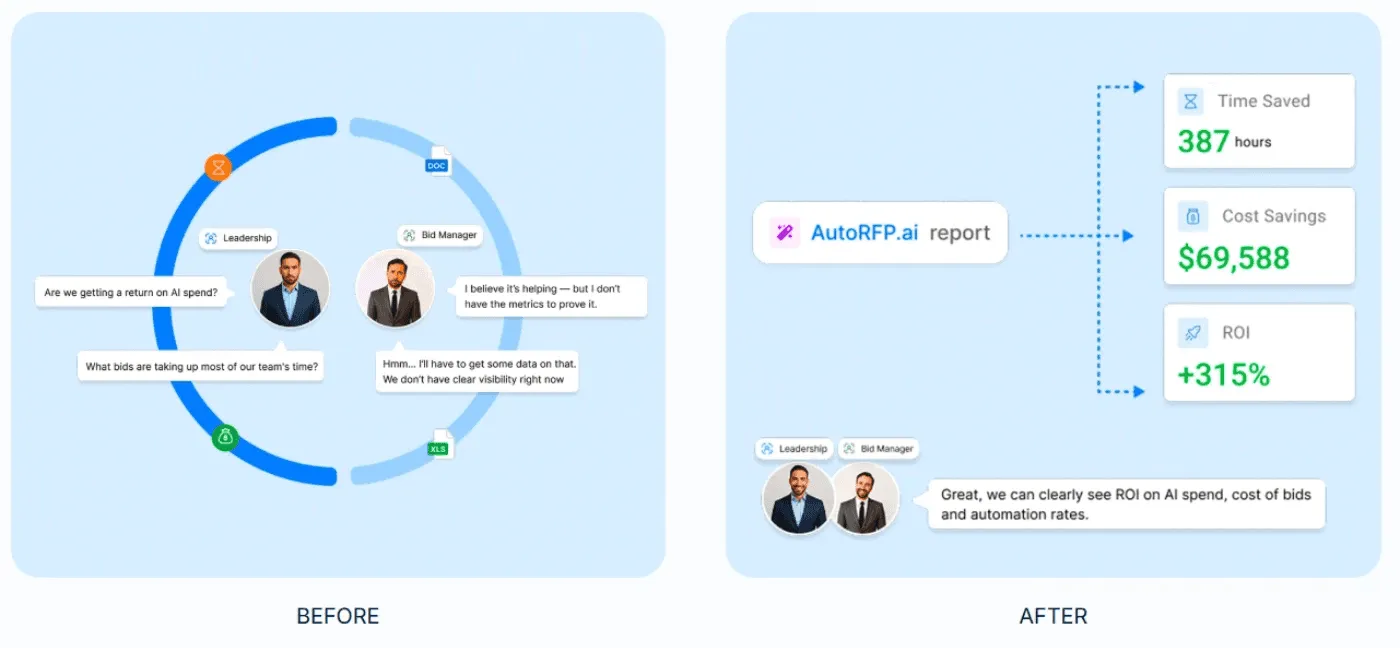
MedeAnalytics described their pre-RFP project managed world as ‘herding cats.’ Without clear ownership, their Sales Operations lead Katie Huff was spending hours chasing contributors across departments, manually tracking progress, and watching deadlines close in with no system keeping anyone accountable.
“AutoRFP.ai has been one of the most life changing tools that I’ve used in my career.” — Katie Huff, Sr. Director, Sales Operations, MedeAnalytics
After deploying AutoRFP.ai, MedeAnalytics eliminated 100% of that administrative overhead.
Challenge #2: SMEs Bottlenecking the Draft
The instinct to put technical SMEs in charge of first-draft writing feels logical. Who better to answer a technical requirement than the product expert? Experience would say otherwise.
SMEs write for precision, not persuasion. They prioritize completeness over competitive differentiation. Proposal teams inherit a patchwork of styles, jargon, and incomplete answers that need full rewrites under deadline.
The risk isn’t just inefficiency. It’s that SME-led drafting fragments the proposal’s strategic voice at exactly the moment it needs to be sharpest. The fix is structural: the proposal team owns the narrative, SMEs validate for technical truth.
SugarCRM hit this wall hard, experiencing unsustainable volumes with each question consuming 20+ minutes of engineering time.
“A lot of the security questionnaires we get can contain 500–2,000 questions. These were sometimes taking several hours to complete. There were always 15–20 questions that required our Subject Matter Experts, using up their valuable time.”— Shana Sweeney, Executive Leader, SugarCRM
AutoRFP.ai helped SugarCRM automate 90% of the initial response work. The result: 15 of their top 25 enterprise customers won through that leaner, faster RFP process through just one team managing their global RFP volume.
Challenge #3: Content That Lives Everywhere and Helps No One
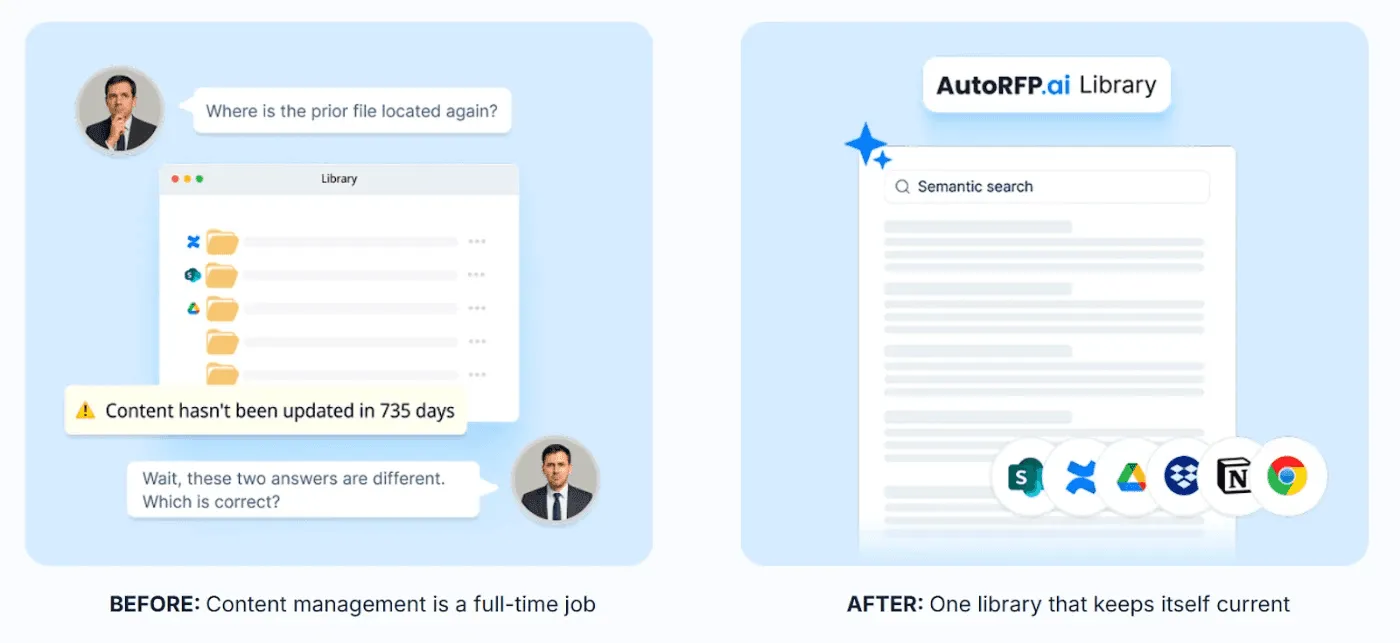
Most mid-market B2B teams respond to RFPs while their best content is scattered across shared drives, email threads, old decks, and someone’s local folder. Every new bid requires a full excavation with no guarantee what surface is current, accurate, or the version that actually won.
Legacy RFP software tried to solve this with content libraries. But the maintenance burden quickly became the new problem.Teams spent more time tagging, organizing, and auditing the library than responding to bids. The tool that was meant to save time created its own overhead.
AutoRFP.ai’s software takes a different approach. There’s no need for teams to maintain a library upfront because it learns from every approved response automatically. Every submission that gets signed off feeds back into the system, improving future AI-generated answers over time.
Workforce.com was caught in exactly this cycle. Managing responses across multiple product suites for a global market had the team locked in repetitive content creation with no scalable path out.
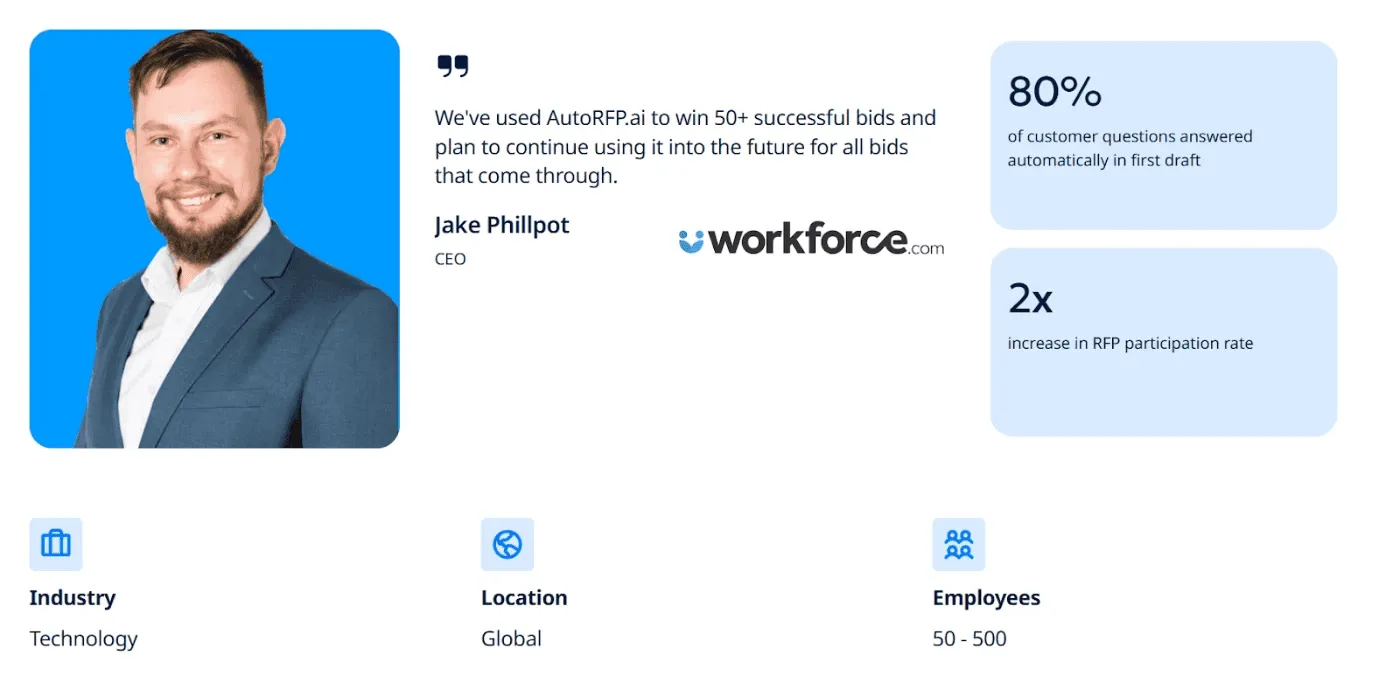
I’m really impressed that when we go and bid with AutoRFP.ai, in most cases 80% of the questions the customers have are answered with the first instance. — Jake Phillpot, CEO, Workforce.com
AutoRFP.ai helped Workforce.com double their RFP participation rate and close 50+ successful bids on the platform without adding headcount or building a content library from scratch.
Challenge #4: Timelines That Ignore the Reality of Coordination
A 10-day RFP window looks workable on day one. By day seven, with three contributors who haven’t submitted their sections, a compliance review still pending, and SMEs unreachable, it becomes a crisis managed in real time.
Most RFP timelines are built backwards from the submission deadline without accounting for the actual coordination load: review cycles, SME availability windows, the legal teams’ sign-off, and the inevitable scope clarifications that arrive mid-process.
Effective bid management means building timelines forwards from the moment the RFP lands with realistic buffers and hard internal deadlines set 48 to 72 hours before external submission.
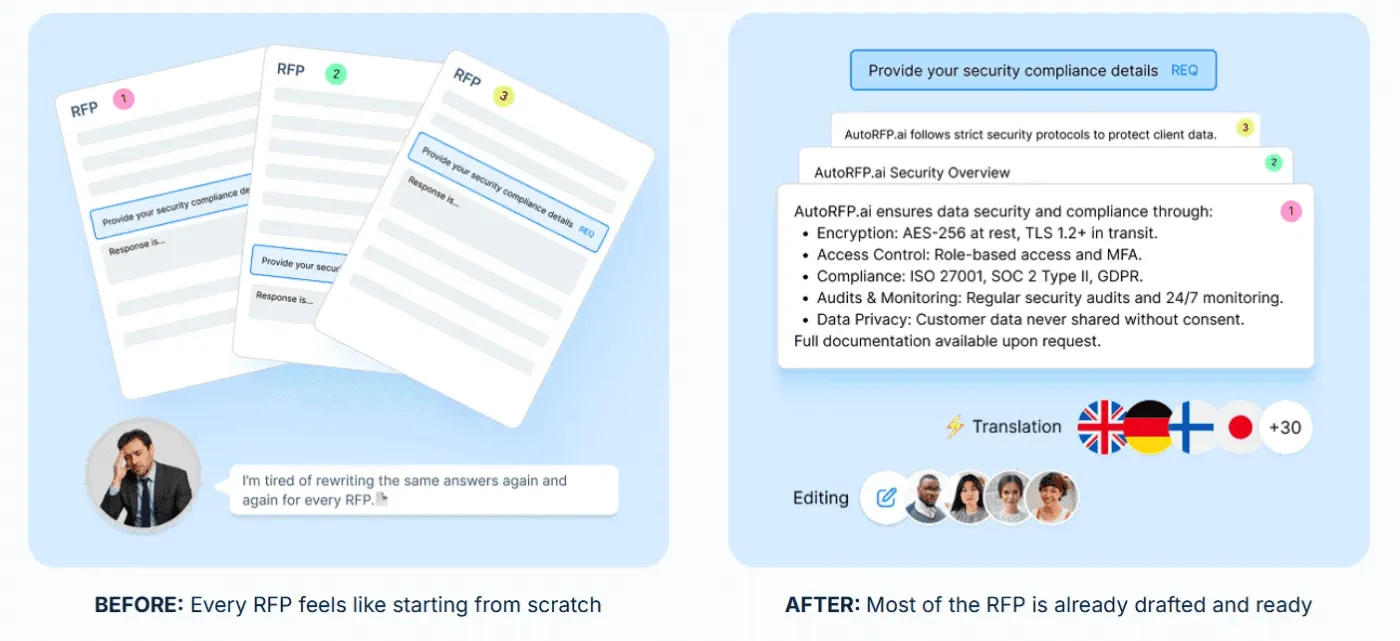
Fiddler AI’s breaking point came when their COO spent far too much time on a single government RFP.
“The COO was working on an RFP for a government contract, and he spent the entire weekend, about eight hours, answering this one RFP. We knew this wasn’t scalable as we continued to grow.” — Amanda Bell, Senior Manager of Revenue Operations, Fiddler AI
After implementing AutoRFP.ai, that same class of security questionnaire dropped from 30 collective hours to 3 to 4. That’s an 87% time reduction.
Challenge #5: Volume Outpacing Capacity
This is the silent performance killer. As RFP volume grows, teams absorb the load through sheer effort spent on longer hours, faster turnarounds, and fewer quality checks. Win rates don’t collapse immediately, so the problem stays invisible until it’s critical.
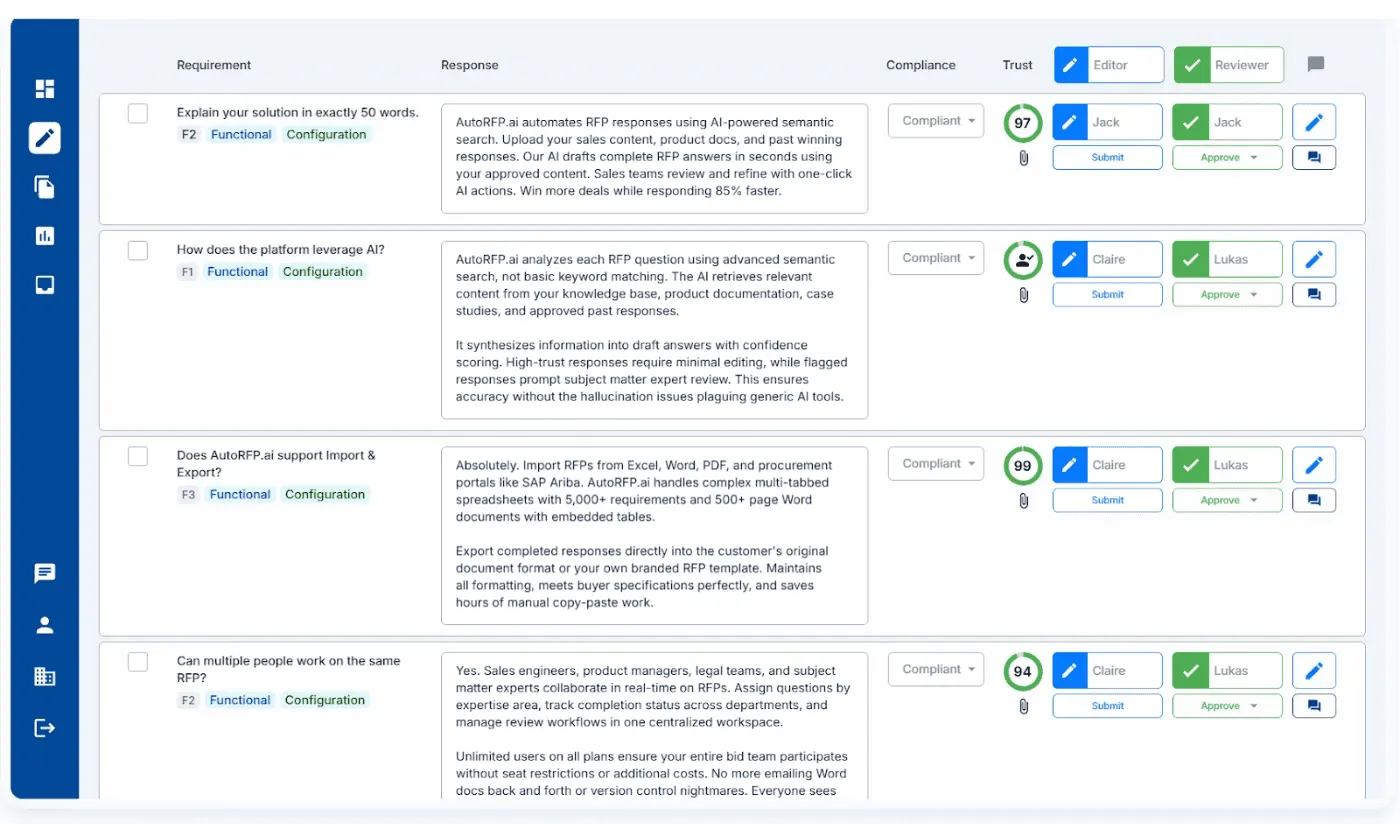
A 2026 study shows that this is unambiguous:
“Performance collapses when volume per FTE rises beyond sustainable thresholds. Teams managing high bid loads without proportional capacity demonstrate the weakest win rates in the dataset regardless of maturity, experience, or how good their writers are.”
Overload degrades the quality of responses in exactly the areas that matter most: customer insight, win theme development, tailored narrative. The bid goes out. But it has no edge.
Benefits of a Well Optimized RFP Project Management Process

Video transcript
So you've just received an RFP. Maybe it's the first time you're doing it. Potentially you're an experienced bid manager, and you wanna understand what is the RFP management process, like process, challenges, and how do you win these highly competitive and challenging bids? In this video I'm gonna show you through the exact RFP management process, challenges, share with you some data in relation to winning bid teams and how they win these complex bids that can really elevate your business. Let's jump into it So why does RFP management matter? An RFP or request for proposal is when a large organization, let's say an enterprise with 10,000 staff, or federal government body wants to procure products or services. Where RFP management matters is we surveyed with between AutoRFP.ai and Stargazy over ninety-seven bid professionals in our twenty
twenty-six proposal win rate report. You can find the link below if you wanna have a look yourself of the proposal win rate report. In this report, we found that fifty-one percent of teams without content automation sit in the low win cohort. So in our RFP management video today, we're gonna go into content automation. We're gonna talk about how ninety-four percent of high win teams use joint collaboration with their subject matter experts, not having the subject matter expert drafting. And where this all matters is the median shortlist rate. So the rate of which your RFP makes it to the next stage and isn't disqualified is sixty-three percent for high win teams versus thirty-eight percent for low win teams. So the teams that have very strong RFP management processes and structure, not only are they winning more, but they're making it through the RFP process to the next step almost double or triple the rate of other teams with content automation, joint collaboration with SMEs, and a lot of other things.
So let's jump into it. But before that, I wanted to leave you with this quote: " Most teams lose RFPs because their system is perfectly designed to produce the results they currently achieve." That was in the Proposal Win Rate report from Christina, the founder of the Stargazy community, a bid manager community, and that really stuck with me, is that if you have a poor system for your RFP management and response, you are setting yourself up to fail, which is why RFP management and systems and processes matter a lot more than heroic efforts one-off bid that you spent, hours and hours fine-tuning. But actual process and repeatable ways to win will get you and your business more revenue than just the one-off effort of trying to win a random bid. And finally, sixty-five percent of the bid teams that win the most
use AI proposal tech, which is what Audirfp.ai is and where I'm from. So what is RFP management? RFP management is how you organize everything that happens between receiving an RFP and submitting your response. Think about it could be everything from when you first discover an RFP on a public tender notice board. Let's say it was for a public tender notice board. Receiving an RFP and submitting your response. It involves people, content, and process. So what is the RFP management process? It starts off with a kickoff meeting. When you see it or you receive that private or public RFP, think about who needs to be involved. Get executive stakeholders on board quickly, especially if it's a very highly competitive and commercial bid. What is the response strategy? How are we going to make our response best fit for the evaluation criteria to win the RFP? Draft and assign. Who is doing what section?
How are we going to complete those sections? And overall, what does a great first draft look like? That is where AI can help the most. Review and submit. Who gets final say on the pricing and commercial? Who gets final say on legal? Who gets final say privacy, security, and compliance measures? Make sure that's clear from the start, and be ready when you have your first draft and everything is ready to be reviewed, that it can be submit cleanly to the right people at the right time. Audit and analyze. Something we don't do often enough in bid management is think about how could we do better with this bid? What feedback can we do, and how can we improve for next time? Which leads into that next one, continuous improvement, and that is the difference between a one-off effort and a systematic approach to RFP management and bid response that will get you to win bid after bid versus just that random one bid that you were lucky to get. An effective kickoff meeting does not just rehash to everyone
exactly what the RFP is saying. It is about establishing clear deadlines, where we talked about who is going to submit each answer each section, who's gonna draft each section, who's going to review each section. That's where you wanna have all those people there to establish clear deadlines for each of those contributors. Then you should already have somewhat of an understanding here, but this is where you can kinda lean on the people in this meeting to develop win themes. A win theme is what is your clear competitive advantage or way that you are going to structure your response with persuasive writing, with clear customer stories, that will get you the win in this RFP. For instance it could be an enterprise that cares a lot about security and privacy, and it could be based in the EU, is looking for a vendor who meets certain requirements. And you could be the only vendor, and you may know that you're the only vendor who meets the high-level requirements in relation to security and privacy, and you believe that's a competitive advantage for your company and for this bid.
Overall make sure that you plan all your supporting documents, so everything that the final submission should include. And you can use like an RFP checklist. We've got a pre-submission checklist in the links below. But you can use a pre-submission checklist to make sure, again, all of that is taken care of when you go to submit. And then assign a single project owner who drives accountability. This would often be a bid manager or at least, or a project manager, someone who is keeping an eye on all the deadlines. Clarification questions is an often overlooked part of the RFP process that can really help you understand that buyer and should be used every time. What you don't wanna be doing is submitting a question for the sake of submitting a question. Don't ask something that is very clear in the RFP. That could reflect negatively. But do think of some useful questions, that you can submit back to the buyer that will, help understand their current solution better and what they're currently doing. Map requirements to identify capabilities.
You could look at, for instance, there could be Moscow ratings, there could be mandatory nice to have, must-have, and so on. But each of those requirements you can compare to, evaluation criteria, and you can look at where do you stack up. But every single one of those requirements, where do you stack up just at a first glance? Even better is that step is in your AI go, no go or your go, no-go process before you even start to bid on, start contributing resources. You've already seen if you're actually a good fit for this bid before jumping headfirst. Build a response plan with section owners, deadlines, and review cycles. We discussed that just before. And decide your competitive angle before writing a single word Now, drafting response and assigning owners.
So this is where we actually start to write. So each of the reviewers and writers they begin to work. Use real-time collaboration so multiple people can work simultaneously. You never wanna have a bid that only one person can access at a time. That's not very conducive to strong teamwork. Pull from your your content library for common questions instead of writing from scratch. So at the start of the video, I mentioned how a strong content library often underpins a winning bid team, and here is the time that you can use that. So if you have pre-filled answers or approved answers in regulatory environments that you can pull from readily to answer common requirements, then this is where you use that. Make sure, though, you're not just mindlessly copy and pasting. Make sure that where appropriate, you're weaving in that win theme throughout the RFP and bid response. AI tools, and this is where a company like and product like ours, AutoRFP.ai, really shines, is generating that first draft.
AutoRFP will demonstrate a first draft in a matter of seconds from a blank RFP document and it'll leverage your content library for that, really speeding up the RFP response time, increasing participation rate, and giving you more time to write even stronger and better responses. So it goes into kind of like an AI feedback loop to continuously improve your responses. That can be one part tooling, and tooling can be one part of your RFP management process and response process that can really underpin a winning strategy. Some larger bids and structured processing involve a different colored reviews, where it goes through multiple and sequential reviews of different sections for relevant people. One trap around reviewing is making sure that the value of the bid and that win theme isn't lost through people's opinion. If you have ten different people review a section, you're gonna have ten lots
of different feedback and potentially some of them are contradictory or some of them are the same. But you wanna make sure that, of course, you're applying feedback if they're experts in that space. But you as the editor or project owner of that section should ensure that the win theme and what makes that a winning bid isn't lost. That's the review trap And finally, just before you go to that final review, run your pre-submission checklist, spelling, grammar, compliance, consistency and so on. And again, in the description below, we've got our pre-submission checklist that you can download for free, and that can be part of your winning process. Finally, we've now submitted that RFP. So some kinda top-level metrics that you should track is your stages the bid goes through. How many do you not bid for because it wasn't a good fit? That's a good thing to measure. Make sure there's endless opportunities, but you wanna bid what actually makes sense. The ones that you bid for, what were the outcomes of those b-
The ones that you bid for, what are the outcomes for those bids? Was it won? Was it lost? Did you withdraw? Did you stop the bid because of resourcing issues and never submitted it? Next level, once you have that data in terms of the status of your bids , is what were the size of the bids and what was the cost of the bid? That's a really tricky thing to measure. There's some great resources out there around cost of bid, but effectively you wanna make sure that these bids are profitable. So if there's a ten percent chance on a ten million dollar bid, but it costs two hundred grand to bid, that's a really tough one to make. And then also make sure that, you wanna make sure, in a good system or a good AI RFP software like AutoRFP or other software out there in the RFP software market, should automatically be using your responses that you're working on and add them into your library and intelligently store that and categorize that content so it can be used for next time. That's where it's really important to consistently write better and
better, and your content library kind of builds over time, and your systems are set up to produce better results as your company gets, makes bid management and RFP response and the management, RFP management process a competitive advantage of the company And finally, continuous improvement. So it's really not out there to ask for feedback, whether that's a private enterprise bid or if it's government bid. Often this may even be posted publicly. But you wanna make sure you get feedback on the bid, and not just on the bids that you win, but the bids that you lose are sometimes more important. You may unearth that you shouldn't have bid on that in the first place, that it wasn't a good fit from the start. You may realize a flaw in your RFP management process and where something needs to be sharpened up for next time. And continuous improvement in your RFP management process implementing that will just kinda make it better and better every time, and that's what really helps companies go from winning the occasional RFP worth a million dollars
to consistently winning million-dollar RFPs and substantially growing the business's footprint in the enterprise so what are some of the common RFP management challenges? Outdated systems and bottlenecks. Thinking about that process is where is the most amount of friction? That could be following up people to review. So you're always having to message them and be like, "Hey, can you review a section? This was due yesterday." It could be that your content lives in ten different systems. You can never find the right answer. It could be technical docs. It could be SharePoint. It could be Google Drive or whatever. And then and then content library paralysis. So if forty percent of saved references may reference outdated information, no one has the full data to update them. Now, here's some best practices to help you win RFPs consistently and land those million-dollar contracts. Automate the repetitive work. AI has come so far and can help out in particular places of the RFP management process.
Whether it be automating the repetitive work of a first draft and finding the relevant information out of your content library, AI is incredibly strong in that. AutoRFP.ai customers consistently get eighty percent plus AI first draft rate off their existing content, and you wanna make sure that standardized templates. Centralize everything, so it's easy to find the right and source the right information. Cross-functional collaboration, multiple people can edit at once. Reviewers it's easy for someone to review. It's an easy-to-use system. You don't want some clunky software that they have to log in, and an SME can never use it, and therefore, they hate having to help you on an RFP. And track performance metrics automatically. Every time you are moving through your CRM or your relevant software, these opportunities that the bid software is also updating, or at least your bid process data is there. Automating routing questions to the right SMEs, so you don't have to think about who should this go to. Real-time progress tracking so nothing falls through the cracks, and automatic importing of different documents to get a really high level of AI first
draft, and trust scores telling you which answers need human review. So the AI is doing a lot of heavy lifting. That's kinda what AI RFP management looks like is the AI is taking care of that manual work, and the human is coming in to ensure that the win themes are strong, that the pricing is competitive, and that evaluation criteria are met, and they're going to win that bid. All right. What I wanted to leave you with today was a live demo of just the project management capabilities with an AutoRFP.ai and how that can help your RFP management process. So looking in here, we have an RFP project. You can see here that already forty-five of my responses have been submitted and reviewed, nine have been, nine have been submitted but not reviewed, and there's still fourteen left drafted. So I can quickly click into my Drafted, see what ones are left left need to be edited, and then I can look after those as needed. So I can click into my fourteen draft and see, okay, we're still waiting for someone here to to submit those, and I can go in, submit, and make changes. So it's a very easy kinda multiplayer capability, seeing where everything's at.
Can go to my Project Overview and see that the project is due in five days. This is everyone who worked on that project, when it's due. My first draft was highly AI automated, ninety-seven point one percent draft. And overall we have sixty-two percent exceed compliance, thirty-five percent fully compliant, and I can quickly see what response is partially compliant and understand why that's partially compliant and kinda review that. By just having one look and a couple of clicks, I can see, against the evaluation criteria, what responses need to be improved or where we're potentially weak on this competitive bid before having to really do a lot of work. I can see project attachments and everything else going into this bid. And so that's what a project overview dashboard for a competitive bid looks like. If you wanted to have a look at AutoRFP and give it a try, you can go to our website autorfp.ai. Here, you can have a look and learn more about our product and everything else that kind of goes into it and what kind of automation rates our customers are achieving with autorfp.ai. And you can also book a demo to spend time with our team, and in this demo, they'll
provide a really guided walkthrough of the platform, help understand your business, and see really if it's a good fit or not. Thanks. I'm Rob from autorfp.ai. Hopefully, that was helpful in relation to your RFP management process. See ya.
Getting RFP management right isn’t about administrative tidiness. It’s a direct performance lever with measurable commercial impact.
Impact #1: Faster Response Cycles Without Sacrificing Quality
Structured project management compresses timelines by eliminating wasted hours in:
Hunting for content
Chasing contributors
Rewriting SME drafts
Running emergency last-minute reviews
When roles are clear, content is accessible, and timelines have real buffers, teams move faster by removing this friction.
AutoRFP.ai accelerates this further by automating the first-draft stage entirely. When an RFP lands, the AI immediately generates draft responses pulled from existing content and prior approved submissions. Your team gets a working document to refine, not a blank page to fill.
| 2xRFP participation rate — Workforce.com | **87%**time reduction per questionnaire — Fiddler AI | **90%**initial response work automated — SugarCRM |
|---|
Impact #2: Higher Quality Submissions That Actually Win
Capacity saved on drafting is capacity redirected to strategy.
When bid managers aren’t writing from scratch or hunting for old answers, they focus on the elements that actually move evaluator scores such as:
Win themes that speak directly to the prospect’s priorities
Differentiated narratives
Responses that demonstrate genuine customer insight
Teams combining content automation with systematic insight routines are 3x less likely to sit in the bottom tier of win-rate performance. That’s the compound effect of automation software plus insight plus content reuse. By understanding the core principles of how to win a bid, teams can redirect the time saved by automation into high-impact strategy and differentiation.
Impact #3: A Scalable Process That Gets Better Every Time You Use It
A well-structured RFP project management process compounds over time in these ways:
Repeatable workflows mean every bid runs faster than the last
Approved responses feed back into your content system
Lessons from wins and losses sharpen future Go/No-Go decisions
The infrastructure improves with every cycle
This structural advantage is what separates high-volume winning teams from teams stuck in permanent reactive mode.
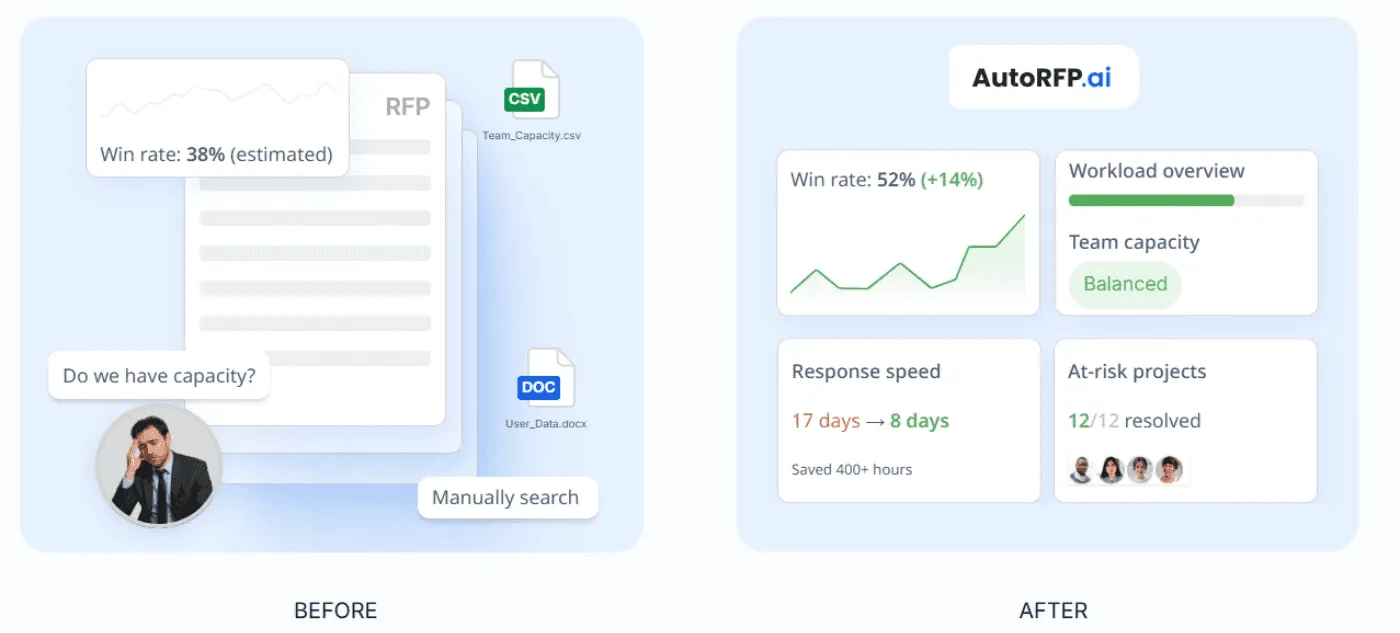
As AutoRFP.ai CEO Jasper Cooper puts it, “The real advantage isn’t simply automating content. It’s what teams do with the time they get back. The winners use it to invest in their processes and provide more insightful responses.”
RFP Project Management Optimization Strategies (By Experts)
Here are the best practices that consistently show up in high-win teams, backed by the data and validated by practitioners in the field.
Strategy #1: Run a Disciplined Go/No-Go Before Every Bid

Video transcript
Transcript is auto-generated and may contain minor errors.
starting topic today, all about go, no go. So, yeah, we're both really keen to jump into it and as we go, if you're not aware, we're So, Jasper and I from AutoRFP.ai, as the name would suggest, we're an AI RFP software. I know we've got quite a lot of customers on the call today. We've also got some non-customers. Yeah, as it says on the housekeeping slide there, our goal today is really you walk away with something actionable. Yes, we'll be showing some AutoRFP near the end, but Jasper's going to dive really deep into a lot around calculating your Pwin, cost of an RFP, to incorporate that into your go, no go. Uh and then I'll be covering off quite a lot in regards to Claude and everything else, but I'll get to that in a sec. So, everything that we put in today, so whether it's like URLs, prompts that we're sharing, that will also be included in the email as well, as well as the recording. So, if you need to duck off early, no problem. Please do. We've all got work and so, you'll get an email probably like a couple of hours after the webinar today with the recording and all the materials.
Any questions, please do put through the chat Q&A. I'll try to figure out to hopefully get the chat working. I'd love to chat to everyone as we go, but of course, feel free to throw it in the Q&A and I'll get to touch on those as we go or we'll have a dedicated space at the end to to go through the Q&A as well. Awesome. Today's agenda. I'll be going a little bit in regards to definitions and learning starting from the basics of go, no go or bid, no bid or all the different names it may go under. Jasper's going to go into, like I mentioned, really talking about calculating the cost of an RFP and taking that into account with regards to your go, no go. Really solid stuff there. Have an example framework which will he'll share and everything else. I'll be using some AI tools, so Gemini and Claude. So, effectively how you can use AI for go, no go without AutoRFP. Or if you do use AutoRFP and you want to go that little bit further as well, although there's obviously a lot you can do with our platform. You know how to use those as well. So then Jasper will be covering
auto RFP, how to use project analyzer feature and go no go there. We've made some recent changes, that's really cool. And then at the end we'll have that Q&A as well for everything that we may not get to as we go through. Awesome. All righty. Hey, so one of the cool things that we did recently was the proposal win rate report. We did that with the Stargazy community which is an online bid community run by Chris Carter who I think might be on the call today. Um, if you're bid management, I recommend joining. It's a cool it's a good community. Lots of really helpful stuff there. Jasper and I are both active as well. But what we did together with the Stargazy community is we surveyed over a hundred proposal managers, bid writers, RFP teams and crunched the numbers about some of the things that winning bid teams or bid teams in general do. And of course some of the questions were about go no go. What we found interesting is 71% of all teams have a go no go qualification.
They're actually between the a high win team, so a team that won more than 50% of their bids, and team that won less than like 10% of their bids, both had go no gos. So there's actually no difference in who you did no go. A lot of it came down to review and governance and automation. So 65% of high win teams have a formal review and governance with regards to their process including go no go. So what we're going to go show today is yes, it's kind of like different tiers to go no go that you can incorporate in your workflows in relation to your complexity of bids, uh the cost of bids and everything else as well. Probably no surprise to everyone is something else the data showed was that teams with a high bid workload win less. So there's actually this great graph within the report and of course I'll share the report as soon as I get the chat working. but you'll get an email afterwards as well with it. But effectively, so less FTE to bid ratio, winning less. And then, high win teams yeah, consistently at higher automation,
systematic customer insight, and a strong governance and go no go with that as well. So, we're going to be covering one part of that. But, I'll throw it to Jasper to cover the next kind of portion. >> Cool. So, I guess yeah, an interesting thing is like AI was built for go no go. Someone say even more than RFP response, like AI has this ability to summarize at extremely high performance levels across insane amounts of documents. Probably as everyone knows, right? But, I think AI allows you to finally say no to more because of a few things, right? So, not only can it do that analysis, but it can do it so quickly that when someone runs to you with a bid and goes, "No, this is due in a week." You don't have to start going, "Oh, we need to do the go no go process first, and that takes 2 days, and we need to go through all 247 pages." You can actually run one in minutes and find red flags immediately, so you don't even need to have the conversation in the first place. So, that's a pretty big game changer, just reducing it from 2 days to have an initial result in a few minutes. Really sad one, but we've found it to be true
is that the results come from a third party. God forbid the bid manager knows what the win rate might be, or that this is a serious red flag we've seen a hundred times. But, just the fact that it's generated by AI has this third party, "It's not me, it's the AI." effect and halo around it, which makes it easier for some people that want to say yes and donate their nights and weekends. It makes it easier for you to say no. And then, the experience of having better than human performance as well, right? So, it can find needles in haystacks and do rationalization and do things that only SMEs could pick out really if they were doing the go no go. From really niche security or environmental governance requirements that you might not fully understand on first glance, it's able to pull those things out immediately without having your SMEs go through every single bid that you look at, and it's able to pull that red flag up for you. So, it finally lets you say no, and then that's of course good. To make it clear for everyone, no is a very good thing. It saves organizations tens, hundreds,
millions of dollars in costs. It protects your team's morale and culture as well. It's There's nothing worse than having a low win rate and going back to back on lost bids and oh, sorry, and hey, can we jump on a call to debrief? No one wants that. You just want to be winning back to back. That this process helps shield your team from that morale that can cause a negative spiral. And then of course, the time that you're investing in those opportunities that you should have said no to, that actually degrades your ability to win the ones that you said go to. So, yeah. Highlight for anyone that's not currently having this process to definitely invest in it. But, I wanted to jump into go no go from the CFO seats. So, a lot of the time we just think about it as a softer framework where hey, let's fill out this form, let's get some numbers, and let's do it that way. But, I thought let's pull it all the way back to first principles as an investment as an organization even. What makes sense to bid on? What doesn't make sense to bid on if we're just talking numbers? So, there's a few numbers here that are super important to understand going into an RFP. One is the
total contract value, right? This should be somewhere in the document. You should be able to calculate the price. They should maybe have the terms that they're open to. Maybe it's 3 years, 5,000 users, great. Then you can use that to forecast what the pricing range might be. The gross margin. So, actually how much profit there would be in this particular contract. A lot of that it can be assumed. So, you might talk to your finance team and say, "Hey, what is the average gross margin on an opportunity like these that we've worked on? Can you give me a ballpark to start?" But, different things will impact the gross margin. Maybe you offer implementation or professional services for free. Those have a real cost, but if you're going to have to provide those for some customers and not for others, that is going to impact the gross margin and how profitable one RFP would be should you win it versus another. So, those are the two things that may sit a little bit outside of the bid function, not something you necessarily have control over, but something is really good to understand you'll need in your calculations if you want to put
your CFO hat on and do the go no-go process. The next ones are purely owned by the proposal team in my mind, which is that probability of win. So, how likely you to actually win this opportunity with a non-biased approach, how accurate can you get that percentage of win, what elements fall into that, what have you learned over time. It's a hard thing to nail. You start in ballparks and then start to optimize that over time to get more and more accurate. Uh and then the cost of the bid as well. I think even a high-level idea of how much you spend on a bid is an insane tool for leverage in saying no to something. But, if you can start to understand the cost of one bid versus another because they are very different a lot of the time. Sometimes orders of magnitude for double the contract price or sometimes the smaller contracts take way more time than than even some of the largest. So, have that cost of bid and have a methodology for that is is really useful as well. So, those are the four numbers. And
basically a CFO would ask themselves, will this bid make me more money than the other things I could do with that same investment? To talk really macro, they could just spend that money on ads, right? And get a certain amount of leads to the business. That might be a way to do it. They might be able to buy a certain amount of sales development reps to hammer the phones and look for opportunities that way. There's a lot of different ways to spend money in the business. So, being an effective use of that money is awesome. It's going to be awesome for your career. It's going to be awesome for your team. It's going to give you the reinvestment and the resources you need to go far and basically be a winner. And the calculation is, let's take the contract value, great, so we've got that, it's a big contract, amazing. Then what is the actual margin? Like how much money we're actually going to make on that contract as far as the margin, the profitability, and what is our actual probability of winning that? So we take that together and that gives us kind of the expected value of that. And then we take away what it actually costs to bid on that and then we get our expected value. So this is a calculation that the CFOs might run all the time for different things, but basically, yeah, is this a worthwhile investment at all?
It's like a mini business case nearly for that particular bid. So there's a classic one here as an example, like a million-dollar trap, right? Which is salesperson runs over, oh my god, we have a $2 million contract opportunity, it's crazy, the CRO's excited, everyone's super excited, and we do have a chance, we do have a real chance. Even if it's 15% it's worth bidding on. Um and it would be a great logo, blah blah blah. But here, looking at the math, we've got a $2 million contract, we've only got a 40% profit margin, and we have a 15% opportunity to win. It's going to cost us $120,000 once we factor all of the labor from the implementation team, through our SMEs, through our security review, our external lawyers, and the process of answering 800 of their different requirements and customizing the solution for them in that proposal to even have a chance to have that 15%. And we can effectively see that the expected value of this particular contract is actually $0. So there's no
point in doing this $2 million opportunity, but as like crazy as that sounds, that's the math, right? Whereas at the same time that someone's bringing that to your desk, you might have something else, like a $400,000 contract with a 55% margin, so only slightly more, and only a slightly higher win rate at 20%. But the big difference here being that you may have already completed an RFP like this in the past. It's very similar. You can expect a high automation rate maybe from the tool that you use because of that. You've done a very one that's recent. This is amazing because your expected value is huge now because your cost of actually going into that bid is so much lower. So, you find really weird opportunities where it's actually because of that number, the gross margin being high or the probability of win being very high or maybe the cost being pretty high as well. You get these interesting combinations where the expected value is actually higher than you think or you get the exact opposite where the expected value is actually lower than you think. So, to think in these terms is very interesting in a go no go and
it's the type of language that people can understand as well outside of like our softer like we're in the debating club. Oh, but they have this requirement. Oh, but they have this and we don't have that and last time we did why? This really brings the conversation down to the math level and they can start to see the factors at play. So, I think that's really powerful. Now, you know, a lot of people in in in AI is about doing like is doing about doing it faster which means you can do more and that is great. That is like a fundamental piece of this maths, but if your probability of win is not great, if the gross margins on the contracts you're going after is not good, if the contract value doesn't make sense and your cost of bid is still super high, that is going to be bad and much like closing a lot of bad deals, that's actually bad for your business, right? So, not all it's you get the right to increase the number of bids once you have a solid process down and a good expected value on those bids. And basically, your total return as maybe a bid team as an RFP team is the total expected value
that you can put out in a month, in a year, in a quarter and how you can grow that over time. So, really you want to think about how can we decrease the cost of bids? Sometimes there's really easy solves there. We'll talk about go no go today. Maybe that can save you a bunch of time and therefore resources that you can reinvest and then you can reinvest that maybe in your probability to win. What are the things you could be doing that you're not now that you know would increase it further customer research and insights and other things from the win rate report. And then, great. Once we've got that nailed down, then yeah, how can you increase the number of bids, right? You've got a machine that works, then scale it. And that's what I see as a lot of the fundamental values that a great bid team knows and can drive to drive their total expected value and that's how we turn the bid and RFP proposal function from what is seen as a cost basis big cost generator because yeah, you're basically just like spending a bunch of money and then trying for stuff to oh, this is how revenue generation works. I can invest in this maybe like I invest in ads. Oh, and you can tell that ads get get a ton
of investment, right? And that's because there's just certainty is built around the metrics and the numbers that go into it. Let's talk about probability of win. A lot of people will already know about this, but just to kind of recap different example criteria you might consider when building a probability of win model is one of the big things is strategic fit, right? What are the key pain points of that customer? What are they actually looking to solve and how do you map against those? Do they have a certain geography, industry, size and how do you fit in there? Do you not work with German customers at all because of some data laws? Do you specifically do very well in California because you've got your office space there? These are all high-level considerations that are super important, sometimes complete critical do no go elements. Legal fit is a lesser one I would say, but in certain areas you want to look at things like the required warranties, the caps that are required. There are a lot of times what people leave to the very end is the legal stuff and that's really the kicker. There is some stuff that they're solid on that they say you do
one thing wrong in this contract and we will send your company insolvent with a lawsuit that will send you after that and that just can't be done by most companies. So, those are things to to look into immediately. Compliance, right? Do you meet the regulations, mandatory internal policies, the service fit, service levels, professional services required, the commercials, of course, making sure that the expected margins are good enough to warrant your bid and they're working on the desired pricing model that you can operate on against your competitors effectively. And then the technical fit, of course, is there integrations, is there certifications that are mandatory. Now, this is a lot of stuff. Like this can This is a lot of work to do properly. We see people have very simple don't know go frameworks, which are a great foundation. You need one, for sure. Five questions gives you a high-level thing, gets you if like 80/20 for some, they're able to get a lot of the value. But for those that are rock solid, they really are going into all of these different areas, qualified across them all, and finding the red flag maybe just in one of these sub areas, and being able to drag that right up to the front of the
procurement and go, "Hey, wait to bid on this interested party, we would need this legal thing to be changed. Great, we're not even starting the RFP process until that can be confirmed from your legal team." Saving them hundreds of thousands of dollars in bid time per year. And then the types of criteria that that we generally think about is like the binary, so the non-negotiables. What are just the things you cannot and will not do under any circumstance. So, that's one class, and the other class would be the weighted uh category, which is where you're maybe doing something like assigning a percentage, or what I like more so is like raw scores to things and saying, "Great, for opportunities above 90% fit or above an 80% fit, we're going to go ahead with those." Or what I prefer, which is things above 1,000 score to 256 score, whatever that range is out to, to know that you proceed. So, basically, cool, does it pass all the non-negotiables? Great, then we can even consider moving along. And then on top of that, does our score add up to
something that is above our threshold in order to proceed? So, that's our probability of win. And not only we're not just doing the go no go there, right? We're just working towards are we doing this at all or is it an absolute no based on the binary or the very low score? So, even on probability of win in general, like it's just too low to even consider the opportunity. If we're above that threshold, then we're actually trying to calculate the probability of win. So, we can go 60% great, that's awesome. Or maybe a 70%, like how can you start to dial in and figure out what those margins might be? What separates like something where it's basically in the bag to something that is a coin toss, one you're willing to play. Cool. And then the cost of bid. There's always the writing time, right? So, you're considering how much of my hours is this going to take to do the information gathering, the drafting, the editing, and that's the most straightforward part of calculating the cost. But there's so many other elements that you need to consider that a CFO would, right? Which is the costs of the management time. So, is there kickoff meetings? Is there communications? Are
you pulling executives into those? What kind of level of people you can have people's people in an organization whose time is worth at least a thousand dollars an hour sometimes being pulled into the largest opportunities. So, this can be excessively increase the costs. The review time. What kind of subject matter experts do you need? For example, like if you've got you know, I'll give you another example, if you've got an AI engineer of some sort and they need to review some of this, like that could be a serious material cost because their opportunity cost of what else they could be working on just brings so much value to the organization. So, you think about those different subject matter experts and how much their time costs. Solutioning, right? Is there is it custom? Do we need those SMEs involved not just to review, but actually to build something out custom? Do we know the kind of cost range involved with that versus what they could be working on, right? So, some of our customers in like professional services, they could just bill out that same person that's going to build the scope of work for free on this opportunity that they could bill out to a real customer to basically
do the same thing. The legal element, right? So, the costs of that, if they if you have to rely on external parties or the specialist lawyers in some cases, that can get very expensive very quickly. So, having an understanding of the documents that have been provided, can they just sign your standard contract? So, that can basically be zero or do they need their own terms? Maybe times that by the number of pages and just start to get rough ballpark ideas of what these costs are. And then planning, right? So, implementation, product road maps, other elements like that. So, you might look at a security review component and say, "Great, we take the number of requirements that are to do with security, we times that by an average of 8 minutes per security questionnaire per question, and then times that by the opportunity cost." So, let's say $150. So, for 80 questions on this particular bid, the security review component is $1,000. And that's one of our many inputs, which makes up our total cost of bid, right?
So, here we've got all of those calculated out, the writing time, the management time, review time, solutioning, and you can see it really starts to stack to the point where maybe you thought this was like a $10,000 bid roughly and now it's like $24,900, which is going to materially impact those types of calculations. So, cool. We've gone through how to get all of those four. And I'll just start with some light examples of what you might ask to ascertain this information immediately. So, one is super easy, contract value. Just like, "What is the contract value and the methodology to calculate that?" You should have that down pat or someone in your team should be able to give you something for a ballpark. The gross margin, can we reach out to the team on that? And also, what are the elements? Maybe ask your finance team, "What are the elements that would impact the profit margin of a particular customer, and they might be able to tell you some of those aspects. You might ask some questions around that. And then, the probability of win. So, that's really where you get into all of the different types of questions you can ask. We have a template which has all of
the very generic and standard ones that we have observed, but these are usually down to the company and really something only a bid team can really know for sure. So, you really need to take ownership for that, understand the trends, and what influences that probability of win. But here, is this with our ideal Does this customer meet our ideal customer profile? Are there mandatory certifications? Does there need to be custom development? What are your strong suits and what are the weak points? And then, ask all the questions around that. And then, the cost of bid, right? So, go get those different elements that they require. Standard contract, how many requirements are there? What is the estimated word count? Will this require us to do X? And then, bring all of those elements. So, this is quite a lot of questions, right? If you were to hand this over to like a junior business analyst and give them this job, it would really be quite something. But luckily, we're handing this job over to AI, at least in the first instance, to be able to run through hundreds of pages and check it across all of these different criteria. So, it makes a whole new level of a go no-go process actually feasible.
So, we find that even some of the smallest businesses are able to achieve better go no-go processes than the largest Fortune 500s on Earth, just because of that. So, we do a lot, of course, around AI models. So, when we work with our models, we work probably like you, agnostically. So, we will switch from Gemini to Claude to GPT, all in the course of a day, it seems, these days. But when we're talking about go no-go, there's some important things to factor in for the actual model you use. Um because it's quite a different use case to your day-to-day chatbot, or even the writing component of the RFP process. So, just want to break down some of the more technical speak, but what you're looking for in these models and what benchmarks actually mean something for this use case. So, one is the context window. This is really important in certain industries in particular, but the context windows of a lot of the state of the art models are actually very small. What that means is how much can it actually see at once?
So, in the RFP game, we need a lot of content in there. We need all of the customers appendices, we need all of the invitation to respond, we need the Excel matrices, we need the word doc form fill out, we need everything in one place. And potentially even context about the customer at a higher level like where they're based, their employees, about us page, etc., etc. So, you can see the models here, some of the state of the art and like leading ones right are like your Claude Opus models. With a good amount of information per page, you can end up only fitting 93 pages into that model's window. Where Google apparently runs the state of the art and the highest level of performance in the large context sense, so they're up at 466 pages of yeah, detailed information. They're able to load huge amounts of data into that model and it can see all of that context at once. And why it's important to see that at once is so that it doesn't do this. So, if
you use Claude or ChatGPT a lot, you'll have this compacting kind of situation where it has the context and then it compacts it, which is basically writing a summary and then putting the summary in. So, it can miss correlations, it can miss things that you would miss if you would just have a summary of part of the document and then the rest maybe you can't make the correlation required to answer what the contract value is or to answer how big the implementation is and what that's going to require. So, context window is it was a huge limitation until Gemini, the Google team, stepped up to to really take care of that. Although, it's still possible in these smaller models to compact it and get the get the what you need, particularly if you're working on smaller amounts of documents or one document at a time. There's another aspect of it, which is the technical term for it is needle in a haystack recall. But basically, it's how much attention to detail does the model have? Because as much as we put the documents into different models, like, "Wow, that's an amazing result." It will
miss things. Certain models will miss things a lot more than others. Now, all have in profit impressive performance when you look at them because that's the benchmark. That's what it's all centered around is looking plausible, but you know, whether or not it is actually correct and it's completed the entire document is another question, right? So, you don't want to miss things in the go no go process. And that's why this needle in the haystack part is important. This is basically a benchmark they run where they can upload an entire book, for example, and then put in a very specific word or term or sentence and then ask it a question based on that book. And certain models are able to pull out on page 248, there was this phrase. And other models miss it completely as if it wasn't in the document at all. So, that's really important, of course, for this use case. So, again, the Gemini models from Google do extremely well on this, but also the Claude and GPT models, I believe, are nearly up to the stage of the Gemini models on this. So, they don't miss as much as they used to. There used to be quite quite a large gap. So, here you can see the older Gemini 1.5 model
benchmark. It would, yeah, find the needle placed in all of these different places and it missed the needle in the haystack very few times across a thousand a million tokens, which is a huge amount of information. Yeah, 500 or so very detailed pages or potentially thousands of lesser detailed pages. Whereas, the GPT-4 model turbo at that in that case couldn't you actually couldn't upload that much content even to start with. So, yeah, that's another aspect. And then reasoning. So, when you hear about new models and new benchmarks and which one's the best, most people are just talking about reasoning, which is basically its level of like intellect, right? Is it able to reason? And that is important, but it's not probably the most important thing for this use case. Just because in this case, the answers a lot of the time, for a lot of use cases, are just like stated in fact. They're just somewhere in the document and they just need to be found and then summarized. They don't really need to be connected. We don't need to think about it too much at a super big level of detail. Certain products, certain services, you might
need this if you're doing custom solutioning, but if you're selling, say, a software as a service platform out of the box or you're selling a you're doing DDQs for like asset management firm, you're selling financial products, a lot of the time you're going to be able to find that immediately. You're going to pick that needle out of the haystack and present that as the answer for the go no go process. You're not going to need all this reasoning. And if you do need reasoning, that's also not really where you'd want to rely on a model to do this particular part, I would say, just yet. Yeah, but that's the three aspects of the models. But I'll hand over to you, Rob, to step us through a Gemini example of how you can use that tool for go no go. >> Yeah, awesome. Thanks, Jasper. And apologies, everyone, regarding the chat. I had a deep into it and there was a setting on our Zoom account. I think it's a new setting Zoom added in, which disabled chats and I wasn't I'm not able to re-enable it for this webinar, but going forward, I've configured the setting. Always love when a software adds something new and make things change compared to last time you did a webinar, which is
always fun. Cool. So, I'm going to go into Gemini first using AI for go no go and then go into go into Claude. And yeah, really interesting stuff from Jasper just then about things like context window or token limit. Uh cuz we want to take that into account and that's where Gemini Pro 3.0 and million plus or million tokens really valuable for that. It's a huge context window as Jasper just explained. And then Claude as well, generally it's coming off very strong with things like following instructions. So, I'm going to show a new agent framework called Agent Skills, partially new probably in the last 6 months, and show you that in regards to Claude and it's very good at yeah following task list. Of course, you use ChatGPT as well, but I just won't necessarily be covering that today as well. Perfect. Awesome. Hey, one thing we're going to share in the webinar, sorry, in the email afterwards is our kind of free to download template of a go no-go decision template. So, Excel spreadsheet
and it goes through quite a lot of those components that Jasper mentioned towards the start around team, like cost of bid, RFP fit, where it's technical fit, legal, compliance, everything else. And effectively, I'm using this spreadsheet or you could use a spreadsheet you create yourself. I know a lot of people already have their go no-go spreadsheets. And you can feed that to the AI model. So, in my example, I'm actually going to be sending this to Gemini and it's going to use my own scoring matrix see criteria in its go no-go AI analysis, which is really powerful stuff. And that's how you can again, I'll be sharing prompts and the spreadsheet and everything else in the email afterwards. But again, you can use the same models and the same logic for your own prompts, your own spreadsheet, and everything else as well. Or of course, you can take what we're providing and customize it further to your specific business. I really implore you implore you to do that. One, I know
a lot of people already do this, but one kind of hack when it comes to creating really great prompts for the models is again, use the AI to do it for you. So, when I'm using when I'm creating this prompt for Gemini, Gemini created that prompt for itself. Like I asked it I find I work with it to improve the prompt, but models themselves are very good at creating prompts for themselves. That's generally the kind of the thing. So, if you're creating a prompt Claude, use Claude and Gemini use Gemini. But, let's jump into it. So, I have my prompt here, which I'm copy and pasting just from the other side of my screen. I'm putting it into Gemini. Now, what I'm using as an example is Cursor. Those who might be familiar, Cursor is a cloud Oh, sorry. It's an IDE, which is a effectively a developer coding tool. It's also one of the fastest growing B2B SaaS companies for in the last couple of years. Really on the frontier of AI SaaS development and taking developers by
storm and and everything else. Why I'm using them as an example because a few months ago and I did a YouTube video on this is that the Australian Tax Office, or the ATO, brought out a tender on coding agents and so on. So, that's the kind of the example tender I'm going to use. So, I'm going to use a real company, obviously a company I don't work for. I'm with no affiliation with Cursor, but yeah, I'm going to just chuck in all those different tender documents that I found via the government tender. So, this is a good example of private company Cursor maybe maybe looking to bid on a public tender. And then so, we download those documents. Probably I haven't even scanned those documents just yet. Let's say I was running this process. But, on the public portal we're saying, "Oh, before I even get into it, I want to use AI to give me that cursory glance." And Jasmine touched on that throughout around. Cool. We can use AI for very quick and strong analysis, and then human can come in and check and and so on. So, in this example would be a public tender that I found, and before I
even like bring it to the rest of the team, let's run just like a bit of a go no go and give me an analysis of that tender before I start having to read the tens or hundreds of pages that we find. And then what I'm going to drag in is my go no go decision template. So that is that Excel spreadsheet. So I've got my prompt. I've got the tender documents, and I've got my go no go spreadsheet. And now I can ask Gemini 3.0 to do the work. I want to go on to I'll kick it on thinking actually, for I feel like it'll take actually too much time for today's webinar, but I can check and make sure things like when we're using the models, let's say you're using ChatGPT and using 5.2, make sure it's on the thinking mode. Using Claude, make sure extended thinking is on. In this example with Gemini, thinking is on. Effectively, you're telling it to use more thinking, like more grunt work to complete this task, which is really important for something as detailed as large amount of documents and go no go. So I click submit, and then that's going to go
through and do its analysis as if I was someone from Cursor. I haven't obviously provided it too much details regarding Cursor, but there's quite a lot on the webinar. So it's going to go through, and as you can see, evaluate the different documents and so on. So I can open in here, and we can see the AI's own reasoning, and it's going through and effectively following my prompt to now try and present the go no go. And from that, you can see here it's starting to come out again. Where the Gemini models are, they're also quite fast, which is great. And so we can see here, it's giving me the detailed analysis. Effectively, it's saying you're not going to go for this, which I actually agree. I don't really know too much about Cursor, but they generally they are selling to enterprise, but I don't think they want to get bogged down necessarily in Australian government implementation. So it's probably not as good strategic fit, which is one of the one of the components in the spreadsheet and one of the components just I spoke about. They're a US company with a US data residency. They're probably not going to
go for that. And you can see right here, technical non-functional requirements regarding data residency and hosting presents a significant barrier. The ATO managed solution must be hosted in Australian region not stored offshore. And then it matches that against the technical requirements. So before I've even read the tender documents, Gemini in what was that? Maybe like 20, 30 seconds has a analyzed that for me. And I can go, "Okay, great. We're not going to even invest time into this bid." And I can but I can chat to it. I can say, "Okay, you found this functional requirement. Whereabouts do you find it?" And it would provide that detail. But before I give that prompt to it and chat to it about the documents, I'm just going to read back through further. And you can see it's given me a tender analysis, budget, and kind of what is the potential contract value. It knows that the ATO go to tender must be $10,000 or more. You can see a big range. I'm hoping this is in the millions of dollars. Key dates. You can see this was from a little while ago. So that it's obviously passed by now. Hosting, data residency, integration points. It needs
to integrate with Visual Studio and so on. Cursor actually doesn't meet that requirement. Which I'm surprised it didn't necessarily come up here. Cursor is a fork of Visual Studio Code but not necessarily meet that requirement. So you again you want to cross-reference and check this as well. And it's given me an information security summary as well. So I can talk to it and say, "Hey, what page of the documents did you find this information?" And I can ask for a sources. And then it can provide that information to me and so on. And And this is that just the point about needle in a haystack. You can go back and go, "Okay, in that recall, where did I find that information?" And you can see here it's specifically in the hosting requirements, which is a requirement 3.101. Great. So look at the document, verify that. And then if the AE Listen, AE just sent this to you or a sales person just sent to you, like, "Oh, we need to bid on this government tender, you can be like, actually, in 3.01 it specifies mandatory hosting requirements that we do not we do not fit. So, it's not a technical fit, it's not a strategic fit, we're not going to bid on it.
And I've done all of that in less than 5 minutes. So, that's one way where AI in this example of no go can be really powerful. And again, you can ask it more information. In my YouTube video, I do go further into having it like specifically look at the spreadsheet and fill out the spreadsheet for me, or at least provide me a table within the chat window. So, you can also you can get really deep into it and continue that conversation with it. So, what I'm going to share with you after, as I mentioned, is the prompt I used, the go no go decision template, this Excel spreadsheet that we have. And then you can take that and go even further with it as well, as you would like. Cool. Next is Claude. Jasper already knows that >> 13 minutes, Rob, as well, so you might >> Yeah, yeah. Yeah, definitely. So, Jasper already knows, Fabby, I am a bit of an Anthropic fanboy, but one thing that's really cool about Claude, and it's actually become an open framework across all of the different models, is agent skills. So, this is actually maintained by Anthropic, but you can read up on it,
agentskills.io, and effectively it's great way to specify how it's going to use it. So, I've already uploaded my skill for Claude, and this one is an RFP shredder skill. So, it's going to go through the RFP and find the relevant information for it. So, I've made a fake RFP here. It's a Japanese bank, and I'm a B2B I'm a B2B banking software, and I'll ask it, can you use the RFP shredder skill to analyze go no go for this RFP? And you'll notice that my prompt that's all my prompt is. This is not in a project or anything else. And effectively, you can see here that skill sits in the back end of Claude in this example and it has all its detailed prompts to do list reference materials in that skill. And it'll go through and reference that to then complete the task. So what a skill is good for is a task. Anyway, it's going to go through that, complete
that information and again, what I'll share afterwards in the email is a link to the skill, but I implore you again to customize that to your business's needs. But this is where a skill is really powerful. Now that's going to complete. I think we're all going to know details quickly, but I'm going to throw back to Jasper and let him cover off kind of the next parts of the webinar. Oh, Jasper, you're on mute, sorry. >> Awesome, thanks. Yeah, let that run in the background. Sometimes it can take quite a bit. So we'll jump into like how we're approaching this at AutoRFP and it might give you some inspiration for other tools, internal workflows, etc., but what we set up specifically is project analysis. And go no go is a part of the broader project analysis. I'm just going to focus on on on go no go today's webinar, of course, but what I've set up here is a quick example where I've broken down those different areas, cost of bid, contract value, gross margin, win probability and then assigned some
basic questions to each of those. And these are just basic examples to kind of get your head thinking through what that could look like. example, reference cost, right? Under the cost of bid. So what are the customer reference requirements and then estimate a cost of $1,000 per reference. So I'm estimating it's going to take about $1,000 worth of time of the account manager to reach out to them and so on and so forth in order to get a reference. So just take the number of references we need and estimate those at $1,000 each. Then the writing cost, let's estimate the total writing cost of $40 per requirement. So I've done some math previously and then said, "Okay, cool. looks about $40 based on our current labor spend and the amount of efficiency we're able to get from our platform, let's say." And then, for security, what are the number of security questions, and assume a cost of $60 per security-related requirement, blah blah blah. So, I've built this in as that section, and then I've got similar things for what is the contract value, and I can even give it like a calculation methodology for estimating the contract value. So, here,
for example, I've just said number of projects will inform the pricing, estimate the pricing assuming that XYZ. So, you put your own pricing model in there, and then it's able to calculate based off that. The gross margin, is there anything that will impact that? The win probability, right? We could do a lot of different things, but for example here, if they need SOC ISO 27001 and SOC 2 type 2, that's a great fit. That's where we're going to be really strong, so return 100. If there's another standard that's mandatory, give it a score of 20. If there's other standards mentioned, give it a score of 80. So, depending on if there's other mandatory ones, whether how we fit into that particular thing, we're returning scores on a 0 to 100 point scale for that requirement. And then you can see there's a lot of other ones as well, like where do they need their data hosted? Return a score between 0 and 100 based on that. Is there an appetite for AI in their RFP workflow? If it's not mentioned at all, then maybe that's not a good fit for us versus they're very serious about it as part of their core business case, and
that's where we're going to to do better. So, all of those are built in, and I guess a point around what Rob's waiting for at the moment is that analysis is we run that analysis then automatically on any opportunity that's uploaded. So, if they've got like a Salesforce integration, the AE comes in, they upload their documents, and then all of that runs in the background. So, that allows us to use the best and slowest models and methodologies over time that can take extremely long amounts of time to get the best results, but we're able to to do that because of this approach. When I log into Auto RFP, I'm going to have the intake already created in this case. So, sure, I could create one manually, come in and upload the tender files, and start the import process, and then I can run that project analysis in real time. So, this is going to look through and find the customer name, and then start to run those calculations that we were talking about. But, in a lot of cases, that's already run. So,
I've even got one here for the intake, where someone has submitted this to me. It's pending, and I jump straight in. I can see all of the requirements, so I can see that the vendor must provide a minimum three case study references. There's 10 functional requirements that need reviewing there or these different areas. There's the security component that's being calculated out, the contract value's being calculated out. All of these different elements are all good to go, and we can also see the confidence scores actually coming from the AI as well. It's really hard to validate sometimes whether that's true or not at a glance. Like we saw in Rob's example, like it says all of that, but that's great, but is that true? Like where is that? And you're asking, is this on this page? And then I'm opening up the doc and finding the page and such. But, this is all sourced and linked specifically back to verbatim text in the particular document. So, here I can see the source. It literally says in the RFP, "Vendors must supply a minimum of three client references." So, it's showing me that, and I think that verbatim quotes is the
best way to rely on AI to make sure that's actually in the document as stated, and you can trust it. As well as just being able to view the underlying documents easily. So, yeah, that's a really quick workflow, and yeah, you can see here the other project I've created is all spun up, and exact same results there, and we're able to export that as well. So, now I can take that out of the system directly in this kind of format and take that over to a manager, CRO, AE and go, "Hey, here's the reason that we're not going to go for this opportunity, right? It's going to cost us XYZ. The estimated contract value is only this. The gross margin is less than 60% and because of these points, etc., etc." So, I've got nearly a business case for this particular response to say go, yes, we should 100% do it or no go. And we think this is really just the start of that entire workflow as well. Good to show that. I can cut you back I cut back to you, Rob. Unless you had anything else that I skipped over there. >> No, I was just going to say with that RFP project analysis or any project
analysis or go no go that you're doing and Jasmine just showed you how you can export that. I know a lot of customers, for instance, that would upload they have a central place they want to store their go no go decisions. And it's really strong to have that. And I know Jasmine's going to cover more in relation to feeding that back into a really strong loop. But that that's why and it's actually a new feature that little export button probably in the last couple of weeks that the team brought out. You can also do it from the project details point of view when you're having existing project. So, if you have some no go go that you've ran through Auto RFP already and you want to export out of your projects, you can do that as well. Uh but yeah, I know customers >> Sorry, yeah, that's a really good point though around the structured information, right? Because you're not necessarily getting structured information unless you're capturing that manually inside of your CRM or something every time. The nice thing about this is not only having that to reference back to. Like, why did we say no to that opportunity last time or why did we ultimately choose to go to that red flag not come up and then have that in a
structured way. So, over time we could even gently run reports on, hey, here's new go no go criteria that you should be putting in or one worth removing that actually doesn't have a material impact on your win probability. >> Absolutely. Yeah, and then Yeah, Amy just asked as well in just a relation to that. Yes, you can definitely see that now in in order RFP as well. Yeah, perfect. So, I'll just I'll just quickly show you the that Claude analysis and then I'll throw it back to Jasper just to tie off the webinar today as well. Claude has gone through with that RFP shredder skill that I showed. Uh and again, I will share the skill after the webinar. And it's gone through and it's completed that entire analysis. It actually took quite a bit of time. So, it took about 5 minutes. So, that entire time Jasper was presenting, it went through and broke down everything there as well. It's pretty strong stuff. Other mandatory requirements, in this example it said, "No, do not go ahead." This was a Japanese bank. We don't have Japanese hosting requirements. I use a lot of SaaS examples just cuz I'm from
that SaaS background. But, it brought out some really good stuff. My one also then says, it if we were going to go for this as win themes we can incorporate. And that's where you can really use AI again to further not not replace a workflow, but just to help optimize and help make a process more efficient. And then the human comes in and provides more details there as well. So, yeah, there's this you can see here it's weighted every single criteria and that's why it's gone no go there as well. Yeah, really powerful stuff. Won't go into too much detail. I just want to show that final report that I can then download and so on. So, that's a good way how you can use Claude for your kind of RFP analysis. But, yeah, well then we're going to we'll tie off the webinar today and we'll finish off and yeah, we'll go from there as well. Jasper, did you have Did you want to share those last couple ones? That's right. >> Yeah, absolutely. >> Perfect. >> Cool. And yeah, jump in with any questions generally on go no go in general. Happy to weigh in on anything. But, yeah, I think I I I ran through that right in capturing that information. And I think the last part
system or not is you just want to make sure A to set up that framework, set up that math, analyze each opportunity using it, make decisions, and capture that reasoning somewhere. And then ultimately come back to that. Actually come back to that in a quarter, in 6 months, at the end of the year, whatever that looks like. And then have a review of what is actually pushing wins versus losses, and regularly implement the questions that would actually catch that out next time. And keep those a continuous flow. The market's going to change, your product offering's going to change, your services, etc. It's constantly changing. So for you to be able to predict the probability somewhat accurately, you're going to really need to be on top of what's actually driving wins and losses realistically. So yeah, constantly evolving thing. And I think that's what's maybe next for AI is going us in the right direction going, "Hey, I looked at 100 of the previous RFPs, and here's our current no-go. No, I would like to propose to make this change." But for right now, I think yeah, being really ingrained in that process, you'll
definitely see a return on your time. Oh, and yeah, as Rob said, we're going to provide out all of the different links. So no need to copy these off the screen. You'll get the email with all the different resources you could jump into the tools and the prompts and etc. And yeah, thank you very much for everyone's time today. We're looking forward to even more better prepared webinars in the future as well. So just getting started, and appreciate you joining us on these first ones this week as we figure it all out. >> Yeah, definitely. We'll have the chat for the next one. No, thank you. I was just going to say as well, just to Jasper's point, and if any feedback Thank you so much. So yeah, it's great to see Catherine, Shane, Chris, and Amy, everyone in the chat saying well done. So yeah, if you have any particular feedback on the webinar or things you'd like to see for next topics. So you've got I know a lot of people have Jasper's email, but from that email that I send out afterwards, feel free to reply to that email as well. I see that. And yeah, we can just keep working out. We look into these every month or so on very applicable use cases and how you can use AI. So if anyone
didn't have any particular questions, we do have a couple minutes, but otherwise we might finish up shortly. I know Jasper was jumping on that one question that was in there, but yeah, honestly that's a lot of it, guys. >> Yeah. >> As well. Jasper, do you have anything? >> around. Sorry, if a question within the go no-go matrix relates to a third document, does that need to be uploaded? >> And yes, like 100% you're going to want all of the context related to be able to answer that go no-go. Otherwise, the model might step out of its lane and kind of make assumptions and hallucinate the context that it might not have access to. So, definitely have a bias for uploading more content over less or even having two stages, one where you ask it, "Do you have the necessary content to accurately answer all of these go no-go criteria?" And then if not, then let me know and I can go dig that up for you so it's not tempted to go and just make it up. >> Definitely. I think another really important part about when you're sharing documents, like you'd have noticed >> I used >> fake data and examples, public examples,
is you do want to be cautious, of course, with data sharing back to training the models. So, in Claude's example with Anthropic, uh a paid subscription, have data sharing turned off. Same with ChatGPT, paid subscription, data sharing turned off. Talk with your IT team if you're unsure or the team in your company who manages AI use across the company. The last thing you want to be doing is putting in a private invite-only RFP with a lot of commercially sensitive information about a potential customer of yours or your company's own commercially sensitive information and uploading that and having the model train on it. So, that's one thing that we focus very heavily on with Order RFP. Of course, with our own product, we're not training on any customer data at all. It's explicit in our terms of use, and also when we're then using third-party APIs via Azure, like Microsoft Azure, AWS, Google, we're also then not absolutely not
sharing any data back to models to train on. So, it's a really core part of our product and our ethos. But yeah, just making sure I know Jasper, you actually had it regarding Gemini. Exactly. >> All the personal accounts do go straight to training. So, yeah. That's good to know before you use it too heavily. Yeah, in your personal life or in your work life. >> Definitely. So, yeah, with Gemini, you can't necessarily turn off the training as well. So, again, customer sensitive data, being really cautious of that as well. Perfect. Everyone, yeah, thank you so much. And yeah, Jasper, do you have anything else to say at the end? Otherwise, I think we'll call it there. >> Not at all. Enjoy the rest of your mornings, evenings, and all of the above. >> Awesome. Thanks, everyone. >> See you. >> See you. >> Bye.
The fastest way to improve your win rate is to stop responding to RFPs you were never going to win. Every low-fit bid your team says yes to is time, headcount, and strategic capacity stolen from an opportunity you could actually close.
A rigorous Go/No-Go evaluates prospect fit, competitive position, insight advantage, team capacity, and whether you can articulate a compelling reason to win. If you can’t answer those questions confidently before kickoff, you have no business committing to a response.
“Winning sales teams use a data-driven Go/No Go qualification matrix. The matrix helps them know if the opp is a good bid or a dud. Without it, we’re either closing churn or something unwinnable.” — Christina Godrey Carter, Founder, Stargazy
71% of high-win teams enforce a formal Go/No-Go qualification step. The difference between high- and low-win teams is whether leadership actually holds the line on their processes. High-win teams disqualify more often, bid fewer low-fit opportunities, and concentrate resources where they have genuine competitive advantage.
AutoRFP.ai’s AI Go/No-Go feature scans an incoming RFP and generates a structured bid/no-bid analysis in minutes by surfacing fit gaps, flagging compliance risks, and giving bid managers a defensible decision framework without hours of manual analysis.
| Criteria | Ask Before You Commit |
|---|---|
| Strategic Fit | Does this prospect match our ICP? Do we have relevant reference cases? |
| Competitive Position | Do we have a genuine differentiator, or are we filling capacity for its own sake? |
| Insight Advantage | Have we spoken with this prospect? Do we know their evaluation criteria and priorities? |
| Team Capacity | Can we absorb this bid without degrading quality on concurrent opportunities? |
| Win Theme Clarity | Can we articulate in one sentence exactly why we should win this specific RFP? |
Strategy #2: Assign Roles Before Kickoff, Not During the Bid
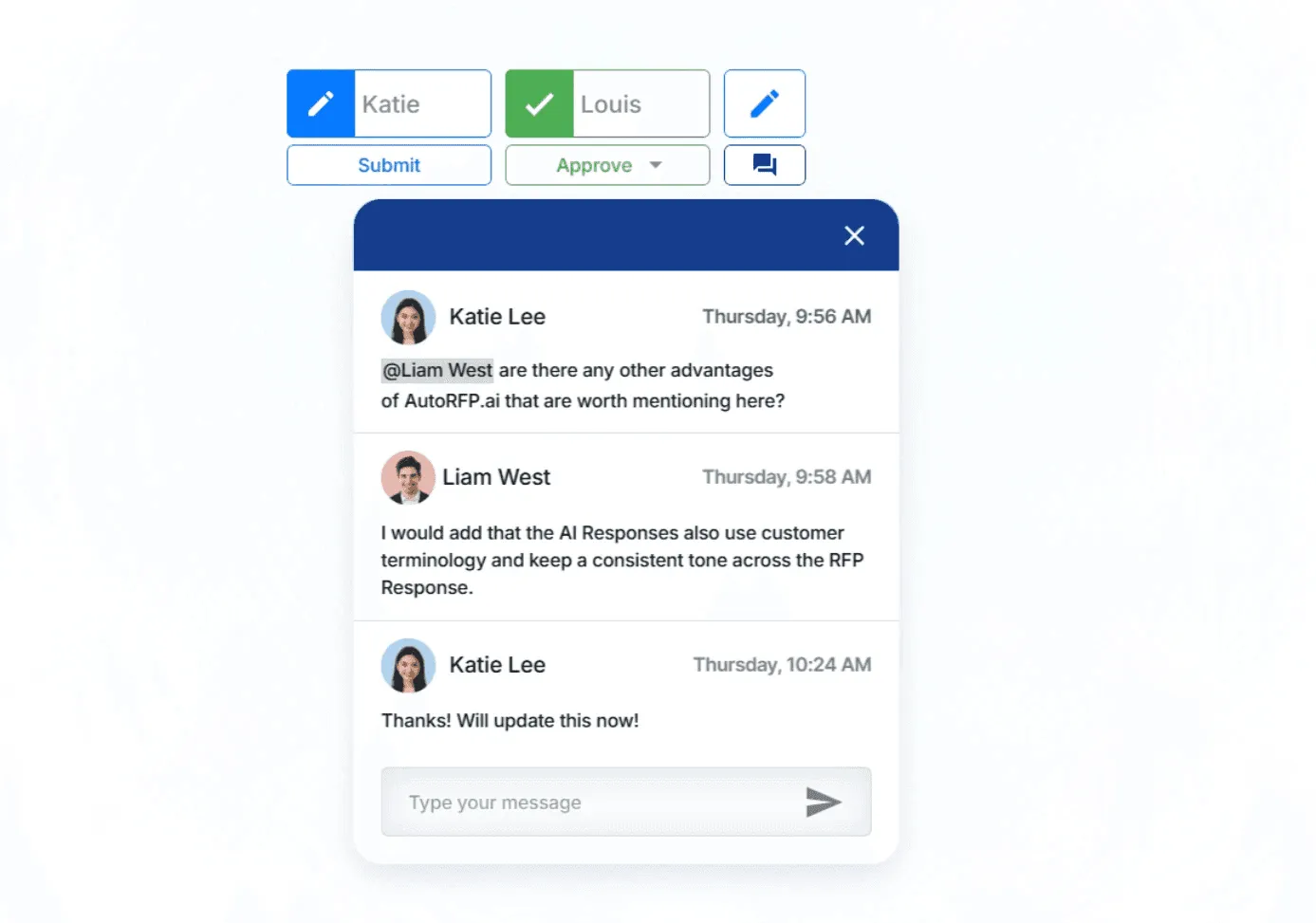
Every bid should launch with a kickoff that assigns explicit ownership: who writes each section, who reviews it, who holds final approval authority, and what the internal deadlines are. This sounds obvious but it isn’t standard practice.
One of the most common failure modes in RFP project management is roles that are assumed rather than assigned. The gap only surfaces at the review stage, too close to submission, when there’s no time to fix it.
So, what’s the structure that consistently correlates with high win rates?
Proposal teams that own the first draft
SMEs validating technical accuracy
Bid manager owning the narrative coherence and final review
In fact, studies show that SME-led drafting correlates with the lowest win rates in the dataset.
MedeAnalytics eliminated their entire administrative follow-up burden after implementing AutoRFP.ai’s built-in project management. Automatic assignment, progress notifications, and clear ownership tracking replaced the manual coordination cycle entirely.
Strategy #3: Define Win Themes Before Anyone Writes a Word

Video transcript
Transcript is auto-generated and may contain minor errors.
Hey everyone. >> Hey y'all. Thanks for joining. >> Well, we uh while we wait for people, um you can put in the uh obligatory where am I from in the chat, but also I am curious cuz Spotify Wrapped just came out yesterday, what your top album or top song is. So, if you put that in there, too, extra extra points. >> We're going to start. I think we'll play maybe like 60 seconds or so past the start time, and then the rest can you can catch up on the recording. >> Hi, Northern Ireland representing. It's good to see you, Michael.
>> Cool, cool, cool. Good to kick off with you all. >> I'm good. >> Let's start. Let's jump straight in. Thanks, everyone, for coming to the Proposal Win Rate Report 2026 uh with Stargazy. I'm Jasper Coope, co-founder and CEO of AutoRFP. Um yeah, really excited for what we're going to jump in here today, and we have a Q&A as well at the end. So, if you want to jump in with any questions, you can do that through the Zoom webinar there, and we'll have some time after to catch up and go through it. Over to you, Crystal. >> Yeah, I am Crystal Carter. I am the founder of Stargazy, um which is we we focus on data for proposal people, best practices, and we have a nice little community of proposal professionals. So, yeah, it'd be good to see you all over there if you're not there already. But, this data is the stuff we we are most excited for. Um So, methodology. Jasper, are you ready for me to jump into methodology? Okay. So, methodology, I know this is
like the most boring part of the report, but I want you all to know that uh this is going to be really useful for everybody who is on this call. Uh because everyone we surveyed um they're from public sector, they're from private sector, they're from people who do a mix of both private and public sector, they're across multiple geographies, multiple industries, multiple size of bid teams. Uh we had 97 bid uh professionals who responded from different teams. Um and the average person who responded, they're proposal manager, they're proposal professional in some way, and they're usually doing about 51 to 150 RFPs per year. So, these are real mature organizations who are responding to RFPs. Um the average deal size is between 100k to 500k USD ACV. Uh but we also have people who are doing multi-million dollar ones and ones who are doing RFPs that are for like 10k. So, we have a really wide mix of people who responded, which I think is great.
>> And then to jump into the cohort, so how we broke it out. So, we've got the high win cohort, which is 51% of the RFPs that they participated in over the last 12 months they won. Then we've got the mid win cohort between 26 and 50%, and then the low win cohort, which is 0 to 26%. So, what we really wanted to focus on in this particular report is actually the delta. So, not generalities about kind of everyone that responds to RFPs, you know, where the numbers moving, but what is the actual difference between people in the high win cohort and the low win cohort, and a few extra facts just about the high win cohort is every single respondent that was in the high win had a dedicated bid manager and they were roughly doing about 150. So, they're on the larger scale side of things and nearly all of them um were in the middle of maturity as far as their uh part of the organization's age. So, they weren't teams that had started or got spun up in the last 12 months, nor were they teams on average that had existed for over 5 years. They
were kind of in that middle range of 1 to 5 years. So, maybe had some flexibility with their processes and were still kind of growing into it. So, that's really what the report focuses on is that contrast between the two. >> Yeah, and to jump right into it like the about the actual data we received is um people win and lose based primarily on their proposal strategy and execution, which is huge. Um so, and I I mean that in broad strokes, but the steps within your proposal process, if you're actually following it um with your execution of the process, um the sales strategy supporting that process and who is in charge of what pieces of that process, right? It's all about those things. Um if you have a low win rate, um it's an operating model problem. Whereas, if you have a high one, your operating model is doing great. So, most teams that are losing RFPs it's because their system is perfectly designed to produce the results they currently achieve. So, if you're only winning 20% of your RFPs, that's because your model is built
to deliver that 20%. If you're if you have a 50% win rate, it's cuz it's built to achieve that win rate. So, just keep that in mind as we are we're going through the data. >> Yeah, and some of the data drives the best practices that no longer win. So, what are those things that everyone says that seemingly are true, but not necessarily? And and we learned a lot. There's six kind of core ones um on the top that we wanted to go straight into, which is the more bespoke writing the better, Right? So, the more customized the responses are, the more time they're spending on that, the better. Relationships are the number one way to win RFPs. You've got to have prior relationships, deep relationships, etc. That SMEs should be involved in the drafting process, so they can make sure it's accurate. That execution is going to matter far more above any kind of process or methodology that you've deployed or spent time on. That bid teams are there to increase efficiency, like an accounts receivable function or something. It's like, the
more time we can save other people in the organization, the faster we can do this, the better. And that teams, you know, with AI, with technology, can now do more with less. So, all of these, one way or another, were disproven through the data that we captured. The biggest single discrepancy was the difference of priority, or what winners attributed their previous wins to. So, customer insight here is just a huge difference between the low win cohort, their level of importance on that, and the high win cohort. So, while they kind of treat equally things like win themes, team expertise, the level of compliance with the RFP itself, where things really diverge is how much they think that the relationship matters and the price matters. So, while low win teams said customer insight is one of the lowest importance or attributed things for their wins,
customers on the high win rate side, organizations on the high win rate side, put that as their number one thing. So, these people have moved past just giving compliant responses or being responsive and then providing additional context. They're genuinely taking the time to do a lot of customer research and then actually provide insightful responses. They're providing numbers that aren't just the price of their product or service. They're providing numbers that are maybe based on that company's annual report. They're providing business case. They're showing that they care and understand their actual needs. They're giving those prospective customers confidence that you actually understand what they're trying to achieve through that RFP process. Another thing that really differentiates them is that there's a direct correlation between the amount of automation that the high win cohort does and their win rate and then the low win cohort. And to be clear, it's not that the low win cohort is not doing any automation. They're doing probably a lot
more automation than many people were doing 3 years ago. It's that the high win cohort continues to pull away in the amount of content they're able to reuse. So, basically, they're not starting from empty slates, nor are they even starting with, you know, 40% of the proposal um ready to go all the core aspects of it drafted. They're starting with 65% of the content they need, 70% of the content they need. And that level of automation and content reuse, the fact that they are so organized and ready to go means that they can reinvest that time in providing those customer insights. And the bespoke time they do spend is on the right things rather than trying to figure things out, pull from SMEs, or go backwards and forwards in their process trying to get the content they actually need. Another part is that they have a more defined process in general. So, we broke that out by the number of elements. So, not specifically the number of steps that they have in their process, but
actually the number of things. So, an element would be something like a go no go, which most teams had, uh win themes, which most teams had. But, there's a short list rate and a win rate correlation to other things as well. So, maybe one example was customer research, more structured intakes, um postmortem learning and putting that into the next bid. Having those additional elements helps you stack your win rate, make sure those learnings are going through and overall you're having a more mature and advanced process. So, you can learn more about that in the report itself as well. And just to visualize the difference there is that those content systems are creating capacity for responding insightfully. So, when we actually look at the time stack and like how much time these teams are spending on different elements, yes, the low win teams are reusing content. They are maybe spending some time on customer insights, but they're spending so much of the time just on the fact their process is not
mature. So, there's process inefficiencies, they're going backwards and forwards through things and then they're doing a kind of bespoke writing as well because they can't find exactly what they need straight away. Their content management is just not in a place where it's possible to have that much content reuse. Whereas, the high win teams are coming in with a huge foundation of reuse content ready to go, freeing up their time to do more research, get more insights, learn more maybe from that sales team. And then when they're spending their time on bespoke writing because they're absolutely still doing huge element of that, they're spending it in the right spots, on the right things, the things that actually matter, the things that move the dial and they know that because they've done the customer research to know what moves the dial for this particular prospect. >> Yeah, I think one other big thing that surprised me. Like I this wasn't even on my radar. When we were asking questions, it just the data made it so interesting. And that is a that SMEs
actually can be a huge problem in your win rates. Um and I think if you are on LinkedIn for 2 seconds, if you go to a conference and talk with other proposal professionals, SMEs are going to be one of the things that come up because they are really hard to to get to actually respond to your responses in your RFP or to check it or in your proposal specifically. Um So, the data that we found around this was a high win teams actually use SMEs less and it might be partly because of the reasons of them being so difficult to to capture their time to help us. Um what we have seen is if you are are a high win rate cohort, you're probably using SMEs just to check specific responses that you really need help with. But, they are not drafting your responses. They're not writing them from scratch. Um you're using them as little as possible. Um and what we're seeing is is the high win cohort, the proposal team really wins that narrative. And this is across industries, even really SME heavy industries.
So, this isn't like just for like SaaS or something where you might not need an SME as much. Um and what we're seeing is is part of the reason is SMEs are really good at writing technically accurate responses, but they're not very good at taking that customer insight and like we talked about earlier and writing that into the narrative. They're not good at being persuasive in that writing. Um and so, that is another the reason why. So, if you're really like relying on your SMEs to respond to your RFPs, that is going to be like a true hindrance on your actual win rate, not just on your process and efficiencies. Sorry, that one just like surprised me so much. Um But, there's also the bid revenue dependence effects. Um and that is the more revenue that, you know, depends on your proposals or your RFP win rates, the more your win rate depends on structure and insight. Um and so, what we're really seeing here is teams that are in bid critical organizations where like 26% to 75% or
more of your revenue comes from RFPs, they behave very differently from those where bids are just like seen as peripheral for like just admin, not really contributing to your your revenue. Um and there's other like performance outcomes that are diverging too. So, the the high performers, the people with high win rates, um they're winning because they are treating their bid engine as a strategic revenue system, like all the way up to the top, right? Um whereas like the low win rate cohort, they're in the the same revenue environment, but they lose more because they treat bids as that administrative paperwork, as that cost center, that overhead, whatever you want to call it, kind of a negative connotation within the organization. Um and the dependence on bids amplifies whatever the organization is already doing, both the good and the bad. So, it correlates more strongly with win rates, their maturity, their content practices, or their AI adoption. Like this is the number one thing. Um so, each step in
your revenue dependence increases the likelihood of being a high win rate team, but only if the ownership and insight systems are in place. Uh so, if you guys on this call, if you're a proposal leader, if you're a sales leader, what does this actually mean for you? It means if bids are driving your business, the business you've got to invest in your proposal engine. Um you have to invest in your structure, your governance, your insight, so like the pre-RFP information that you get, um and your FTE, like your people, not just like your systems and your software. Um so, if you are like currently sitting in a bid team, and you notice that your sales team, your leader leadership, proposal, marketing, sales leadership, whoever they are, if they are treating you as like a cost center or overhead or just as admin, then they are doing more harm to their revenue than just wasting your time. Like they're having um a truly detrimental effect to your revenue. Like I can't hammer this home enough. Like it doesn't just feel bad, it's going to be
bad for your whole organization. Um, and the data is just unambiguous about this. So, when competitive bids represent a large share of your revenue, like you have to invest in these things. I'll stop I'll stop ranting about it, but uh, it's just like take that as seriously as you can. Um, another really interesting thing and something that I really want to see the data come in on is all about AI. All right, like how does AI help us win? Cuz we see this in so much marketing, like AI is going to help us win more. Well, yes and no. So, um, AI usage, um, what we're seeing is nearly half the teams that responded, they use AI proposal tools. Uh, but AI adoption alone is not separating the high performers from the middle performers or the low performers. Um, and that doesn't mean that AI lacks value or that we shouldn't care about it, but it means that most organizations are using it on top like if you're a low win rate, you're using that AI on top of really weak foundations that we are already talking about. Because like as we all know, AI amplifies whatever
system is plugged into. Bad system, amplify it. Good system is going to amplify that. So, if you're a low performing team, um, we already see we see this so much, like AI is accelerating the poor processes, it's generating more generic content, it's not using that insight, right, that we talked about. It's uh, deepening those rewriting cycles, which as we already seen is a huge problem, and it also masks that really weak clear like qualification process that we have to be good at. So, if you guys are a proposal or sales leader, what does this mean? Does it mean you forget about AI? Absolutely not. Um, basically it just means that AI is not a shortcut to high win rates, right? It's value depends entirely on the underlying process, your insight intake, your win theme definition, um, bid that SME models, and the content governance. So, if you if you have all those things down and you're using AI on top of it, like you are golden. You're going to be doing so well in a lot easier way, but if you don't, um,
it's it's not going to help you win more. So, uh, future state Oh, Jasper, I'm handing that over to you. >> Of course. >> Yeah, yeah, yeah. So, the future state is the teams that will win in 2026, based off all of this data, is the ones that demonstrate customer insight to the questions that matter, right? First and foremost, they're going to be providing those types of responses, not your generic, not your AI slop, not your responses from 3 years ago that are now outdated. They're going to be providing up-to-date, accurate, sure, but actually insightful responses. They're going to run a more governed and well-resourced bid engine. These are not going to be the teams that get gutted or halved and then replaced, you know, with AI, quote-unquote. These are ones that have well-resourced, um, with bid engines that are ready to scale. They know how much head count they're going to need to add. They know how much time it takes to do certain things. They're ready, uh, to get traction and to scale very quickly into more and more wins.
Um, so we're going to see some very strong teams come out with that and with the AI leverage that is going to power that kind of baseline, uh, revenue engine. And then, those teams that can align sales, proposals, and subject matter experts around that one narrative, not just letting everyone kind of contribute randomly in their own way, but having a very structured process in which those different teams can contribute, making sure that they're working around one narrative. And at the end of the day, that is the RFP team's job is to make sure that it is a narrative that is persuasive, um, not just, uh, narrative that is accurate. And then, finally, that AI adoption, it's not something we're going to see go away. People are going to see that um, amplify their work extremely and they it's not going to compensate for the for the weak responses though. We are going to see a lot of AI slop. Hopefully our competitors use as much AI slop as possible to bid on these RFPs against us, right? That's what we want. But on the on the other side of that, if we're all able to have stronger processes than our competition and
leverage AI to help us hone it in rather than dilute it, then that's what's going to help us all win in 2026. >> Yeah, so there are seven things that we took away from all this data that you can genuinely start on now. Like you don't have to wait for sales kickoff season next year to to get this started. I think this is something you can probably start planning for now. Um and these are going to be the biggest levers that you can use to heighten your bid like your win rate, which of course you're going to want to do. Um and that is something that we know like we know deep down are correct, but the data now backs it up and that is starting every bid with insight. Insight about your customer and making sure you're getting into the world and everybody's on that same page about that insight before you start drafting whether that's a person drafting or AI drafting or mix of both. You have to have that in there as that first piece. Um the second is assigning clear
ownership. So like Jasper was mentioning, you need one team to own that bid. It can't be a mix of a bunch of organizations. It has to be one team. Uh the next thing is win themes and that is narrative before content. So using those insights and then building out that those win themes that you're then going to use throughout your response. The fourth is move SMEs out of authorship. If they're writing your responses right now, do whatever you can to get them out of there. Have them validate your responses to make sure they're accurate. Don't have them write. Um the fifth thing is tighten that qualification. Don't bid on low fit opportunities. Like the data just shows it's not just burning people out, which it definitely is. That's a big deal. But it's also actually hurting your win rate because you're focusing on the wrong things. Time, resources are not infinite. They're finite. So, focus on the right things. Um and then govern the content library. So, uh make sure that your content library, wherever it's pulling from, whether it's a proposal management tool, whether it's proposal management tool that you know, can get things from everywhere. Make sure that it's curated,
that it's vetted, and that it's mapped to the really critical themes that you you tend to have with your customers. And the seventh and last thing is track your shortlist rate. Um now, uh you're probably going to be like, "Christina, I've seen your LinkedIn post. You don't care about shortlist rates." And that's true. Like for KPIs, I don't care about shortlist rates. Uh but it is going to be a signal of compliance failure. And also, like if your messaging is just completely off. Right? So, that's just kind of like a a canary in the coal mine situation. Um these seven things that you can really fix or just focus on or start tracking uh before your SKO in 2026. >> Cool. And finally, yeah, where to get the the full report? So, you can get it at auto rfp.ai win hyphen rate hyphen report. And you'll also get an email if you've signed up to this webinar uh immediately after. Uh but also at the stargazy.io intelligence level. If you want to talk about that. >> Yeah. Yeah. So, um you guys will be able to get it both on the website, the
stargazy.io website, but also within the community. So, people can start having conversations about it, ask questions. Uh because everything that we went through today was, of course, like a really fast overview. Um but there's a lot of in the actual report itself, there's a lot of data, a lot of information, um and a lot of the nuances that come across with all of these. Like they're like they're not all necessarily black and white. There's there's going to be nuance. And I think it's That's in the report, but it's going to be important for us as proposal professionals to be able to have that conversation and what that actually means in our in our day-to-day. >> Well, so you can drive drive that now, but yeah, happy to jump into Q&A if you want to have any questions either about the report itself or anything adjacent. Just yeah, an opportunity to dive in deeper. >> Yeah, we have a question. Jasper, I'm going to give this one to you. But it's from Brian and it's Please expand on the steps and ideas involved in govern the content library. >> I wish it was I wish it was that simple
that I could um content library governance. It's such an interesting thing and back to like the the sneeze and how you involve them in the process. I think um when it comes to that, govern your content library, I don't just actually mean libraries. Like Or or no one should mean libraries. You should really think about content holistically across the organization and the types of content that you have the highest dependence on as far as what's involved in your responses. Maybe for some teams that's a lot of like legal stuff. Maybe for other teams it's purely product most of the time. That's where I would start. And when you talk about governance, it's like, is that up to date? Are people posting updates on your product in a Slack channel at the moment? Well, that's not a great governance process. You need to be moving them to a change log potentially, leveraging that change log to respond rather than having to figure out what's actually shipped and what they're just talking about in a product channel and teams. So, there's kind of that maturity curve. So, when we say governance, just figure out A, which is the most important content that you actually need access to time and time
again. And then how do you know that it's actually accurate? How do you get it to the point where it's compelling and persuasive the way you're responding? It's not just like from the change log, it's written with its features and benefits in a way that a customer can actually consume. Um and how do you make it accessible? Is it in a place where with a touch of a button or a type of a keyword or search, you can immediately pull that information, find those features and benefits, and give it to a customer. So, it's accurate, it's compelling, and it's fast. And I would say those are kind of the three things of governance that I would start to jump into. And then when it comes to technical, that's that's a that's a huge exercise. But, um I would start with mapping the types of content and where they come from in your organization. And against those three aspects, how mature you think you are. >> Um and then uh I'll I'll take some of it, Jasper, please chime in. Um but, Sabrina, you said, "Can you define more clearly or explain a bit more about what are considered insights?" Um this is going to be just about
anything that you can learn about the customer. Like, what are what's keeping them up at night? What are their pain points? Um if they purchased you, like what are they afraid of like messing up if they purchased you? Um you know, what are what are they worried about internally in terms of their own promotions? Specifically, what are they worried about in terms of like if they're having revenue problems, like if that's, you know, somewhere publicly, um if they have to do financial reports or anything like that. It's going to be genuinely anything that is going to be very relevant for the stakeholders who you know will be evaluating or making decision on your proposal. And I know it's very, very broad. Um but, I specifically used to spend before AI, I used to spend 2 days on research alone. And then of course, like working with my capture or BD person to um get any information from calls that they had with the customer, any emails they had with the customer, um not just stuff that was publicly available. So, it's as much as you can. But, yeah.
Jasper, chime in. >> I think yeah, a really simple one is if you work on the private side, if they're a public company, they're listed, then those annual reports are just like the most fundamental thing that anyone should be reading, no matter really, even what you're selling if the deal size is, you know, 50, 100k plus, 500k, million, I mean, definitely. What is that organization focusing on strategically? And that can at least be a part of it. And then yeah, as Kristina says, there's just so much more nuance and detail that you want to get into, but I'd say like start there if you haven't started at all, and then just get more and more context. And yeah, 2 days seems like a good budget depending on the deal size for sure. Um one from Odvar around it's easy to think of uh you know, reused content as not tailored, um but there's a like a different interpretation. Absolutely. I think what the high win rate teams that like I've worked with one-on-one that like they they know what can just simply be reused as is, and the customer's not going to
care. It's not a differentiator. It doesn't matter. They just need yes in the box and move on. And they know which ones they're spending time on. So yes, they actually do have a lot of like verbatim reuse or slightly reuse for the stuff that doesn't matter, but these are good content libraries. They're not super verbose, um or too they're not just yes no, nor are they huge pages not actually answering the question they asked. They're they're they're well um done content libraries. They can reuse that. And then the only bespoke elements are the questions that are differentiated. And I guess this is probably more true for companies that sell repeatable products where a lot of the baseline stuff is the same, right? Do you support users? Can you log in with Google? All of that kind of stuff, they're not spending time there at all. What they're doing is they're spending time on the commercials, the long-term partnership, what does the road map look like, give us a company overview, the implementation timeline. That's where they're spending their time. They're not spending it in the security, legal, and box-ticking exercises. >> Also, shout out to Odvar. He's one of my
favorite sales leaders of all time. So. Um Chelsea, really quick, I'm going to answer your question. Um, so the survey size was uh we surveyed 97 uh proposal professionals. Um, and they were across This was at the very beginning when we mentioned it, so sorry if you missed it, but it was across private sector, public sector, and also teams who do a mix of both. And it was in a bunch of geographies as well, but mostly UK, US, and Australia. We have some uh Nordics and EU countries as well. >> Nicola had a good question, and I don't I don't work at all in the defense space, but just around like more bespoke and technically complex documents that really do need SMEs. I'm interested on your thoughts on this, Chris, but I've seen a sandwich approach work quite well, where you actually start with a proposal manager using drafts from like maybe similar types of projects, if there is any time being vastly similar,
trying to get that bespoke down, cut it down, and then move on to uh the SME, and then back to the proposal manager at the end. So there's kind of like a start, like here's the raw outline and framework that we want you to work to, and here's maybe the theme that we want that SME to work into, and then there's a very controlled process at the end to make sure that we're not just approving whatever SME put in, but there's going to be maybe some heavy edits if they had to write a lot of bespoke content. >> Yeah, Nicola, like I So I I have worked in the DoD and MoD uh ministry, so I get what you're saying, and it is it's it's way trickier than just about anywhere else. Um, so what I've seen work really well is as much as possible, I mean, of course, saying what Jasper said, but also uh doing interviews with them, so you're getting that information from them, unless like they have to literally like like solution something out, like drawing it out, which I know they sometimes have to do with the DoD space, but if it is something that they can just solution through and talk it out with you, and you record that, and then either you manually or like within you
and AI, then writing that out into the solution is actually far more effective and does a lot less rewriting that has to be done. Um Of course, like they then of course have to validate validate it as you know, but that I've seen that work really well. I don't know if that answers your question. But thanks, Nicola. >> Good practices for managing the content library. I'm happy to take that or >> Yeah, sorry. I'm just Yeah. >> Yeah, another another interesting one. >> Um Yeah, I just so best practices in managing a content library. I think it really I know like we've touched a little bit on it, but I think it really depends on like what you're using. And I know that's I hate it depends answers, but I do think it kind of does depend. Like if you're using a proposal management system, some of them require tagging and indexing and a lot of manual work. Um Whereas other ones do like a light
version, some of them none of it. So I think it's no matter what you're using though, I think best practices is kind of what Jasper was saying, and that's only have in there what you know you're going to reuse. Don't have a bunch of content in there that you that that you're never going to update. Like if you know it's outdated, then there's no point in it being there. And if you have a really hard time updating all the content you have, that's just it's just a waste of time. Um but if you have a proposal management system of some sort that can connect to a variety of different tools that you know gets updated. Like if you can connect it to like technical documentation, for example, or like HR policies or environmental policies, whatever it is that you know gets updated by that specific team, that to me is is really useful and a really smart thing to do. >> Definitely. I I think the future is meeting SMEs where they are. And just to kind of like expand on that
point, there was company recently that we worked with and they had the like a Fortune 500, so much of their information is actually publicly updated. Like it's mandated that they update it publicly. That just by using their website content, their public filings, etc., they could have way better responses than they were getting from their library even though they've got SMEs assigned, they're trying to review it, they're trying their best to run that whole process and have thousands of entries updated. At the end of the day, actually meeting the subject matter experts where they were, which was I actually have to complete this filing. I actually have to update these documents on our help site, that kind of thing. Um that is just like having way better practical results in reality. So, although maybe in in someone's mind you're like, "No, I want to maintain a library-based approach uh and maintain that manually and have it very structured." For some, that's actually just not practical. And you do just need to go to an approach where you can just get the information where it is actually updated. And unfortunately, um yeah,
that can sometimes involve tools like, you know, you can start with a ChatGPT there or something more generic, even just copy-pasting that information around or having links to it. And maybe giving up on certain parts of your library like a long tail. Like, if there's any responses that are getting used, you know, once in 800 questions, then maybe don't maintain that in your library. Maybe just actually go out to the source every time. As long as that takes, it might take you actually less time overall than trying to maintain a copy of the long tail of questions. >> Yeah. Um so, there's so many questions. Like, it's hard to know which one to go to next. Um I'll try and go in order though. So, uh Michael, you had a couple questions. Um So, the relationship between customer insights and then like of course the customer relationship like there is a nuance here and this is mentioned quite a bit in the report but the nuance is uh what we've seen in the past is relationship with the customer was like enough to win right like maybe you went golfing with them or you got your nails done with them like whatever
it was that was enough you were buddies. Now that's not enough. Um you have to not just have that relationship with them but you have to have that really deep insight about them and prove that within your response just because the customer evaluation committee is now so much bigger. So even if you don't have that relationship with them which of course it's going to help you if you do you still need to have that deep insight that you probably didn't just get from that person you had a relationship with uh because it's it's not going to encompass all of the different stakeholders who have a genuine stake in that decision and who could easily kick you out if you don't meet with what the customer in like what they actually care about what they need to hear from you. >> Yeah. And you hear this in like the general kind of sales literature all the time like you need to multi-thread you need to meet all of the stakeholders you need to run you know who's your economic buyer versus your champion versus your user buyer. But even the best sales people on earth realistically for the deals that really matter they're not going to be able to meet everyone on the buying committee. The only way that you're getting through to
a lot of these people on the buying committee is through their responses because they're revealing their portions of their responded RFP. So at the end of the day how you find those people is you actually just try and figure out their problems and that can only come through insight. You're not going to be able to get them to to golf to nails to the bar. Um you're going to need to do as much research as you can and kind of make it undeniable that of any vendor that responded you understand each person's challenges the most in the organization and have gone deep on it and that a lot of the time is overruling any personal relationship even if you've got a CFO or something like side you know as much as they love them, they trust their stakeholders when there's, you know, three or four of them saying the same thing. >> And in terms of terminology, um I feel like every country and industry I'm in has a different one. Like I went to an asset management bidding uh conference this morning. Totally different terminology than I would ever use. So, it's it's just it's so different no matter
where you are. It's um it's a lot of fun. Uh The next one is um and once again, I'm going to have you take this one, Jasper, cuz it is um quite a bit about content management, but is tagging a big part of that content management? >> Yeah, tagging is such a such an interesting one and such a slippery slope as well. So, tagging categorization is important. Like it's critical. People say like in AI context is everything, right? And it's about how do you give a user, a person, an AI agent, whatever you're using, how do you give the context of what's going on? And right now, the only 100% effective way to do that, I think, is to categorize in some way, whether you're putting stuff in folders or using tags um to categorize things. And this is only applicable for organizations that have more complex products or offerings or services, where they need to go into an RFP and they need to basically have, hey, only this context in our organization is relevant to this
bid. Because your biggest risk, both from people just writing the responses and AI, is that they're pulling information out of the wrong bucket to the same question. So, you're getting the you're getting the question, you're going, oh great, this is the answer. You put it in. No, that's the wrong entity. No, that's the wrong product. No, that's the wrong country. And that's how you end up with a laborious and low governance process. So, that's where tagging and categorization becomes critical. So, think about it in those contexts is I think the first question that we ask to see if that's even necessary in the first place is, if I gave you a the is there two answers for anything? And if there is, then great. We're already talking about two different buckets, maybe two different tags, and then we go from there. You want to keep it as minimal as possible, but unfortunately, I think it's basically a necessity um depending on your industry. Sometimes it'll be soft to make a mistake one in every thousand. In asset management, for example, you make a mistake once in every thousand, we had a prospect that got sued for $46 million by the SEC for that. So, that probably, you know, just roll with the tag
approach if you're there. Um but outside of that, if you're selling B2C software, um and and selling a little bit more casual, then then maybe it's not the juice isn't worth the squeeze. >> Yeah. Um there there is so much nuance with this this one, the tagging, which is kind of where I wanted you to take it. Um but um I'd worry one question from you is, taking SMEs out of the question, what would an ideal team look like? Once again, I think this is going to be really dependent upon the type of team you have in the industry you're in. If you are in um like a DOD or MOD sort of situation, then they're they're always going to need to be in there to uh reviewing your content and reviewing uh the response to make sure that it's accurate, and of course, um interviewing them for the solutioning piece, cuz they're going to be um integral to that. Um same with like AEC. Uh but if you are more in like software SaaS, um then uh unless you have like really complicated solutions, you probably hardly need them at all.
Um you probably only need them as like a an organization where you and I both worked, um we didn't use them at all um because we didn't need to because it was our our product was so simple that we could go from end to end and feel confident that our responses were accurate. Um and so if you are in that situation, um maybe only have them review the things that you are unsure of that are completely new, that are maybe a little bit more complicated, a little bit more technical, that you don't feel com- like um comfortable answering. Like I wouldn't use them as like a a comfort blanket. I would use them only if if you think you need them. Like obviously don't put your- yourself in danger or your your company in danger of responding incorrectly, but as as much as you cannot use them, I would not use them. As my suggestion. >> Really interesting one from Julie came up around recently heard a stat 40% of the procurement teams are using AI to evaluate our bids. Do you have any insights on how to structure the response or tactics to address that issue? How do I increase the AI score?
And that in my experience with this was actually working with a procurement software that was putting in um the AI review system into it and they were talking to us about how we did it on the other side and we had a feedback system that tries to basically predict what procurement will think. Um and in our testing, it preferred AI responses over ones that we writ- wrote as humans. So this is a small sample set. I'm sure that they'll adapt and and get better at certain things, but certainly um longer responses that cover all of the requirements. So I think things that are really going to hurt people in the future is where they're not properly responsive and they're indirectly answering questions with generic template. That's really going to pop your tires when someone goes um you know, "Do you have any operations in Singapore?" and you say, "We have global operations in 20 countries and blah blah blah." without specifically naming Singapore, you're done. The AI system that's going to is going to catch you on
that where a human person like a human reviewer might be um a lot softer, I think, on your level of responsiveness to those questions and kind of assume, do some further research, that kind of thing. So I think your it does um like it does raise the bar of like how much it needs to actually respond to the question. Um and you can't miss a portion, you know, if it's three questions in the one question, you're going to want to have to tick all of those three off um to to make sure you're you are responding to that. >> Yeah, one thing I want to add is make sure that you are really talking to the like I mean, Destry just said but the evaluation score is probably going to be like one of the most important things you can focus on. So like I mean, I've seen teams where they they make sure they feed that into their AI to help use that in every single response. And then review it based on evaluation criteria for every single response. Um but I I would also say that although they're using AI to review them, they're still usually like at least in the short-listed ones, they're still having a person usually review those three to four shortlists. So you're still going
to have to have it readable to a human. So it's like this the new best writing practices I think are about to change rather dramatically, but we still have to remember that human element. >> Exactly. It's nearly like AI's going to cover the gaps in your responses, but the human's still going to be there to like find the the the differentiator. So you're still going to want that portion of it ultimately win. >> Um in terms of So somebody asked if we can share the link to the report. That's going to get emailed to you like directly after, I think. So and it's also, yeah, right here. >> Right there as well. >> Um Also, really really quickly I'll go into other major differences in the RFP process in public tender versus corporate invitations for bidding. Um there are nuances, of course, usually in wording um but no, I I usually I've I've worked in both quite a bit um in both like DOD and MOD uh which are are very very formal.
Usually they are going to be more focused on the Shipley process, whether that's good or bad that's up to you to decide, but they they do tend to be a little more formal, have quite a longer review cycle. Um but I do see that changing rapidly, whereas like the B2B like enterprise side is usually a lot more I won't say loose but I would say they're a lot more efficient with their processes. But I I really when I see differences in processes I actually see them more differences in industries versus uh public versus private. And the data by the way I didn't see any difference between best practices. So I don't think best practices change. Um Anything else Jasper? >> Nothing else Anna. Happy to call it there. Thanks everyone for your time and for your questions. Great to dive into them. Um
Yeah, look forward to you reviewing the report and we're super keen for any any feedback uh what we can capture next time. I think we learned a lot capturing information for this report, drawing out those insights and then actually being able to figure out how we can provide like a much more insightful and detailed report next time at a whole new scale. So I'm already looking forward to the to the next one but I think the insights in this is super powerful and will definitely get it started into into 2026. So yeah, keen for you to dive in and thanks for your time. >> Yeah, thank you so much everybody. >> Thanks all. Bye.
Win themes are the strategic arguments that tie your entire response together. They answer the question every evaluator subconsciously asks:
“Why should we choose this vendor for this specific requirement?”
A win theme is not a feature list. It’s a proof-backed argument that links your specific capability to the prospect’s specific problem. It’s differentiated from competitors and expressed in the prospect’s language. One win theme per major evaluation criterion is the target.
Define win themes at kickoff before a single section is drafted. When every contributor knows what strategic argument their section supports, the responses cohere into a case rather than a collection of answers.
Without defined win themes, you get individually competent responses that fail to make a compelling cumulative argument.
Key Data: Teams that formalize win themes before drafting begins show measurable shortlist rate improvement across every sector. 71% of high-win teams use formal win themes consistently. Among low-win themes, the number drops sharply and that gap compounds with every bid run without them.
Strategy #4: Automate the Boilerplate to Protect Strategic Time
The most valuable hours in any RFP response are the ones spent on customer insight, win theme refinement, and tailored narrative. These are the elements that move evaluator scores. They’re also the elements most likely to get cut when teams are under time pressure.
Automating the first-stage draft protects the team’s time for work that automation cannot do such as:
Understanding the prospect’s real priorities
Crafting a narrative that positions your solution compellingly
Making the judgment calls that turn a compliant response into a winning one
AutoRFP.ai generates 80%+ usable AI-drafted answers from day one, connecting to your existing content sources (such as Google Drive, Confluence, SharePoint, Notion, and Salesforce) so the response engine draws from your most current, accurate information. Your team reviews, refines, and redirects. The machine handles the first draft. Your team handles the strategy.
Fiddler AI validated this in one practice. Across Q1 2025, 63% of all AI-generated responses required zero or one-word changes. Not a rough draft to rewrite but a near-finished answer that freed their team to focus entirely on differentiation.
“The dread of a new Security Questionnaire hitting our inbox is gone. AutoRFP.ai makes the process so much easier, the workflow is a breeze and we haven’t lost weekends to RFPs since.” — Amanda Bell, Senior Manager of Revenue Operations, Fiddler AI
Strategy #5: Review in Layers, Not All at Once
Last-minute all hands document review are an antipattern. When everyone reviews everything simultaneously, issues compound such as:
Formatting conflicts
Inconsistent messaging
Factual errors
SME corrections across different document versions simultaneously
Structured bid teams use layered reviews which include:
A technical accuracy check from SMEs at the section level
A narrative coherence pass from the bid manager at the document level
A compliance check confirming every requirement has a direct answer
These happen sequentially, each with dedicated time.
AutoRFP.ai supports this model with inline commenting, section-level approval workflows, and version tracking so reviewers work their specific layer without creating the version chaos that kills late-stage bids.
Strategy #6: Replace Manual Content Hunting with Semantic Search
The hours bid teams spend hunting for prior responses and relevant content is one of the most expensive wastes in the RFP process. It is also one of the most avoidable.
Legacy RFP software used keyword search. You needed to know exactly how an old answer was tagged to find it. Search for ‘GDPR compliance’ and you’d miss everything filed under ‘data protection’ or ‘EU privacy.’
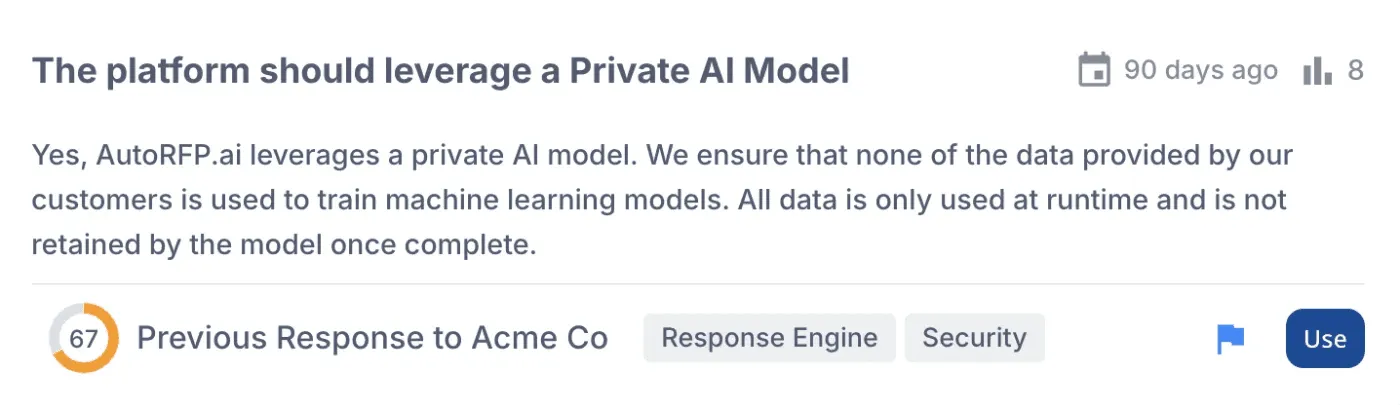
AutoRFP.ai uses semantic AI search. It understands the intent behind a question and surfaces conceptually related content across your full response history, regardless of how it was originally tagged or worded.
This removes a significant coordination burden from bid managers. It also means AI-generated first drafts are grounded in accurate, contextually relevant content from day one.
Optimize The Management of RFPs & Responses with AutoRFP.ai
RFP project management is only as good as the system underneath it. Clear roles, structured timelines, win themes, and layered reviews require a platform that keeps teams aligned, content accessible, and progress visible without adding friction.
AutoRFP.ai delivers this by automating first drafts, learning from approved responses, surfacing content through semantic search, and managing end-to-end collaboration.
The result? A bid management process that gets faster, sharper, and more reliable with every bid you run.
If your bid management team still relies on email, clunky legacy tools, or Excel sheets, the process you have now will not scale to the growth you’re targeting.
Book Demo with AutoRFP.ai to see the platform in action or explore AutoRFP.ai’s features to see how it fits your workflow.
Data in this article is drawn from the 2026 Proposal Win Rate Report, a survey of 97 bid professionals covering win rate cohort analysis, capacity benchmarks, and the structural patterns behind sustained high performance. Download the report for the full data.
