
RFP Technology in 2026: Ai, Automations And More…
Stop wasting hours drafting RFP responses. Learn how RFP technology helps proposal teams automate answers, track approvals, and increase bid success

Robert Dickson
RevOps Manager, AutoRFP.ai··8 min read
As soon as RFP volume spikes, most organizations discover their “process” is really just heroic people and shared folders.
Modern RFP technology centralizes content, tracks ownership, layers in AI to draft responses, and uses automations to keep everything moving.
This article explains what RFP technology is, why traditional approaches break at scale, and how the tools have evolved.
We will cover core capabilities to look for, how AI and automation are reshaping expectations, standout platforms, how to choose the right solution for your team, and the future direction of RFP technology.
What Is RFP Technology? (Beyond Spreadsheets and Templates)
Request for proposal (RFP) technology is a set of tools and workflows that manage end-to-end RFP work: intake, coordination, drafting, review, tracking, and submission.
What it typically includes:
Central response library plus tagging and search
Templates, formatting, and version control
Workflow: Tasks, owners, deadlines, reminders
SME collaboration, comments, approvals
Compliance and audit trail (legal, security)
Integrations (CRM, docs, knowledge bases)
AI support (drafting, Q&A, summarizing, reuse)
Tracking plus submission (status, deadlines, final checks)
The Challenges of RFPs When Businesses Scale
Here’s a quick table showing the top challenges teams face as RFP volume grows with business scale.
| Scaling challenge in RFPs | What it looks like in real life |
|---|---|
| RFP volume jumps | More bids come in than the team can handle, so quality slips and responses get rushed. |
| Capacity cliff | Win rates drop once volume outpaces the bid engine’s structural limits. |
| No single source of truth | Teams hunt through old folders and spreadsheets, reuse outdated answers, and introduce contradictions. |
| “Must-bid” on low-fit opportunities | Time is wasted on the wrong deals, diverting focus from winnable bids. |
| Inefficient cross-team approvals | Legal, security, and SMEs become bottlenecks, and proposal managers spend days chasing sign-offs. |
| Diffuse ownership + SME inconsistency | Accountability blurs, reviews get patchy, and quality drifts across sections. |
| Personalization breaks at scale | Copy-and-paste wins for speed, but responses feel generic and don’t align with the buyer’s exact needs or criteria. |
Evolution of RFP Technology (How We Got Here)
Here’s the quick history of RFP technology, so you can see why modern teams are rethinking the old workflow.
Era 1: The Pre-Digital Era: Informal & Paper-Based (Pre-1960s)
Method: Bids were relationship-driven and handled through physical mail, newspaper ads, and trade publications.
Limitation: Everything was slow, localized, and hard to compare consistently at scale.
Era 2: The Industrial & Telephone Age (1960s–1980s)
Method: RFPs became more standardized as projects grew, with coordination via phone, fax, and postal services, and proposals delivered as printed binders.
Limitation: Distribution and evaluation were cumbersome, storage-heavy, and difficult to update once submitted.
Era 3: Manual RFP Management (1990s–2000s)
Method: Teams ran RFPs through email threads and shared folders, drafting in Word and tracking requirements in Excel.
Limitation: Version sprawl and duplicated work persisted, and finding the “right” answer was still a scramble. More copying, more pasting, more chasing reviewers, and more last-minute surprises when details change.
Era 4: Template & Content Libraries (2000s–2010s)
Method: Early RFP tools introduced templates and reusable libraries, typically powered by keyword search plus tagging/taxonomy, the foundation of what most teams now think of as an RFP toolkit.
Limitation: Libraries became stale, and manual upkeep was heavy; keyword searches often returned incorrect context.
Era 5: AI-Powered RFP Platforms (Late 2010s–Now)
Method: Today’s platforms use AI to retrieve and draft content in a more context-aware way, pulling relevant content based on meaning rather than just keywords.
Advantage: It shifts work from “find and paste” to “verify and tailor.” Strong setups improve over time: teams update core answers, tighten governance, and refine drafts based on wins, losses, and evaluator feedback. AI works best when it strengthens a clean process, not when it sits on top of messy, outdated inputs.
“Winning in the AI era requires organizational readiness, process maturity, and strategic intent. Technology multiplies performance. It does not create it.” – Christina Carter, Founder at Stargazy
RFP Technology Core Capabilities
These are the baseline capabilities RFP technology should cover to run an end-to-end, repeatable process.
1. Centralized Answer Library (Single Source of Truth)
A modern RFP platform should include a centralized answer library that acts as your single source of truth.
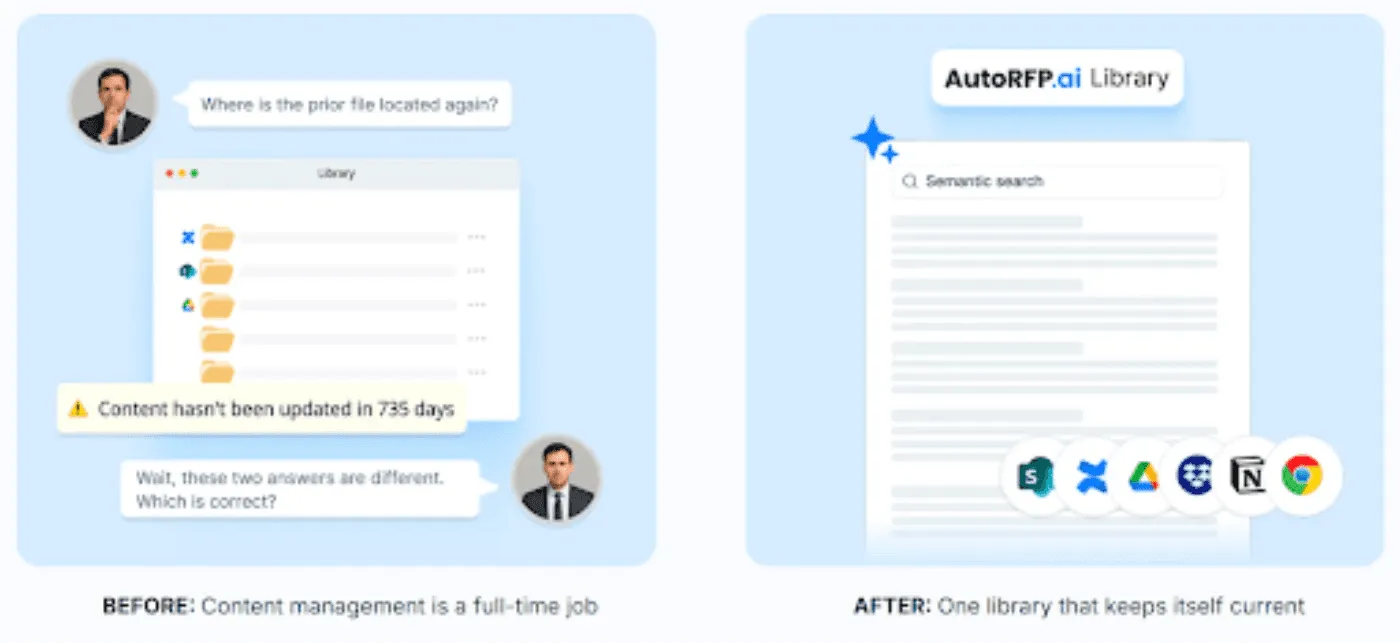
This capability keeps approved messaging, proof points, and standard responses in one place, so teams stop reusing outdated content.
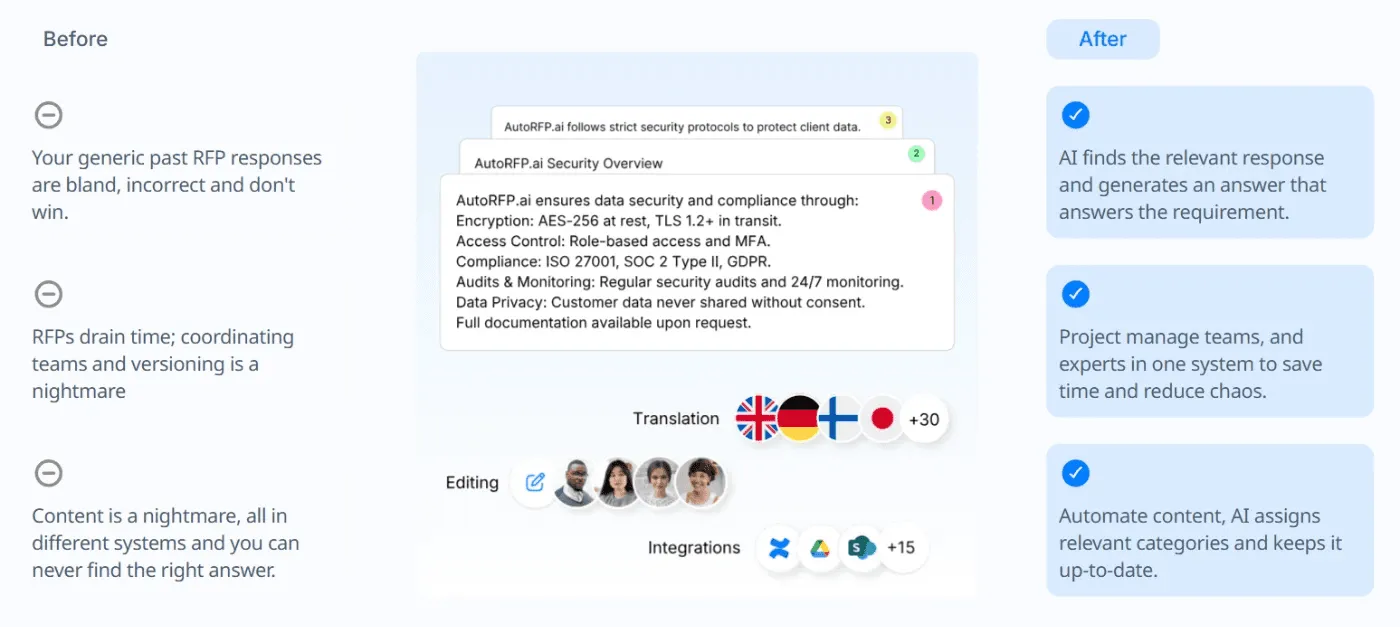
Advanced AI RFP tools like AutoRFP.ai can auto-suggest answers by searching previous responses plus a content library.
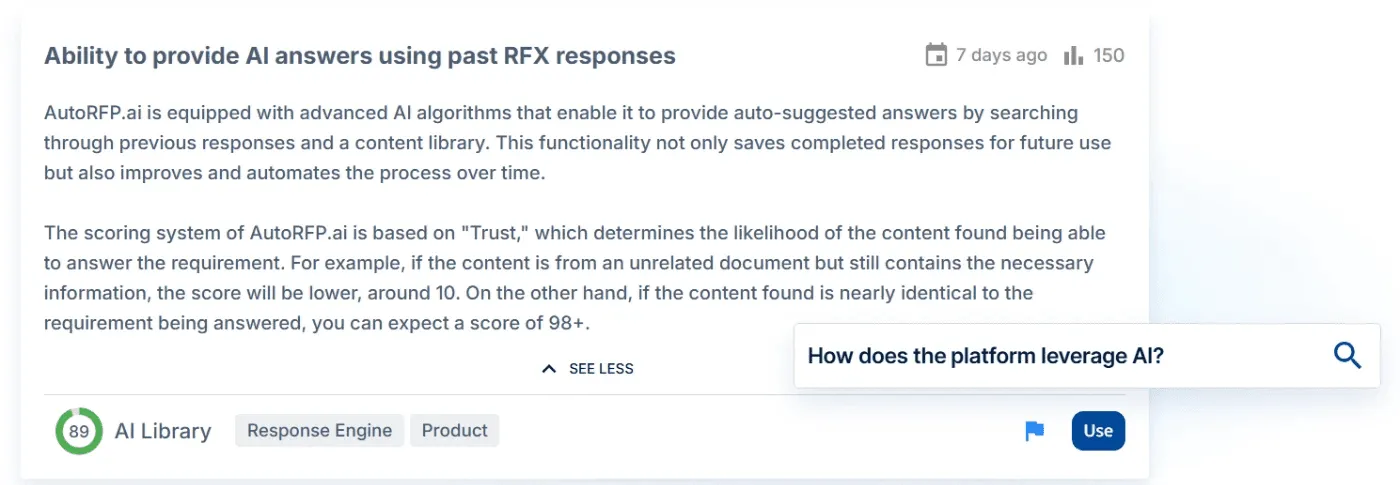
You can search by meaning, not keywords, and every approved response is automatically categorized and added, so your library improves with every RFP with no manual upkeep.
According to AutoRFP.ai’s 2026 Proposal Win Rate Report, 59% of high-win teams use content library automation.
2. AI-Assisted Response Generation
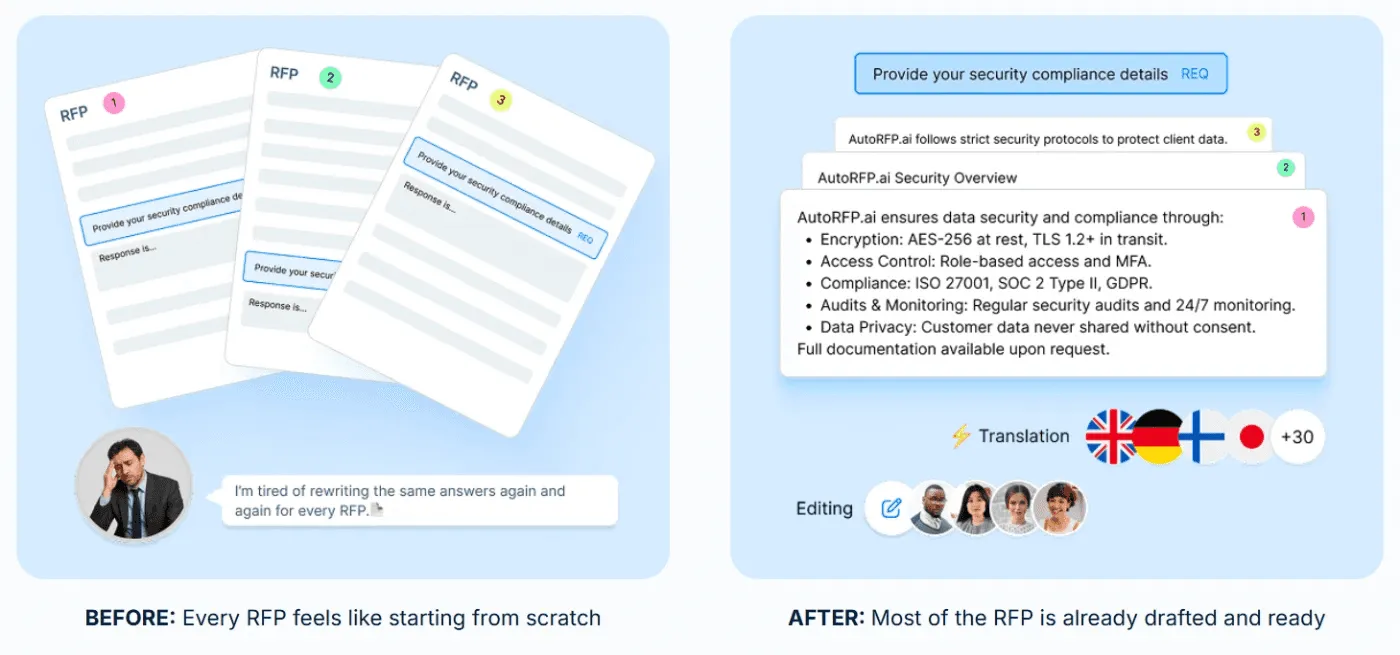
Another core capability is AI-assisted drafting. The goal is not to replace writing, but to generate accurate first drafts fast using AI trained on your winning responses.
“In working with over 200 companies moving to an AI-first approach, we’ve learned that the real advantage isn’t simply automating content. It’s what teams do with the time they get back. The winners use it to invest in their processes and provide more insightful responses.” – Jasper Cooper, Co-Founder and CEO of AutoRFP.ai
3. Collaboration and Workflow Management
RFP technology should include workflow tools that assign owners, track progress, and keep SMEs accountable.
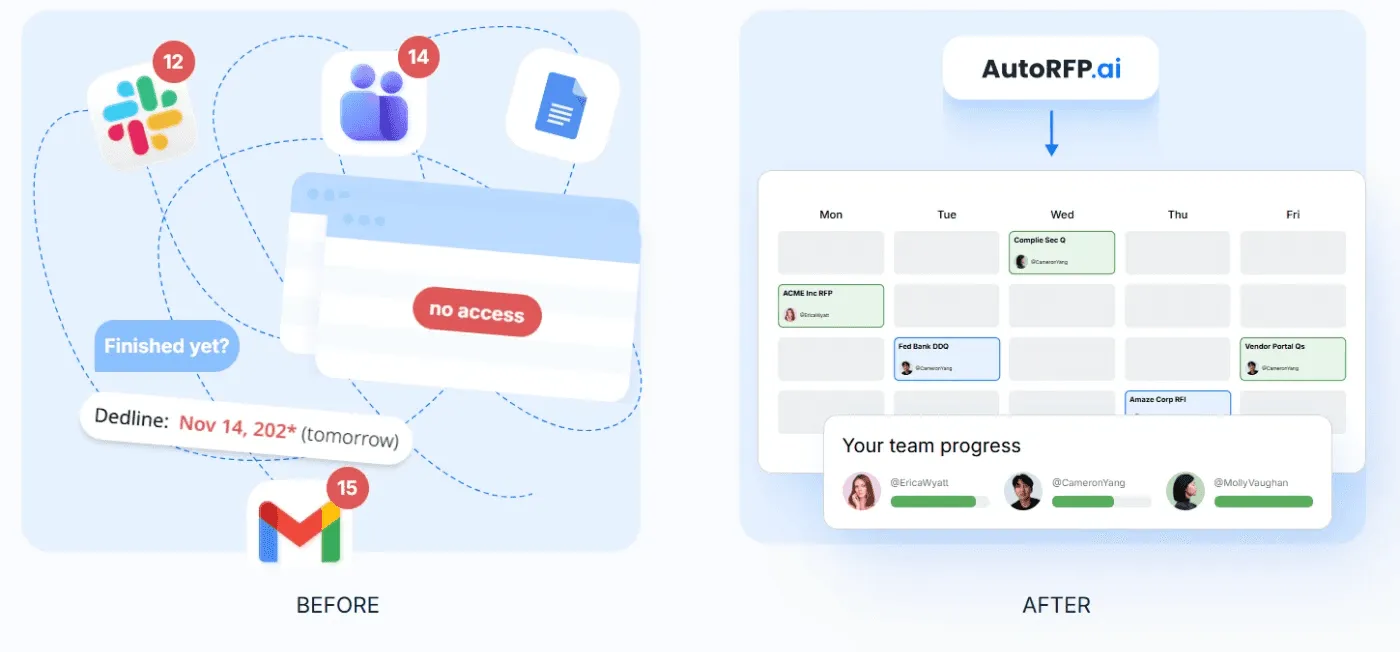
This capability replaces spreadsheets, email chains, and daily check-ins with real-time visibility across RFPs, RFIs, DDQs, and security questionnaires.
4. Integrations with Existing Tools
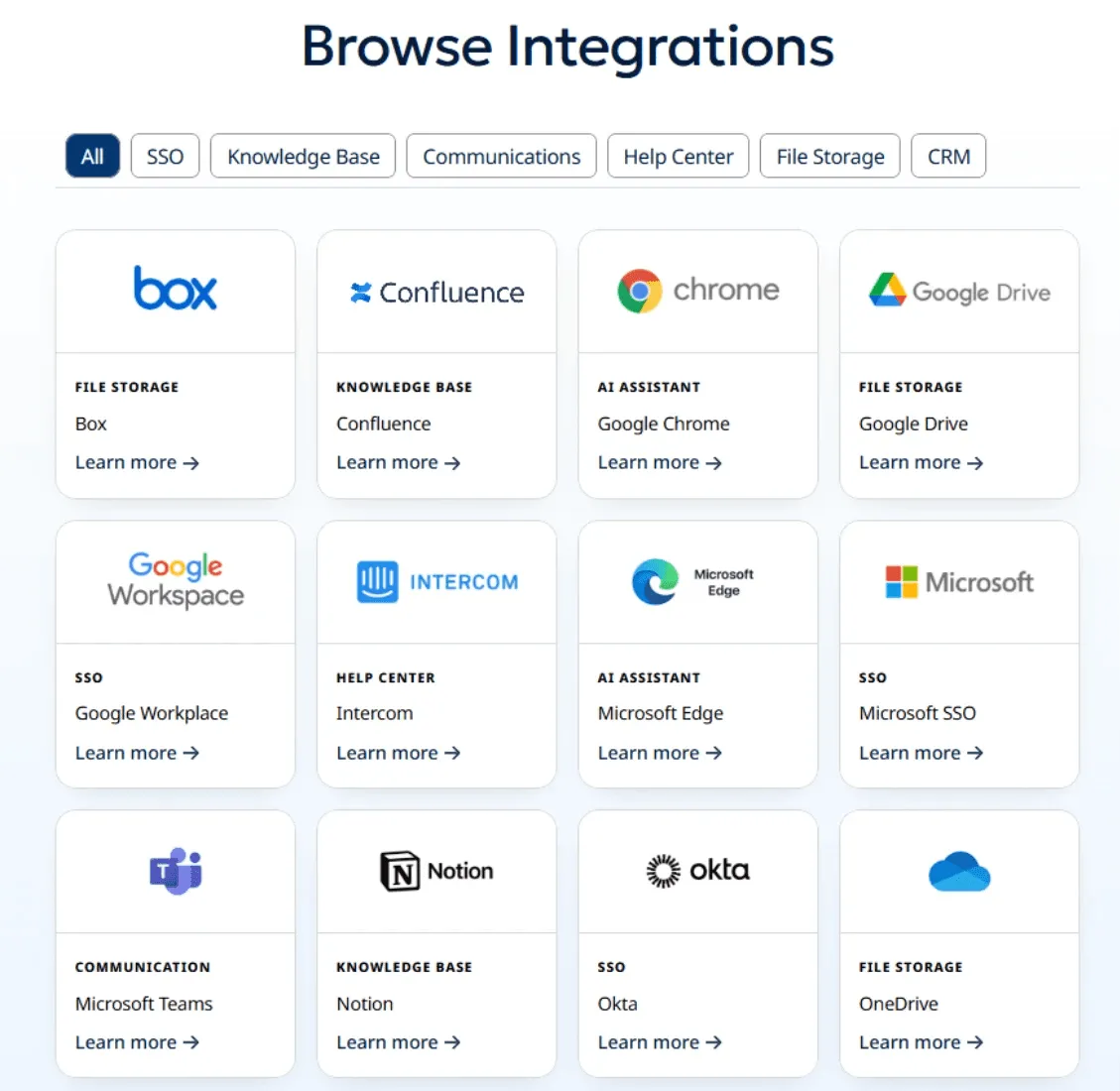
Core platforms also integrate with the systems teams already use, including SSO, knowledge bases, communication tools, file services, CMS, and CRM. Integrations with Teams, Slack, Google Drive, and similar tools reduce manual work and prevent content from getting stuck in silos.
5. Reporting
Reporting is another core capability that separates modern platforms from legacy tools.
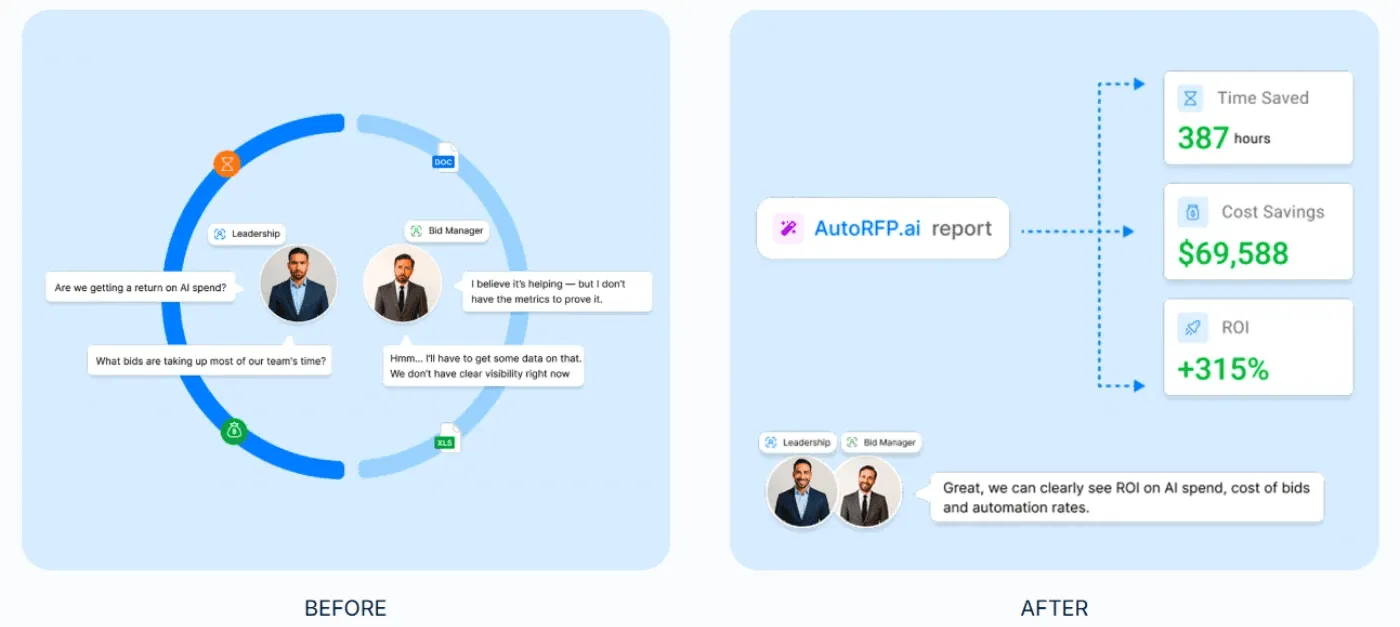
Strong RFP technology tracks automation rates, cost savings, and team efficiency across projects.
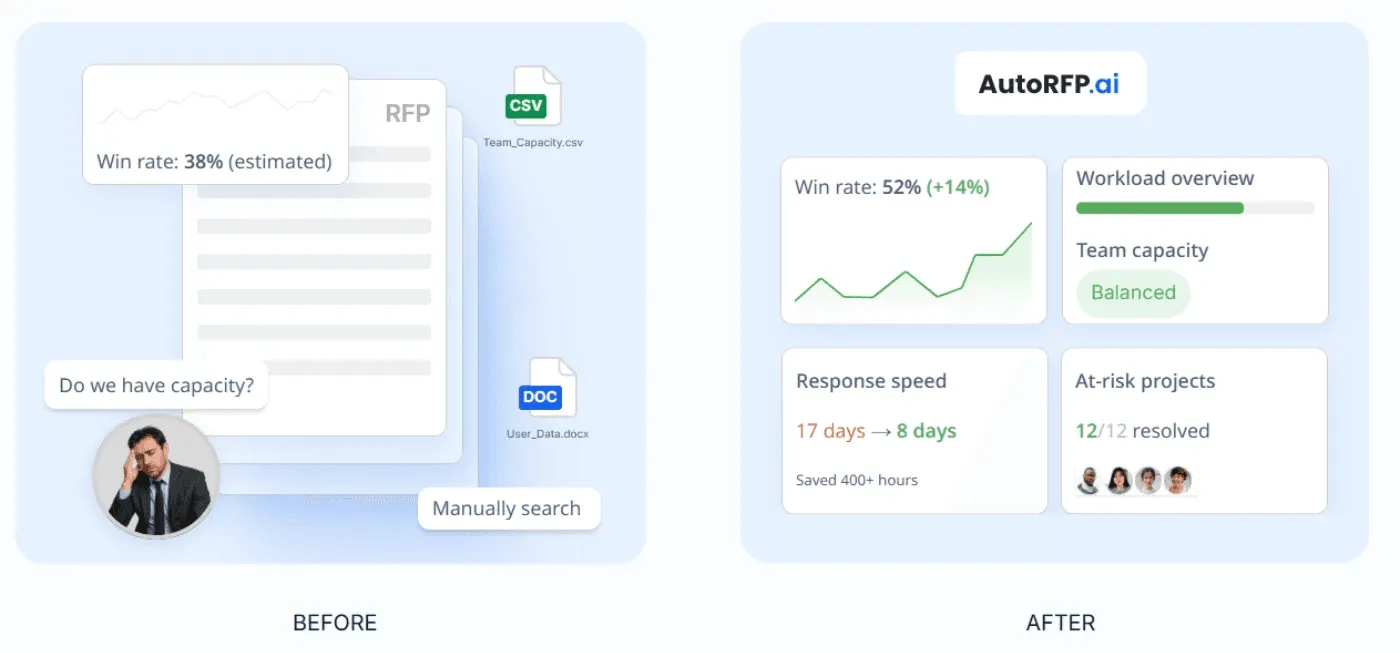
It also reports win rate, team capacity, volume, and velocity, enabling leaders to plan resources without guesswork.
6. Security and Compliance Controls
Finally, enterprise-grade security is a core capability. Good RFP technology should be GDPR-compliant, offer EU, US, or AU hosting options, and meet standards such as ISO 27001 and SOC 2 Type II.
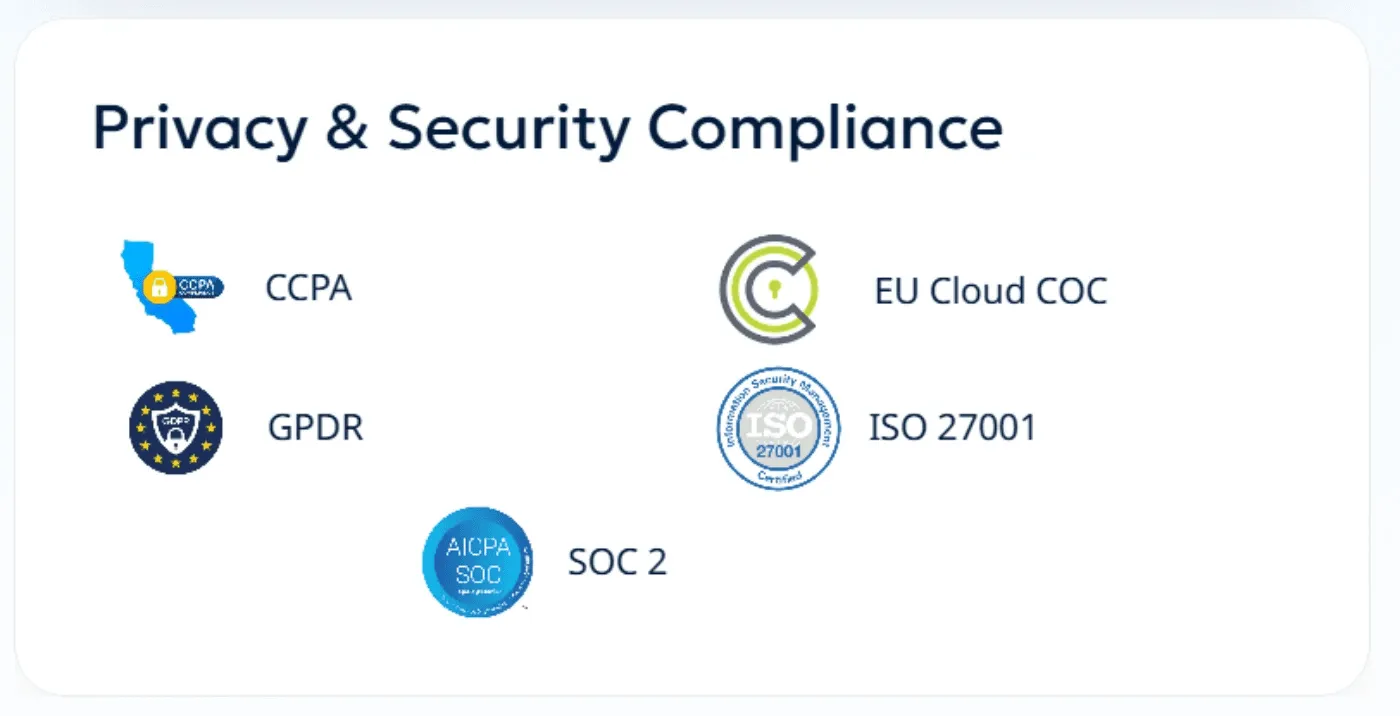
It should also ensure customer data is not used to train public machine learning models, and that data is used only at runtime and not retained after completion.
How AI & Automations Are Changing RFP Technology
AI and automation are shifting RFP work from manual assembly to faster drafting, smarter reuse, and earlier risk control.
| What’s changing | What it enables |
|---|---|
| Much faster response times | AI can draft first passes for complex RFPs in minutes, so teams spend more time tailoring and validating. |
| Smarter content libraries | Libraries are moving from manual tagging to meaning-based retrieval. AI pulls the most relevant past answers, suggests improvements, and keeps responses consistent across documents. |
| Automatic intake and structuring | Drop in a Word, Excel, or PDF. AI extracts requirements, sections, and context automatically. |
| Go/No-Go screening | Automation checks RFPs against criteria upfront and flags impossible requirements before the team wastes cycles. |
| Portal questionnaire automation | Scrape questions from portals, generate answers from your library, and export back. This can support systems like Ariba, UpGuard, and Jaggaer. |
| Gap analysis at scale | Track compliance answers across history, aggregate patterns, and spot repeat non-compliance risks. |
Side note: AI proposal tech is now mainstream in higher-performing workflows, with 65% of high-win teams using it.
This video shows what modern AI-driven RFP workflows look like in practice:

Video transcript
Transcript is auto-generated and may contain minor errors.
Have you ever wanted to know how AI can answer RFPs? That's what I'm going to show you today using the power of AutoRFP.AI and how you can use AI to automate up to 80% of your RFPs. My name is Rob from AutoRFP.AI. Let's jump into it. AutoRFP.AI, we're a software product leveraging the latest models from OpenAI, Anthropic, and Google to automate our customers, whether that's technology companies, finance companies, healthcare businesses in 44 plus countries across the globe automating their RFPs. But, our goal is not just to automate, but to help them win. So, let's look at the RFP response market in 2025. We have our legacy RFP software players.
That's your Responsive.AIs, your Loopios, Qvidians, have been around for, you know, 10 plus years and really brought software to the RFP process in managing your subject matter experts and team members, project management, in having a question and answer bank, and using keyword search to automatically copy and paste answers from your content. Then, you have a lot of really new Silicon Valley based AI RFP software. It seems like every week there's a new AI RFP software. Probably no surprise to you watching this video. AI is a great use case for RFPs. There's a lot of new startups in the space. AutoRFP, we're actually in a nice position having launched 3 years ago before chat GPT released and building
our product since then with hundreds of customers all across the globe from Fortune 500 companies to Silicon Valley tech unicorns using our software every day to automate the mundane. That is what an RFP is, isn't it? It's a bit mundane. What kind of challenges do businesses and team members have when they search for an RFP software? You might be spending like Amanda here, who is one of our customers before she picked up Order RFP, spending a lot of time just answering RFPs. That raw horsepower needed to complete thousands of questions across these large documents, whether it's Word documents, PDFs, Excel spreadsheets, supplier portals like SAP Ariba. Amanda, actually their COO at that company, would spend an entire weekend
just answering an RFP. We've all been there. I have as well. Or you might be like one of our customers, Jason, before he picked up Order RFP, using a lot of time to maintain his legacy RFP software. He had this big content library of questions and answers and constantly was having to spend time just maintaining that, where he was now spending more time stuck in content nightmare land than actually answering RFPs. It was really challenging. Or you might be like one of our customers, Katie, before she picked up Order RFP, was spending a lot of time just trying to version control, wrangle subject matter experts to answer questions, and just the speed of collaboration and project management deadlines was really tough.
So, what AI workflow then automates this entire RFP process? First, people would upload their requirements, those RFP tender documents that you receive from your prospects in any format they come, whether that's PDF, Word, Excel, zip file. Upload all that relevant information into the system, and then it'll begin answering with AI those different responses in 40 plus different languages, whether you receive an RFP in German but write answers in English and have it translate back. It uses your data lake of content and AI to find the relevant information to then automate an RFP response to every single requirement and every single question. Then, once that's done, you have that
highly automated AI first draft, you get your team in there, project manage deadlines, ensure that there's proper oversight on responses from legal, security, pricing, commercials, whoever it is, they're engaging in the product and using it to collaborate and get that winning RFP response. You don't want to just automate, you want to win. And that's where Auto RFP really shines, because as you're writing those winning responses, it just gets better and better over time, constantly learning from your work. Awesome. Let's jump into the product. This is AutoRFP.ai. You can see I have all my different projects. I'm going to create a project. And here is my blank RFP documents. I've got a zip folder that contains three different documents in here. Really interesting what's happening right now is we're using Gemini Flash
2.5 to automatically answer any questions in relation to that document. So for instance, I want to know if data needs to be stored in specific geography and provided my answer there. So it's doing an AI go no go analysis. Then here we have our document. It's got multiple tabs in Excel spreadsheet. Automatically the AI has scanned the entire document and picked up every functional and non-functional requirement, everything that's relevant for my cover letter that I'm going to produce in my PDF. And then this appendix B has some information as well. Then we have our data lake of content in AutoRFP.ai. That might be your web pages, your integrations, 15 plus integrations that AutoRFP can pull in and sync automatically. And the AI is going to use specialized re-ranker models to then ensure that there's the
most relevant answer for that specific question. It's much better than just creating something in ChatGPT. I'm not going to do a translation today, but here I would translate if needed and I create my project. This is where we see the magic really happen. So we have our data lake of information, which is all our content from our business, the context, past RFP responses, and then we have the AI sourcing the relevant information, then the AI from that information drafts relevant answers, and we have multiple LLMs that then ensure that answer is the best it can be for that response in the entire context of our business and the entire context of the RFP. You can see that it's quickly answering those different RFPs. We can jump to different sections and see cool, RFP workflow, it's answered. Oh, there's a
few questions there that have a lower trust score. Let's jump into to understand why. So, that content there is relevant to the search query, but it's 7 months old. I want to make sure that a person reviews and actually submits a new answer for that. So, everything in my RFP workflow, I'm going to then assign George to be the editor for that response. George will be at receive a notification in Slack, in Microsoft Teams, or via email. George will be able to jump in, answer those, and then submit them for my review. So, that's how I collaborate seamlessly across OrderRFP.ai. Then, across my trust scores, I want to look down and find those that are still generating and any that are at lower trust scores, and again, further answer those questions and assign to different team members as relevant. We've got our drop-downs that are in the RFP were automatically assigned by the AI depending on the answer. Our
responses automatically generate and bring across tables, so I have my service level agreement, my SLA here, answered in a table and generated into the response. Images that you might have in your RFP response will also come through automatically with your content with the AI generating as well. I want to jump over to my project overview. I understand when this project is due, what the AI draft rate was, what my compliance levels are, who is involved in this RFP process, how many do they have to review, do I need to send any reminders? If I want to add any attachments to include in my submission. So, I'm going to uh include my ROI report, my integrating with Notion doc, and all the different information that I want to include in that submission, I can do so. Then I have my AI assistant. So, in
answering these responses, I can prompt and write custom prompts to improve that response. I can use my quick writing actions to fix up any spelling or grammar, check for inconsistencies, and so on. I can find and search with my AI semantic search to find any relevant content and use those answers as well. Then I can improve that response. Then in my comments, I can discuss with my team. Please review this specific part. So, then I can comment and collaborate with my team. Once I have my edited response from the AI, I can accept and see where those revisions are, and quickly accept that new response. I have a full audit trail of any AI actions as well as people actions over my responses. I can restore to previous versions. So, you never have a collaboration and versioning issue.
Everyone, multiple people at once, are working in OrderRFP. And then what I think's one of the coolest things is the AI assistant. With the relevant content and context, I can just chat to the AI regarding my business, regarding this RFP, regarding these requirements, and it can provide answers to help me improve my responses as I work through the RFP. Next, I'm going to approve all my responses because this one is ready to submit. So, now all I have to do is export that RFP. Now, all I have to do is export that RFP. So, I click export all and the power of AutoRFP and the AI involved here, I'm not fiddling around with those original source documents, inserting or copy and pasting answers. Instead, it is
automatically populating those answers in there. We've downloaded our files in those original format with AI having answered and automated our RFP process. I'm going to jump into We have two things here. We've got our customer files, which are the original documents that required answers, and we can jump in here and see all those answers and where they've gone. So, across my multiple tabs, we have all of my responses and the drop-down that's come through for every one of those responses with me not having to do a single thing, and then I'm ready to submit that Excel spreadsheet with those requirements. I've got my docx as well with the relevant information filled out, and one of the coolest thing is I have my cover letter or my proposal that I can include in that pro- process, and this includes all
relevant information and additional information on my RFP response. So, my export template that I created in Word doc and uploaded to AutoRFP as a template, the AI has then automatically generated answers and responses for my executive summary, for my transmittal letter, and for everything that I want to upload additionally, whether it's a solution overview, whether it's more information about our AI security and privacy, and all that information has come through, and the AI has filled this out. For instance, there's my SLA table that we saw the AI generate earlier, and it's filled that information out ready for me to then submit and add, includes any images like reviews across Gartner, and all that information has come through ready to export to the customer. And that's the end-to-end workflow of
AutoRFP.ai, from uploading my blank RFP, leveraging my data lake of organizational context and past RFP answers, for the AI then to automatically generate and respond to and automate the RFP process, to collaborating with team members across the entire RFP process, and then exporting to the original customer format and submitting my RFP. There's one really important thing I want to make sure to convey when you're thinking about AI and RFP software. And that is what might be the boring, but incredibly important security, privacy, and transparency. At AutoRFP.ai, we pride ourselves on getting security, privacy, and transparency right from day one.
Our customers, as I mentioned, in over 44 plus countries, hundreds of businesses from Fortune 500 to Silicon Valley unicorns using AutoRFP daily, have global hosting options across the US, across Europe in Germany, and in Australia for APAC. Everywhere we have global offices, an office in Vancouver, in Stockholm in Sweden, in Brisbane, Australia, providing 24 six support across the globe. There is zero training, and I want to make sure this is absolutely clear, zero training on customer data for models. We are not sending any customer data back to the OpenAIs, the Anthropic's, or the Google's of the world. Your data, customer data, is your data. The outputs that the AI generates is clearly stated
in our service agreement that those are your outputs. You control this data. It's not AutoRFP. We're not secretly building some sort of AI model ourselves for based off customer data. We're not secretly trying to hurt our customers in the long term. We build for our customers. AutoRFP is a bootstrap company, profitable, growing 15% month-on-month, headcount doubling every six months across the demand we have for our solution, and we build it for you, for our for our customers. We don't build it for venture capital to one day uh try to sell the company. We don't build it for private equity that are trying to lay off and you know, squeeze every penny from the business. We do it for our customers. That's why we built. And you can find out all that
information in our trust center and our legal center as well. If you're interested in jumping on long and learning more about AutoRFP.ai, head over to our website. We've got a lot of information there about the business, uh the product, about our pricing as well. Uh you've got our annual plans across scale, accelerate, and enterprise. We have customers with as little as 24 projects a year, so 24 RFPs a year, to as much as over 1,000 RFPs done every year. The scale uh all the way in between. You can book a demo and spend time with our team, and they can provide a much more uh You can spend time with our team, and they can provide You can spend with time with our team, and they can provide a much more detailed breakdown and a customized demo for you and your business about AutoRFP. So, head over to AutoRFP.ai today and learn more about it. Thanks. See you.
So, head over to AutoRFP today. That I'm Rob from AutoRFP.ai, and we just covered off AI and how to automate your RFP process with AutoRFP.ai.
“Previously, our content was disorganized and unruly. The largest factor in improving win rates, outside of our product growing stronger, has been leveraging AI across our content. We now sell four product suites across 3 continents, without organization, chaos reigns.” – Jake Phillpot, CEO at Workforce.com
RFP Technology Types You Should Know in 2026
These are the core RFP technology types teams use to draft faster, enforce compliance, and send submissions on time.
1. Libraryless Semantic Search Plus On-Brand AI Drafting
This type of technology focuses on meaning-based retrieval and AI drafting, enabling teams to reuse winning language without building a manual library.
Key features:
Advanced AI auto-suggests answers by searching across past responses based on meaning, not just keywords.
Finds conceptually related content regardless of wording and connects ideas across your full response history.
Libraryless approach with no setup time required to build libraries, taxonomies, or folders.
Gets smarter with every RFP you complete, with zero manual organization required.
Generates first drafts, answers common questions fast, and helps teams reuse winning language without copy-paste.
Pros
Fast adoption with minimal setup.
Strong consistency from the reuse of proven answers.
Cons
- Quality depends on the strength of your past responses and source materials.
Best for
- Teams that want AI-first drafting plus semantic search without the overhead of maintaining a library.
Examples
- AutoRFP.ai

Video transcript
Transcript is auto-generated and may contain minor errors.
Hey, I'm Rob from autoRFP.ai. What is autoRFP.ai? Well, autoRFP.ai is an AI software as a service or SaaS application that does AI for proposal or RFP responses. That includes RFIs, like request for informations, includes due diligence questionnaires or DDQs, and includes security questionnaires. So, you can find all about us at autoRFP.ai. So, we're a technology company. We have offices all across the globe including Brisbane, Australia, Vancouver as well. And effectively, our tool allows, whether it be bid managers, sales people, proposal writers, RevOps team members, sales leadership, answer complicated request for proposals. So, what is a request for proposal? You can see one of our other videos below in the description. But effectively, our system
looks something like this. And it lets team members, and you can have unlimited number of people log in to autoRFP.ai, good product, allows people to go in, create projects, which would be for instance an RFP. I can go in here, create my information from my zip file, and that includes, you know, like an Excel spreadsheet, PDF, Word doc. We can run an AI go no go project analysis on the RFP. And then effectively from that, we can bring in all the information in terms of what are the questions, where our AI automatically scans the documents and figures out what is being asked of the RFP, whether it's multiple tabs in an Excel spreadsheet and everything else, whether it's drop-downs. And that all happens automatically through the power of AI. Then, we generate our response, and we can do it in in 40 plus different languages and adding languages all the time. Once you've imported your RFP into order rfp.ai,
you can collaborate with your team members assigning different people to answer the questions, review the questions, looking at an overview of the entire project and project managing due dates. Now AI effectively starts automatically answering those different questions based on your knowledge documentation. So that might be your website, your help docs, your technical documentation, your past RFP answers or security questionnaires, your security policies. But effectively all that different company information you import into order RFP and then our AI leverages that to create an AI first draft of an RFP response. Once we're happy with all those requests, we can approve it. That goes into the model to learn from and add to. So your current responses are automatically used for new responses and then you can export that as well. And then the final cool thing about order RFP is you have a lot of different
integrations that you can pull in, whether it's knowledge documentation from places like Notion, Google Drive and so on. So that's order RFP. We're an AI SaaS app. Uh you can host globally. We do not use customer data for training purposes or to send it back to LLMs. So we're secure and private. We have our ISO 2701 certificate and our SOC 2 certificate and then you can find up-to-date pricing and information on our website. Or if you came to learn more, you can book a demo and schedule time with our team. Thanks.
Book Demo of AutoRFP.ai to see how libraryless semantic search turns your past wins into on-brand first drafts in minutes.
2. Response Management, Reuse, Workflow, Plus Compliance
This technology helps teams keep answers consistent, manage SME input, and control approvals so RFP responses stay clean and audit-ready.
Key features: Response library plus tagging/search, tasks/owners/deadlines, SME comments plus approvals, version control plus audit trail, permissions plus compliance support.
Pros: Reduces rework and inconsistency.
Cons: Needs governance to stay clean.
Best for: Teams with multiple SMEs plus frequent product, legal, or security updates.
Examples: Loopio, Responsive (RFPIO), Qvidian.
3. Niche and Industry-Specific RFP Tools
RFP platforms in this space are designed for GovCon and technical bids, where strict structure, compliance, and repeatable formats are non-negotiable.
Key features: Industry workflows, compliance tracking, structured authoring, past performance libraries, requirement mapping, and regulated export formats.
Pros: Strong fit for strict, high-stakes bids.
Cons: Less flexible outside the niche.
Best for: GovCon, technical industries, security-heavy proposals.
Examples: XaitPorter, QorusDocs
4. Specialized Proposal and Design Software
Visual-first proposal technology helps teams create more interactive, engaging proposals.
Key features: Visual proposal design, interactive pricing, web-based proposals, embedded media, e-signatures, and tracking.
Pros: Better-looking proposals plus faster approvals.
Cons: Not built for RFP governance or compliance.
Best for: Sales-led proposals, productized services, shortlist pitches.
Examples: Proposify, Qwilr.
This brief walkthrough covers the main RFP software categories and how to choose the option that fits your team.

Video transcript
Transcript is auto-generated and may contain minor errors.
Hey, I'm Rob from Auto RFP.ai. We're going to go into the best RFP software in the market. What is RFP software? And jumping into it, looking at some of the different major players, and helping you hopefully decide which ones are worth having a look at. If you are interested in having a look at them, I recommend going to their website. RFP software in the market in 2025, you can break down some of the best players into two main markets or two main camps. You've got your legacy RFP software providers, like Loopio, Responses, Qvidian, which I'm going to go into detail. And then you've got your AI native players, like Auto RFP.ai I'm from. You've got Tribal, HeyRFP, Shift Hub, and and plenty of others as well. So, what are the difference between the two? Your legacy RFP software, they have generally been around since early 2000s. They brought software to the RFP process. RFP software providers
effectively built an ability for a company to store all their documentation and information and kind of questions and answers. So, it's like a question and answer bank. They built these big banks of answers and questions for companies. Then when they would get a new response or new RFP, it would use keyword search to copy and paste from the Q&A bank into that new RFP uh that they just received. So, that's what a legacy RFP software is. Then you have your AI native players who have launched since the huge uptick in AI with ChatGPT in uh what was that? 2021. So, Auto RFP.ai, we actually launched a couple of weeks just before ChatGPT came out. I've been building the product over the last three or four years with hundreds of customers. And effectively, your native AI players don't have all that legacy tech debts. They're built with a basis of being a vector database, which is a specific term with AI. They then use AI semantic
search, which effectively takes in the context of responses. And when you get a blank RFP, it'll pull in not just information from your Q&A bank, but from your website, from your case studies, from your integrations and different knowledge sources, and eventually use that to answer the RFP. So, that's kind of the nuts and bolts of it. You've got your legacy players who some do actually have AI now as well. And then you've got your AI native players. As I mentioned, you have all your content. That is generally your Q&A banks, your past responses, it might be your Google Docs, your SharePoint, Confluence, Notion, all your different information that you think holds relevant content for an RFP response. You upload that to the system or you integrate great and pull it through automatically. Then, when you have an RFP, you upload the RFP, create a new project. The AI, generally speaking, your AI native players, this is how it works.
It's going to automatically start drafting the responses or using a powerful AI semantic search to use to find relevant verbatim responses and effectively draft responses. It's going to allow your team to collaborate, set project deadlines, bring in subject matter experts to help answer that RFP. The really big thing about AI RFP software is it uses reinforcement learning to continually improve. And from your new responses, as you approve them, it gets better and better as time goes by. That's your RFP software in a nutshell. Now, how you can help determine what are the best RFP software. I would really recommend jumping on G2 or Gartner, having a look through actual verified user reviews. They'll have lots of different information regarding the RFP software. You can kind of click into each of those and understand it a bit better, the pros and cons, and so on. The RFP software is a pretty fast-moving
market, so I'd definitely recommend looking at a number of tools. Most of the providers here that you'll that I'll go into, you can book in for, you know, a 30-minute, 45-minute online demo just from their website. Hopefully, they don't have to do too many discovery questions. They jump on that call and they show you through the platform. So, your RFP software, like I said, you've got your Responsive, your Loopio. So, when you're looking at G2, you can look at, you know, the number of responses, but also you want to focus on the quality of responses, so what the actual total score is. And I would say anyone who has more than 50 or so reviews, as you can see, that's kind of how I made the short list today, is generally kind of worth a consideration to have a look at as well. Then you have Gartner. So, Gartner for your best RFP software has all the relevant information in relation to those different providers. Again, the reviews. You can understand more about each of those providers and what people are actually saying about those software. So, we've had a look at the review slides. Let's jump into some of the RFP software market's providers for 2025.
Loopio is an RFP software provider, one of those what you might classify as a legacy provider. They have a lot of really great large logos. They have been in the market for quite a long time now. Effectively, the basis of that product is kind of a question and answer bank using your past responses to then copy and paste when you bring in a new empty RFP. It's kind of the general gist of the product, and you can find out more information about Loopio from their websites. You can book in for a demo to chat to their team to understand more about them, and so on. Under plans, they have some information about their pricing. They don't have public pricing, but you can request a quote and get more information regarding their pricing. I believe their pricing plan has add-ons, so you can take that into account in relation to finding the right package that meets your requirements for what you're looking at. Responsive or responsive.io, they are also acquired a company called RFP360. If someone's referencing RFP360, that also is responsive.io or responsive.
Responsive is an RFP software. Again, one of those legacy providers that have been around for quite a while, have a lot of really large customers, and you can kind of get to know more about their product by going to their website. So, you can see here like I said, you effectively have a question and answer bank of your past responses, and then you can upload documents, your blank RFPs, and it helps answering those and has your different reporting and project management capabilities, and so on. If you want to chat to their team, you can request a demo, get to know them better. Or, in their pricing, the yeah, their pricing isn't available on the website, but you can obviously get a quote from their team, and I believe they also have paid add-ons as well in some ways. There you go, paid add-ons as well to find a plan that meets your your business's requirements as well. So, that's responsive.io. Now, jumping onto the next best RFP software, we have Qvidian. So, Qvidian is part of a much larger
family called Upland. They have a lot of products across their entire suite. Qvidian is one of those legacy RFP software providers that is a Q&A bank and uses your past RFP answers to help answer RFPs. You can, of course, find out more information on their websites. You can request a demo, and so on. What we found is that Qvidian generally has a lot of financial services customers, so those in managed investment funds, and so on. Next you have order rfp.ai. So that's where I'm from. Order RFP, we were one of the first AI native RFP software. So like I mentioned, that means our entire premise of product is based on effectively a vector database which is all your relevant context that might be used to answer an RFP. Then when you have a blank RFP, it comes in and then our system uses AI to generate responses, provide trust scores to see if you can trust the responses, has AI
actions to iterate and improve on the responses as you go and kind of work through your RFP. Then you then export that RFP back into the exact same format, translate it if necessary to different languages and so on. You can of course find out more about order to our team. If you'd like to book a demo with our team across the globe, we have global offices. You can find out more about some of our customers on our website as well. And then in our pricing, we do show our pricing in relation to some of our different plans there as well. So you can kind of see what makes sense for you. Our pricing is based off projects per year. Oh, I didn't mention about Loopio and Responsive. As far as I'm aware, their pricing is based off like seats. So number of team members that you might have used the tool. So you might actually come across different pricing models across some of the RFP software in a list of top best RFP software. You can find out more about order rfp.ai and chat to our team if you'd like. Go Jumping on to next, you've got Hey Iris. So Hey Iris is another AI RFP native
software provider. Again, one of the newer ones. They've got a video there that kind of showcases and goes through parts of their product, some of their customers as well if those are relevant customers to yourself. I don't believe they have pricing on their websites, but if you'd like to get in touch with their team, you can of course book a demo to understand more about them as well. Then you've got another one which I wanted to throw in is Shift Hub. Shift Hub is a little bit different to some of the others where they just focus on security questionnaire automation. Although all the RFP software I mentioned, whether it's Loopio, Auto RFP, Hey Iris, they all can do security automation questionnaire automation. Shift Hub just focus just on that. And you can find out more about their site by going there. And again, similar to Auto RFP and Hey Iris, you know, using AI to help answer those security questionnaires and so on. And you can kind of I don't believe they have pricing on their website, but you can understand more about them by obviously booking a demo and chatting to their team as well.
Next, you have Tribble. So, Tribble or tribble.ai is a little bit different to the other ones as well. Tribble, as far as I'm aware, isn't necessarily a product you log into, but it's a Chrome extension that then works in where you work. So, that might be Google Docs, Google Spreadsheets, you know, kind of completing RFPs in G Suite. It then comes in and answers different questions within those documents for you. So, that's Tribble. Yeah, they they again still integrate with like your knowledge base and support docs and those different information just like Auto RFP does. And you know, pulls in different information to help to help answer that as well. Don't believe they have pricing on the their website, but I'm sure there's some more information here as well so you can understand you can get to know them better. And you of course can book a demo as well and chat to their team if you'd like to learn more. So, that was our comprehensive list of best RFP software for 2025. So, we've got your legacy players, like I mentioned, your Loopio, Responsive, Qvidian. And then you've got your AI
native players or kind of like disruptors in the space, you know, your Auto RFP, Hey Iris, Tribble, Shift Hub, and so on. If you'd like to find out more about Auto RFP, obviously get in touch or any of the others, you can obviously visit their website and book in for a demo. So, that was the best RFP software for 2025. Thank you.
How to Choose RFP Technology for Your Organization
Pick RFP technology based on your workflow and risk, and here’s how to do that:
| What to check | What it means in practice |
|---|---|
| Start with your real workflow | RFPs only, or also RFIs, DDQs, security questionnaires, plus portal submissions. |
| Continuous, insight-driven system | Integrates capture, content, governance, and AI into a single system. |
| Prioritize contextual retrieval | Systems that surface relevant, accurate, context-aware content based on meaning and requirements, not static libraries and manual tags. |
| Check governance built in | Roles, approvals, versioning, and audit trails should be native, so “approved” actually means something and stays current. |
| Validate AI quality | Can it draft from your winning responses, support Q&A, and offer one-click edits for clarity |
| Workflow and accountability | Owners, reminders, blockers, and real-time progress across every section and question. |
| Request demos | Request a demo and ask them to run it end-to-end |
The Future of RFP Technology
Here’s what the future of RFP technology will likely look like.
| Future of RFP tech | What it means |
|---|---|
| Automation is becoming core | AI handles intake, structuring, compliance checks, and first-pass drafts so teams spend time on strategy, tailoring, and proof. |
| Governance becomes a product feature | Built-in, risk-based review flows (by deal size and compliance level) so drafts move fast without losing accuracy or control. |
| AI becomes baseline, not a differentiator | Many teams already use AI (including about two-thirds of top performers), so your operating model and content quality decide outcomes. |
| Integration and intelligence will deepen | Tighter connections across the RevOps tech stack, including CRM and contract systems, to surface predictive insights, reduce errors, and create more proactive workflows. |
Start Using AutoRFP.ai for Faster RFP Responses
The best RFP teams do not rely on heroics.
They rely on repeatable execution. AutoRFP.ai helps you build that rhythm, so handoffs are clearer, edits are cleaner, and submissions stop turning into last-minute scrambles.
Start using AutoRFP.ai today and book a demo to see it in action.
Frequently asked questions
How does semantic search in RFP technology reduce “guesswork” during reuse?
With keyword search, teams have to guess the exact words someone used months ago. Semantic search understands intent and context, so it retrieves relevant content even when wording differs.
Is RFP technology secure?
Yes, it depends on the tool you choose. RFP platforms can be secure if they meet enterprise standards, including GDPR compliance, EU/US/AU hosting options, ISO 27001 and SOC 2 Type II certification, no external AI training, and data sovereignty controls.
How does AutoRFP.ai differ from RFP technology compared with library-based platforms like Loopio/Responsive?
Loopio/Responsive-style platforms usually require a full content library before you see value. AutoRFP.ai is libraryless, learning from approved responses, so you skip upfront library builds and ongoing manual organization.
