
How to Improve Your RFP Process: 7 Key Steps to Win More Bids
Discover how AI-driven RFP response tools boost efficiency, accuracy, and collaboration in procurement.

Robert Dickson
RevOps Manager, AutoRFP.ai··9 min read
The first step in improving the RFP process is admitting that it needs to change. Too many teams try to get great results from a broken system, which costs them both money and time.
In this article, I’ll walk you through practical steps, best practices, and real-life examples that’ll help speed up your response process, improve how you approach finding RFPs, with recent RFP statistics showing just how much even small win-rate gains can impact revenue.
What Is an RFP Process
The RFP process is the systematic way companies respond to requests for proposals from potential clients. This process involves analyzing a proposal’s requirements, answering questions, and presenting a strong case to win the client’s business compared to others.
7 Key Steps to Improve Your RFP Process

Video transcript
So you've just received an RFP. Maybe it's the first time you're doing it. Potentially you're an experienced bid manager, and you wanna understand what is the RFP management process, like process, challenges, and how do you win these highly competitive and challenging bids? In this video I'm gonna show you through the exact RFP management process, challenges, share with you some data in relation to winning bid teams and how they win these complex bids that can really elevate your business. Let's jump into it So why does RFP management matter? An RFP or request for proposal is when a large organization, let's say an enterprise with 10,000 staff, or federal government body wants to procure products or services. Where RFP management matters is we surveyed with between AutoRFP.ai and Stargazy over ninety-seven bid professionals in our twenty
twenty-six proposal win rate report. You can find the link below if you wanna have a look yourself of the proposal win rate report. In this report, we found that fifty-one percent of teams without content automation sit in the low win cohort. So in our RFP management video today, we're gonna go into content automation. We're gonna talk about how ninety-four percent of high win teams use joint collaboration with their subject matter experts, not having the subject matter expert drafting. And where this all matters is the median shortlist rate. So the rate of which your RFP makes it to the next stage and isn't disqualified is sixty-three percent for high win teams versus thirty-eight percent for low win teams. So the teams that have very strong RFP management processes and structure, not only are they winning more, but they're making it through the RFP process to the next step almost double or triple the rate of other teams with content automation, joint collaboration with SMEs, and a lot of other things.
So let's jump into it. But before that, I wanted to leave you with this quote: " Most teams lose RFPs because their system is perfectly designed to produce the results they currently achieve." That was in the Proposal Win Rate report from Christina, the founder of the Stargazy community, a bid manager community, and that really stuck with me, is that if you have a poor system for your RFP management and response, you are setting yourself up to fail, which is why RFP management and systems and processes matter a lot more than heroic efforts one-off bid that you spent, hours and hours fine-tuning. But actual process and repeatable ways to win will get you and your business more revenue than just the one-off effort of trying to win a random bid. And finally, sixty-five percent of the bid teams that win the most
use AI proposal tech, which is what Audirfp.ai is and where I'm from. So what is RFP management? RFP management is how you organize everything that happens between receiving an RFP and submitting your response. Think about it could be everything from when you first discover an RFP on a public tender notice board. Let's say it was for a public tender notice board. Receiving an RFP and submitting your response. It involves people, content, and process. So what is the RFP management process? It starts off with a kickoff meeting. When you see it or you receive that private or public RFP, think about who needs to be involved. Get executive stakeholders on board quickly, especially if it's a very highly competitive and commercial bid. What is the response strategy? How are we going to make our response best fit for the evaluation criteria to win the RFP? Draft and assign. Who is doing what section?
How are we going to complete those sections? And overall, what does a great first draft look like? That is where AI can help the most. Review and submit. Who gets final say on the pricing and commercial? Who gets final say on legal? Who gets final say privacy, security, and compliance measures? Make sure that's clear from the start, and be ready when you have your first draft and everything is ready to be reviewed, that it can be submit cleanly to the right people at the right time. Audit and analyze. Something we don't do often enough in bid management is think about how could we do better with this bid? What feedback can we do, and how can we improve for next time? Which leads into that next one, continuous improvement, and that is the difference between a one-off effort and a systematic approach to RFP management and bid response that will get you to win bid after bid versus just that random one bid that you were lucky to get. An effective kickoff meeting does not just rehash to everyone
exactly what the RFP is saying. It is about establishing clear deadlines, where we talked about who is going to submit each answer each section, who's gonna draft each section, who's going to review each section. That's where you wanna have all those people there to establish clear deadlines for each of those contributors. Then you should already have somewhat of an understanding here, but this is where you can kinda lean on the people in this meeting to develop win themes. A win theme is what is your clear competitive advantage or way that you are going to structure your response with persuasive writing, with clear customer stories, that will get you the win in this RFP. For instance it could be an enterprise that cares a lot about security and privacy, and it could be based in the EU, is looking for a vendor who meets certain requirements. And you could be the only vendor, and you may know that you're the only vendor who meets the high-level requirements in relation to security and privacy, and you believe that's a competitive advantage for your company and for this bid.
Overall make sure that you plan all your supporting documents, so everything that the final submission should include. And you can use like an RFP checklist. We've got a pre-submission checklist in the links below. But you can use a pre-submission checklist to make sure, again, all of that is taken care of when you go to submit. And then assign a single project owner who drives accountability. This would often be a bid manager or at least, or a project manager, someone who is keeping an eye on all the deadlines. Clarification questions is an often overlooked part of the RFP process that can really help you understand that buyer and should be used every time. What you don't wanna be doing is submitting a question for the sake of submitting a question. Don't ask something that is very clear in the RFP. That could reflect negatively. But do think of some useful questions, that you can submit back to the buyer that will, help understand their current solution better and what they're currently doing. Map requirements to identify capabilities.
You could look at, for instance, there could be Moscow ratings, there could be mandatory nice to have, must-have, and so on. But each of those requirements you can compare to, evaluation criteria, and you can look at where do you stack up. But every single one of those requirements, where do you stack up just at a first glance? Even better is that step is in your AI go, no go or your go, no-go process before you even start to bid on, start contributing resources. You've already seen if you're actually a good fit for this bid before jumping headfirst. Build a response plan with section owners, deadlines, and review cycles. We discussed that just before. And decide your competitive angle before writing a single word Now, drafting response and assigning owners.
So this is where we actually start to write. So each of the reviewers and writers they begin to work. Use real-time collaboration so multiple people can work simultaneously. You never wanna have a bid that only one person can access at a time. That's not very conducive to strong teamwork. Pull from your your content library for common questions instead of writing from scratch. So at the start of the video, I mentioned how a strong content library often underpins a winning bid team, and here is the time that you can use that. So if you have pre-filled answers or approved answers in regulatory environments that you can pull from readily to answer common requirements, then this is where you use that. Make sure, though, you're not just mindlessly copy and pasting. Make sure that where appropriate, you're weaving in that win theme throughout the RFP and bid response. AI tools, and this is where a company like and product like ours, AutoRFP.ai, really shines, is generating that first draft.
AutoRFP will demonstrate a first draft in a matter of seconds from a blank RFP document and it'll leverage your content library for that, really speeding up the RFP response time, increasing participation rate, and giving you more time to write even stronger and better responses. So it goes into kind of like an AI feedback loop to continuously improve your responses. That can be one part tooling, and tooling can be one part of your RFP management process and response process that can really underpin a winning strategy. Some larger bids and structured processing involve a different colored reviews, where it goes through multiple and sequential reviews of different sections for relevant people. One trap around reviewing is making sure that the value of the bid and that win theme isn't lost through people's opinion. If you have ten different people review a section, you're gonna have ten lots
of different feedback and potentially some of them are contradictory or some of them are the same. But you wanna make sure that, of course, you're applying feedback if they're experts in that space. But you as the editor or project owner of that section should ensure that the win theme and what makes that a winning bid isn't lost. That's the review trap And finally, just before you go to that final review, run your pre-submission checklist, spelling, grammar, compliance, consistency and so on. And again, in the description below, we've got our pre-submission checklist that you can download for free, and that can be part of your winning process. Finally, we've now submitted that RFP. So some kinda top-level metrics that you should track is your stages the bid goes through. How many do you not bid for because it wasn't a good fit? That's a good thing to measure. Make sure there's endless opportunities, but you wanna bid what actually makes sense. The ones that you bid for, what were the outcomes of those b-
The ones that you bid for, what are the outcomes for those bids? Was it won? Was it lost? Did you withdraw? Did you stop the bid because of resourcing issues and never submitted it? Next level, once you have that data in terms of the status of your bids , is what were the size of the bids and what was the cost of the bid? That's a really tricky thing to measure. There's some great resources out there around cost of bid, but effectively you wanna make sure that these bids are profitable. So if there's a ten percent chance on a ten million dollar bid, but it costs two hundred grand to bid, that's a really tough one to make. And then also make sure that, you wanna make sure, in a good system or a good AI RFP software like AutoRFP or other software out there in the RFP software market, should automatically be using your responses that you're working on and add them into your library and intelligently store that and categorize that content so it can be used for next time. That's where it's really important to consistently write better and
better, and your content library kind of builds over time, and your systems are set up to produce better results as your company gets, makes bid management and RFP response and the management, RFP management process a competitive advantage of the company And finally, continuous improvement. So it's really not out there to ask for feedback, whether that's a private enterprise bid or if it's government bid. Often this may even be posted publicly. But you wanna make sure you get feedback on the bid, and not just on the bids that you win, but the bids that you lose are sometimes more important. You may unearth that you shouldn't have bid on that in the first place, that it wasn't a good fit from the start. You may realize a flaw in your RFP management process and where something needs to be sharpened up for next time. And continuous improvement in your RFP management process implementing that will just kinda make it better and better every time, and that's what really helps companies go from winning the occasional RFP worth a million dollars
to consistently winning million-dollar RFPs and substantially growing the business's footprint in the enterprise so what are some of the common RFP management challenges? Outdated systems and bottlenecks. Thinking about that process is where is the most amount of friction? That could be following up people to review. So you're always having to message them and be like, "Hey, can you review a section? This was due yesterday." It could be that your content lives in ten different systems. You can never find the right answer. It could be technical docs. It could be SharePoint. It could be Google Drive or whatever. And then and then content library paralysis. So if forty percent of saved references may reference outdated information, no one has the full data to update them. Now, here's some best practices to help you win RFPs consistently and land those million-dollar contracts. Automate the repetitive work. AI has come so far and can help out in particular places of the RFP management process.
Whether it be automating the repetitive work of a first draft and finding the relevant information out of your content library, AI is incredibly strong in that. AutoRFP.ai customers consistently get eighty percent plus AI first draft rate off their existing content, and you wanna make sure that standardized templates. Centralize everything, so it's easy to find the right and source the right information. Cross-functional collaboration, multiple people can edit at once. Reviewers it's easy for someone to review. It's an easy-to-use system. You don't want some clunky software that they have to log in, and an SME can never use it, and therefore, they hate having to help you on an RFP. And track performance metrics automatically. Every time you are moving through your CRM or your relevant software, these opportunities that the bid software is also updating, or at least your bid process data is there. Automating routing questions to the right SMEs, so you don't have to think about who should this go to. Real-time progress tracking so nothing falls through the cracks, and automatic importing of different documents to get a really high level of AI first
draft, and trust scores telling you which answers need human review. So the AI is doing a lot of heavy lifting. That's kinda what AI RFP management looks like is the AI is taking care of that manual work, and the human is coming in to ensure that the win themes are strong, that the pricing is competitive, and that evaluation criteria are met, and they're going to win that bid. All right. What I wanted to leave you with today was a live demo of just the project management capabilities with an AutoRFP.ai and how that can help your RFP management process. So looking in here, we have an RFP project. You can see here that already forty-five of my responses have been submitted and reviewed, nine have been, nine have been submitted but not reviewed, and there's still fourteen left drafted. So I can quickly click into my Drafted, see what ones are left left need to be edited, and then I can look after those as needed. So I can click into my fourteen draft and see, okay, we're still waiting for someone here to to submit those, and I can go in, submit, and make changes. So it's a very easy kinda multiplayer capability, seeing where everything's at.
Can go to my Project Overview and see that the project is due in five days. This is everyone who worked on that project, when it's due. My first draft was highly AI automated, ninety-seven point one percent draft. And overall we have sixty-two percent exceed compliance, thirty-five percent fully compliant, and I can quickly see what response is partially compliant and understand why that's partially compliant and kinda review that. By just having one look and a couple of clicks, I can see, against the evaluation criteria, what responses need to be improved or where we're potentially weak on this competitive bid before having to really do a lot of work. I can see project attachments and everything else going into this bid. And so that's what a project overview dashboard for a competitive bid looks like. If you wanted to have a look at AutoRFP and give it a try, you can go to our website autorfp.ai. Here, you can have a look and learn more about our product and everything else that kind of goes into it and what kind of automation rates our customers are achieving with autorfp.ai. And you can also book a demo to spend time with our team, and in this demo, they'll
provide a really guided walkthrough of the platform, help understand your business, and see really if it's a good fit or not. Thanks. I'm Rob from autorfp.ai. Hopefully, that was helpful in relation to your RFP management process. See ya.
The exact process of responding to RFPs differ from company to company. But following the below high-level process ensures you respond to clients timely and persuasively.
Step 1: Build a Centralized Knowledge Base
Create a single source of truth for all your RFP content to ensure no important information is missed and you’re able to submit responses promptly.
A centralized knowledge base should include:
Answers to frequently asked questions that are pre-approved by stakeholders
Important product specifications
Compliance and regulatory documentation
Success stories from past clients
Company information
Step 2: Use a Go/No-Go Framework to Weed Out Irrelevant RFPs
Not all RFPs are worth your team’s effort and time. Working on incompatible ones might steer your focus away from prospects with a high probability of conversion.
Implement a go/no-go framework that analyzes each proposal based on your set evaluation criteria. This again differs from company to company, but should include the below factors:
Company’s strategic fit: Will winning this proposal expand your portfolio, strengthen your market position, or help you enter a new market?
Project scope: Can your team realistically deliver the required solution in the timeline and budget given?
Competitive advantage: Any strong differentiators that help you stand out compared to other vendors?
Profitability: Is it worth the cost and effort of responding to an RFP?
Win probability: How likely are you to win this proposal?
Step 3: Standardize Your Workflow and Assign Responsibilities
On average, companies submit responses to 147 RFPs in a year. Considering this, a lack of a standardized process would result in a chaotic system in which opportunities are missed and time is wasted.
To prevent this, document each phase of the RFP response process and share it with all internal stakeholders. Define the criteria for qualifying RFPs, set timelines for each stage, and create a feedback workflow to streamline the process.
Assign ownership across roles such as bid managers, subject matter experts, bid writers, and reviewers so everyone is aware of their responsibilities.
Step 4: Implement an Efficient Response Automation Software
Manually searching for responses in the knowledge base and writing them drains resources, slows down proposal submission, and introduces the risk of errors.
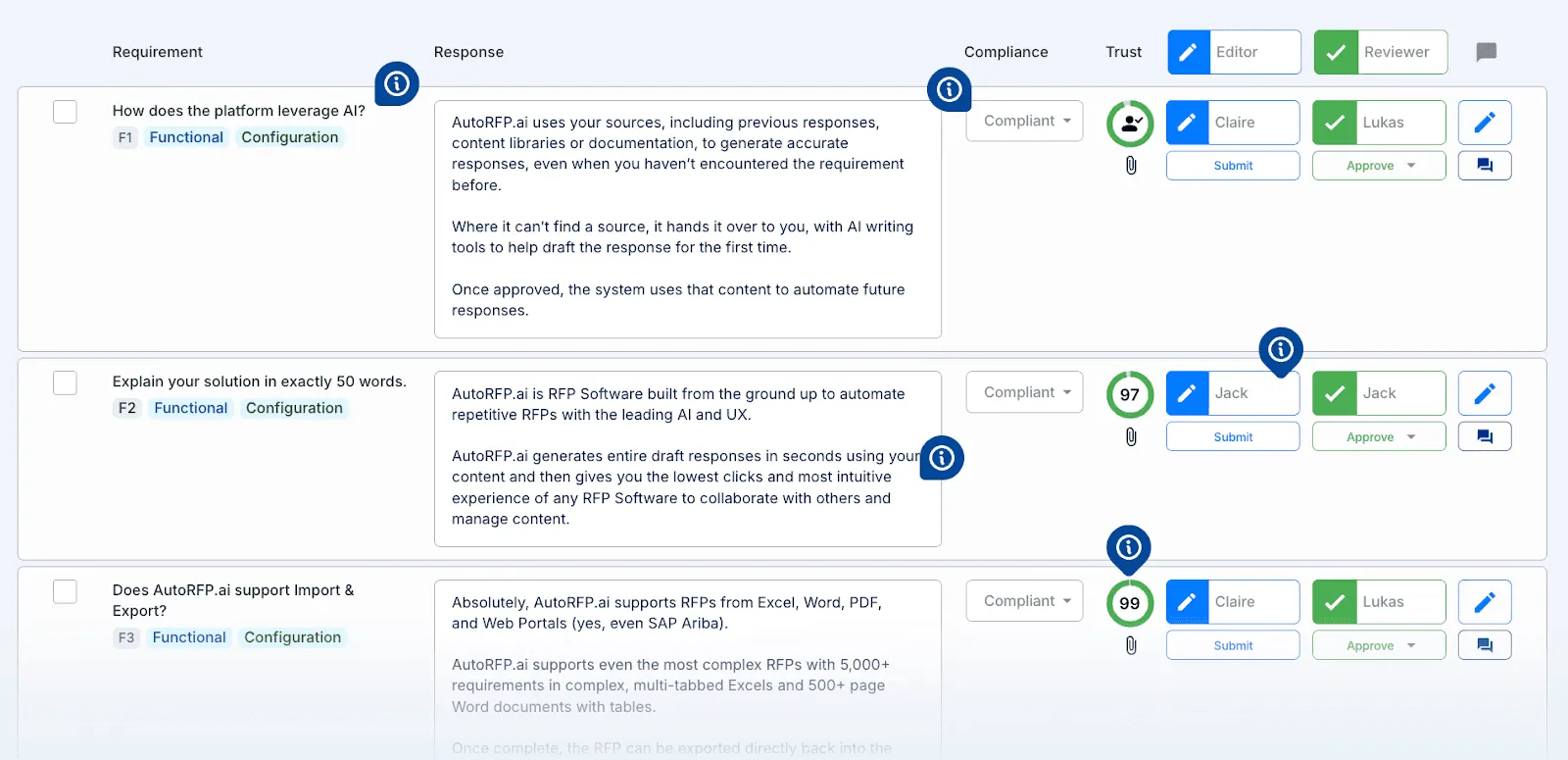
Using an AI-powered RFP management software will automate the time-consuming parts of the process, so your team can focus on other strategic activities.
My recommendation is AutoRFP.ai that generates accurate responses in seconds. Its semantic search finds answers to complex requirements and provides source references to avoid hallucinations in answers.
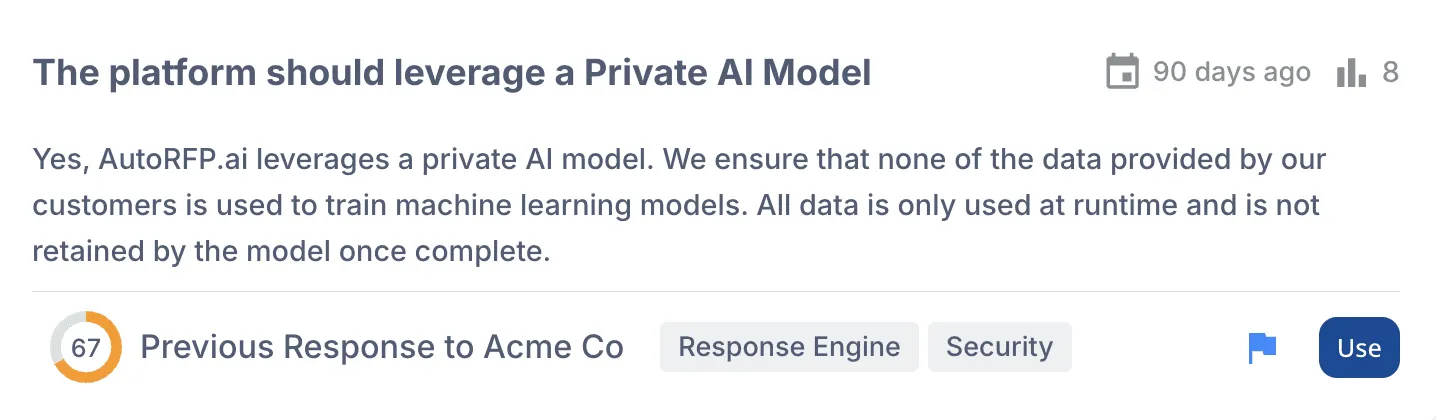
Side Note: AutoRFP.ai offers a 30-day money-back guarantee, letting you try the platform with no risk. Book Demo today to see the platform live in action.
Step 5: Create Proposal Templates for Similar Industries
Develop templates that address the unique challenges, compliance requirements, industry standards, and terminology of different sectors.
For example, healthcare RFP templates should give references to HIPAA compliance, while financial services templates should cover SOC2 compliance, data encryption standards, and regulatory reporting processes.
This approach is recommended because:
Tailored responses resonate more with clients and improve win rates
Review cycles are minimized as there is less back-and-forth with internal subject matter experts
Teams can respond to more RFPs faster without compromising quality
Step 6: Set Quality Checkpoints Along the Entire Process
Build quality benchmarks into your workflow to catch friction before escalation and errors before submission.
Implement a multi-level review process that checks for technical accuracy, compliance references, and branding guidelines. Create checklists for different stages to ensure no important step is missed.
Lastly, encourage team members to proactively highlight blockers or any confusing areas as they arise.
Step 7: Set a Regular Cadence to Evaluate the RFP Process for Improvements
After each month or quarter, conduct a retrospective with your team. In these meetings:
Review performance metrics like time spent to respond, win rates, and trends.
Encourage conversations about what went well, what could be improved, and which blockers affected productivity.
Analyze whether your current RFP response software still meets your team’s needs or if it’s worth exploring alternative solutions.
This review ensures your RFP response process continuously improves and adapts to your team’s evolving goals. It also sets a culture of accountability and transparency, where everyone feels responsible for improving win rates rather than just meeting deadlines.
What Are the Benefits of Improving Your RFP Process
Continuously improving your RFP workflow is essential. A well-optimized process directly influences efficiency, win rates, and ultimately, your company’s growth.
Faster Response Times
A well-thought-out RFP process cuts down the time required to complete and submit proposals.
By removing repetitive tasks, using automation, and keeping pre-approved content ready, teams can respond to RFPs in days rather than weeks. This faster turnaround lets you respond to greater request for proposal documents and gives an edge over your competitors.
Higher Response Accuracy
Standardized processes and automation tools ensure all proposals contain accurate, up-to-date information. This builds client confidence and reduces the risk of errors that could damage your reputation.
Side Note: Not all RFP response platforms deliver on their promises. Many make big claims but fall short. In contrast, AutoRFP.ai stands out - 63% of its AI-generated responses are ready to submit without any edits.
Lower Team Burnout
A manual and inefficient RFP response process results in your team being stressed out. An efficient process, on the other hand, automates repetitive tasks and makes the process more manageable. This results in a happier, less stressed out team that focuses their efforts on more strategic tasks.
Better Resource Allocation
Understanding which RFPs to pursue and which to let go ensures you invest resources where they’ll have the greatest impact. The go/no-go decision-making improves ROI on your proposal efforts and allows teams to focus on winnable opportunities.
Greater Win Rates
When your team spends less time on manual, repetitive work and more time thinking strategically, your proposals start to stand out. You can focus on what really matters: understanding the client’s pain points and explaining the value your company brings.
This naturally makes your responses more persuasive, helps you build trust with prospects, and ultimately leads to higher win rates.
Important Roles in the Process
Successfully improving your RFP process requires clear ownership and streamlined alignment across all involved roles. A strong proposal team usually includes:
RFP/proposal manager: Leads the entire response process, manages timelines, assigns responsibilities, and ensures all requirements are met. They act as the main point of contact and keep the project on track from start to finish.
Bid writer: Translates product-specific and business information into clear, persuasive language. They write executive summaries, tailor responses for each client, and prepare a strong case for selection.
Pre-sales engineers: Brings technical know-how by aligning your solution with what the client actually needs. Equipping these teams with specialized presales software allows them to automate technical questionnaires and explain how the solution will work in the real-world while keeping details factual
Subject matter experts: Provides deep product knowledge, technical input, and a strong competitive edge. Their insights ensure accuracy and credibility to the proposal response. Depending on the context, they can be product managers, engineers, or legal advisors, among others.
Account executive: Brings client context, relationship insights, and strategic direction to shape the proposal’s tone and positioning. They ensure the response aligns with the client’s priorities and competitive landscape.
Tips for Running an Effective RFP Process
Even with the right structure in place, optimizing the RFP process takes practice. The below RFP response best practices are small improvements that can create a big impact and help increase win rates.
Automate the Redundant Tasks
Tasks like searching for answers, writing drafts, and improving the content flow slows down your team and makes the process more inefficient. A good AI-powered RFP response software can automate this “busy work” without compromising on quality.
AutoRFP.ai uses AI to search the content library smartly, auto-fill responses accurately, and generate first drafts in a fraction of the time than manual methods.
Use Proof Stacking to Build Credibility
Don’t rely on just one case study to highlight your strengths. Instead, layer multiple forms of social proof throughout your proposal: case studies, testimonial quotes, industry certifications, media coverage, etc.
Speak Your Client’s Language
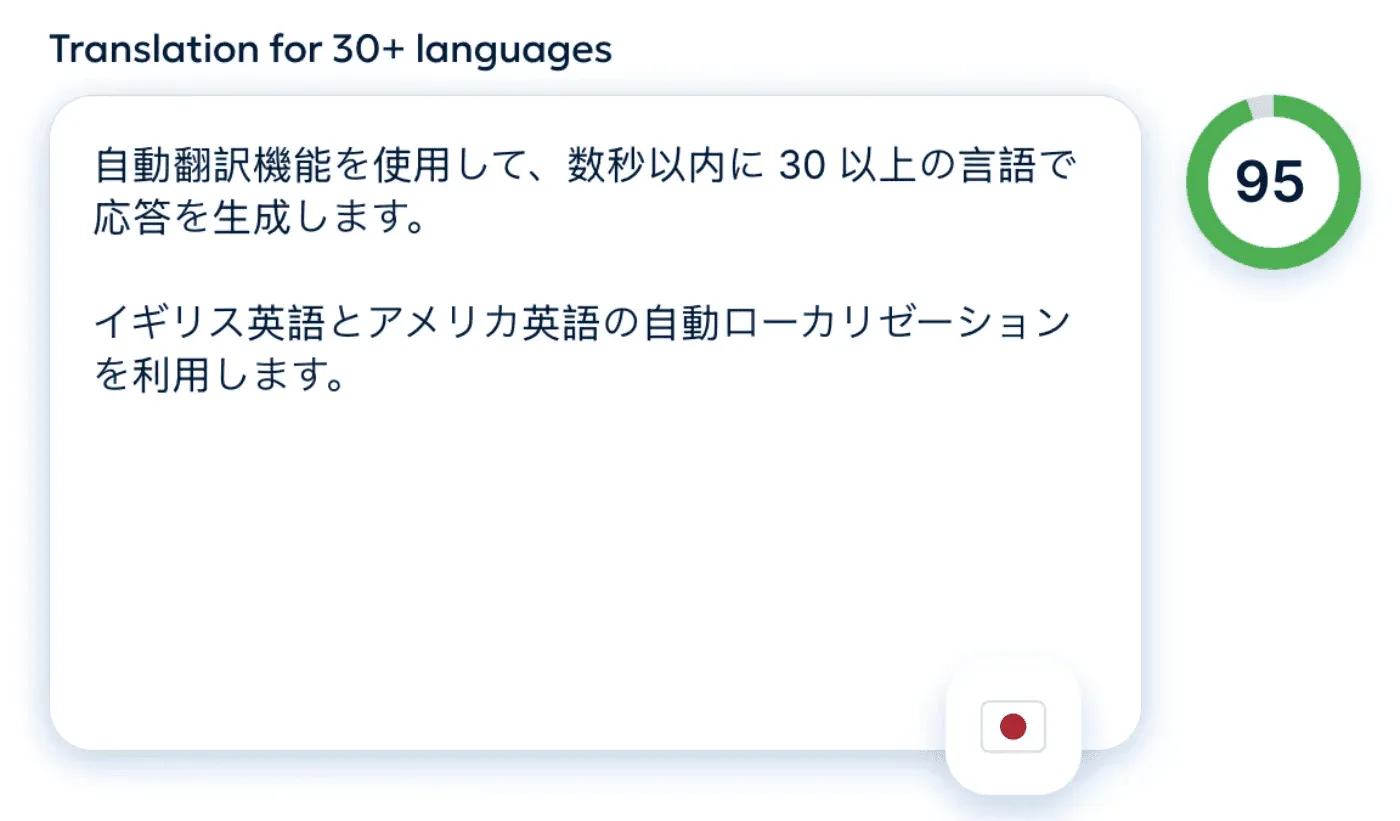
When going after global opportunities, responding in the prospect’s preferred language shows cultural respect and can be a strong competitive advantage.
However, manual translation is time-consuming, expensive, and risky if inaccurate. AutoRFP.ai offers automated translation that lets you respond in 50+ languages instantly, ensuring your proposals are accessible and inclusive.
Common Mistakes to Avoid When Improving Your RFP Process
Even with a solid system in place, it’s easy for teams to fall into traps that hurt win rates. Recognizing these common mistakes early can help you streamline your workflow and improve response quality.
Forgetting about your content library: Many teams create thorough libraries but fail to update old content and add new information. If not maintained, these libraries can generate inaccurate responses that increase manual workload and can hurt your reputation.
Skipping the proposal qualification step: Responding to every RFP wastes resources on unwinnable opportunities. Teams that chase every request spread themselves too thin and produce mediocre responses.
Using inefficient automation tools: Some teams attempt to manually create automation workflows using ChatGPT or use RFP software that produce inaccurate drafts.
Case Studies of Companies Improving Their RFP Process
Now that you know the tips to implement and the mistakes to avoid, let’s look at real examples of companies that successfully improved their RFP processes.
Fiddler AI
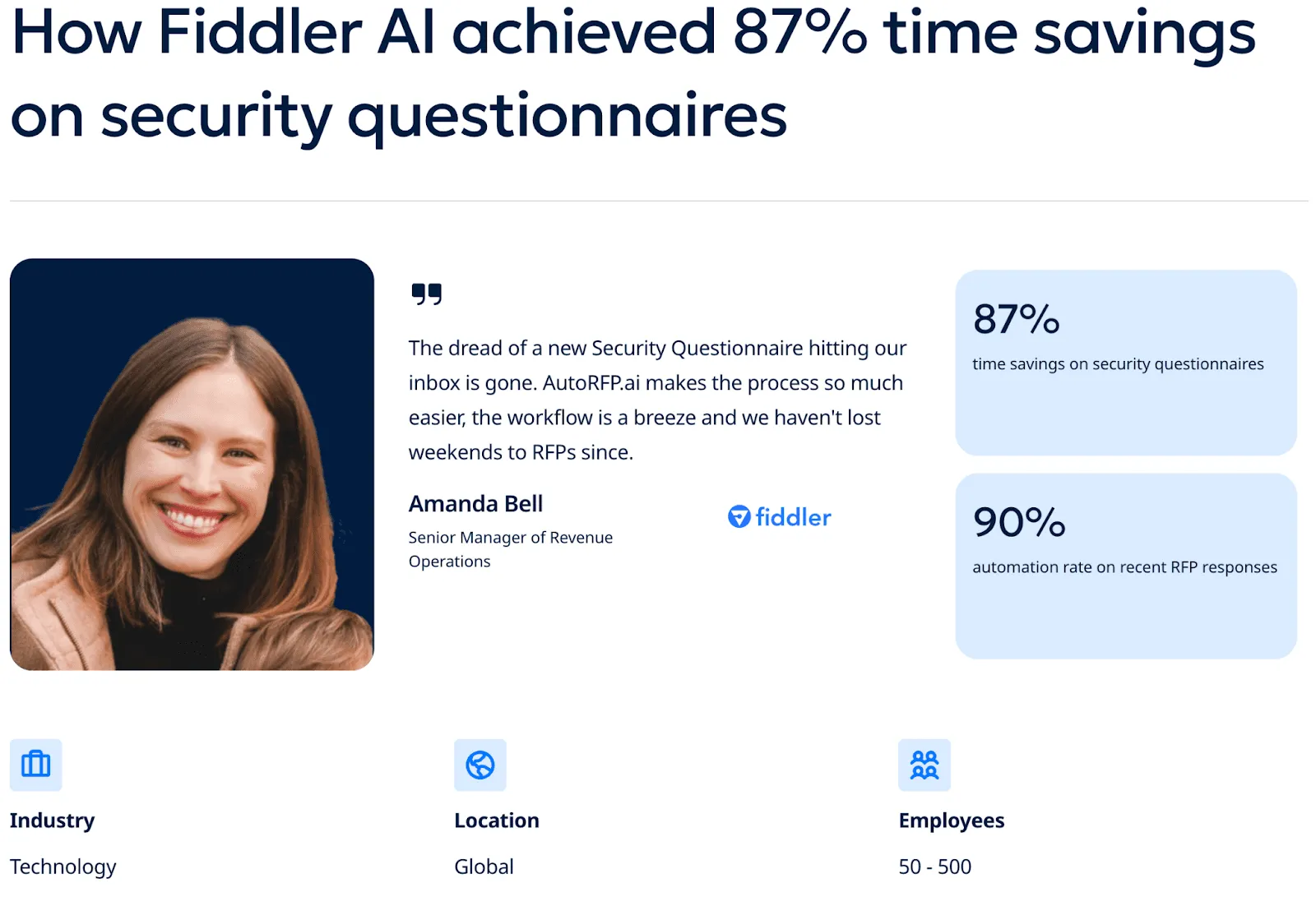
Fiddler AI had an inefficient process for managing security questionnaires, with responses consuming 30+ hours and extending into weekends. Their initial solution, an in-house chatbot, was also prone to inaccuracies.
Looking to improve this inefficient process, Fiddler AI adopted AutoRFP.ai that led to an 87% reduction in response time and 90% automation rate on RFP responses.
Workforce.com
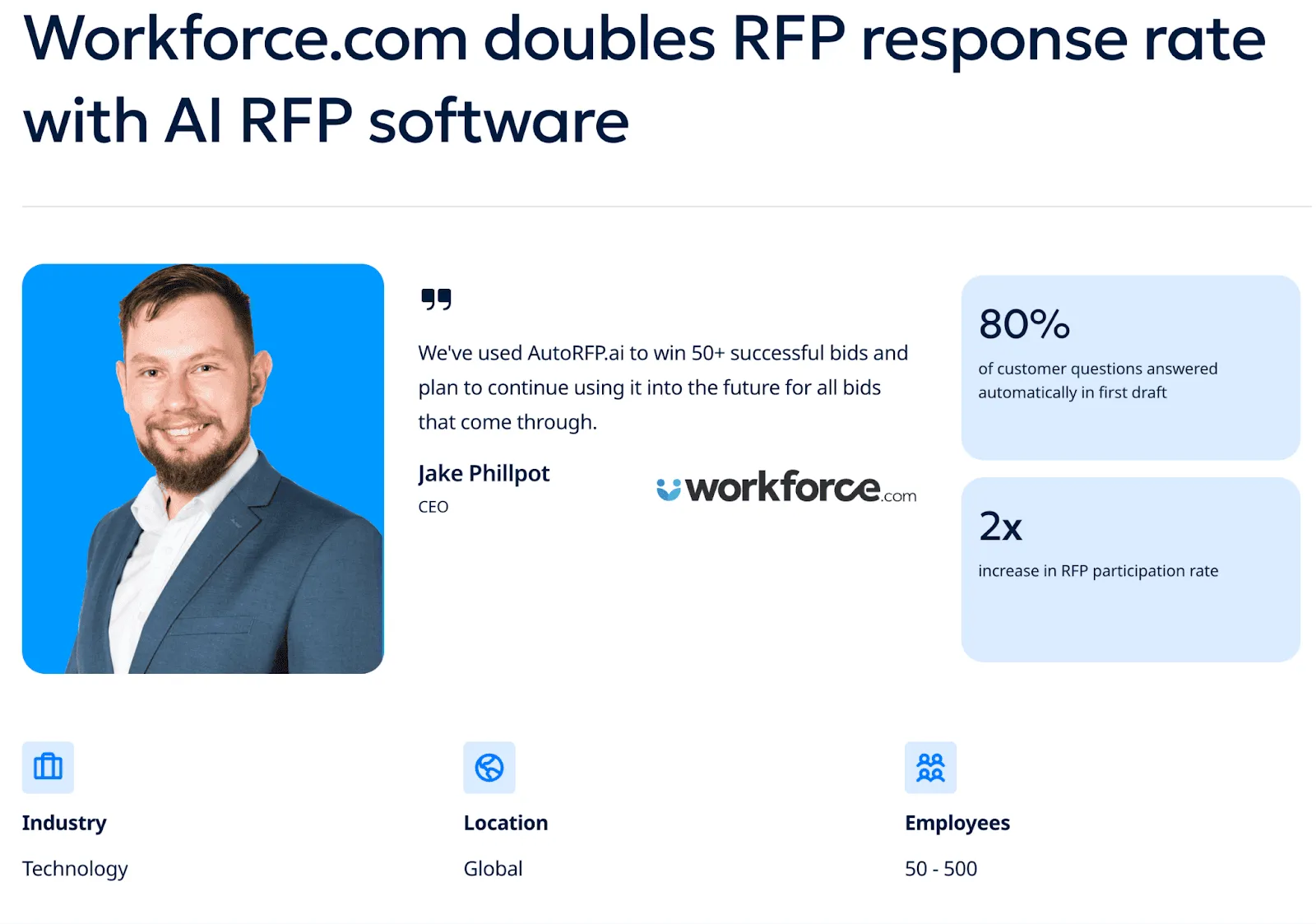
Facing challenges in managing complex RFPs while expanding globally, Workforce.com searched for a solution to streamline their response process.
By partnering with AutoRFP.ai, Workforce.com automated response generation and achieved an 80% automation rate for creating first drafts. This allowed them to double their RFP participation rate.
AutoRFP.ai’s translation feature further facilitated their global growth by enabling responses in 50+ languages without requiring extra resources.
Improve Your RFP Process With AutoRFP.ai
Transforming an inefficient RFP process to one that is optimized for higher win rates is easily doable. All that is needed are standardized workflows and the support of a trusted RFP automation software.
AutoRFP.ai is a robust solution that is trusted by companies in 44 Countries. It offers AI response generation, seamless team collaboration, transparent pricing, and a 30-day money-back guarantee. Book Demo today to optimize your RFP process and maximize RFP win rates.

