
ILPA DDQ Guide: Key Considerations & How to Complete
Learn what the ILPA DDQ is, what sections it covers, and how fund managers can complete and automate their due diligence responses more efficiently.

Robert Dickson
RevOps Manager, AutoRFP.ai··19 min read
The ILPA DDQ is one of the most widely used formats for institutional due diligence in private markets. If you are completing it for fundraising, annual reviews, or manager monitoring, the fastest path is understanding how the template is structured and what each section is really trying to capture.
This guide gives you a practical way to work through it with clearer ownership, better consistency, and less rework across teams.
What Is The ILPA DDQ?
The ILPA Due Diligence Questionnaire is a standardized template created by the Institutional Limited Partners Association for evaluating private equity fund managers and investment opportunities.
This isn’t just another form to fill out. It’s the industry standard that streamlines the due diligence process between Limited Partners and General Partners:
Limited Partners: Institutional investors like pension funds, endowments, and insurance companies
General Partners: Fund managers
Think of the ILPA DDQ as the investment industry’s common language.
Before ILPA standardized this process, every institutional investor created their own due diligence questionnaires. Fund managers responded to hundreds of slightly different questions asking essentially the same thing. The waste was staggering. Teams spent weeks reformatting the same information for different questionnaire formats.
The current version, ILPA DDQ 2.0, was released in 2021 and represents a significant evolution from the original v1.2, released in 2018. The updated version incorporates enhanced ESG components developed in partnership with the Principles for Responsible Investment and introduces a comprehensive DEI Metrics Template.
ESG: Environmental, Social, Governance
DEI: Diversity, Equity & Inclusion
Typical use cases span both sides of the investment equation.
Limited Partners use the ILPA DDQ when evaluating General Partner investment opportunities and conducting ongoing manager monitoring. General Partners complete ILPA DDQs during fundraising and annual reporting cycles.
ILPA DDQ vs. Other Due Diligence Questionnaires
The ILPA DDQ occupies a specific niche in the broader due diligence landscape. It is not interchangeable with other questionnaire types, though people often confuse them.
ILPA says its DDQ is designed to standardize key areas of inquiry during investor diligence of managers, including firm, fund, investment strategy, portfolio management, risk, ESG, and governance topics.
| Questionnaire type | Main focus | Typical questions | Who usually reviews it | How it differs from ILPA DDQ |
|---|---|---|---|---|
| ILPA DDQ | Fund manager evaluation and investment due diligence | “How does the firm operate?” “What is the investment strategy?” “How are risk, ESG, and governance handled?” | Limited Partners, investment teams, operational due diligence teams | Investment-specific and built for evaluating General Partners and private market funds |
| Vendor DDQ | Vendor operations, compliance, security, and risk | “Can we trust your systems?” “What happens when things break?” “How do you protect our data?” | Procurement, compliance, legal, IT, and risk teams | Focuses on vendor reliability and third-party risk, not fund manager evaluation |
| Security questionnaire | Information security controls and technical risk | “What encryption standards do you use?” “How do you manage access controls?” “Do you have penetration testing results?” | Security, IT, and compliance teams | Narrower and more technical than the ILPA DDQ |
| General RFP | Vendor selection across multiple buying criteria | “What is your pricing?” “How long does implementation take?” “What support do you provide?” | Procurement, business stakeholders, sales teams, and evaluation committees | Broader and more commercial, usually used to compare multiple solution providers |
How Other DDQs Work
Vendor DDQs focus heavily on technical operations, security protocols, and operational risk. These questionnaires drill into areas such as SOC 2 compliance, penetration testing results, incident response procedures, and business continuity planning. The questions centre on: “Can we trust your systems? What happens when things break? How do you protect our data?” Vendor risk questionnaires often assess data security, compliance, continuity, incident response, and certifications.
Security questionnaires narrow even further into information security specifics. They are essentially technical audits disguised as questionnaires. Expect questions about encryption standards, authentication protocols, access controls, and vulnerability management. Security teams drive these assessments, not investment teams.
General RFPs cast a much wider net. They cover everything from pricing models and implementation timelines to customer support structures, product roadmaps, and competitive differentiation. RFPs exist to help buyers choose between multiple solution providers across diverse evaluation criteria.
Why The ILPA DDQ Is Different
The ILPA DDQ differs fundamentally from all of these. It is investment-specific.
The questions focus on firm operations, investment strategy, portfolio management, risk frameworks, ESG integration, and organisational governance. ILPA DDQs evaluate whether a fund manager or investment firm operates with the sophistication, controls, and strategic clarity that institutional capital requires.
Because each questionnaire type asks for different information, teams need a response process that can adapt to the format instead of treating every DDQ like the same document.
AutoRFP.ai handles all DDQ types, not just ILPA-specific questionnaires.
The same semantic search and automated drafting capabilities that accelerate ILPA DDQ responses also work for vendor due diligence, security questionnaires, and standard RFPs. That means teams can respond faster across different questionnaire formats without rebuilding answers from scratch every time.
History and Evolution of ILPA DDQ
To understand why the ILPA DDQ became so widely used, it helps to look at how due diligence questionnaires evolved from fragmented, custom documents into a standardized framework for Limited Partners and General Partners.
Before ILPA DDQ
The ILPA DDQ v1.2 launched in 2018 as ILPA’s initial standardization effort.
Before this template existed, every Limited Partner created custom due diligence questionnaires. Pension funds asked 300 questions. Endowments asked 250 different questions. Insurance companies asked 350 slightly different questions.
General Partners responded to hundreds of unique questionnaires annually, each requesting the same fundamental information in different formats.
This fragmentation created massive inefficiency.
A typical private equity fund manager might raise capital from 40-60 Limited Partners. Each LP sent their own proprietary DDQ. The fund manager’s operations team spent months coordinating responses across departments, reformatting data, and tracking which version of which answer went to which investor.
The duplicated effort served nobody.
LPs couldn’t easily compare managers because everyone reported differently. GPs burned resources on questionnaire completion instead of portfolio management.
How ILPA DDQ v1.2 Solved The Problem
ILPA DDQ v1.2 solved the fragmentation problem by creating a common framework. Major institutional investors agreed to adopt this standardized template.
The benefits materialized immediately:
| Before ILPA DDQ | After ILPA DDQ v1.2 |
|---|---|
| Every LP used their own proprietary questionnaire | LPs could use a common due diligence framework |
| GPs answered similar questions in different formats | GPs could organize responses around ILPA’s question structure |
| LPs struggled to compare managers consistently | LPs received more consistently formatted responses |
| Operations teams spent months reformatting data | Fund managers built centralized response libraries |
| Responses were harder to reuse across fundraising cycles | Teams could invest in stronger, reusable answers |
Fund managers built centralized response libraries organized around ILPA’s question structure. Limited Partners received consistently formatted responses that enabled true apples-to-apples comparisons.
The Shift From DDQ v1.2 To DDQ 2.0
The transition to DDQ 2.0 in 2021 represented evolution, not revolution.
ILPA didn’t rebuild the questionnaire from scratch. They enhanced the existing framework based on three years of user feedback and shifting industry priorities.
Key Improvements In ILPA DDQ 2.0
Key improvements in ILPA DDQ 2.0 focused on three areas:
| Improvement area | What changed | Why it matters |
|---|---|---|
| Enhanced ESG integration | Enhanced ESG integration through partnership with the Principles for Responsible Investment (PRI). The ESG section expanded significantly. | It reflected institutional investors’ growing focus on sustainable investing and climate risk assessment. |
| DEI Metrics Template | Introduction of the DEI Metrics Template. Diversity, equity, and inclusion became mandatory disclosure areas for modern fund managers. | The template provided standardized metrics for team diversity, inclusive practices, and progress tracking. |
| Digital workflow modernization | Modernization for digital workflows. The structure became more compatible with automated response systems and electronic submission portals. | It made the DDQ easier to manage, reuse, and submit through modern response systems. |
Industry Adoption
Industry adoption tells the real story.
Current estimates suggest 60-70% of institutional Limited Partners have adopted ILPA DDQ 2.0 as their primary due diligence framework.
The remaining 30-40% either use v1.2, particularly smaller institutions that haven’t updated their processes, or maintain proprietary questionnaires, usually very large institutional investors with specialized requirements.
Why Standardization Matters
Standardization matters for both LPs and GPs.
| Audience | Benefits |
|---|---|
| Limited Partners | Limited Partners benefit from consistent formatting that enables true peer comparisons, reduced evaluation time through familiar question structures, and better data aggregation for portfolio-level ESG reporting. |
| General Partners | General Partners gain efficiency through reusable response libraries, reduced coordination overhead across fundraising cycles, and the ability to invest in quality responses knowing they’ll be used repeatedly. |
“The transition to DDQ 2.0 in 2021 represented evolution, not revolution. ILPA didn’t rebuild the questionnaire from scratch. They enhanced the existing framework based on three years of user feedback and shifting industry priorities.” - Jasper Cooper, CEO & Co-Founder at AutoRFP.ai
Who Sends the ILPA DDQ and Who Responds?
The ILPA DDQ is mainly used between Limited Partners and General Partners during private market due diligence.
Limited Partners usually send the ILPA DDQ. These include pension funds, endowments, foundations, insurance companies, sovereign wealth funds, and other institutional investors. They use the questionnaire to evaluate fund managers before committing capital and to monitor existing managers over time.
General Partners usually respond to the ILPA DDQ. These include private equity, venture capital, private credit, infrastructure, real estate, and other private market fund managers.
They use the questionnaire to explain their firm operations, investment strategy, portfolio management approach, risk controls, ESG practices, and governance structure.
Why Limited Partners Send The ILPA DDQ
Sarah Chen manages investment operations for a $12B pension fund. Her team processes 200+ due diligence questionnaires annually across the fund’s private market allocations. The ILPA DDQ represents a critical tool for her standardization efforts.
Sarah’s challenge: Every private equity, venture capital, and real assets manager operates slightly differently. Some excel at operational rigor. Others focus purely on deal sourcing. Some have sophisticated ESG integration. Others treat sustainability as an afterthought.
Sarah needs to evaluate these managers consistently, comparing their operational capabilities across standardized criteria.
The ILPA DDQ solves this problem.
When managers complete the same template, Sarah can build scoring rubrics that apply uniformly. She can aggregate responses to identify patterns, such as “70% of our PE managers lack formal DEI policies.” She can track changes over time, such as “Has this manager’s approach to climate risk assessment evolved since last year’s DDQ?”
Without ILPA standardization, Sarah’s team drowns in bespoke questionnaire formats. With it, they focus on analysis instead of data wrangling. The efficiency gains compound annually.
Why General Partners Need To Respond Efficiently
For General Partners, the ILPA DDQ is not just a formality. It is a key part of fundraising, investor relations, and ongoing manager monitoring.
A strong response helps fund managers show that they have the operational maturity, investment discipline, risk controls, ESG processes, and governance standards institutional investors expect.
But the workload can become heavy fast.
Sarah evaluates whether to automate ILPA DDQ processing using technology like AutoRFP.ai. Her calculus: 200 DDQs annually at 40 person-hours each equals 8,000 hours of manual work.
That’s four full-time equivalent employees just managing questionnaire logistics. Automation that cuts this to 8-12 hours per DDQ justifies significant investment.
ILPA DDQ Structure: Full Breakdown
ILPA DDQ 2.0 organizes into several major sections, each targeting specific aspects of fund manager operations, investment strategy, governance, risk, ESG, DEI, and fund economics. ILPA’s own DDQ lists 20 diligence topics, including Fund Terms, Firm Governance / Risk / Compliance, Accounting / Valuation, Reporting, ESG, and DEI.
Firm Information And Organization
This section covers basic firmographics and organizational structure.
Questions focus on:
Firm history and ownership structure
Key personnel and leadership team composition
Assets under management (AUM) across strategies
Investment focus and geographic scope
Legal entity structure and regulatory registrations
The questions seem straightforward but require precision. “Assets under management” can mean different things. Are we talking committed capital, invested capital, or unrealized value?
ILPA defines these terms specifically. Getting the numbers wrong creates credibility issues that echo through the entire evaluation.
Side note: Keep one approved source of truth for firm history, AUM figures, ownership structure, and leadership bios. This prevents different teams from submitting slightly different answers across DDQs.
Typical first-time completion for this section: 4-6 hours.
Most firms have this information readily available. The challenge isn’t finding the data. It’s formatting it consistently across team members who might have slightly different versions of firm history or personnel descriptions.
Investment Strategy And Process
This section digs into how the fund identifies, evaluates, and manages investments.
Key areas include:
Deal sourcing methodology and pipeline development
Investment evaluation criteria and decision framework
Due diligence process for potential investments
Portfolio construction and concentration limits
Exit strategies and realization timelines
Risk assessment and mitigation approaches
General Partners struggle here because investment strategy often exists in partners’ heads rather than documented processes.
ILPA wants systematic frameworks, not “we know it when we see it” approaches. Documenting tacit knowledge into explicit procedures takes time.
Typical first-time completion for this section: 8-12 hours.
The answers exist. Articulating them clearly for external evaluation requires thoughtful documentation and internal alignment.
Fund Terms And Economics
This section evaluates the economic structure of the fund and how those terms compare with predecessor funds.
Questions usually focus on:
Fund fee structures
Preferred return hurdle
Distribution waterfall methodology
Carried interest structure
Clawback provisions
Management fee basis calculation
Transferability of partnership interests
Exculpation and indemnification standards
ILPA DDQ 2.0 specifically asks General Partners to provide fee structures for predecessor funds, explain blended LP effective fees, describe waterfall methodology, and provide detail on carried interest, clawbacks, and management fee calculations.
Fund terms require extra care because they connect directly to alignment of interests. LPs want to understand not only what the terms are, but how those terms affect incentives between the General Partner and Limited Partners.
Typical first-time completion for this section: 8-14 hours.
The difficulty is not just explaining the terms. It is making sure every economic detail matches the legal documents and investor-facing materials.
Operations And Infrastructure
This section evaluates operational capabilities and systems.
Topics cover:
Technology systems for portfolio management and reporting
Back-office operations and service provider relationships
Compliance monitoring and regulatory reporting
Business continuity planning and disaster recovery
Information security and data protection measures
Technology vendors receiving ILPA DDQs spend significant time here.
Questions designed for fund managers, such as “Describe your portfolio monitoring systems,” translate awkwardly for software companies, such as “Describe your product development infrastructure.”
The key is framing technical operations in business continuity and risk management terms that resonate with institutional investors.
Typical first-time completion for this section: 10-15 hours.
Requires coordination across IT, operations, and compliance functions.
Risk Management And Compliance
This section examines how the firm identifies, monitors, escalates, and manages operational, regulatory, and governance risks.
Questions usually focus on:
Compliance manuals and codes of conduct
Internal controls
Conflicts of interest procedures
Anti-corruption policies
Insider trading controls
AML/CFT policies
SEC examinations or deficiency letters
Political contributions and lobbying activity
Whistleblower policies
ILPA’s Firm Governance / Risk / Compliance section asks how firm policies are supervised, monitored, enforced, updated, communicated to employees, and used to manage issues when they are identified.
This section matters because LPs are not only evaluating investment performance. They are evaluating whether the firm has the discipline, controls, and governance structure to manage institutional capital responsibly.
Typical first-time completion for this section: 8-12 hours.
The response usually requires input from compliance, legal, operations, and senior leadership.
Fees, Expenses And Conflicts Of Interest
This section looks at how the firm handles costs, fees, offsets, related-party arrangements, and potential conflicts.
Questions usually focus on:
Management fees
Transaction fees
Broken deal fees
Monitoring fees
Director fees
Fund formation costs
Organization expense caps
Affiliate services
Fee offsets
Conflicts of interest policies
Related-party arrangements
ILPA DDQ 2.0 asks firms to explain whether the Firm or Fund pays specific expense categories and how fees such as advisory fees, broken deal fees, capital markets fees, director fees, monitoring fees, and transaction fees are handled.
This section often overlaps with Fund Terms and Risk Management, but it deserves separate attention. LPs want to know where economic leakage may happen, how conflicts are disclosed, and whether the GP’s interests remain aligned with investors.
Side note: Be specific here. Vague answers like “handled in accordance with fund documents” usually feel weak unless supported by clear examples, policies, and references to actual fee treatment.
Typical first-time completion for this section: 6-10 hours.
The main challenge is coordinating accurate answers across finance, legal, compliance, and investor relations.
ESG And Sustainability
The ESG section expanded significantly in ILPA DDQ 2.0 through partnership with PRI.
Questions address:
ESG integration approach and investment philosophy
Sustainable investing policies and exclusion screens
Climate risk assessment and carbon footprint monitoring
Proxy voting policies and shareholder engagement
Impact measurement and reporting frameworks
Alignment with frameworks like TCFD or SASB
ILPA says the updated ESG section in DDQ 2.0 draws on an updated version of PRI’s Limited Partners Private Equity Responsible Investment DDQ. It also says this synchronization creates more efficiency and standardization.
This section reflects institutional investors’ growing focus on sustainable finance.
European LPs particularly scrutinize ESG responses given SFDR requirements. US public pension funds increasingly face political pressure around ESG, creating nuanced positioning challenges for fund managers.
Typical first-time completion for this section: 8-12 hours.
Firms with mature ESG programs pull from existing documentation. Firms building ESG capabilities struggle to articulate evolving approaches.
Diversity, Equity And Inclusion
ILPA DDQ 2.0 introduced a comprehensive DEI Metrics Template.
This represents a significant evolution from v1.2’s limited diversity questions.
Key areas include:
Team diversity data across gender, race/ethnicity, and other dimensions
Inclusive hiring practices and talent development programs
Diverse manager programs and supplier diversity commitments
Board composition and governance diversity
Progress tracking and accountability mechanisms
ILPA says the DDQ and Diversity Metrics Template are intended to standardize key areas of investor inquiry and provide a framework for ongoing monitoring of DEI progress.
The DEI section creates discomfort for many firms. Asking for demographic data raises privacy concerns. Small teams struggle with statistical significance.
Firms at early DEI journey stages worry about unfavorable comparisons to peers with more mature programs.
Here’s the hard truth: institutional investors aren’t looking for perfection. They’re evaluating commitment, progress, and honest self-assessment.
A small firm with 20% team diversity and a clear action plan to reach 40% often scores better than a large firm at 25% diversity with no improvement strategy.
Pro tip: Frame DEI answers around data, direction, and accountability. LPs want to see what the firm measures, what changed, and who owns the next step.
Typical first-time completion for this section: 6-10 hours.
Data gathering takes time. Determining what to disclose and how to frame progress requires thoughtful consideration.
How to Complete an ILPA DDQ Efficiently
Manual ILPA DDQ completion follows a predictable pattern. Someone receives the DDQ. They panic briefly about the timeline. They start copying and pasting from old responses. They realize half the questions have changed or need updated information. They email five different departments. They wait for responses. They chase people down. They compile everything into the template. They discover formatting issues. They fix the formatting. They submit.
This process takes 40-60 hours for first-time completion and 15-25 hours for subsequent responses using improved response libraries. Here’s how to transform that timeline.

Video transcript
Transcript is auto-generated and may contain minor errors.
Hey, we're going to jump into how you can use AI to automate your DDQ process. Let's jump into it. We're going to be using AutoRFP.ai, where an AI software application cloud-hosted across the globe with hundreds of customers, everyone from Silicon Valley startups to some of the largest managed investment fund companies in the world across managed investment funds with portfolios and offices across Switzerland, United States, and Singapore using our product every day to answer hundreds and thousands of DDQs. Let's jump into it. So, AutoRFP, you can upload diff- you can upload different DDQs that you might get. This might be your LP DDQs or just any from
your LPs that are coming through and you want to highly automate that process. You can also upload your RFPs and any other kind of compliance questionnaires you'd like. Really, what AutoRFP is Really, what AutoRFP is effectively you create an AI knowledge lake with your relevant context. This could be information from your website, whether that's fund information like investment performance over time and other relevant public information. AutoRFP can scrape that information automatically or it could be technical documents or fund documentation in relation to your products and services and so on. But effectively, all that information, as well as integrating with 15 plus other systems like Google Drive, SharePoint, Microsoft Teams.
We pull that together into an AI knowledge lake, which is a vector database. Then AI starts to do its work across two different ways to generate DDQ responses en masse. First is the AI semantic search which uses embedding models and re-ranker models to effectively site the most relevant context. That's how we have customers in Auto RFP that have hundreds and thousands of or tens of thousands or hundreds of thousands of pieces of content in their Auto RFP library with specific categorization in relation to tagging. For instance, here I have tagging. If I was a managing investment fund, I could go all the way down to particular asset-backed credit and
different investment platforms and all different funds and effectively that relevant context is provided to the LLM. So then it knows what is the right information for automating DDQs. So then you have an AI response agent that takes that relevant context and across a series of LLMs, whether it's Gemini, OpenAI, and Anthropic, generates a response. That can then be collaborated across the team as well as translated to 50 plus languages with translation and AI optimization for localization of translation as well. English US, English Australia, and English UK, and so on. Then within the product, you have workflows, whether it's integrating with your CRM like Salesforce for intakes of new
DDQs, importing via portals, AI analysis, and a lot more. And let's jump into that. So, within AutoRFP, you have your different projects that might be a RFP, a due diligence questionnaire, and so on. We create those projects, load the relevant files. That comes in, whether it's a zip file, Excel, PDF, Word doc, and we import that information. First, we do a project analysis. Imagine this LP, this is the first time you're working with them, and the first time they've sent you a due diligence questionnaire. You may have specific questions that you want to understand before responding to that DDQ based off the context and content in the due diligence questionnaire itself. That's where we leverage an LLM AI to analyze that relevant DDQ and provide any answers to our questions, and it'll provide sources as well a confidence
scoring based off that information. So, now I've looked through that, and I've read through the DDQ, it's time to start answering. First, here our software will automatically mark up the document with AI and OCR to effectively specify what are the requirements and what are the responses that it needs to then generate answers for. So, you can see here it's done multiple Excel tabs. It's looked at the PDF and pulled out the requirements there from the DDQ, whether it's tables and so on. It's also done that in a Word doc, other information that might be relevant. Then, we can choose what content is most relevant. So, here I might say, "Okay, this is a fun four, and this information's relevant, and that's the kind of content that I want to use to answer this our DDQ.
Once we have our content selected with your tagging and hierarchy that makes the most sense for your kind of large waves of context for the LLM, we then can provide what kind of style responses we want, and we can change anything here later, and what languages. Now, the fun begins. So, this is pretty cool. So, we have generate we have pulled in all those responses. So, now the fun begins. The AI, as you can see, it's ticking up along the top is automatically generating responses for those questions based off our context. Everything's going to come in here from rich text formatting to tables to images. Anything that you have in your content that was relevant for that answer, it will then effectively, like I said, use a re-ranker and embedding model to source the relevant information, and then use AI to generate those responses. Any of these responses I can go in and click here and understand the trust
score. And so, that will provide whether it's a tag level match across our context. So, for instance, our information and the confidence of that response as well. Clicking in edit here, I can see more relevant information. It hasn't pulled from This is actually expired two months ago. So, our content features have expirations and teams to review content and all the kind of information you provide you can do in the content. If then I want to say this content looks great, but I actually want to suggest any changes or flag it for review, the content owner would then get information for that content. Let's say instead I actually wanted to add in this relevant information and this relevant information, but then I want to add a prompt to edit that with the AI or just use a little prompt here to shorten that response and effectively AI now will again answer and edit that response according to my prompts that I've used there.
I I can see the changes and then I can accept those changes and of course there's revision history and AI assistant so I can ask it questions to help me understand that requirement in more details. Like I maybe I don't know what an SAP Ariba is. Sadly I do, but maybe I don't and it can tell me more information there. So that's a bit of our response editor and now all those different responses have come through. I can go to my different sections within the DDQ like my artificial intelligence section. I can select all those requirements and I can start assigning those to relevant team members. So I might assign this to the legal team as reviewers and so anyone from the legal team now has the opportunity to review those responses once I start submitting them and they will get Microsoft Teams notifications or Slack about that workflow and get updates on the process of the project as it goes.
Let's take a step back and say I was now project managing this DDQ response because I'm the investment manager for that fund. I can click on the project overview, quickly see how many responses are left to complete, who they've been assigned to, send reminders to those team members, again Slack, Microsoft Teams, and I can also see when the project is due and how our overall progress as time goes on. We can add additional attachments as well. So, I might want to add this attachment and this attachment. So, when I export my completed project, that will then include any attachments that either myself or the AI has added. Let's take a step forward and go back to now answering those responses. Here, of course, I can make any changes as I want and submit that and work through my task list of different tasks for those responses until it's done.
Looking through, we can also look at any low trust score ones we have or any that are empty, which might which will require human intervention to answer. So, looking at this low trust score, I can see, okay, why is it low? And then I can go in and I can edit and make changes to that response. You also might notice there's a second AI score here, and this is the AI feedback score. The AI feedback score will tell me if how well that response, whether it's AI or human generated, will is answering that DDQ requirement. Okay, so we've just finished editing our responses, we've reviewed the trust scores, filled everything out that needs to be filled out. We can regenerate responses, write additional feedback like and so on. Now, we're ready to export. So, once everything is approved, and what we can
do there is then mark the project as completed and then export that entire project, and that can include any proposal templates that you have. So, that might be executive summaries and other relevant information that is in your firm's tone and marketing collateral and that and then you can have the requirements and relevant context auto-generate into those export templates. And then we can export that and then submit the DDQ. So, that's a lot of it. So, we're AutoRFP.ai. We're a DDQ software and RFPs that helping global technology and fund manager companies all around the globe automate the mundane when it comes to DDQs and RFPs. And not just automate, but really help free up people to write better responses to win more faster. In terms of our pricing and all our
information, you can find out more information. If you're doing more than 50 DDQs per year, recommend getting in touch with us by booking in for an online demonstration. And you can find all about us at AutoRFP. ai. Well, thank you. I'm Rob from AutoRFP and I'm glad I could show you how to leverage AI to automate the DDQ process. Thank you.
Step 1: Organize Your Response Library
Create a centralized content repository for reusable answers.
Don’t scatter ILPA DDQ responses across individuals’ hard drives, email attachments, and various versions floating in Dropbox. Build one authoritative source.
Common sections that repeat across DDQs include:
Firm history and organizational overview
Key personnel biographies and track records
Investment philosophy and strategy
Performance metrics and historical returns
Operational capabilities and systems
ESG policies and practices
DEI metrics and initiatives
Version control for firm information updates matters critically. When AUM changes, when key personnel join or leave, when investment strategy evolves, or when performance numbers update, you need systematic processes to refresh the response library. Otherwise, you submit outdated information that creates credibility concerns.
Manual bottleneck:
Teams spend weeks setting up taxonomy, folders, and tags.
Content discovery depends on how well someone organized it upfront.
Search quality relies on manual categorization being done correctly.
Old answers can stay in circulation after they become outdated.
Different teams may reuse different versions of the same answer.
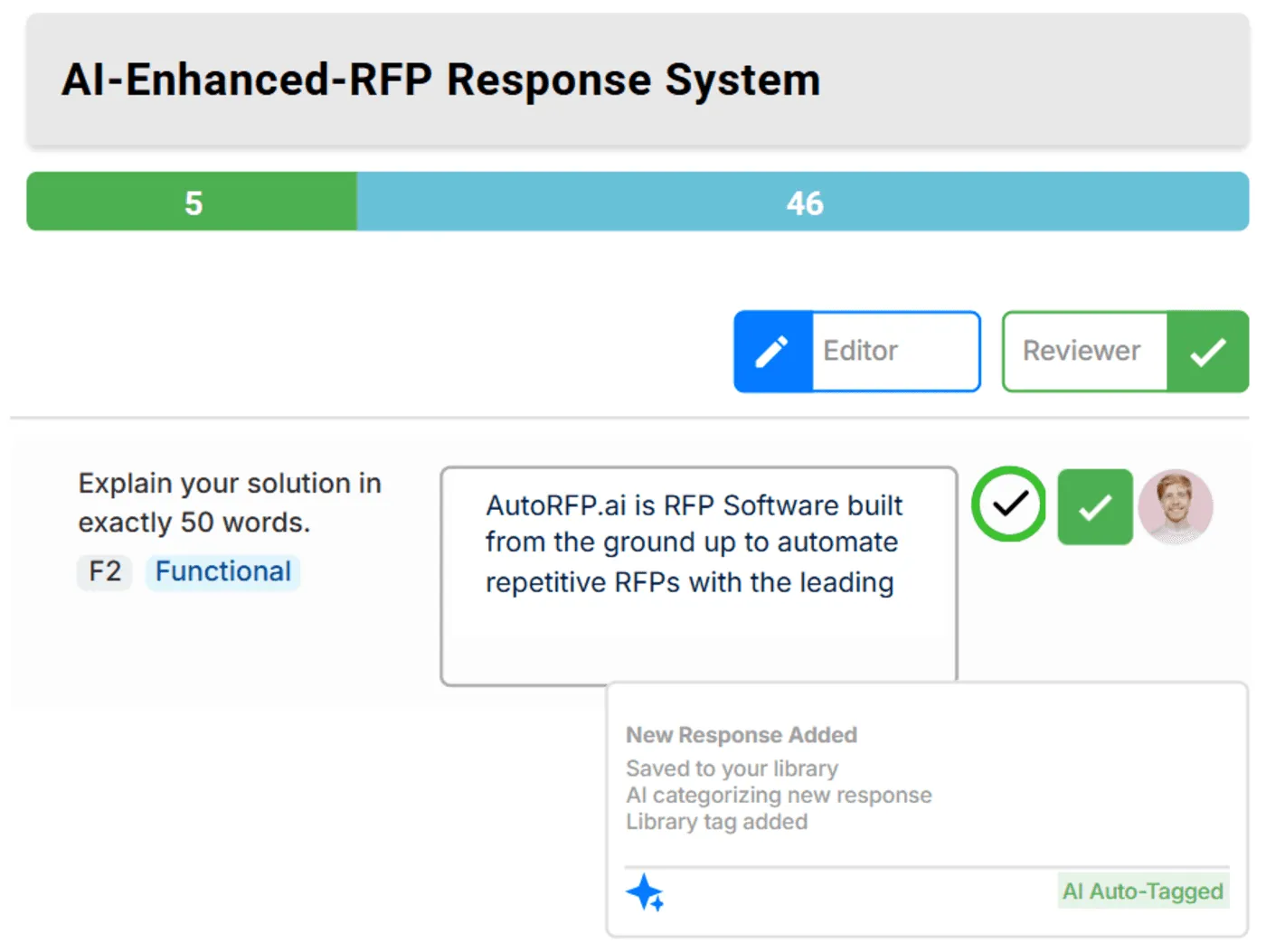
AutoRFP.ai reduces this setup burden by learning from approved responses instead of requiring teams to manually build and maintain a traditional content library. It helps teams create a searchable response base from past approved answers, sales content, product documents, and company materials.
Pro tip: Treat your response library as a living source of truth, not a storage folder. Every answer should have an owner, review date, and approval status.
Step 2: Map Questions To Existing Content
The question-answer matching process separates efficient teams from struggling teams.
When a new ILPA DDQ arrives, someone needs to review every question and determine:
Do we have an approved response for this?
Do we have a partial response that needs updating?
Is this a net-new question requiring original content?
Identifying gaps in existing content takes experienced judgment. A question about “climate risk assessment in portfolio companies” might be answerable from existing ESG documentation, might require synthesizing content from three different sources, or might reveal that your firm lacks formal climate risk practices.
Semantic search vs. keyword matching approaches make enormous differences in efficiency.
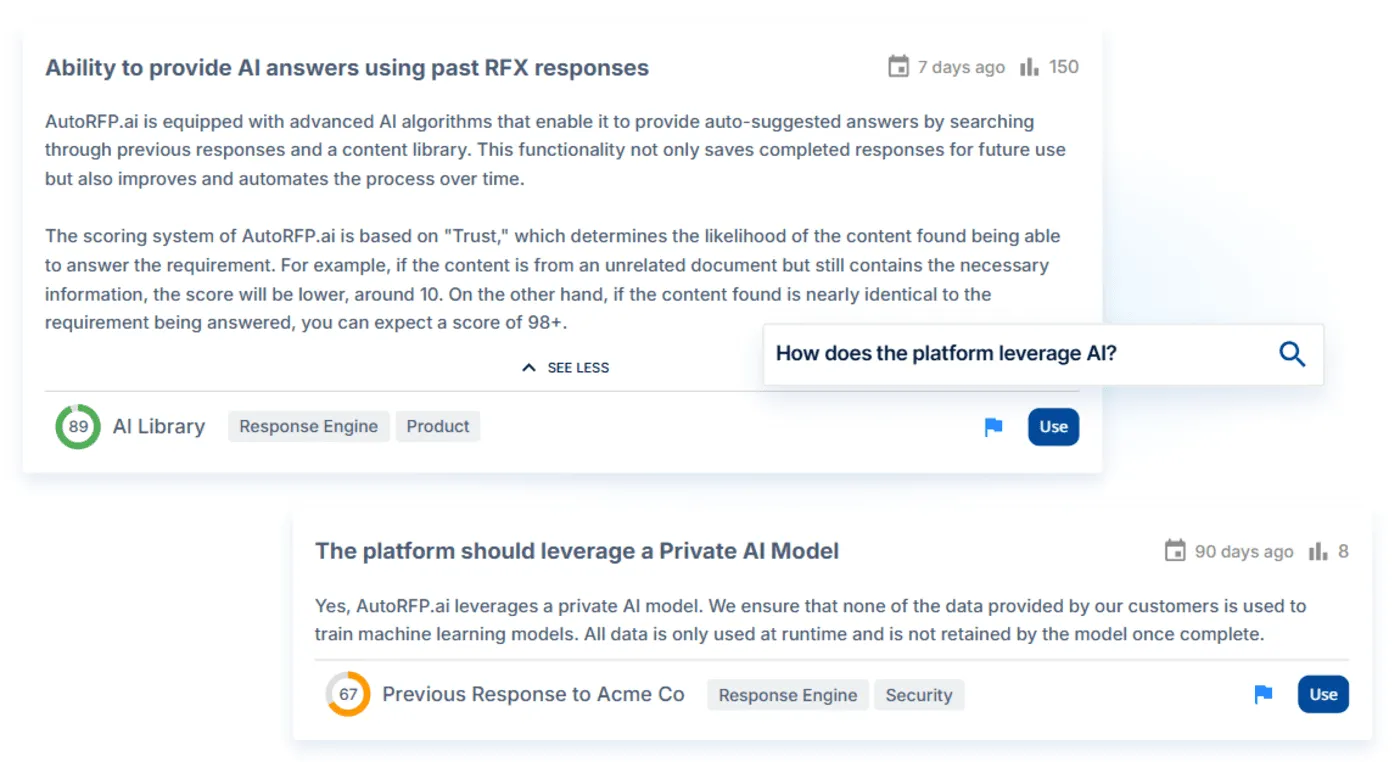
Keyword matching fails because ILPA questions use different terminology than your response library. You store content under “Environmental, Social, and Governance Practices.” The DDQ asks about “Sustainable investing philosophy and ESG integration.” Keyword search misses the connection. Semantic search understands the concepts related.
Manual bottleneck:
Teams spend hours reading each question and searching old responses.
Keyword search misses useful content when wording differs.
Experienced team members become the only people who know where answers live.
Gaps are often discovered late, when deadlines are already tight.
Partial answers require manual comparison across multiple documents.
AutoRFP.ai supports this by using semantic search to match questions with relevant approved content, even when the wording is different. Its response engine finds relevant past responses by meaning rather than keywords, helping teams surface reusable answers faster.
Step 3: Coordinate Cross-Functional Input
ILPA DDQs require input from multiple departments.
ESG data comes from sustainability teams or portfolio operations. DEI metrics originate in HR. Technical infrastructure questions need IT and engineering input. Financial statements and audit information flow from finance. Business continuity and disaster recovery documentation lives in operations.
Workflow coordination challenges compound quickly. Each department has different timelines, priorities, and response quality standards. The person coordinating the ILPA DDQ becomes a project manager, tracking assignments, chasing responses, and ensuring consistency across sections written by different people with different styles.
This coordination overhead typically consumes 30-40% of total ILPA DDQ completion time. You spend 15-20 hours just managing the process, separate from the actual content development.
Manual bottleneck:
Teams chase SMEs through email, Slack, meetings, and shared documents.
Section owners miss deadlines because tasks are not clearly tracked.
Reviewers comment in different places, creating version control issues.
The DDQ owner spends more time managing people than improving answers.
Different departments may write in different levels of detail and tone.
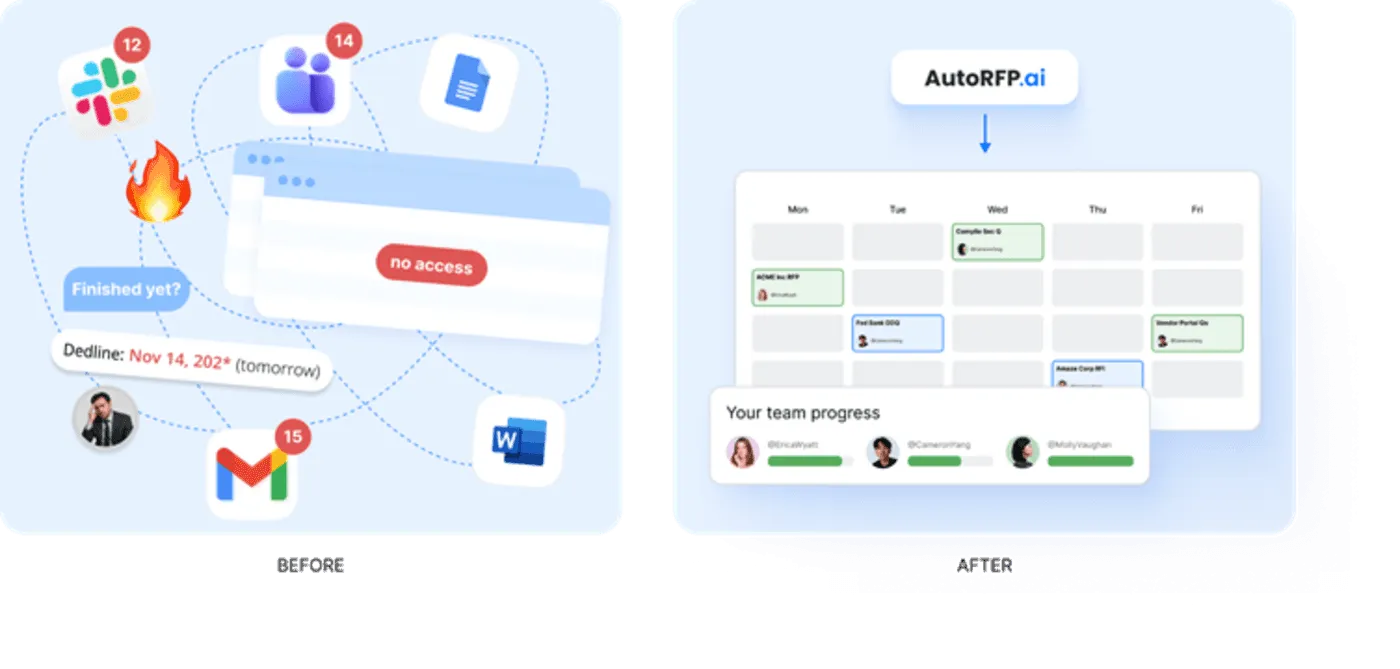
AutoRFP.ai helps reduce this coordination burden with inline commenting, section-level approval workflows, and version tracking. It also supports task assignments, notifications, and deadline reminders so reviewers work in one system instead of scattered documents.
Pro tip: Assign reviewers by expertise before the DDQ arrives. ESG, finance, legal, compliance, IT, HR, and investor relations should each have clear ownership areas.
Step 4: Maintain Consistency Across Responses
Version control for evolving answers prevents embarrassing inconsistencies.
When your firm’s AUM changes from $8.2B to $9.1B during fundraising, every ILPA DDQ response referencing AUM needs updating. When a key partner leaves and a new partner joins, personnel sections across all responses require revision.
Ensuring data consistency requires discipline across:
AUM
Personnel
Performance metrics
Portfolio composition
Fund terms
ESG data
DEI metrics
Compliance information
Manual processes fail here because people copy from the most recent response, not necessarily the most current information.
Quality assurance processes catch errors before submission. Someone needs to review completed ILPA DDQs for:
Factual accuracy of all data points
Consistency with other investor communications
Appropriate response length and detail
Complete addressing of all question components
Proper formatting and professional presentation
Manual bottleneck:
Teams copy from the most recent answer instead of the most accurate one.
Updated AUM, personnel, ESG, or performance figures may not flow into every response.
Different contributors may use different messaging, tone, or value propositions.
Reviewers spend too much time checking consistency instead of improving quality.
Outdated source documents can create conflicting answers across DDQs.
AutoRFP.ai helps maintain consistency by pulling from approved content, past winning responses, and company documents through a centralized AI-driven knowledge base. Its semantic search and AI drafting help teams reuse approved messaging, while human review workflows keep final answers accurate before submission.
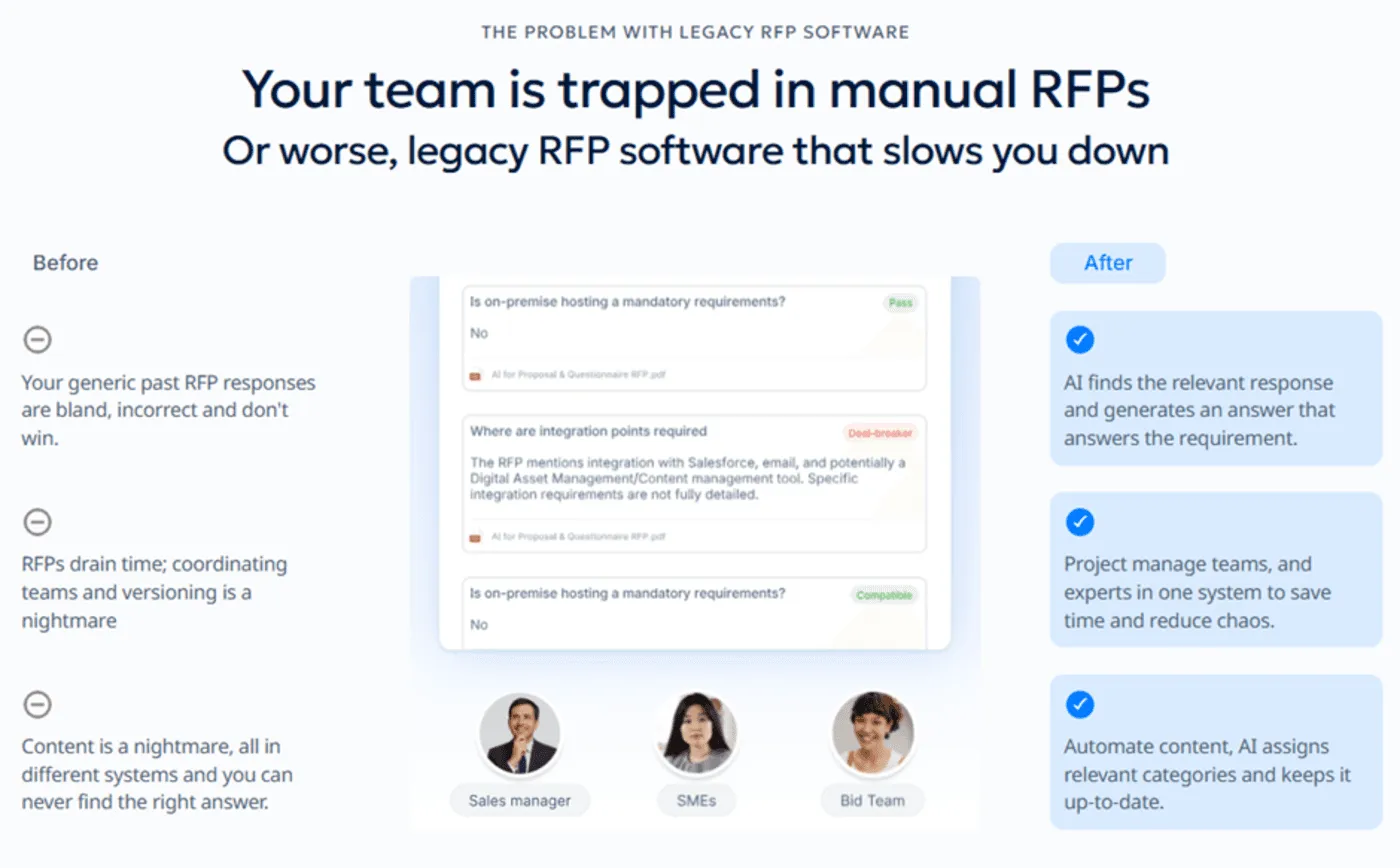
Pro tip: Build a final consistency check around high-risk fields: AUM, team size, performance data, fees, ESG claims, DEI metrics, compliance status, and fund terms.
Common Challenges in ILPA DDQ Response
The pain points in ILPA DDQ completion cluster around resource constraints, version control failures, data aggregation difficulties, and implementation barriers for less-sophisticated respondents.
Time And Resource Constraints
The average time to complete an ILPA DDQ manually for first-time completion is 40-60 hours spread across 2-3 weeks. This assumes the firm has most required information documented somewhere. Firms building documentation from scratch can hit 80-100 hours.
Coordination across 5-8 departments is typical.
Investment teams provide strategy and portfolio details.
Operations covers systems and processes.
Finance supplies financial statements and performance metrics.
Legal handles regulatory and compliance information.
HR provides DEI data.
Sustainability or ESG teams, if they exist, contribute environmental and social governance content.
The opportunity cost of senior staff time hurts. Partners and senior investment professionals spend 10-15 hours reviewing and approving ILPA DDQ responses. That is 10-15 hours not spent on deal sourcing, portfolio management, or LP relationship building.
Pro tip: Tackle this challenge by assigning section owners before the DDQ arrives. Set clear deadlines, review checkpoints, and escalation paths so one person is not chasing every department at the last minute.
Version Control And Consistency Issues
Keeping answers current as firms evolve creates perpetual challenges.
Your response library contains last quarter’s AUM figures. Current AUM increased 12% since then. Someone copies the old figure into a new ILPA DDQ. The Limited Partner notices the discrepancy with your monthly reporting. Trust erodes.
Multiple versions floating across teams compound the problem.
The investment team maintains their version of portfolio strategy descriptions. The marketing team has a slightly different language for similar concepts. Operations has their own process documentation.
When ILPA DDQ completion time arrives, three different versions of the same answer exist. Which is correct? Who decides?
Inconsistent data causing credibility issues happens more often than firms admit.
Imagine a Limited Partner evaluating three ILPA DDQs from the same fund manager across different fundraisers. The descriptions of ESG integration evolve, which is good, but basic firmographic data bounces around, which is bad.
One response says the firm has 45 investment professionals. Six months later, the number drops to 42 despite successful fundraising. The LP wonders what happened.
Pro tip: Tackle this challenge by creating one approved source of truth for high-risk fields like AUM, personnel, performance metrics, ESG claims, and DEI data. Review these fields before every submission.
ESG And DEI Data Collection
Newer requirements that firms lack systems for create significant friction.
ILPA DDQ 2.0’s expanded ESG section asks questions that many firms never formally documented, such as:
Carbon footprint of portfolio companies
Proxy voting ratios by ESG topic
Percentage of portfolio companies with board diversity policies
Spend with diverse suppliers and service providers
Climate scenario analysis results
Difficulty aggregating metrics from disparate sources multiplies the burden.
Portfolio company ESG data lives in individual company board decks. DEI information scatters across HR systems, performance reviews, and informal tracking. Financial exposure to climate-sensitive sectors requires analysis across portfolio reporting.
Ongoing monitoring vs. point-in-time reporting reveals process gaps.
ILPA DDQ requests current data. Many firms track this information quarterly or annually. When the ILPA DDQ requests “current portfolio company headcount diversity,” firms realize they collected this data six months ago and have not updated it since.
Pro tip: Tackle this challenge by treating ESG and DEI data as ongoing reporting categories, not one-time DDQ tasks. Keep a recurring update cycle so the team is not rebuilding the answer from scratch every time an LP asks.
How AutoRFP.ai Streamlines DDQ Responses
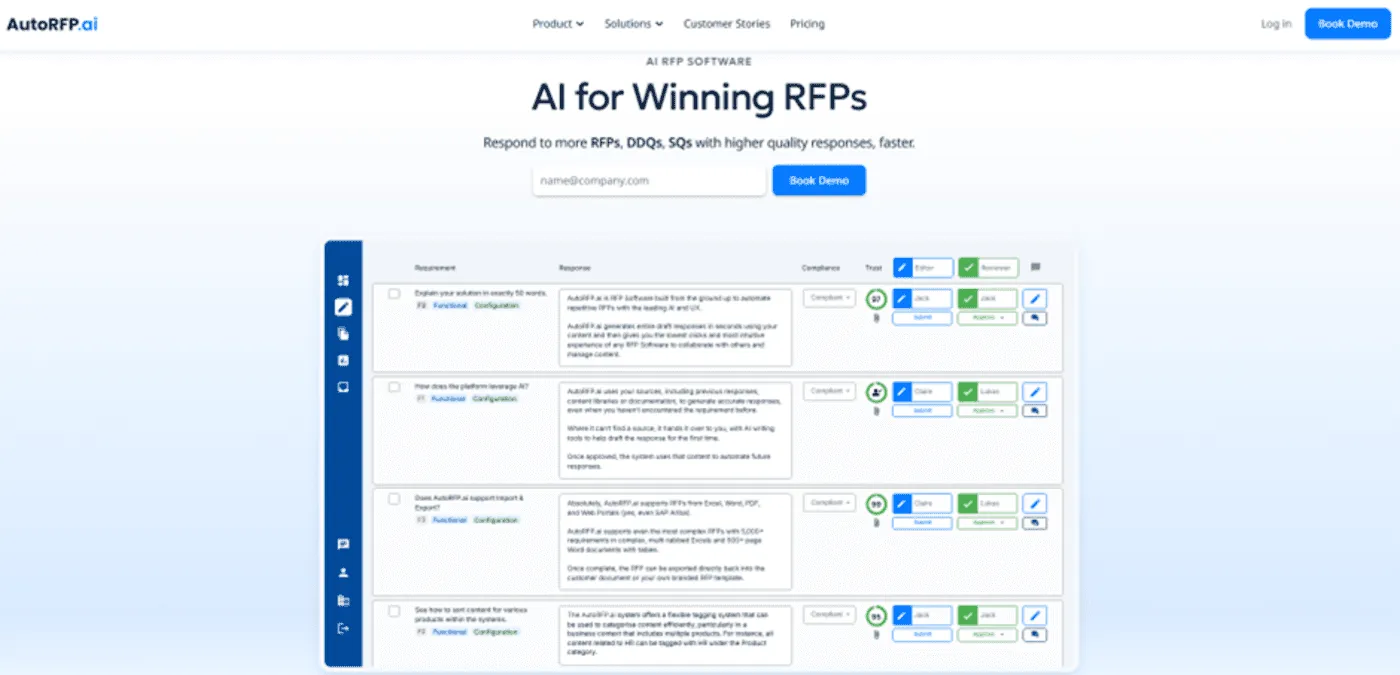
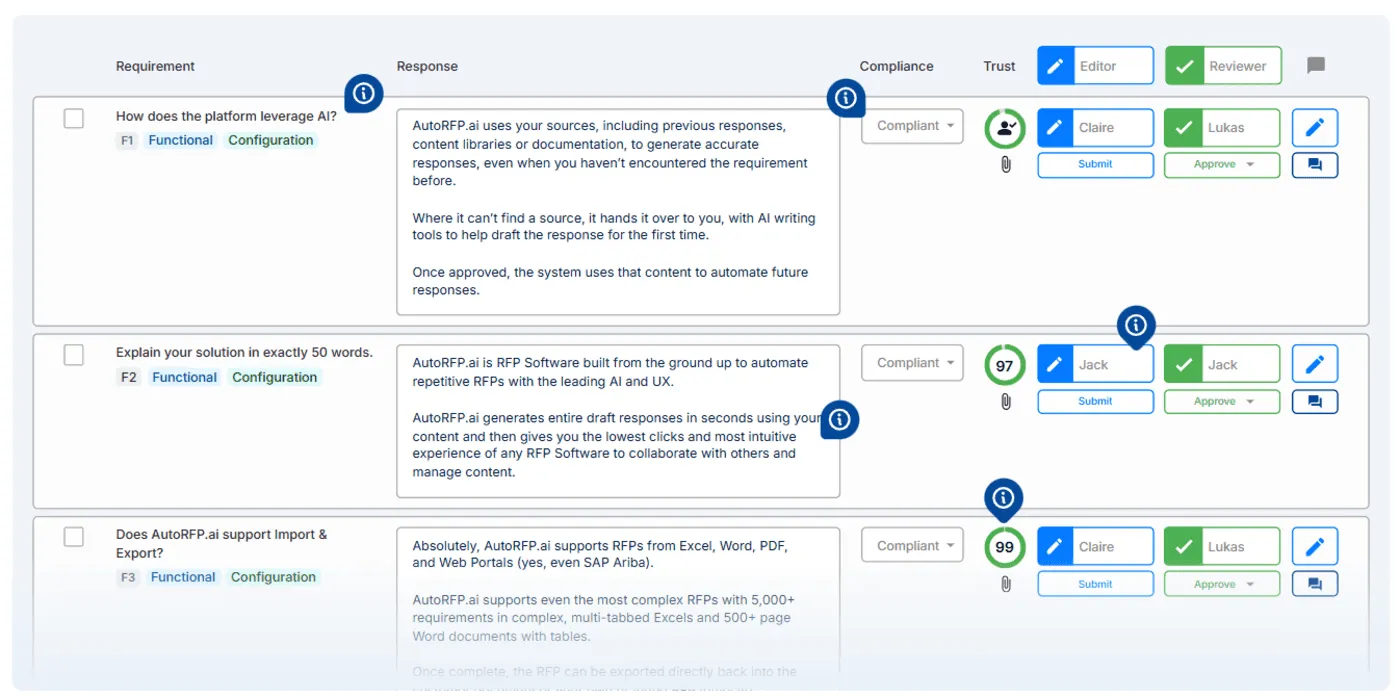
AutoRFP.ai is the best AI DDQ software that helps investment firms respond to due diligence questionnaires faster, with more structure, accuracy, and visibility across the DDQ process. It supports DDQ importing, answer drafting, content reuse, collaboration, consistency checks, and reporting in one system.
1. AI DDQ Response Engine
AutoRFP.ai creates first drafts for DDQ answers using approved past answers, internal content, fund documentation, compliance policies, and company materials.
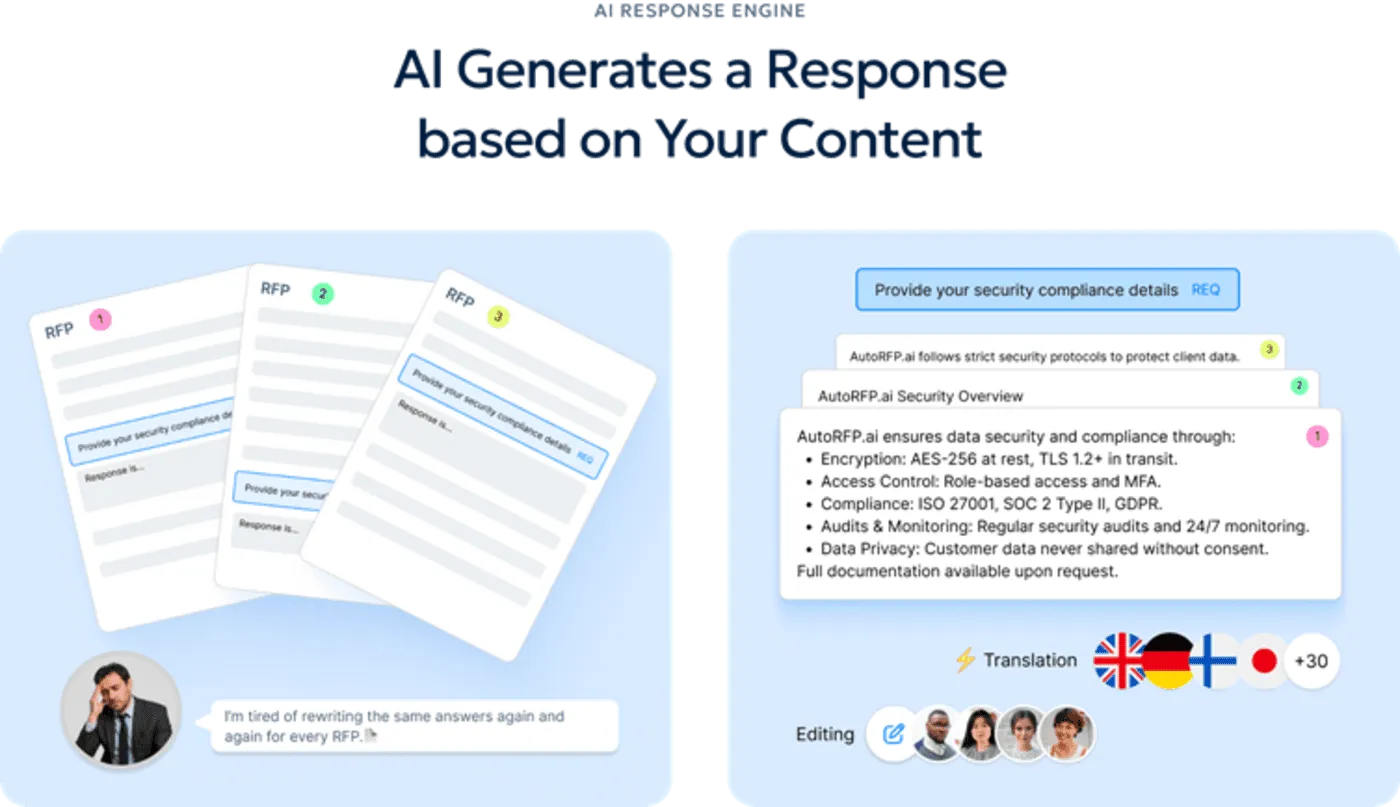
It pulls from trusted source material first, then writes answers in your company’s terminology and preferred tone. This helps teams produce DDQ responses that feel more consistent, accurate, and review-ready.
When source support is weak, the platform highlights that for human review instead of guessing. Each answer can also include visible source support, content freshness, and confidence scoring, so reviewers can check accuracy more easily before approval.
AutoRFP.ai’s DDQ response uses semantic search to retrieve relevant content and draft answers with confidence scoring.
This helps teams:
Draft DDQ answers faster
Reduce copy-and-paste work
Review source-backed responses with more confidence
Prioritize weaker answers that need SME input
Keep the final response more accurate and consistent
2. Self-Updating DDQ Content Library
AutoRFP.ai includes a content library that gets stronger as your team uses it.
Approved DDQ answers can flow back into the library automatically, where AI helps organise and surface them for future use. This reduces the need to manually maintain a large Q&A library from scratch.
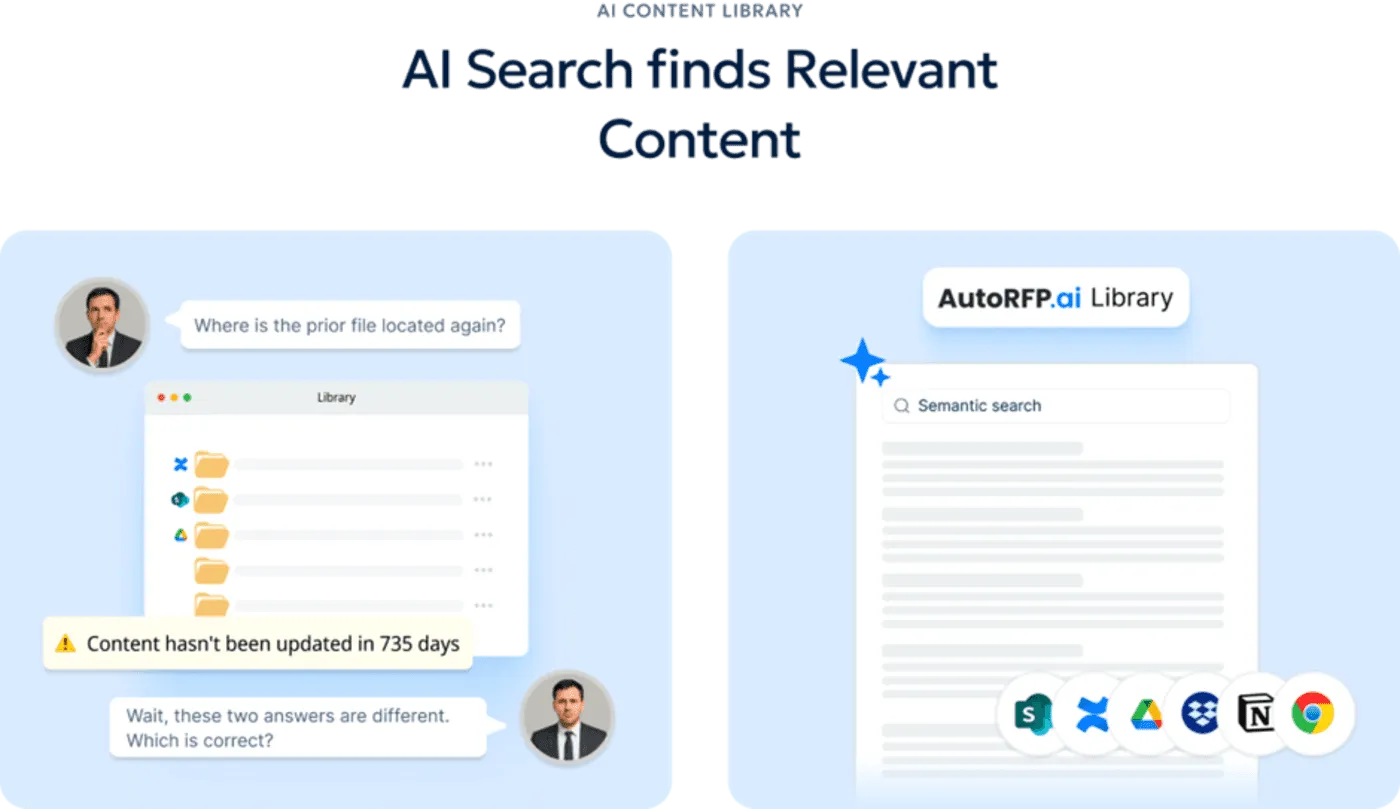
Its search works by meaning, not just exact wording. That helps teams surface relevant content even when phrasing changes across DDQs. AutoRFP.ai’s semantic search helps teams find conceptually accurate answers without manually maintaining a large Q&A library.
This helps teams:
Reuse approved DDQ answers
Find relevant content even when questions are worded differently
Reduce manual tagging and folder maintenance
Keep useful answers available for future DDQs
Build a stronger DDQ knowledge base over time
3. DDQ Document Importing And Requirement Extraction
AutoRFP.ai gives teams a much faster starting point when a new DDQ arrives.
It can import DDQs from Excel, Word, PDF, and investor portals. The platform can also handle complex multi-tabbed spreadsheets and long documents with embedded tables, then extract questions and requirements for review.
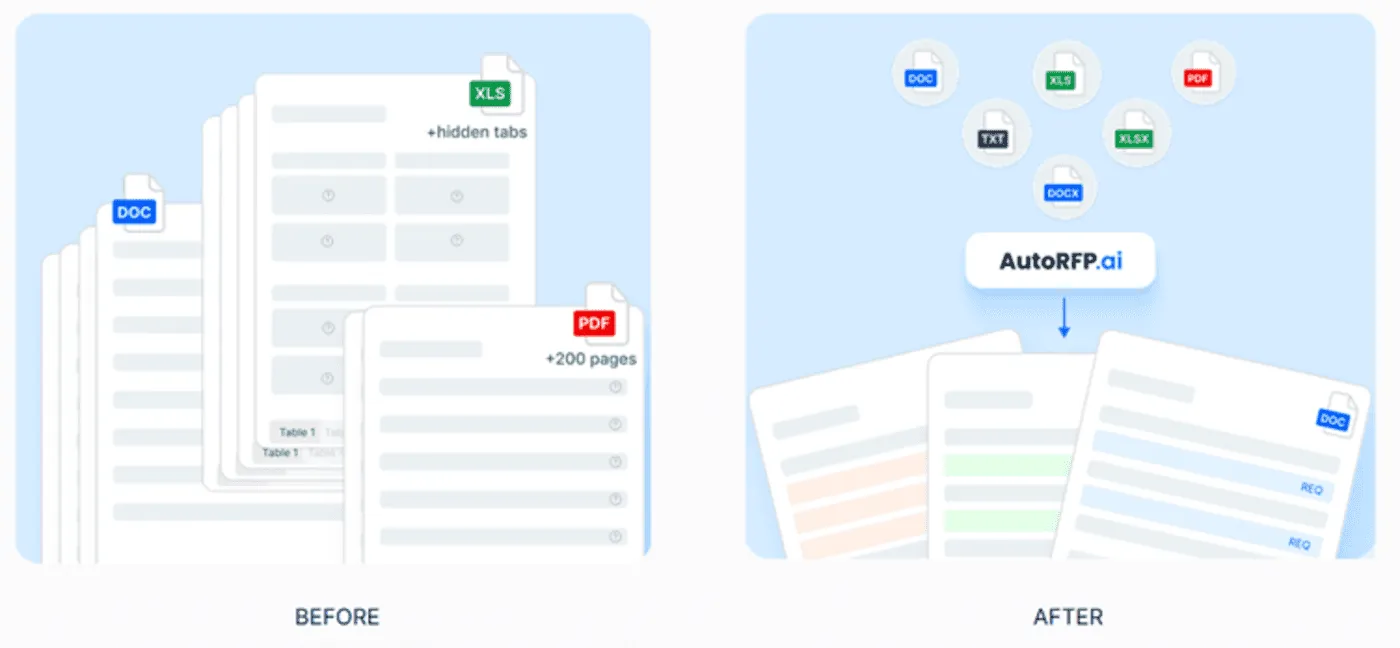
That helps teams move straight into answering instead of wasting time reformatting files.
This helps teams:
Import complex DDQ files faster
Extract questions and requirements automatically
Handle multi-tab spreadsheets and long documents
Preserve the original response format
Reduce manual setup before drafting begins
4. DDQ Project Management That Keeps Responses Moving
Strong project management matters because DDQ work rarely sits with one person.
Most DDQs involve multiple reviewers, SMEs, deadlines, comments, and dependencies. Teams need clear visibility into what is finished, what is blocked, and what needs attention next.
AutoRFP.ai helps teams manage DDQ responses from one central workspace. Teams can assign questions by expertise, track completion status, collaborate in real time, and manage approvals in one place.
This helps teams:
Assign DDQ questions to the right reviewer
Track section progress in real time
Keep comments and approvals in one workspace
Catch delays before they affect the deadline
Reduce reliance on spreadsheets, email chains, and separate check-ins
5. AI Q&A That Helps Teams Find Trusted DDQ Answers Fast
AutoRFP.ai helps teams find approved DDQ information quickly through a sourced AI Q&A assistant.
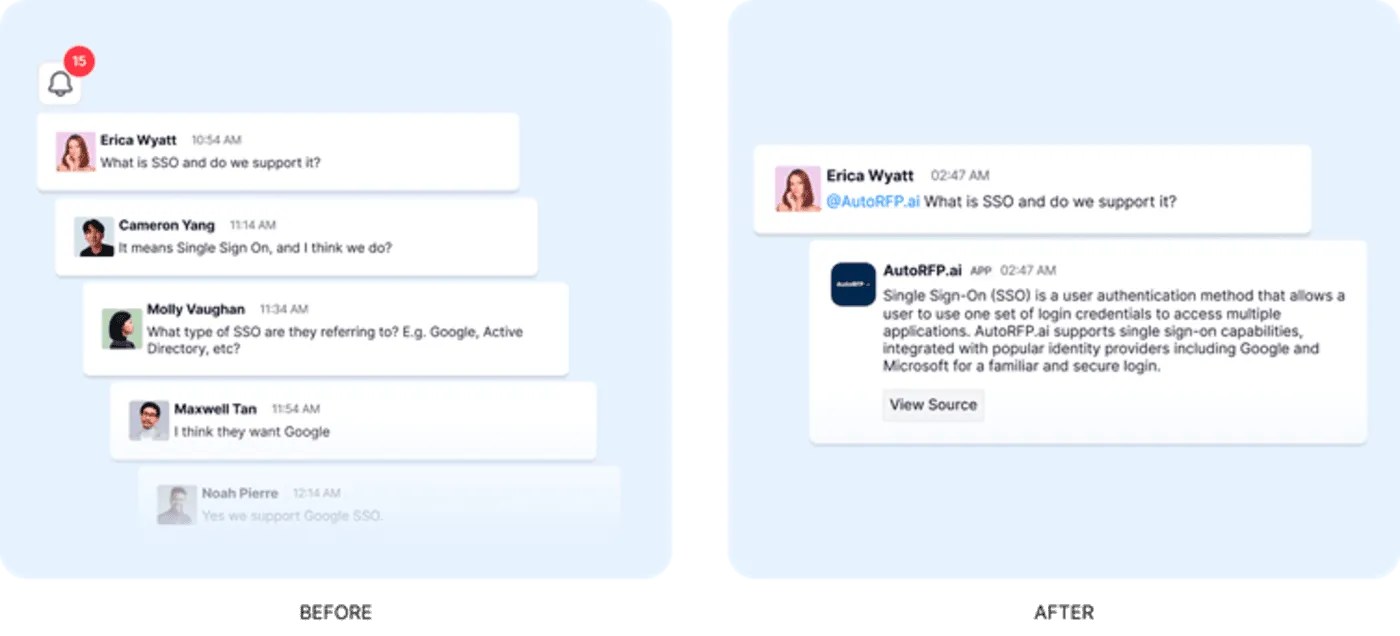
In many firms, people still waste time searching folders, old responses, emails, or internal documents just to confirm one answer. AutoRFP.ai gives teams a faster way to ask questions about ESG policies, fund terms, compliance controls, AUM definitions, DEI metrics, or operational processes and get grounded answers from approved content.
It also works inside Slack and Teams, so users can ask from the tools they already use instead of leaving the conversation to search manually. This helps teams keep DDQ answers consistent because everyone is pulling from the same approved knowledge base.
6. DDQ Reporting And Efficiency Tracking
AutoRFP.ai gives teams a clearer view of DDQ workload, efficiency, and response quality.
Leaders can track automation rate, time saved, cost savings, and DDQ efficiency by quarter or by individual SME.
AutoRFP.ai’s reporting breaks down automation impact across the organisation, including automation rate, time saved, cost savings, and DDQ efficiency.
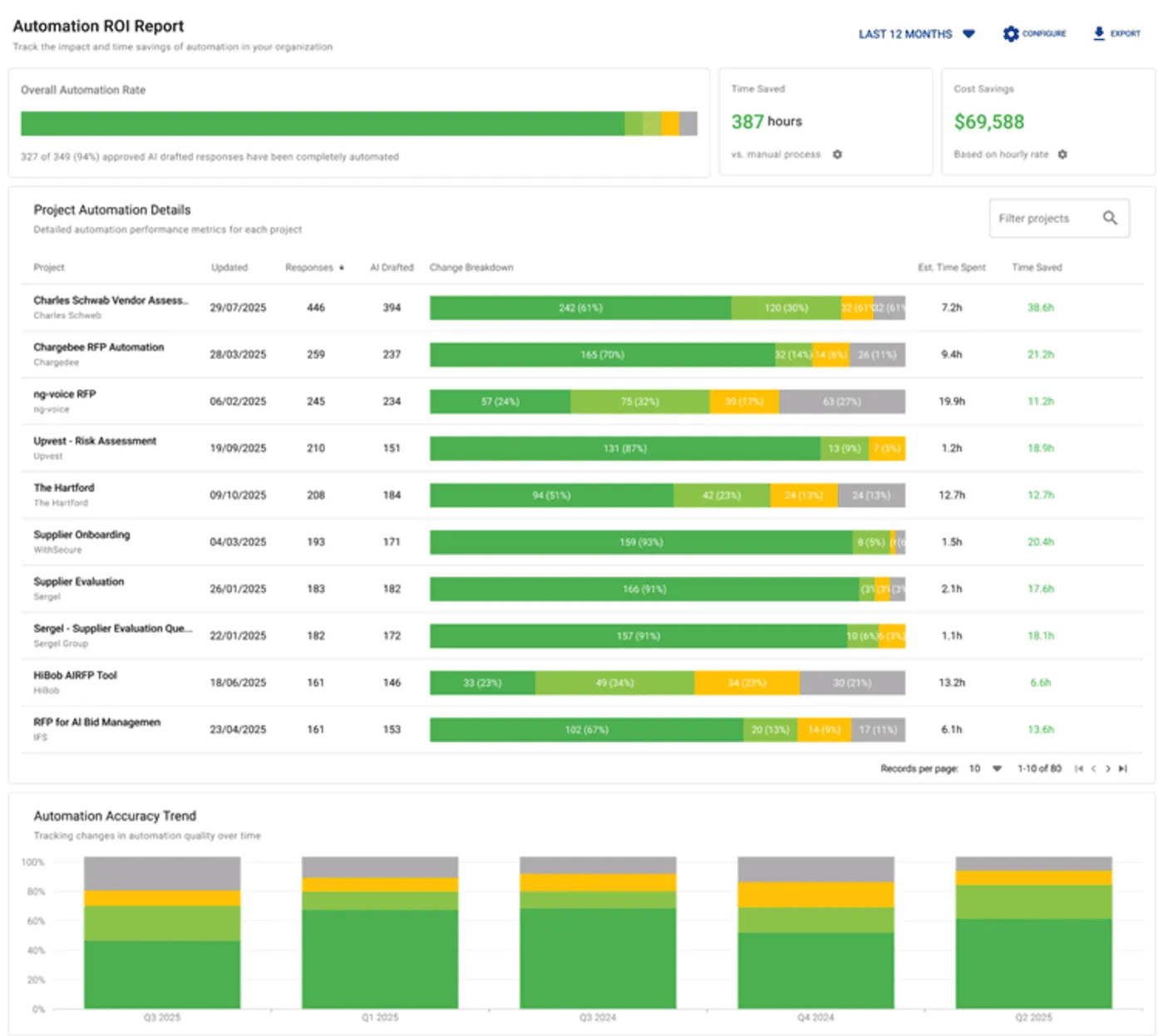
This makes it easier to understand where the team is saving time, where manual review is still needed, and which SMEs carry the heaviest workload.
This helps teams:
Track DDQ efficiency
Measure time saved
Understand SME workload
Prove the value of automation
Improve future DDQ processes with real data
7. DDQ Gap Analysis
AutoRFP.ai helps teams spot weak answers, recurring issues, and content gaps that may slow down DDQ completion over time.
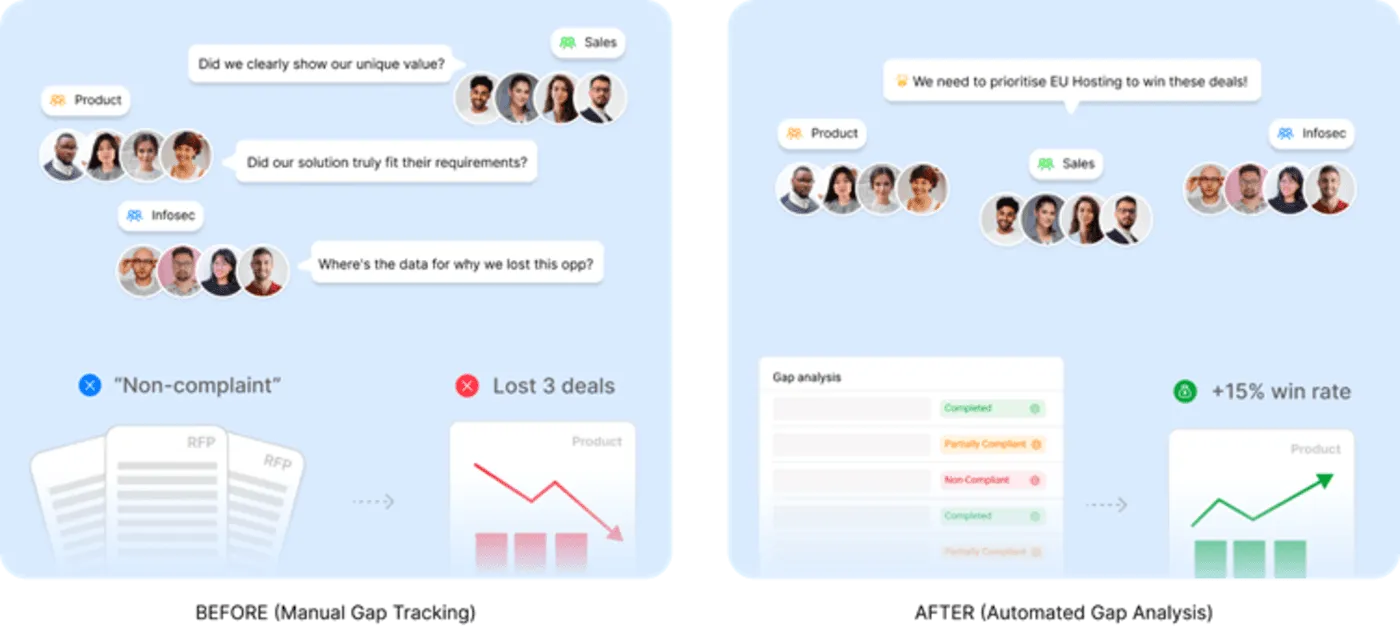
Instead of relying on manual spreadsheet reviews or inconsistent tagging, teams can identify where approved answers are missing, where responses need SME review, and where repeated questions reveal documentation gaps.
This gives investor relations, compliance, finance, ESG, and operations teams better visibility into what keeps coming up. With that insight, teams can strengthen future DDQ responses, address common blockers earlier, and focus effort on the fixes that matter most.
Best Practices for ILPA DDQ Management
Operational excellence in ILPA DDQ management requires systematic approaches that extend beyond just choosing the right tools. Here are the best practices to follow.
1. Establish A DDQ Center of Excellence
Designate ownership at the organizational level. Investment operations teams typically own this for fund managers.
Whoever owns it needs explicit authority to:
Request information from across departments
Set standards for response quality
Allocate DDQ automation platform access
Drive DDQ process improvements
Create governance for content updates. Establish quarterly content review cycles at minimum.
Assign content owners for each major section:
ESG lead owns ESG responses
HR owns DEI metrics
Finance owns financial statements
Define approval chains for content changes that might have regulatory or compliance implications.
Pro tip: Regular content audits, quarterly if possible, help prevent staleness. Review firmographic information for accuracy, performance metrics for currency, personnel biographies for current status, strategic descriptions for alignment with actual practices, and ESG and DEI data for completeness.
2. Build Industry-Specific Content
For vendors, tailor responses to the investment industry context.
Technology companies receive ILPA DDQs from institutional investors conducting vendor due diligence. The questions assume investment management operations.
Your responses should:
Frame technical reliability in business continuity terms familiar to financial services
Describe security practices using terminology institutional investors recognize
Explain ESG practices even though you’re not investing in companies
Position DEI initiatives in talent and culture frameworks relevant to sophisticated institutional buyers
Pro tip: Pre-build ESG and DEI sections proactively. Don’t wait until an institutional investor requests an ILPA DDQ to realize you’ve never documented your firm’s diversity metrics or environmental practices. Build this content while you have time to do it thoughtfully.
3. Integrate With Broader Sales/Fundraising Process
ILPA DDQ responses aren’t isolated compliance exercises. They’re part of larger relationship-building and evaluation processes.
Consistency with pitch decks, data rooms, and other materials matters critically. When your pitch deck describes ESG integration as “core to our investment philosophy,” but your ILPA DDQ responses suggest ESG is an afterthought, Limited Partners notice the disconnect.
The due diligence process begins before the ILPA DDQ request arrives.
Smart General Partners provide investment strategy overviews, historical performance context, and operational frameworks early in LP conversations. This primes the evaluation and makes ILPA DDQ responses feel like natural extensions of existing materials.
Respond to ILPA DDQs Faster & Win More with AutoRFP.ai
ILPA DDQs demand accurate, consistent, and well-organized responses across firm information, investment strategy, fund terms, ESG, DEI, compliance, and operations.
Manual completion slows teams down with scattered documents, version control issues, and constant reviewer follow-ups.
AutoRFP.ai helps teams move faster by importing DDQ files, finding approved answers, drafting source-backed responses, and keeping reviews in one central workspace.
Instead of rebuilding every answer from scratch, teams can reuse trusted content and focus on improving response quality.
Respond to ILPA DDQs faster, reduce manual work, and give your team more time to focus on winning.
Frequently asked questions
1. Is The ILPA DDQ Mandatory For All Private Equity Fundraises?
No. The ILPA DDQ is not mandatory for every private equity fundraise. It is a standardized due diligence template that Limited Partners may request when evaluating General Partners. In practice, it becomes necessary when an investor asks for it as part of their diligence process. ILPA positions the DDQ as a tool to standardize investor inquiry, not as a legal requirement.
2. How Often Do Fund Managers Need To Update Their ILPA DDQ Responses?
Fund managers should update ILPA DDQ responses before each fundraising cycle, annual investor review, or material firm change. This includes changes to AUM, personnel, fund terms, ESG policies, DEI metrics, compliance status, or performance data. Your article already frames ILPA DDQs as part of fundraising, annual reporting, and ongoing manager monitoring.
3. How Long Does It Typically Take To Complete An ILPA DDQ Response?
A first-time ILPA DDQ response typically takes around 40 to 60 hours if most information already exists internally. Subsequent responses can take around 15 to 25 hours when the firm has a stronger response library. The timeline can increase if ESG, DEI, fund economics, or compliance information is scattered across departments.
4. Can Investors Add Custom Questions To The ILPA DDQ?
Yes. The ILPA DDQ is designed to reduce repeated, inconsistent questions, but it does not remove all investor-specific variation. LPs may still add custom questions based on fund strategy, risk concerns, ESG expectations, reporting needs, or internal diligence requirements.
5. What Documents Should Fund Managers Prepare Before Completing An ILPA DDQ?
Fund managers should prepare firm information, fund terms, investment strategy materials, performance data, compliance policies, ESG documentation, DEI metrics, reporting samples, valuation policies, and operational risk materials. ILPA DDQ 2.0 covers broad diligence areas, so having these documents ready helps teams respond faster and more consistently.
