Technical Proposal: How to Write One That Wins in 2026
A technical proposal is a formal document that outlines a solution, methodology, timeline, and cost to address a specific project or problem for a client.

Robert Dickson
RevOps Manager, AutoRFP.ai··10 min read
Writing a technical proposal can feel like translating complex work into something evaluators can score quickly. You need enough detail to prove capability, but not so much that the response becomes hard to read.
This article breaks down how to structure and write a winning technical proposal, with templates, examples, and best practices you can follow. We’ll also look at how AI helps speed up research, drafting, collaboration, and final reviews.
What Is a Technical Proposal?
A technical proposal is the part of an RFP response that explains how your company will meet the buyer’s requirements. It focuses on the solution, delivery approach, implementation plan, team, timeline, technical capabilities, and how you will manage risks or project requirements.
A technical proposal usually covers:
The proposed solution or approach
Project methodology and implementation steps
Technical requirements and how they will be met
Team structure, roles, and responsibilities
Timeline, milestones, and deliverables
Quality control, risk management, and support plan
Relevant experience, case studies, or proof of capability
However, RFPs are just one common situation where technical proposals appear.
For example, technical proposals can be used for:
| Situation | How the technical proposal is used |
|---|---|
| RFP response | To explain how the vendor will meet the buyer’s requirements |
| Tender submission | To prove the company has the right method, team, timeline, and resources |
| Software project | To explain architecture, integrations, security, implementation, and support |
| Engineering or construction project | To explain design approach, materials, methods, safety, and execution plan |
| Consulting proposal | To explain methodology, project phases, deliverables, and expected outcomes |
| Grant or research application | To explain the technical method, project design, or research approach |
| Internal business case | To get approval for a new system, tool, process, or technical investment |
Writing a strong technical proposal takes more than listing features or capabilities. AutoRFP.ai helps proposal teams analyze RFP requirements, draft stronger technical responses, and keep every section aligned with buyer expectations.
Book Demo with AutoRFP.ai to see how your team can create compliant, high-quality technical proposals faster.
When Buyers Request a Technical Proposal in an RFP
Buyers usually request a technical proposal when they need to evaluate more than price. They want to understand whether your solution, process, team, and delivery plan can meet the project requirements.
A technical proposal is commonly required when the RFP involves:
A complex product, service, or implementation
Custom software, system integration, or technical setup
Strict compliance, security, or performance requirements
Multiple project phases, timelines, or deliverables
A need to compare vendor methodology, expertise, and risk management
A formal evaluation process where technical quality is scored separately from pricing
What to Include in a Technical Proposal Response
Here’s what you need to include in a technical proposal response to show the buyer that your solution is compliant, credible, and built around their requirements.
| What to include | What it should cover |
|---|---|
| Executive summary | Summarize the buyer’s problem, your proposed technical solution, and the business value they can expect. |
| Customer insight brief | Show that you understand the buyer’s goals, risks, priorities, decision criteria, and competitive context. This matters because 88% of high-win teams have a defined customer-insight process, compared with 67% of low-win teams. |
| Clear win themes | Include 2 to 4 core messages that explain why your solution is the best fit. 71% of high-win teams use win themes, compared with 42% of low-win teams. |
| Compliance matrix | Map every requirement to the right response, owner, evidence, and document location so evaluators can clearly see that you meet the RFP requirements. |
| Technical approach and methodology | Explain how your solution, system, process, or service will meet the buyer’s requirements. Keep the focus on how your approach reduces risk and improves outcomes. |
| Scope of work and deliverables | Define what is included, what is excluded, and what the buyer will receive, such as reports, software builds, documentation, support, or implementation outputs. |
| Proof and evidence | Add metrics, case studies, certifications, technical documentation, implementation results, or examples that make your claims easier to trust. |
| SME validation | Let subject matter experts review technical accuracy, feasibility, risks, and specialist claims. This is important because 94% of high-win teams use either joint collaboration or a proposal-team-led model where SMEs validate the response. |
| Reusable approved content | Use governed content for standard answers like company background, security, policies, implementation details, and repeat technical responses. 59% of high-win teams use content library automation, compared with 36% of low-win teams. |
| Buyer-specific customization | Tailor the response around the buyer’s use case, priorities, risks, and desired outcomes. Teams that combine content automation, high reuse, and customer insight are three times less likely to sit in the lowest win-rate bands. |
| Governance and review process | Include review rounds for compliance, technical accuracy, narrative quality, pricing alignment, and final submission checks. 65% of high-win teams have formal review or governance, compared with 42% of low-win teams. |
| Implementation plan and milestones | Explain timelines, responsibilities, delivery stages, dependencies, risks, and how the buyer will be supported after award. |
How to Write a Technical Proposal Step by Step
A strong technical proposal should be structured, specific, and easy for evaluators to score. Here’s how to write one step by step.
Step 1: Qualify the Opportunity Before Writing
Before you start writing, decide whether the opportunity is worth pursuing. A technical proposal takes time, input from different teams, and careful review, so you should not treat every RFP as an automatic yes.
Check whether the opportunity fits your solution, capacity, timeline, pricing, and delivery experience.
Review the buyer’s scope, budget, timeline, and mandatory requirements.
Identify any deal-breakers, such as unrealistic deadlines or requirements you cannot meet.
Confirm whether you have enough customer insight to write a strong response.
Decide whether the opportunity is worth the time and resources needed to respond.
Pro tip: Use a Go/No-Go decision template before drafting so your team does not waste time on low-fit opportunities that are unlikely to convert.
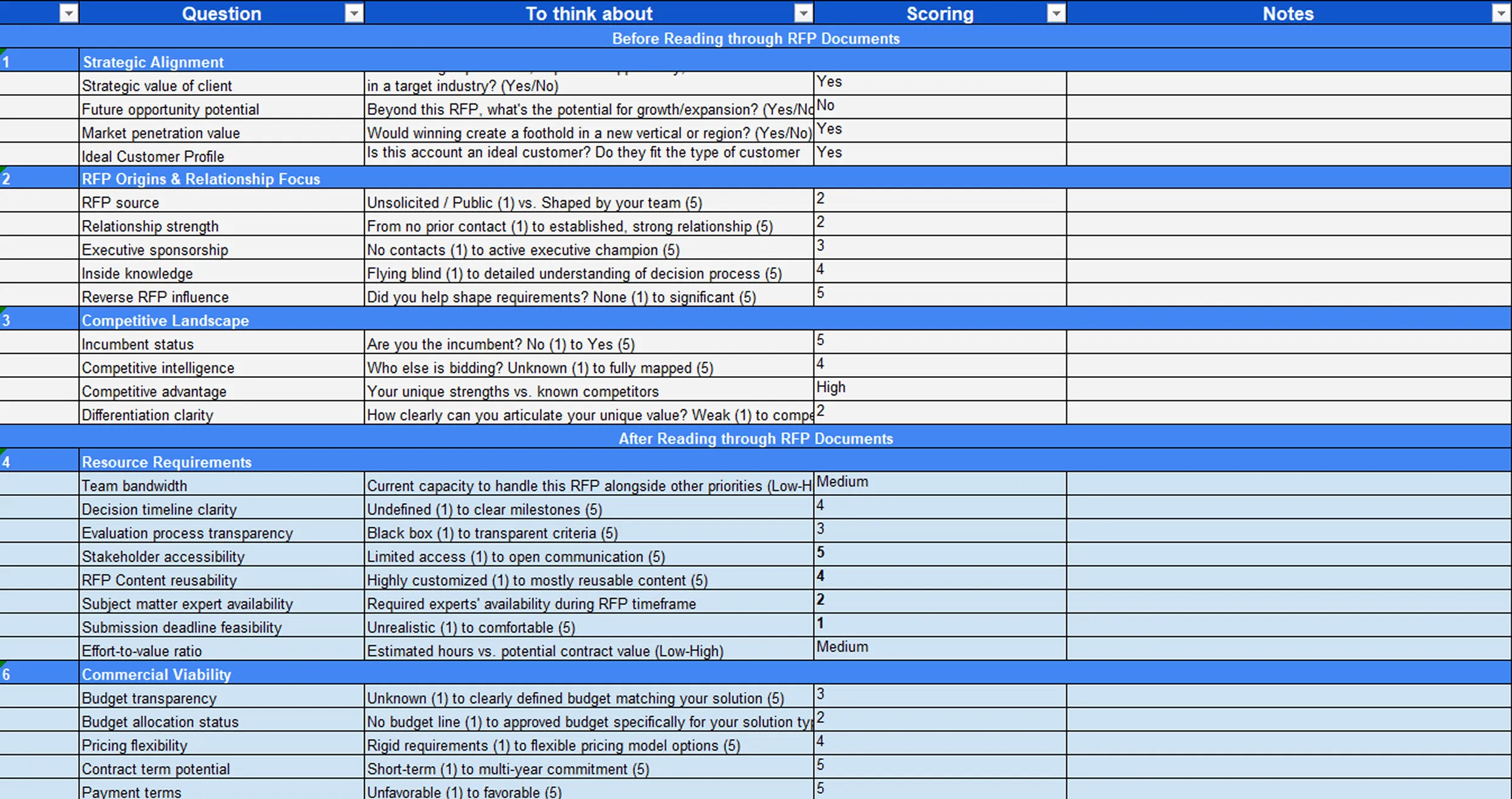
The video below explains how to turn Go/No-Go decisions into a simple expected value calculation, so your team can focus on RFPs that are truly worth pursuing.

Video transcript
Transcript is auto-generated and may contain minor errors.
starting topic today, all about go, no go. So, yeah, we're both really keen to jump into it and as we go, if you're not aware, we're So, Jasper and I from AutoRFP.ai, as the name would suggest, we're an AI RFP software. I know we've got quite a lot of customers on the call today. We've also got some non-customers. Yeah, as it says on the housekeeping slide there, our goal today is really you walk away with something actionable. Yes, we'll be showing some AutoRFP near the end, but Jasper's going to dive really deep into a lot around calculating your Pwin, cost of an RFP, to incorporate that into your go, no go. Uh and then I'll be covering off quite a lot in regards to Claude and everything else, but I'll get to that in a sec. So, everything that we put in today, so whether it's like URLs, prompts that we're sharing, that will also be included in the email as well, as well as the recording. So, if you need to duck off early, no problem. Please do. We've all got work and so, you'll get an email probably like a couple of hours after the webinar today with the recording and all the materials.
Any questions, please do put through the chat Q&A. I'll try to figure out to hopefully get the chat working. I'd love to chat to everyone as we go, but of course, feel free to throw it in the Q&A and I'll get to touch on those as we go or we'll have a dedicated space at the end to to go through the Q&A as well. Awesome. Today's agenda. I'll be going a little bit in regards to definitions and learning starting from the basics of go, no go or bid, no bid or all the different names it may go under. Jasper's going to go into, like I mentioned, really talking about calculating the cost of an RFP and taking that into account with regards to your go, no go. Really solid stuff there. Have an example framework which will he'll share and everything else. I'll be using some AI tools, so Gemini and Claude. So, effectively how you can use AI for go, no go without AutoRFP. Or if you do use AutoRFP and you want to go that little bit further as well, although there's obviously a lot you can do with our platform. You know how to use those as well. So then Jasper will be covering
auto RFP, how to use project analyzer feature and go no go there. We've made some recent changes, that's really cool. And then at the end we'll have that Q&A as well for everything that we may not get to as we go through. Awesome. All righty. Hey, so one of the cool things that we did recently was the proposal win rate report. We did that with the Stargazy community which is an online bid community run by Chris Carter who I think might be on the call today. Um, if you're bid management, I recommend joining. It's a cool it's a good community. Lots of really helpful stuff there. Jasper and I are both active as well. But what we did together with the Stargazy community is we surveyed over a hundred proposal managers, bid writers, RFP teams and crunched the numbers about some of the things that winning bid teams or bid teams in general do. And of course some of the questions were about go no go. What we found interesting is 71% of all teams have a go no go qualification.
They're actually between the a high win team, so a team that won more than 50% of their bids, and team that won less than like 10% of their bids, both had go no gos. So there's actually no difference in who you did no go. A lot of it came down to review and governance and automation. So 65% of high win teams have a formal review and governance with regards to their process including go no go. So what we're going to go show today is yes, it's kind of like different tiers to go no go that you can incorporate in your workflows in relation to your complexity of bids, uh the cost of bids and everything else as well. Probably no surprise to everyone is something else the data showed was that teams with a high bid workload win less. So there's actually this great graph within the report and of course I'll share the report as soon as I get the chat working. but you'll get an email afterwards as well with it. But effectively, so less FTE to bid ratio, winning less. And then, high win teams yeah, consistently at higher automation,
systematic customer insight, and a strong governance and go no go with that as well. So, we're going to be covering one part of that. But, I'll throw it to Jasper to cover the next kind of portion. >> Cool. So, I guess yeah, an interesting thing is like AI was built for go no go. Someone say even more than RFP response, like AI has this ability to summarize at extremely high performance levels across insane amounts of documents. Probably as everyone knows, right? But, I think AI allows you to finally say no to more because of a few things, right? So, not only can it do that analysis, but it can do it so quickly that when someone runs to you with a bid and goes, "No, this is due in a week." You don't have to start going, "Oh, we need to do the go no go process first, and that takes 2 days, and we need to go through all 247 pages." You can actually run one in minutes and find red flags immediately, so you don't even need to have the conversation in the first place. So, that's a pretty big game changer, just reducing it from 2 days to have an initial result in a few minutes. Really sad one, but we've found it to be true
is that the results come from a third party. God forbid the bid manager knows what the win rate might be, or that this is a serious red flag we've seen a hundred times. But, just the fact that it's generated by AI has this third party, "It's not me, it's the AI." effect and halo around it, which makes it easier for some people that want to say yes and donate their nights and weekends. It makes it easier for you to say no. And then, the experience of having better than human performance as well, right? So, it can find needles in haystacks and do rationalization and do things that only SMEs could pick out really if they were doing the go no go. From really niche security or environmental governance requirements that you might not fully understand on first glance, it's able to pull those things out immediately without having your SMEs go through every single bid that you look at, and it's able to pull that red flag up for you. So, it finally lets you say no, and then that's of course good. To make it clear for everyone, no is a very good thing. It saves organizations tens, hundreds,
millions of dollars in costs. It protects your team's morale and culture as well. It's There's nothing worse than having a low win rate and going back to back on lost bids and oh, sorry, and hey, can we jump on a call to debrief? No one wants that. You just want to be winning back to back. That this process helps shield your team from that morale that can cause a negative spiral. And then of course, the time that you're investing in those opportunities that you should have said no to, that actually degrades your ability to win the ones that you said go to. So, yeah. Highlight for anyone that's not currently having this process to definitely invest in it. But, I wanted to jump into go no go from the CFO seats. So, a lot of the time we just think about it as a softer framework where hey, let's fill out this form, let's get some numbers, and let's do it that way. But, I thought let's pull it all the way back to first principles as an investment as an organization even. What makes sense to bid on? What doesn't make sense to bid on if we're just talking numbers? So, there's a few numbers here that are super important to understand going into an RFP. One is the
total contract value, right? This should be somewhere in the document. You should be able to calculate the price. They should maybe have the terms that they're open to. Maybe it's 3 years, 5,000 users, great. Then you can use that to forecast what the pricing range might be. The gross margin. So, actually how much profit there would be in this particular contract. A lot of that it can be assumed. So, you might talk to your finance team and say, "Hey, what is the average gross margin on an opportunity like these that we've worked on? Can you give me a ballpark to start?" But, different things will impact the gross margin. Maybe you offer implementation or professional services for free. Those have a real cost, but if you're going to have to provide those for some customers and not for others, that is going to impact the gross margin and how profitable one RFP would be should you win it versus another. So, those are the two things that may sit a little bit outside of the bid function, not something you necessarily have control over, but something is really good to understand you'll need in your calculations if you want to put
your CFO hat on and do the go no-go process. The next ones are purely owned by the proposal team in my mind, which is that probability of win. So, how likely you to actually win this opportunity with a non-biased approach, how accurate can you get that percentage of win, what elements fall into that, what have you learned over time. It's a hard thing to nail. You start in ballparks and then start to optimize that over time to get more and more accurate. Uh and then the cost of the bid as well. I think even a high-level idea of how much you spend on a bid is an insane tool for leverage in saying no to something. But, if you can start to understand the cost of one bid versus another because they are very different a lot of the time. Sometimes orders of magnitude for double the contract price or sometimes the smaller contracts take way more time than than even some of the largest. So, have that cost of bid and have a methodology for that is is really useful as well. So, those are the four numbers. And
basically a CFO would ask themselves, will this bid make me more money than the other things I could do with that same investment? To talk really macro, they could just spend that money on ads, right? And get a certain amount of leads to the business. That might be a way to do it. They might be able to buy a certain amount of sales development reps to hammer the phones and look for opportunities that way. There's a lot of different ways to spend money in the business. So, being an effective use of that money is awesome. It's going to be awesome for your career. It's going to be awesome for your team. It's going to give you the reinvestment and the resources you need to go far and basically be a winner. And the calculation is, let's take the contract value, great, so we've got that, it's a big contract, amazing. Then what is the actual margin? Like how much money we're actually going to make on that contract as far as the margin, the profitability, and what is our actual probability of winning that? So we take that together and that gives us kind of the expected value of that. And then we take away what it actually costs to bid on that and then we get our expected value. So this is a calculation that the CFOs might run all the time for different things, but basically, yeah, is this a worthwhile investment at all?
It's like a mini business case nearly for that particular bid. So there's a classic one here as an example, like a million-dollar trap, right? Which is salesperson runs over, oh my god, we have a $2 million contract opportunity, it's crazy, the CRO's excited, everyone's super excited, and we do have a chance, we do have a real chance. Even if it's 15% it's worth bidding on. Um and it would be a great logo, blah blah blah. But here, looking at the math, we've got a $2 million contract, we've only got a 40% profit margin, and we have a 15% opportunity to win. It's going to cost us $120,000 once we factor all of the labor from the implementation team, through our SMEs, through our security review, our external lawyers, and the process of answering 800 of their different requirements and customizing the solution for them in that proposal to even have a chance to have that 15%. And we can effectively see that the expected value of this particular contract is actually $0. So there's no
point in doing this $2 million opportunity, but as like crazy as that sounds, that's the math, right? Whereas at the same time that someone's bringing that to your desk, you might have something else, like a $400,000 contract with a 55% margin, so only slightly more, and only a slightly higher win rate at 20%. But the big difference here being that you may have already completed an RFP like this in the past. It's very similar. You can expect a high automation rate maybe from the tool that you use because of that. You've done a very one that's recent. This is amazing because your expected value is huge now because your cost of actually going into that bid is so much lower. So, you find really weird opportunities where it's actually because of that number, the gross margin being high or the probability of win being very high or maybe the cost being pretty high as well. You get these interesting combinations where the expected value is actually higher than you think or you get the exact opposite where the expected value is actually lower than you think. So, to think in these terms is very interesting in a go no go and
it's the type of language that people can understand as well outside of like our softer like we're in the debating club. Oh, but they have this requirement. Oh, but they have this and we don't have that and last time we did why? This really brings the conversation down to the math level and they can start to see the factors at play. So, I think that's really powerful. Now, you know, a lot of people in in in AI is about doing like is doing about doing it faster which means you can do more and that is great. That is like a fundamental piece of this maths, but if your probability of win is not great, if the gross margins on the contracts you're going after is not good, if the contract value doesn't make sense and your cost of bid is still super high, that is going to be bad and much like closing a lot of bad deals, that's actually bad for your business, right? So, not all it's you get the right to increase the number of bids once you have a solid process down and a good expected value on those bids. And basically, your total return as maybe a bid team as an RFP team is the total expected value
that you can put out in a month, in a year, in a quarter and how you can grow that over time. So, really you want to think about how can we decrease the cost of bids? Sometimes there's really easy solves there. We'll talk about go no go today. Maybe that can save you a bunch of time and therefore resources that you can reinvest and then you can reinvest that maybe in your probability to win. What are the things you could be doing that you're not now that you know would increase it further customer research and insights and other things from the win rate report. And then, great. Once we've got that nailed down, then yeah, how can you increase the number of bids, right? You've got a machine that works, then scale it. And that's what I see as a lot of the fundamental values that a great bid team knows and can drive to drive their total expected value and that's how we turn the bid and RFP proposal function from what is seen as a cost basis big cost generator because yeah, you're basically just like spending a bunch of money and then trying for stuff to oh, this is how revenue generation works. I can invest in this maybe like I invest in ads. Oh, and you can tell that ads get get a ton
of investment, right? And that's because there's just certainty is built around the metrics and the numbers that go into it. Let's talk about probability of win. A lot of people will already know about this, but just to kind of recap different example criteria you might consider when building a probability of win model is one of the big things is strategic fit, right? What are the key pain points of that customer? What are they actually looking to solve and how do you map against those? Do they have a certain geography, industry, size and how do you fit in there? Do you not work with German customers at all because of some data laws? Do you specifically do very well in California because you've got your office space there? These are all high-level considerations that are super important, sometimes complete critical do no go elements. Legal fit is a lesser one I would say, but in certain areas you want to look at things like the required warranties, the caps that are required. There are a lot of times what people leave to the very end is the legal stuff and that's really the kicker. There is some stuff that they're solid on that they say you do
one thing wrong in this contract and we will send your company insolvent with a lawsuit that will send you after that and that just can't be done by most companies. So, those are things to to look into immediately. Compliance, right? Do you meet the regulations, mandatory internal policies, the service fit, service levels, professional services required, the commercials, of course, making sure that the expected margins are good enough to warrant your bid and they're working on the desired pricing model that you can operate on against your competitors effectively. And then the technical fit, of course, is there integrations, is there certifications that are mandatory. Now, this is a lot of stuff. Like this can This is a lot of work to do properly. We see people have very simple don't know go frameworks, which are a great foundation. You need one, for sure. Five questions gives you a high-level thing, gets you if like 80/20 for some, they're able to get a lot of the value. But for those that are rock solid, they really are going into all of these different areas, qualified across them all, and finding the red flag maybe just in one of these sub areas, and being able to drag that right up to the front of the
procurement and go, "Hey, wait to bid on this interested party, we would need this legal thing to be changed. Great, we're not even starting the RFP process until that can be confirmed from your legal team." Saving them hundreds of thousands of dollars in bid time per year. And then the types of criteria that that we generally think about is like the binary, so the non-negotiables. What are just the things you cannot and will not do under any circumstance. So, that's one class, and the other class would be the weighted uh category, which is where you're maybe doing something like assigning a percentage, or what I like more so is like raw scores to things and saying, "Great, for opportunities above 90% fit or above an 80% fit, we're going to go ahead with those." Or what I prefer, which is things above 1,000 score to 256 score, whatever that range is out to, to know that you proceed. So, basically, cool, does it pass all the non-negotiables? Great, then we can even consider moving along. And then on top of that, does our score add up to
something that is above our threshold in order to proceed? So, that's our probability of win. And not only we're not just doing the go no go there, right? We're just working towards are we doing this at all or is it an absolute no based on the binary or the very low score? So, even on probability of win in general, like it's just too low to even consider the opportunity. If we're above that threshold, then we're actually trying to calculate the probability of win. So, we can go 60% great, that's awesome. Or maybe a 70%, like how can you start to dial in and figure out what those margins might be? What separates like something where it's basically in the bag to something that is a coin toss, one you're willing to play. Cool. And then the cost of bid. There's always the writing time, right? So, you're considering how much of my hours is this going to take to do the information gathering, the drafting, the editing, and that's the most straightforward part of calculating the cost. But there's so many other elements that you need to consider that a CFO would, right? Which is the costs of the management time. So, is there kickoff meetings? Is there communications? Are
you pulling executives into those? What kind of level of people you can have people's people in an organization whose time is worth at least a thousand dollars an hour sometimes being pulled into the largest opportunities. So, this can be excessively increase the costs. The review time. What kind of subject matter experts do you need? For example, like if you've got you know, I'll give you another example, if you've got an AI engineer of some sort and they need to review some of this, like that could be a serious material cost because their opportunity cost of what else they could be working on just brings so much value to the organization. So, you think about those different subject matter experts and how much their time costs. Solutioning, right? Is there is it custom? Do we need those SMEs involved not just to review, but actually to build something out custom? Do we know the kind of cost range involved with that versus what they could be working on, right? So, some of our customers in like professional services, they could just bill out that same person that's going to build the scope of work for free on this opportunity that they could bill out to a real customer to basically
do the same thing. The legal element, right? So, the costs of that, if they if you have to rely on external parties or the specialist lawyers in some cases, that can get very expensive very quickly. So, having an understanding of the documents that have been provided, can they just sign your standard contract? So, that can basically be zero or do they need their own terms? Maybe times that by the number of pages and just start to get rough ballpark ideas of what these costs are. And then planning, right? So, implementation, product road maps, other elements like that. So, you might look at a security review component and say, "Great, we take the number of requirements that are to do with security, we times that by an average of 8 minutes per security questionnaire per question, and then times that by the opportunity cost." So, let's say $150. So, for 80 questions on this particular bid, the security review component is $1,000. And that's one of our many inputs, which makes up our total cost of bid, right?
So, here we've got all of those calculated out, the writing time, the management time, review time, solutioning, and you can see it really starts to stack to the point where maybe you thought this was like a $10,000 bid roughly and now it's like $24,900, which is going to materially impact those types of calculations. So, cool. We've gone through how to get all of those four. And I'll just start with some light examples of what you might ask to ascertain this information immediately. So, one is super easy, contract value. Just like, "What is the contract value and the methodology to calculate that?" You should have that down pat or someone in your team should be able to give you something for a ballpark. The gross margin, can we reach out to the team on that? And also, what are the elements? Maybe ask your finance team, "What are the elements that would impact the profit margin of a particular customer, and they might be able to tell you some of those aspects. You might ask some questions around that. And then, the probability of win. So, that's really where you get into all of the different types of questions you can ask. We have a template which has all of
the very generic and standard ones that we have observed, but these are usually down to the company and really something only a bid team can really know for sure. So, you really need to take ownership for that, understand the trends, and what influences that probability of win. But here, is this with our ideal Does this customer meet our ideal customer profile? Are there mandatory certifications? Does there need to be custom development? What are your strong suits and what are the weak points? And then, ask all the questions around that. And then, the cost of bid, right? So, go get those different elements that they require. Standard contract, how many requirements are there? What is the estimated word count? Will this require us to do X? And then, bring all of those elements. So, this is quite a lot of questions, right? If you were to hand this over to like a junior business analyst and give them this job, it would really be quite something. But luckily, we're handing this job over to AI, at least in the first instance, to be able to run through hundreds of pages and check it across all of these different criteria. So, it makes a whole new level of a go no-go process actually feasible.
So, we find that even some of the smallest businesses are able to achieve better go no-go processes than the largest Fortune 500s on Earth, just because of that. So, we do a lot, of course, around AI models. So, when we work with our models, we work probably like you, agnostically. So, we will switch from Gemini to Claude to GPT, all in the course of a day, it seems, these days. But when we're talking about go no-go, there's some important things to factor in for the actual model you use. Um because it's quite a different use case to your day-to-day chatbot, or even the writing component of the RFP process. So, just want to break down some of the more technical speak, but what you're looking for in these models and what benchmarks actually mean something for this use case. So, one is the context window. This is really important in certain industries in particular, but the context windows of a lot of the state of the art models are actually very small. What that means is how much can it actually see at once?
So, in the RFP game, we need a lot of content in there. We need all of the customers appendices, we need all of the invitation to respond, we need the Excel matrices, we need the word doc form fill out, we need everything in one place. And potentially even context about the customer at a higher level like where they're based, their employees, about us page, etc., etc. So, you can see the models here, some of the state of the art and like leading ones right are like your Claude Opus models. With a good amount of information per page, you can end up only fitting 93 pages into that model's window. Where Google apparently runs the state of the art and the highest level of performance in the large context sense, so they're up at 466 pages of yeah, detailed information. They're able to load huge amounts of data into that model and it can see all of that context at once. And why it's important to see that at once is so that it doesn't do this. So, if
you use Claude or ChatGPT a lot, you'll have this compacting kind of situation where it has the context and then it compacts it, which is basically writing a summary and then putting the summary in. So, it can miss correlations, it can miss things that you would miss if you would just have a summary of part of the document and then the rest maybe you can't make the correlation required to answer what the contract value is or to answer how big the implementation is and what that's going to require. So, context window is it was a huge limitation until Gemini, the Google team, stepped up to to really take care of that. Although, it's still possible in these smaller models to compact it and get the get the what you need, particularly if you're working on smaller amounts of documents or one document at a time. There's another aspect of it, which is the technical term for it is needle in a haystack recall. But basically, it's how much attention to detail does the model have? Because as much as we put the documents into different models, like, "Wow, that's an amazing result." It will
miss things. Certain models will miss things a lot more than others. Now, all have in profit impressive performance when you look at them because that's the benchmark. That's what it's all centered around is looking plausible, but you know, whether or not it is actually correct and it's completed the entire document is another question, right? So, you don't want to miss things in the go no go process. And that's why this needle in the haystack part is important. This is basically a benchmark they run where they can upload an entire book, for example, and then put in a very specific word or term or sentence and then ask it a question based on that book. And certain models are able to pull out on page 248, there was this phrase. And other models miss it completely as if it wasn't in the document at all. So, that's really important, of course, for this use case. So, again, the Gemini models from Google do extremely well on this, but also the Claude and GPT models, I believe, are nearly up to the stage of the Gemini models on this. So, they don't miss as much as they used to. There used to be quite quite a large gap. So, here you can see the older Gemini 1.5 model
benchmark. It would, yeah, find the needle placed in all of these different places and it missed the needle in the haystack very few times across a thousand a million tokens, which is a huge amount of information. Yeah, 500 or so very detailed pages or potentially thousands of lesser detailed pages. Whereas, the GPT-4 model turbo at that in that case couldn't you actually couldn't upload that much content even to start with. So, yeah, that's another aspect. And then reasoning. So, when you hear about new models and new benchmarks and which one's the best, most people are just talking about reasoning, which is basically its level of like intellect, right? Is it able to reason? And that is important, but it's not probably the most important thing for this use case. Just because in this case, the answers a lot of the time, for a lot of use cases, are just like stated in fact. They're just somewhere in the document and they just need to be found and then summarized. They don't really need to be connected. We don't need to think about it too much at a super big level of detail. Certain products, certain services, you might
need this if you're doing custom solutioning, but if you're selling, say, a software as a service platform out of the box or you're selling a you're doing DDQs for like asset management firm, you're selling financial products, a lot of the time you're going to be able to find that immediately. You're going to pick that needle out of the haystack and present that as the answer for the go no go process. You're not going to need all this reasoning. And if you do need reasoning, that's also not really where you'd want to rely on a model to do this particular part, I would say, just yet. Yeah, but that's the three aspects of the models. But I'll hand over to you, Rob, to step us through a Gemini example of how you can use that tool for go no go. >> Yeah, awesome. Thanks, Jasper. And apologies, everyone, regarding the chat. I had a deep into it and there was a setting on our Zoom account. I think it's a new setting Zoom added in, which disabled chats and I wasn't I'm not able to re-enable it for this webinar, but going forward, I've configured the setting. Always love when a software adds something new and make things change compared to last time you did a webinar, which is
always fun. Cool. So, I'm going to go into Gemini first using AI for go no go and then go into go into Claude. And yeah, really interesting stuff from Jasper just then about things like context window or token limit. Uh cuz we want to take that into account and that's where Gemini Pro 3.0 and million plus or million tokens really valuable for that. It's a huge context window as Jasper just explained. And then Claude as well, generally it's coming off very strong with things like following instructions. So, I'm going to show a new agent framework called Agent Skills, partially new probably in the last 6 months, and show you that in regards to Claude and it's very good at yeah following task list. Of course, you use ChatGPT as well, but I just won't necessarily be covering that today as well. Perfect. Awesome. Hey, one thing we're going to share in the webinar, sorry, in the email afterwards is our kind of free to download template of a go no-go decision template. So, Excel spreadsheet
and it goes through quite a lot of those components that Jasper mentioned towards the start around team, like cost of bid, RFP fit, where it's technical fit, legal, compliance, everything else. And effectively, I'm using this spreadsheet or you could use a spreadsheet you create yourself. I know a lot of people already have their go no-go spreadsheets. And you can feed that to the AI model. So, in my example, I'm actually going to be sending this to Gemini and it's going to use my own scoring matrix see criteria in its go no-go AI analysis, which is really powerful stuff. And that's how you can again, I'll be sharing prompts and the spreadsheet and everything else in the email afterwards. But again, you can use the same models and the same logic for your own prompts, your own spreadsheet, and everything else as well. Or of course, you can take what we're providing and customize it further to your specific business. I really implore you implore you to do that. One, I know
a lot of people already do this, but one kind of hack when it comes to creating really great prompts for the models is again, use the AI to do it for you. So, when I'm using when I'm creating this prompt for Gemini, Gemini created that prompt for itself. Like I asked it I find I work with it to improve the prompt, but models themselves are very good at creating prompts for themselves. That's generally the kind of the thing. So, if you're creating a prompt Claude, use Claude and Gemini use Gemini. But, let's jump into it. So, I have my prompt here, which I'm copy and pasting just from the other side of my screen. I'm putting it into Gemini. Now, what I'm using as an example is Cursor. Those who might be familiar, Cursor is a cloud Oh, sorry. It's an IDE, which is a effectively a developer coding tool. It's also one of the fastest growing B2B SaaS companies for in the last couple of years. Really on the frontier of AI SaaS development and taking developers by
storm and and everything else. Why I'm using them as an example because a few months ago and I did a YouTube video on this is that the Australian Tax Office, or the ATO, brought out a tender on coding agents and so on. So, that's the kind of the example tender I'm going to use. So, I'm going to use a real company, obviously a company I don't work for. I'm with no affiliation with Cursor, but yeah, I'm going to just chuck in all those different tender documents that I found via the government tender. So, this is a good example of private company Cursor maybe maybe looking to bid on a public tender. And then so, we download those documents. Probably I haven't even scanned those documents just yet. Let's say I was running this process. But, on the public portal we're saying, "Oh, before I even get into it, I want to use AI to give me that cursory glance." And Jasmine touched on that throughout around. Cool. We can use AI for very quick and strong analysis, and then human can come in and check and and so on. So, in this example would be a public tender that I found, and before I
even like bring it to the rest of the team, let's run just like a bit of a go no go and give me an analysis of that tender before I start having to read the tens or hundreds of pages that we find. And then what I'm going to drag in is my go no go decision template. So that is that Excel spreadsheet. So I've got my prompt. I've got the tender documents, and I've got my go no go spreadsheet. And now I can ask Gemini 3.0 to do the work. I want to go on to I'll kick it on thinking actually, for I feel like it'll take actually too much time for today's webinar, but I can check and make sure things like when we're using the models, let's say you're using ChatGPT and using 5.2, make sure it's on the thinking mode. Using Claude, make sure extended thinking is on. In this example with Gemini, thinking is on. Effectively, you're telling it to use more thinking, like more grunt work to complete this task, which is really important for something as detailed as large amount of documents and go no go. So I click submit, and then that's going to go
through and do its analysis as if I was someone from Cursor. I haven't obviously provided it too much details regarding Cursor, but there's quite a lot on the webinar. So it's going to go through, and as you can see, evaluate the different documents and so on. So I can open in here, and we can see the AI's own reasoning, and it's going through and effectively following my prompt to now try and present the go no go. And from that, you can see here it's starting to come out again. Where the Gemini models are, they're also quite fast, which is great. And so we can see here, it's giving me the detailed analysis. Effectively, it's saying you're not going to go for this, which I actually agree. I don't really know too much about Cursor, but they generally they are selling to enterprise, but I don't think they want to get bogged down necessarily in Australian government implementation. So it's probably not as good strategic fit, which is one of the one of the components in the spreadsheet and one of the components just I spoke about. They're a US company with a US data residency. They're probably not going to
go for that. And you can see right here, technical non-functional requirements regarding data residency and hosting presents a significant barrier. The ATO managed solution must be hosted in Australian region not stored offshore. And then it matches that against the technical requirements. So before I've even read the tender documents, Gemini in what was that? Maybe like 20, 30 seconds has a analyzed that for me. And I can go, "Okay, great. We're not going to even invest time into this bid." And I can but I can chat to it. I can say, "Okay, you found this functional requirement. Whereabouts do you find it?" And it would provide that detail. But before I give that prompt to it and chat to it about the documents, I'm just going to read back through further. And you can see it's given me a tender analysis, budget, and kind of what is the potential contract value. It knows that the ATO go to tender must be $10,000 or more. You can see a big range. I'm hoping this is in the millions of dollars. Key dates. You can see this was from a little while ago. So that it's obviously passed by now. Hosting, data residency, integration points. It needs
to integrate with Visual Studio and so on. Cursor actually doesn't meet that requirement. Which I'm surprised it didn't necessarily come up here. Cursor is a fork of Visual Studio Code but not necessarily meet that requirement. So you again you want to cross-reference and check this as well. And it's given me an information security summary as well. So I can talk to it and say, "Hey, what page of the documents did you find this information?" And I can ask for a sources. And then it can provide that information to me and so on. And And this is that just the point about needle in a haystack. You can go back and go, "Okay, in that recall, where did I find that information?" And you can see here it's specifically in the hosting requirements, which is a requirement 3.101. Great. So look at the document, verify that. And then if the AE Listen, AE just sent this to you or a sales person just sent to you, like, "Oh, we need to bid on this government tender, you can be like, actually, in 3.01 it specifies mandatory hosting requirements that we do not we do not fit. So, it's not a technical fit, it's not a strategic fit, we're not going to bid on it.
And I've done all of that in less than 5 minutes. So, that's one way where AI in this example of no go can be really powerful. And again, you can ask it more information. In my YouTube video, I do go further into having it like specifically look at the spreadsheet and fill out the spreadsheet for me, or at least provide me a table within the chat window. So, you can also you can get really deep into it and continue that conversation with it. So, what I'm going to share with you after, as I mentioned, is the prompt I used, the go no go decision template, this Excel spreadsheet that we have. And then you can take that and go even further with it as well, as you would like. Cool. Next is Claude. Jasper already knows that >> 13 minutes, Rob, as well, so you might >> Yeah, yeah. Yeah, definitely. So, Jasper already knows, Fabby, I am a bit of an Anthropic fanboy, but one thing that's really cool about Claude, and it's actually become an open framework across all of the different models, is agent skills. So, this is actually maintained by Anthropic, but you can read up on it,
agentskills.io, and effectively it's great way to specify how it's going to use it. So, I've already uploaded my skill for Claude, and this one is an RFP shredder skill. So, it's going to go through the RFP and find the relevant information for it. So, I've made a fake RFP here. It's a Japanese bank, and I'm a B2B I'm a B2B banking software, and I'll ask it, can you use the RFP shredder skill to analyze go no go for this RFP? And you'll notice that my prompt that's all my prompt is. This is not in a project or anything else. And effectively, you can see here that skill sits in the back end of Claude in this example and it has all its detailed prompts to do list reference materials in that skill. And it'll go through and reference that to then complete the task. So what a skill is good for is a task. Anyway, it's going to go through that, complete
that information and again, what I'll share afterwards in the email is a link to the skill, but I implore you again to customize that to your business's needs. But this is where a skill is really powerful. Now that's going to complete. I think we're all going to know details quickly, but I'm going to throw back to Jasper and let him cover off kind of the next parts of the webinar. Oh, Jasper, you're on mute, sorry. >> Awesome, thanks. Yeah, let that run in the background. Sometimes it can take quite a bit. So we'll jump into like how we're approaching this at AutoRFP and it might give you some inspiration for other tools, internal workflows, etc., but what we set up specifically is project analysis. And go no go is a part of the broader project analysis. I'm just going to focus on on on go no go today's webinar, of course, but what I've set up here is a quick example where I've broken down those different areas, cost of bid, contract value, gross margin, win probability and then assigned some
basic questions to each of those. And these are just basic examples to kind of get your head thinking through what that could look like. example, reference cost, right? Under the cost of bid. So what are the customer reference requirements and then estimate a cost of $1,000 per reference. So I'm estimating it's going to take about $1,000 worth of time of the account manager to reach out to them and so on and so forth in order to get a reference. So just take the number of references we need and estimate those at $1,000 each. Then the writing cost, let's estimate the total writing cost of $40 per requirement. So I've done some math previously and then said, "Okay, cool. looks about $40 based on our current labor spend and the amount of efficiency we're able to get from our platform, let's say." And then, for security, what are the number of security questions, and assume a cost of $60 per security-related requirement, blah blah blah. So, I've built this in as that section, and then I've got similar things for what is the contract value, and I can even give it like a calculation methodology for estimating the contract value. So, here,
for example, I've just said number of projects will inform the pricing, estimate the pricing assuming that XYZ. So, you put your own pricing model in there, and then it's able to calculate based off that. The gross margin, is there anything that will impact that? The win probability, right? We could do a lot of different things, but for example here, if they need SOC ISO 27001 and SOC 2 type 2, that's a great fit. That's where we're going to be really strong, so return 100. If there's another standard that's mandatory, give it a score of 20. If there's other standards mentioned, give it a score of 80. So, depending on if there's other mandatory ones, whether how we fit into that particular thing, we're returning scores on a 0 to 100 point scale for that requirement. And then you can see there's a lot of other ones as well, like where do they need their data hosted? Return a score between 0 and 100 based on that. Is there an appetite for AI in their RFP workflow? If it's not mentioned at all, then maybe that's not a good fit for us versus they're very serious about it as part of their core business case, and
that's where we're going to to do better. So, all of those are built in, and I guess a point around what Rob's waiting for at the moment is that analysis is we run that analysis then automatically on any opportunity that's uploaded. So, if they've got like a Salesforce integration, the AE comes in, they upload their documents, and then all of that runs in the background. So, that allows us to use the best and slowest models and methodologies over time that can take extremely long amounts of time to get the best results, but we're able to to do that because of this approach. When I log into Auto RFP, I'm going to have the intake already created in this case. So, sure, I could create one manually, come in and upload the tender files, and start the import process, and then I can run that project analysis in real time. So, this is going to look through and find the customer name, and then start to run those calculations that we were talking about. But, in a lot of cases, that's already run. So,
I've even got one here for the intake, where someone has submitted this to me. It's pending, and I jump straight in. I can see all of the requirements, so I can see that the vendor must provide a minimum three case study references. There's 10 functional requirements that need reviewing there or these different areas. There's the security component that's being calculated out, the contract value's being calculated out. All of these different elements are all good to go, and we can also see the confidence scores actually coming from the AI as well. It's really hard to validate sometimes whether that's true or not at a glance. Like we saw in Rob's example, like it says all of that, but that's great, but is that true? Like where is that? And you're asking, is this on this page? And then I'm opening up the doc and finding the page and such. But, this is all sourced and linked specifically back to verbatim text in the particular document. So, here I can see the source. It literally says in the RFP, "Vendors must supply a minimum of three client references." So, it's showing me that, and I think that verbatim quotes is the
best way to rely on AI to make sure that's actually in the document as stated, and you can trust it. As well as just being able to view the underlying documents easily. So, yeah, that's a really quick workflow, and yeah, you can see here the other project I've created is all spun up, and exact same results there, and we're able to export that as well. So, now I can take that out of the system directly in this kind of format and take that over to a manager, CRO, AE and go, "Hey, here's the reason that we're not going to go for this opportunity, right? It's going to cost us XYZ. The estimated contract value is only this. The gross margin is less than 60% and because of these points, etc., etc." So, I've got nearly a business case for this particular response to say go, yes, we should 100% do it or no go. And we think this is really just the start of that entire workflow as well. Good to show that. I can cut you back I cut back to you, Rob. Unless you had anything else that I skipped over there. >> No, I was just going to say with that RFP project analysis or any project
analysis or go no go that you're doing and Jasmine just showed you how you can export that. I know a lot of customers, for instance, that would upload they have a central place they want to store their go no go decisions. And it's really strong to have that. And I know Jasmine's going to cover more in relation to feeding that back into a really strong loop. But that that's why and it's actually a new feature that little export button probably in the last couple of weeks that the team brought out. You can also do it from the project details point of view when you're having existing project. So, if you have some no go go that you've ran through Auto RFP already and you want to export out of your projects, you can do that as well. Uh but yeah, I know customers >> Sorry, yeah, that's a really good point though around the structured information, right? Because you're not necessarily getting structured information unless you're capturing that manually inside of your CRM or something every time. The nice thing about this is not only having that to reference back to. Like, why did we say no to that opportunity last time or why did we ultimately choose to go to that red flag not come up and then have that in a
structured way. So, over time we could even gently run reports on, hey, here's new go no go criteria that you should be putting in or one worth removing that actually doesn't have a material impact on your win probability. >> Absolutely. Yeah, and then Yeah, Amy just asked as well in just a relation to that. Yes, you can definitely see that now in in order RFP as well. Yeah, perfect. So, I'll just I'll just quickly show you the that Claude analysis and then I'll throw it back to Jasper just to tie off the webinar today as well. Claude has gone through with that RFP shredder skill that I showed. Uh and again, I will share the skill after the webinar. And it's gone through and it's completed that entire analysis. It actually took quite a bit of time. So, it took about 5 minutes. So, that entire time Jasper was presenting, it went through and broke down everything there as well. It's pretty strong stuff. Other mandatory requirements, in this example it said, "No, do not go ahead." This was a Japanese bank. We don't have Japanese hosting requirements. I use a lot of SaaS examples just cuz I'm from
that SaaS background. But, it brought out some really good stuff. My one also then says, it if we were going to go for this as win themes we can incorporate. And that's where you can really use AI again to further not not replace a workflow, but just to help optimize and help make a process more efficient. And then the human comes in and provides more details there as well. So, yeah, there's this you can see here it's weighted every single criteria and that's why it's gone no go there as well. Yeah, really powerful stuff. Won't go into too much detail. I just want to show that final report that I can then download and so on. So, that's a good way how you can use Claude for your kind of RFP analysis. But, yeah, well then we're going to we'll tie off the webinar today and we'll finish off and yeah, we'll go from there as well. Jasper, did you have Did you want to share those last couple ones? That's right. >> Yeah, absolutely. >> Perfect. >> Cool. And yeah, jump in with any questions generally on go no go in general. Happy to weigh in on anything. But, yeah, I think I I I ran through that right in capturing that information. And I think the last part
system or not is you just want to make sure A to set up that framework, set up that math, analyze each opportunity using it, make decisions, and capture that reasoning somewhere. And then ultimately come back to that. Actually come back to that in a quarter, in 6 months, at the end of the year, whatever that looks like. And then have a review of what is actually pushing wins versus losses, and regularly implement the questions that would actually catch that out next time. And keep those a continuous flow. The market's going to change, your product offering's going to change, your services, etc. It's constantly changing. So for you to be able to predict the probability somewhat accurately, you're going to really need to be on top of what's actually driving wins and losses realistically. So yeah, constantly evolving thing. And I think that's what's maybe next for AI is going us in the right direction going, "Hey, I looked at 100 of the previous RFPs, and here's our current no-go. No, I would like to propose to make this change." But for right now, I think yeah, being really ingrained in that process, you'll
definitely see a return on your time. Oh, and yeah, as Rob said, we're going to provide out all of the different links. So no need to copy these off the screen. You'll get the email with all the different resources you could jump into the tools and the prompts and etc. And yeah, thank you very much for everyone's time today. We're looking forward to even more better prepared webinars in the future as well. So just getting started, and appreciate you joining us on these first ones this week as we figure it all out. >> Yeah, definitely. We'll have the chat for the next one. No, thank you. I was just going to say as well, just to Jasper's point, and if any feedback Thank you so much. So yeah, it's great to see Catherine, Shane, Chris, and Amy, everyone in the chat saying well done. So yeah, if you have any particular feedback on the webinar or things you'd like to see for next topics. So you've got I know a lot of people have Jasper's email, but from that email that I send out afterwards, feel free to reply to that email as well. I see that. And yeah, we can just keep working out. We look into these every month or so on very applicable use cases and how you can use AI. So if anyone
didn't have any particular questions, we do have a couple minutes, but otherwise we might finish up shortly. I know Jasper was jumping on that one question that was in there, but yeah, honestly that's a lot of it, guys. >> Yeah. >> As well. Jasper, do you have anything? >> around. Sorry, if a question within the go no-go matrix relates to a third document, does that need to be uploaded? >> And yes, like 100% you're going to want all of the context related to be able to answer that go no-go. Otherwise, the model might step out of its lane and kind of make assumptions and hallucinate the context that it might not have access to. So, definitely have a bias for uploading more content over less or even having two stages, one where you ask it, "Do you have the necessary content to accurately answer all of these go no-go criteria?" And then if not, then let me know and I can go dig that up for you so it's not tempted to go and just make it up. >> Definitely. I think another really important part about when you're sharing documents, like you'd have noticed >> I used >> fake data and examples, public examples,
is you do want to be cautious, of course, with data sharing back to training the models. So, in Claude's example with Anthropic, uh a paid subscription, have data sharing turned off. Same with ChatGPT, paid subscription, data sharing turned off. Talk with your IT team if you're unsure or the team in your company who manages AI use across the company. The last thing you want to be doing is putting in a private invite-only RFP with a lot of commercially sensitive information about a potential customer of yours or your company's own commercially sensitive information and uploading that and having the model train on it. So, that's one thing that we focus very heavily on with Order RFP. Of course, with our own product, we're not training on any customer data at all. It's explicit in our terms of use, and also when we're then using third-party APIs via Azure, like Microsoft Azure, AWS, Google, we're also then not absolutely not
sharing any data back to models to train on. So, it's a really core part of our product and our ethos. But yeah, just making sure I know Jasper, you actually had it regarding Gemini. Exactly. >> All the personal accounts do go straight to training. So, yeah. That's good to know before you use it too heavily. Yeah, in your personal life or in your work life. >> Definitely. So, yeah, with Gemini, you can't necessarily turn off the training as well. So, again, customer sensitive data, being really cautious of that as well. Perfect. Everyone, yeah, thank you so much. And yeah, Jasper, do you have anything else to say at the end? Otherwise, I think we'll call it there. >> Not at all. Enjoy the rest of your mornings, evenings, and all of the above. >> Awesome. Thanks, everyone. >> See you. >> See you. >> Bye.
Step 2: Assign Clear Ownership and Responsibilities
A technical proposal needs one clear owner. Without clear ownership, sections get delayed, SMEs are pulled in too late, and the final response can feel inconsistent.
Assign a proposal lead who is responsible for the full response, then give each section a clear owner and reviewer.
Assign one person to manage the full proposal timeline.
Give each section a named owner and deadline.
Define who will review technical accuracy, pricing, compliance, and final quality.
Keep one source of truth for the latest version, comments, and decisions.
Pro tip: Do not let ownership become shared and vague. One person should always know the current status of every section.
Step 3: Build a Customer Insight Brief
Do not start writing until your team understands the buyer. A customer insight brief helps you move from generic answers to a response that feels specific, relevant, and persuasive.
This brief should explain what the buyer wants, what they are worried about, and how they are likely to evaluate the response.
Capture the buyer’s goals and expected outcomes.
Identify key risks, constraints, and pain points.
Summarize stakeholder priorities, such as finance, IT, procurement, operations, or end users.
Note the buyer’s evaluation criteria and scoring priorities.
Add relevant competitor context if available.
Pro tip: Write a short “buyer reality” summary before drafting. Every section owner should use it to keep their answer focused on the buyer, not just the product.
Step 4: Create Clear Win Themes
Win themes are the main messages that explain why your solution is the right choice. They keep the technical proposal focused and prevent each section from sounding disconnected.
Good win themes should connect the buyer’s priority, your solution, and proof that you can deliver.
Create 2 to 4 win themes before drafting.
Write them in buyer language, not internal product language.
Link each theme to a buyer priority or scoring area.
Support each theme with proof, such as case studies, metrics, delivery examples, or certifications.
Make sure the same themes appear naturally across the executive summary, technical approach, implementation plan, and proof sections.
Pro tip: Use a simple structure for each win theme: “Because you need X, we will deliver Y, proven by Z.”
Step 5: Map Every Requirement Before Drafting
A technical proposal should answer every requirement clearly. Before writing, create a compliance matrix that breaks the RFP into manageable parts.
This helps your team avoid missing pass-fail items, format rules, attachments, or small details that can affect scoring.
List every technical, commercial, legal, and submission requirement.
Add the response owner for each requirement.
Note where the answer will appear in the proposal.
Track the evidence needed for each claim.
Mark whether each item is not started, in progress, reviewed, or complete.
Pro tip: Build the compliance matrix early and review it again before submission. Many proposal mistakes happen because teams treat compliance as a final check instead of a starting point.
Step 6: Write the Core Technical Proposal Sections
Once the strategy, insight, and requirement mapping are ready, start writing the main body of the technical proposal. Each section should answer the buyer directly, explain your approach, and prove that your team can deliver.
The goal is not to add more information than necessary. The goal is to make every section clear, useful, and easy to evaluate.
Technical approach: Explain how your solution, service, system, or methodology will meet the buyer’s requirements. Start with a direct answer, then explain the process, tools, workflows, and controls behind it.
Deliverables: List exactly what the buyer will receive. This may include reports, systems, implementation outputs, training, documentation, support services, integrations, dashboards, or completed project milestones.
Schedule: Show how the work will be delivered over time. Include key phases, milestones, dependencies, review points, and handover dates so the buyer can see that your plan is realistic.
Budget: Explain the cost structure clearly if the technical proposal includes commercial details. Break down one-time costs, recurring costs, optional items, assumptions, and anything that may affect pricing.
Team qualifications: Introduce the people or roles responsible for delivery. Highlight relevant experience, certifications, technical expertise, project history, and why the team is suitable for this buyer’s needs.
Compliance: Confirm how your solution meets mandatory requirements, standards, policies, certifications, security expectations, legal terms, or industry regulations.
Risk management: Explain the risks that could affect delivery and how your team will prevent, monitor, or resolve them.
Support and governance: Describe how communication, reporting, escalation, quality control, and buyer collaboration will work during delivery.
Pro tip: Use the same answer structure across technical sections: direct answer first, method second, proof third, and buyer outcome last.
Step 7: Reuse Approved Content Where It Makes Sense
Not every part of a technical proposal needs to be written from scratch. Standard sections such as company background, security policies, implementation methodology, support models, and certifications can often be reused.
However, reused content should still be checked and tailored to the buyer’s context.
Reuse approved content for repeatable sections.
Check that all reused claims, figures, and policies are still accurate.
Tailor examples and wording to the buyer’s industry, goals, and requirements.
Avoid copying old answers that do not directly answer the current RFP.
Keep one approved content library so teams do not pull from outdated folders or past drafts.
Pro tip: Reuse what does not differentiate you, then spend more time tailoring the sections that influence scoring, such as approach, risk, implementation, and proof.
Step 8: Use SMEs for Validation, Not First-Draft Writing
Subject matter experts are important, but they should not usually own the first draft. SMEs are best used to validate accuracy, strengthen technical proof, and confirm feasibility.
The proposal team should shape the structure, narrative, and clarity, while SMEs protect the truth of the response.
Ask SMEs to review specific sections, not write from a blank page.
Give them focused questions to answer.
Ask them to validate technical claims, assumptions, timelines, and risks.
Collect proof from them, such as documentation, metrics, certifications, or delivery examples.
Keep the proposal lead responsible for final tone and consistency.
Pro tip: Do not ask SMEs to “review everything.” Give them a clear checklist so they can validate faster and with less back-and-forth.
Step 9: Add Proof to Every Major Claim
A technical proposal becomes stronger when every important claim is backed by evidence. Evaluators need to trust that your solution is not only possible, but proven.
Avoid vague statements like “we are experienced” or “our approach is reliable” unless you can support them.
Add case studies that match the buyer’s industry or use case.
Include measurable outcomes where possible.
Reference certifications, standards, accreditations, or technical documentation.
Use delivery examples to show how similar work was completed.
Add timelines, controls, or governance processes to reduce perceived risk.
Pro tip: Run a proof check before final review. Any claim that sounds impressive should have evidence behind it.
“Using evidence is one of the best ways to make your response stand out from the competition. Knowing who the evaluators are and what they care about will help you make smart decisions on what type of evidence to use - and when to use it. In short, keep all of your evidence relevant to them and what they care about.” - Christina Carter, Founder at Stargazy
Step 10: Review for Compliance, Accuracy, and Narrative
A strong final review should check more than grammar. It should confirm that the proposal is compliant, technically accurate, persuasive, and consistent from start to finish.
Separate the review into different passes so reviewers are not trying to check everything at once.
Check compliance against every requirement and submission rule.
Ask SMEs to confirm technical accuracy and feasibility.
Review pricing, assumptions, and commercial details for consistency.
Check that the win themes are visible across the response.
Edit for one voice, clear structure, and easy scoring.
Remove repeated, vague, or unsupported content.
Pro tip: Do one final “evaluator pass.” Read the proposal as if you are scoring it and ask whether every answer is easy to find, easy to understand, and easy to trust.
Step 11: Submit Cleanly and Capture Lessons Afterward
The final submission should be clean, complete, and aligned with the buyer’s instructions. Even a strong technical proposal can lose credibility if files are missing, formatting breaks, or the response is submitted late.
After submission, record what worked and what needs improvement so the next proposal becomes easier and stronger.
Check file names, formats, attachments, signatures, and portal instructions.
Confirm that pricing, dates, and assumptions match across all documents.
Save final approved answers for future reuse.
Track feedback, reviewer notes, common gaps, and SME delays.
Use the lessons learned to improve the next technical proposal.
Pro tip: Treat every submitted proposal as a learning asset. The best teams do not just finish a bid. They improve their process for the next one.
How AI Speeds Up Technical Proposal Writing
AI helps proposal teams move faster by:
1. Automated RFP Analysis
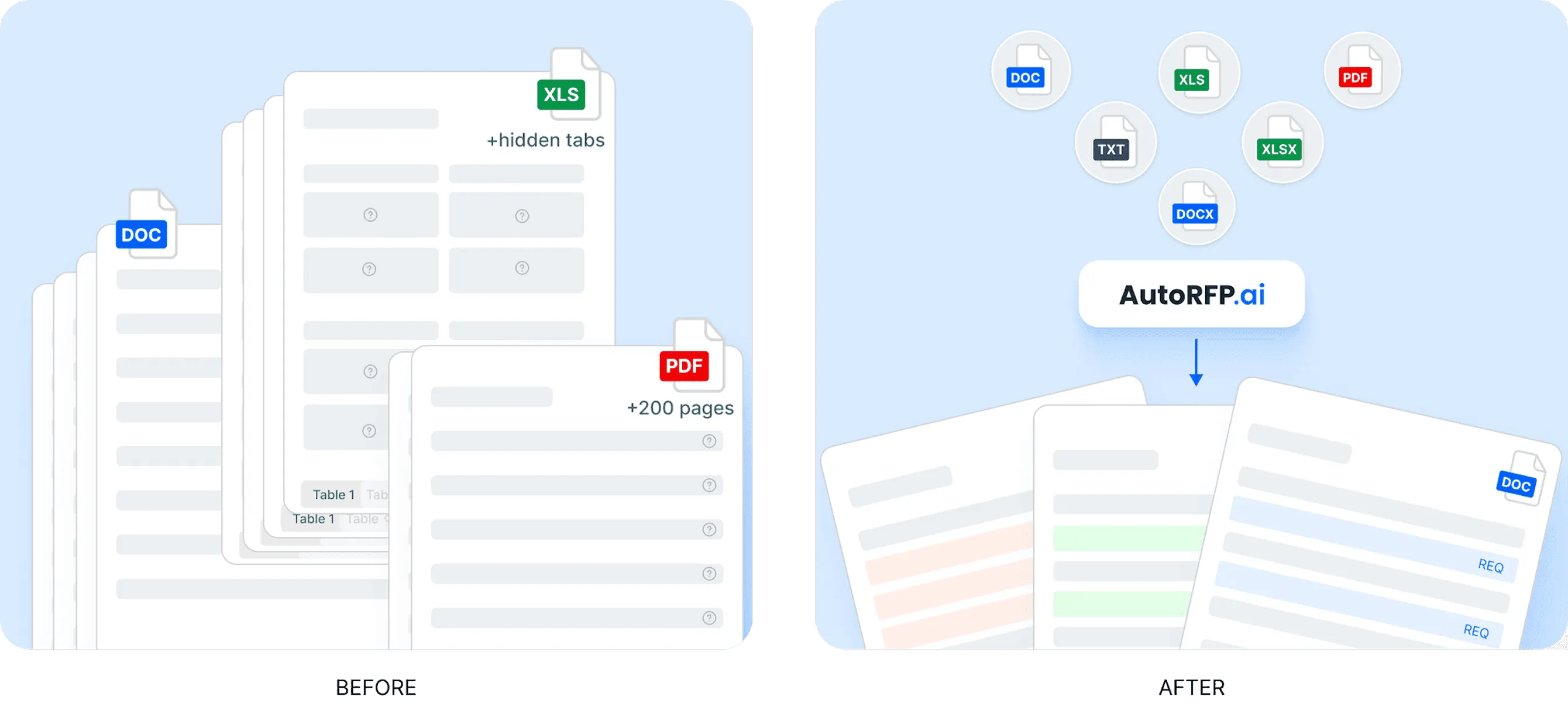
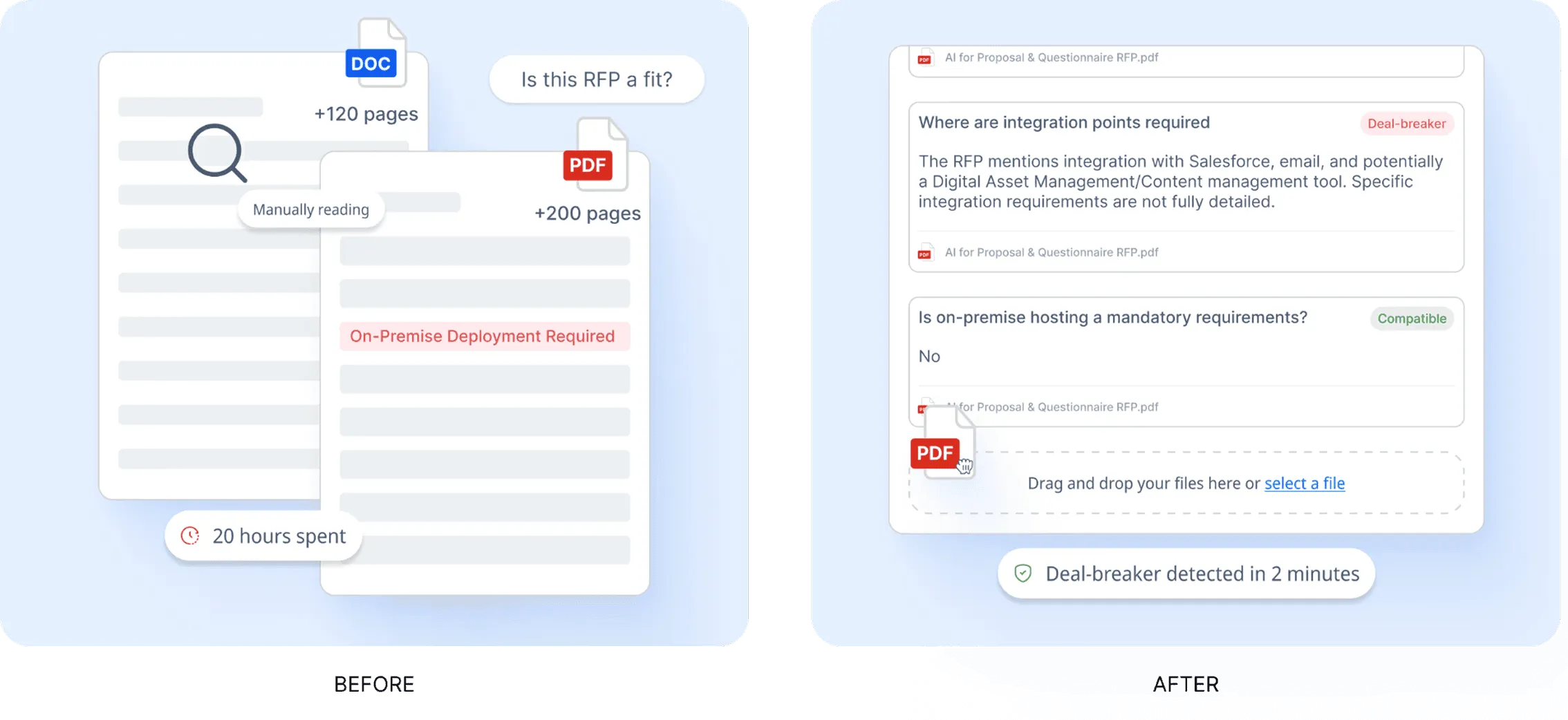
Technical proposals often begin with long RFP documents, compliance matrices, attachments, and requirement tables. AI can scan these files quickly, extract key requirements, identify deadlines, and organize the response structure before the writing starts.
| AI capability | How it helps proposal teams |
|---|---|
| Requirement extraction | Pulls out key questions, deliverables, deadlines, and submission rules from long RFP files. |
| Compliance matrix review | Reads Excel files, nested tables, macros, and structured requirement sheets without forcing teams to reformat everything manually. |
| Bid/no-bid support | Helps teams understand scope, complexity, and capability fit earlier in the process. |
For example, AutoRFP.ai can ingest Word files, PDFs, and Excel documents, including compliance matrices, macros, and nested tables. It then pulls out requirements, sections, deadlines, and supporting context, giving teams a clearer starting point for Go/No-Go decisions before they move into drafting.
2. Instant First Drafts
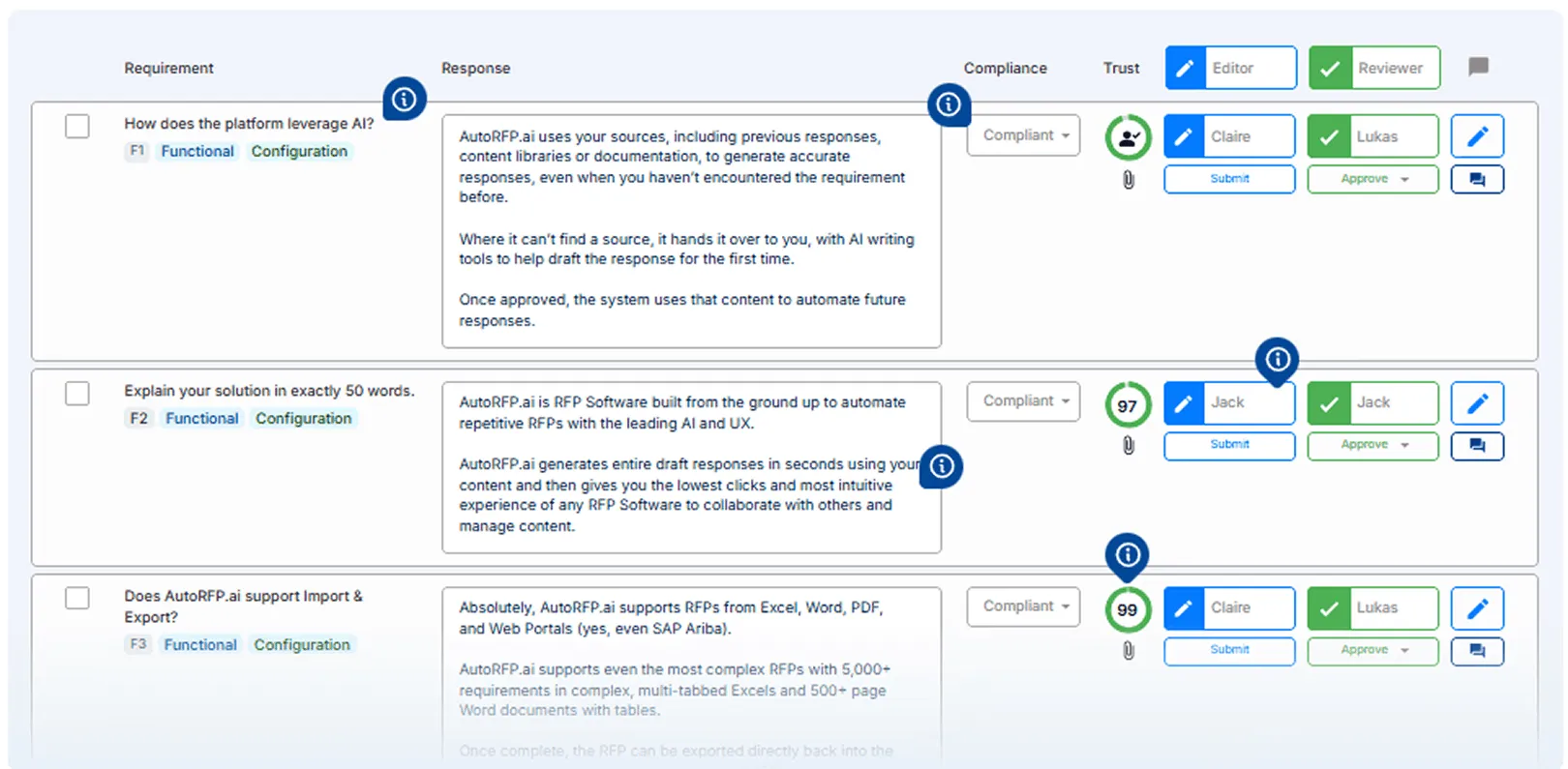
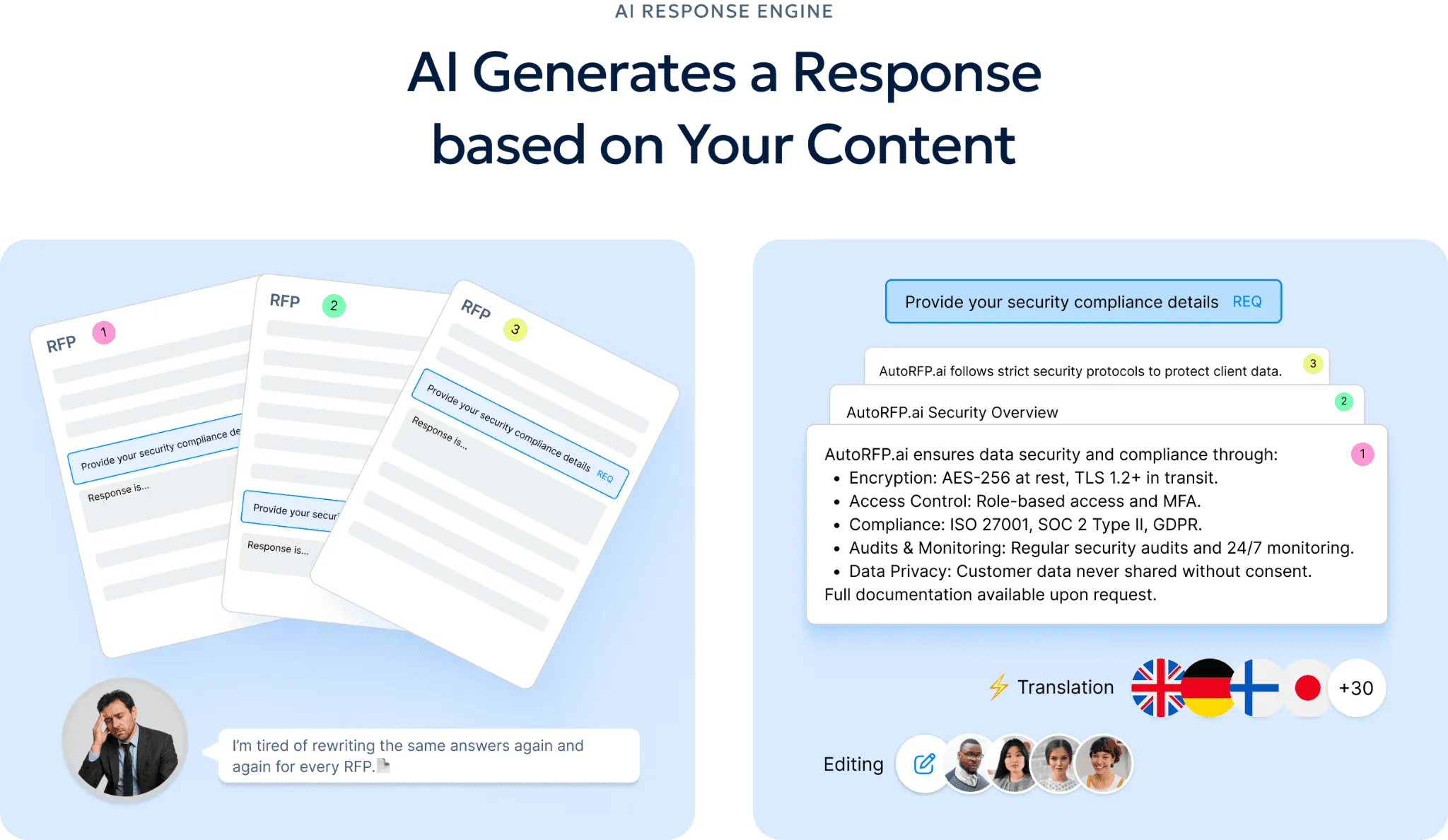
AI can generate first drafts using approved past proposals, technical documentation, and content library material. This gives proposal teams a stronger starting point and reduces the pressure on SMEs to write from scratch.
AutoRFP.ai creates full first drafts in seconds by pulling from trusted source material first. The responses are written using the company’s terminology, tone, and approved content, which helps make drafts more consistent and easier to review.
3. Agentic Editing And Rewriting
AI can also help improve draft quality after the first version is created. If a response is too long, vague, or generic, teams can use an AI project agent to rewrite it directly inside the workflow.
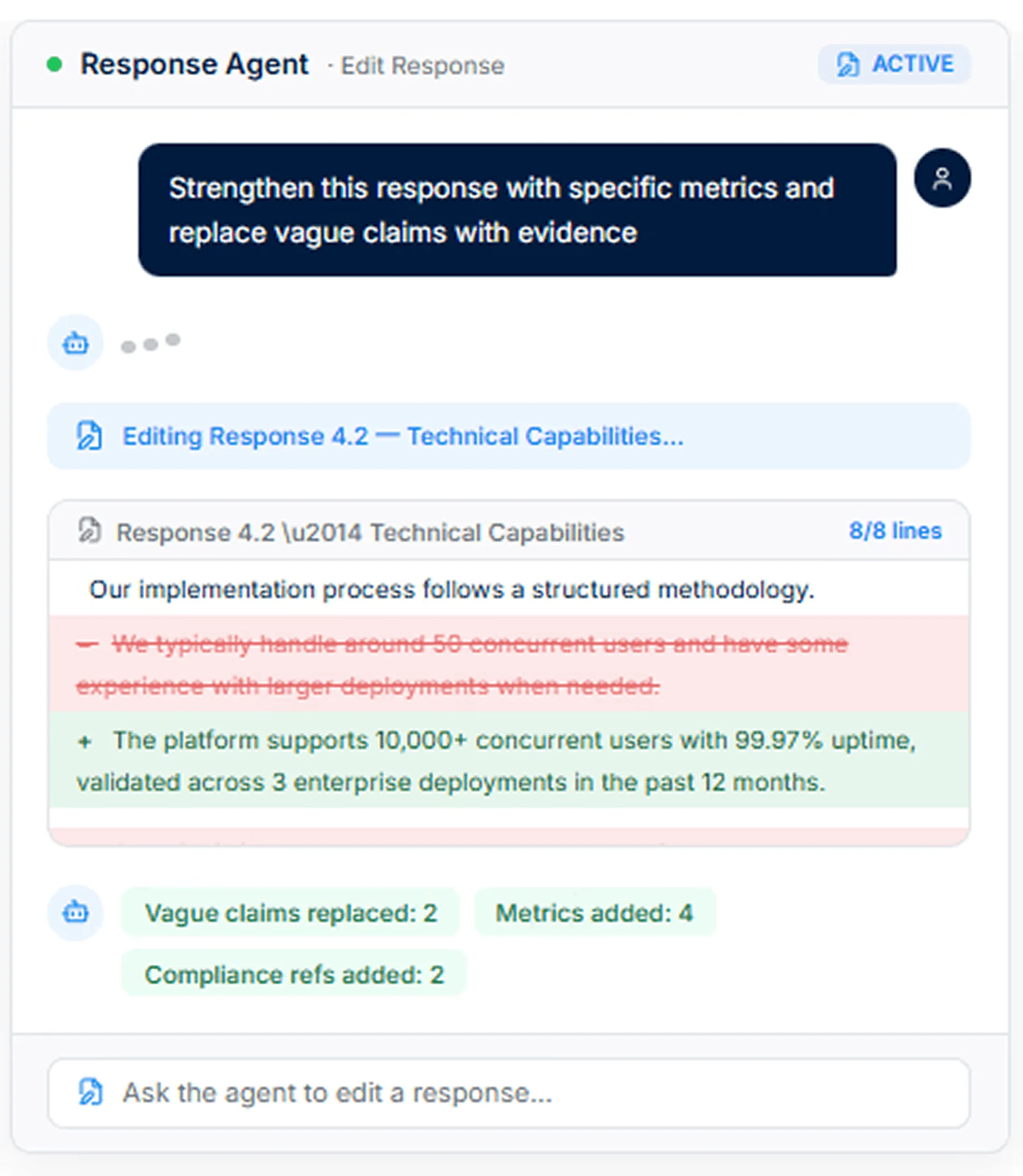
For example, teams can ask AI to:
Tighten a response to meet a word count
Replace vague claims with clearer technical metrics
Make the tone more formal, concise, or buyer-focused
Rewrite a section so it answers the requirement more directly
Improve clarity without changing the technical meaning
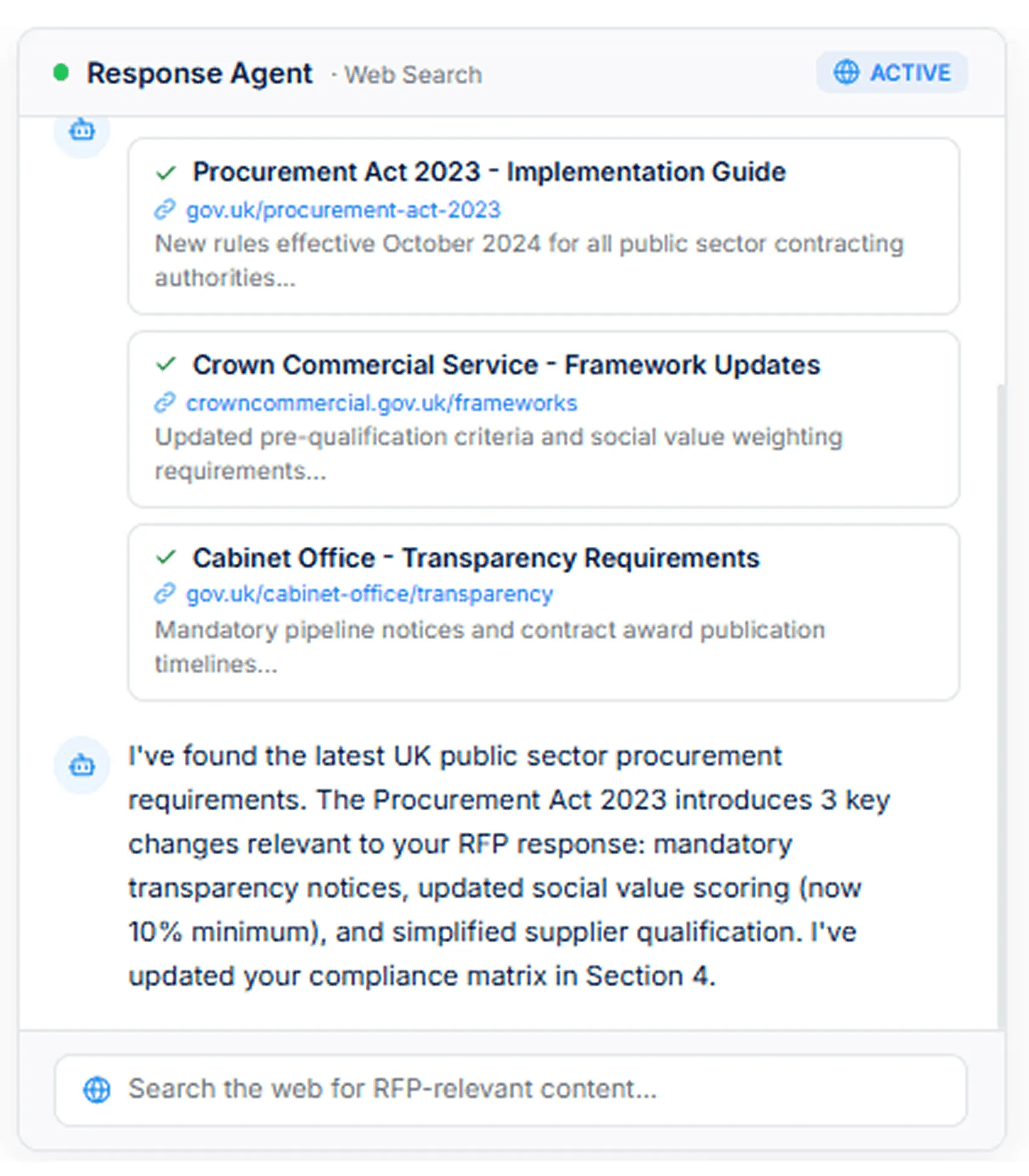
4. Live Web Search And Sourcing
Some AI proposal tools can search the open web for current industry figures, regulatory updates, or compliance references without forcing users to leave the editor. This is useful when a technical proposal needs updated market data, security standards, or recent regulatory context.
| Use case | Example |
|---|---|
| Industry data | Finding updated figures to support a business case or solution claim. |
| Regulatory context | Checking current compliance rules before finalizing a response. |
| Technical sourcing | Finding supporting references for standards, frameworks, or market requirements. |
5. Smarter Content Reuse
AI helps teams reuse approved content more accurately without relying on a manually maintained content library. Instead of copying old answers blindly, AI can learn from approved responses and suggest content that fits the current RFP.
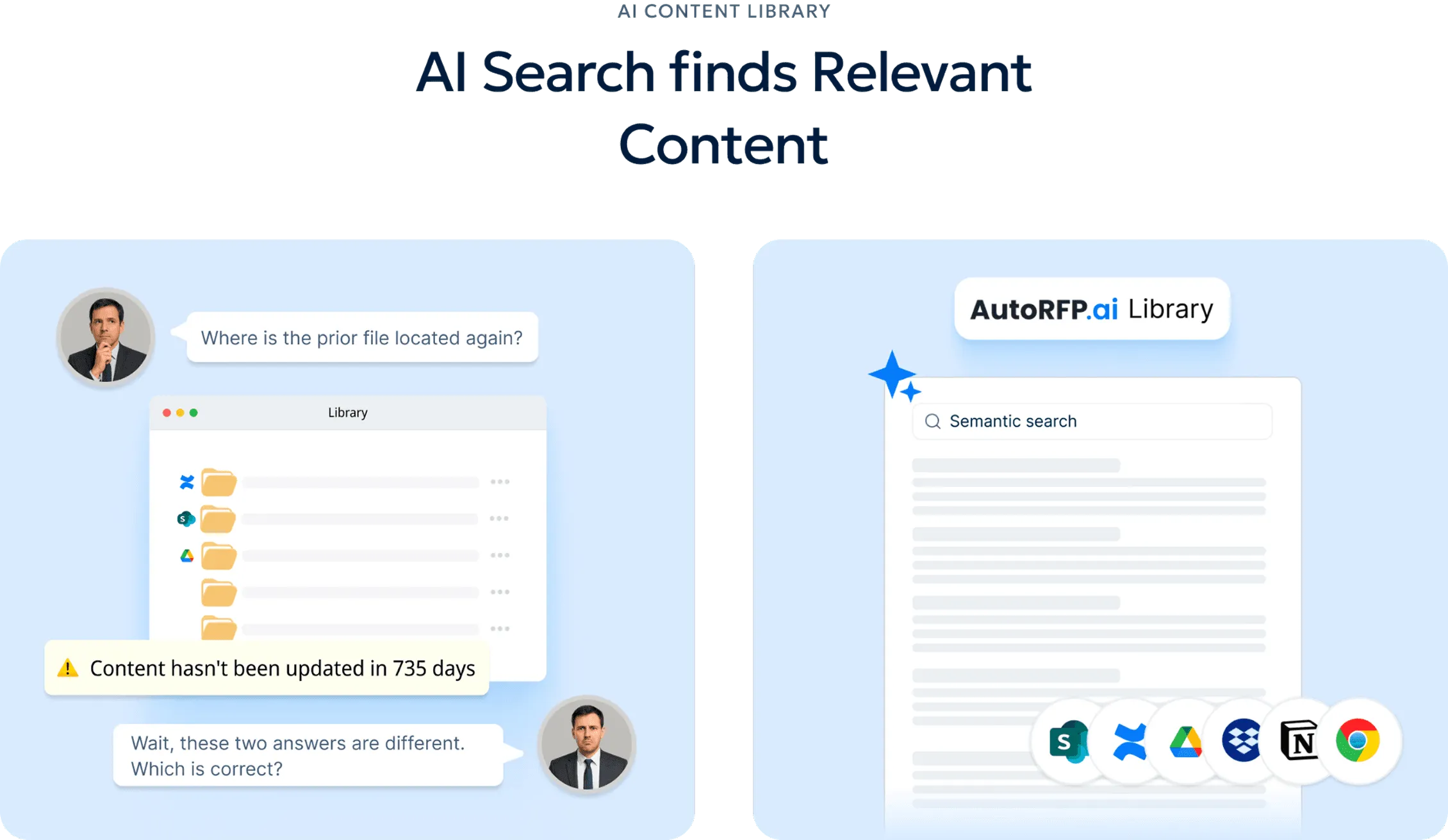
This helps teams:
Reuse approved answers faster
Reduce duplicate writing
Keep messaging consistent
Adapt content as the business changes
Spend more time customizing high-value sections
6. AI Q&A For Trusted Answers
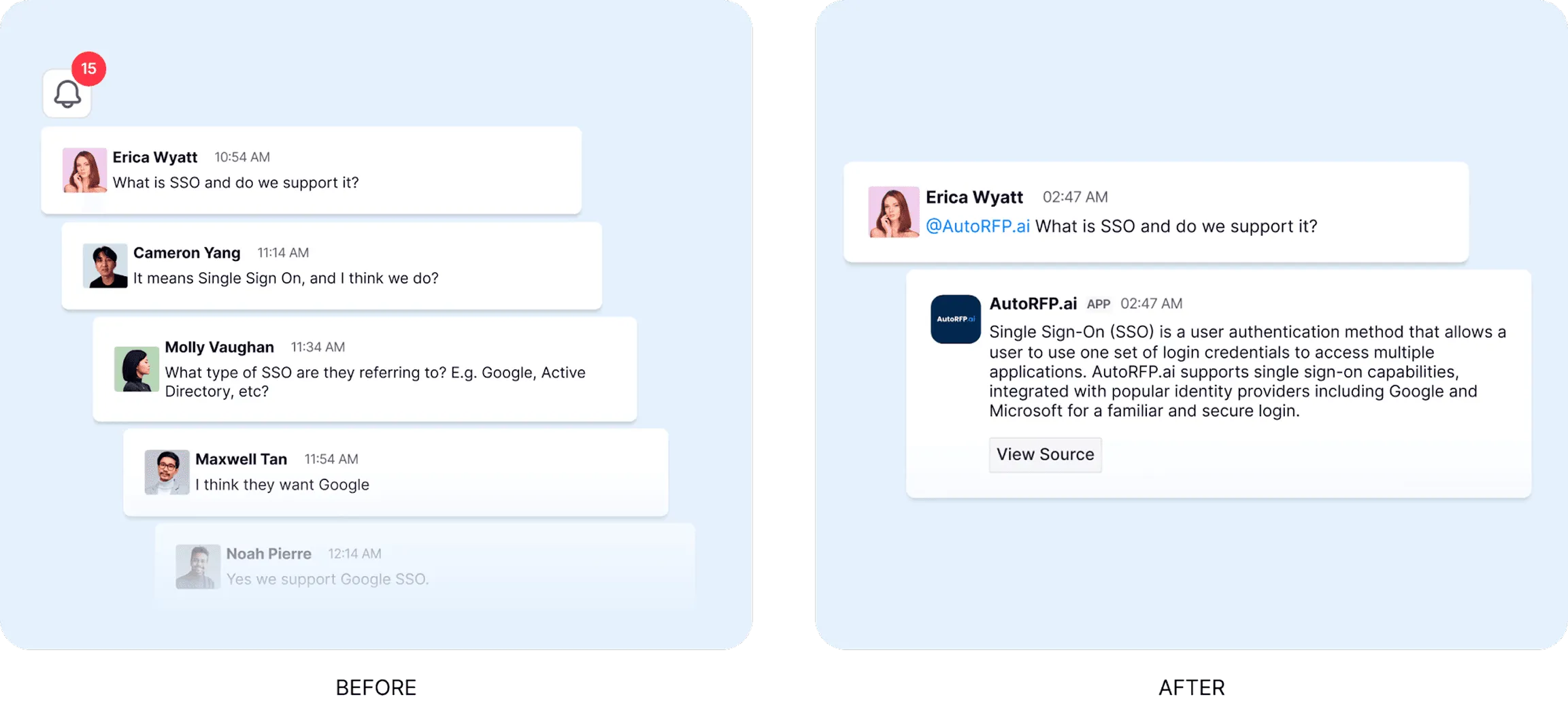
AI Q&A features in some AI RFP tools help proposal teams find approved information quickly. In many organizations, teams still waste time searching folders, old responses, chat threads, or documents just to confirm one answer.
AutoRFP.ai solves this with a sourced AI bot that gives fast answers from approved company content. Teams can ask questions like “What is our GDPR approach?” and get a grounded answer in seconds. It also works inside Slack and Teams, so users can ask from the tools they already use instead of leaving the conversation to search manually.
7. Live RFP Data Inside AI Assistants
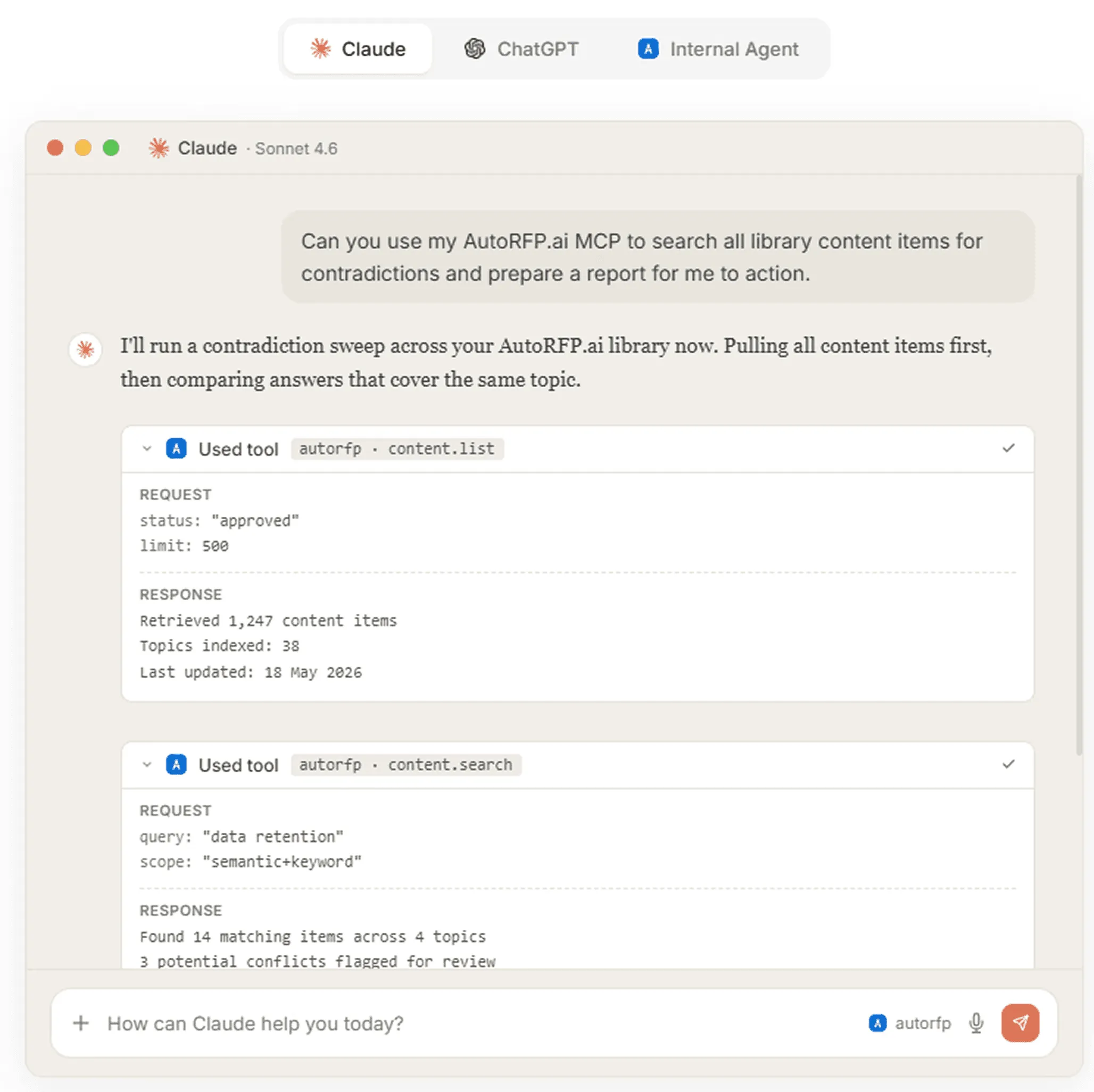
Not every proposal tool offers this, but AutoRFP.ai’s MCP server connects live RFP data directly into Claude, ChatGPT, Microsoft Copilot, and other MCP-compatible assistants. This lets teams use the chat tools they already know while still working from approved proposal content and live project data.
| What teams can ask | Why it helps |
|---|---|
| “What is due for Globex next week?” | Helps teams track deadlines and project priorities. |
| “What have we said about GDPR?” | Pulls approved answers instead of relying on memory or guesswork. |
| “Find contradictions across approved answers.” | Flags mismatched claims before they reach the buyer. |
| “Pull best-fit content for this requirement.” | Helps teams draft faster with live, source-backed context. |
The connector supports semantic and keyword search, follows each user’s AutoRFP.ai role-based permissions, and uses read-only scopes so assistants cannot edit, overwrite, or delete content.
8. Compliance Checking And Formatting
AI can review proposal drafts against RFP requirements and flag missing answers, weak sections, formatting issues, or possible compliance gaps. This helps teams catch problems before the final submission.
A strong AI review can check for:
Missing requirements
Incomplete answers
Inconsistent terminology
Formatting issues
Unsupported claims
Conflicting technical details
Sections that do not match the buyer’s instructions
What You Get From AI Proposal Writing
AI does not replace proposal strategy, SME judgment, or final review. But it can remove a lot of manual work from the process, helping teams move faster while keeping quality more consistent.
| Outcome | What it means |
|---|---|
| Faster turnaround | Teams can complete first drafts in days instead of weeks. |
| SME time savings | SMEs can review and refine AI-generated drafts instead of writing every response from scratch. |
| More consistent quality | Approved messaging, terminology, and technical language can be applied across the proposal. |
| Higher proposal volume | Teams can respond to more qualified RFPs without adding the same level of manual workload. |
For example, AutoRFP.ai client Red Rover automated 95% of responses in a recent RFP, covering 83 out of 87 requirements, and achieved 80% time savings in the RFP response process.
These AI capabilities are useful on their own, but the real impact comes from using the right software. The video below walks through some of the best AI RFP tools to consider in 2026.

Video transcript
Today we're diving into the best AI RFP software that are in the market for 2026. We're gonna be going into the AI agents, the AI workflows, and the AI RFP response process that powers all of these AI RFP software companies. And you're gonna get, at the end of this video, An overview of the best AI native RFP software. Let's jump into it. So first of all, this is a continuation of one of my last videos, which was to do with the best RFP software. So if you wanna have an overall look of RFP software across legacy RFP and AI native RFP, you can have a look at that video which you'll see at the end of the video as well. Link to it below. So what I've analyzed to generate this list of best RFP software is I've looked at the public G2 reviews, the Gartner reviews, and our own industry knowledge, having being an AI-native RFP software ourselves.
So first of all, before jumping into the first one, let's think about the RFP software market as a whole. Effectively, if you're looking for RFP response software, you've got three options. You've got your legacy RFP software. They're like your Loopio, your Responsive, Qvidians. They've been built before AI, and they're effectively a question-and-answer machine. You have your past answers. You get requirements, you upload, and it'll keyword match to find the appropriate answer for those new questions and copy and paste it across. Recently, they've added some more AI features, but they're what we call legacy RFP software, mostly because they've been around for quite a long time and they're not built with a kind of AI architecture to begin with. Then you've got your own AI DIY builds that you can do. Using Claude or ChatGPT or Copilot to effectively help you answer RFPs. And that can be really useful to an extent. And then you'll start to run into issues, especially if you're collaborating across multiple team members, if you're trying to prevent hallucinations and you
wanna get more towards winning responses rather than generic AI responses. You also have your kind of own DIY builds, like doing your own AI agents internally. Then you've got the AI RFP software. These AI native players have been built with AI in mind from day zero, meaning that they're architected for AI and one of the market leaders is AutoRFP.ai.ai, which is where I'm from Okay, there's also the proposal win rate report for 2026. In this report, us and a bid manager community called Stargazy surveyed over a hundred bid managers to find what are those bid teams doing that win the most RFPs, specifically around their tooling, their process, and their systems. What we found, and you can download this report from our website and the link in the description below, is that teams with high content automation and strong processes around customer insights and bringing together all the different data points available to them in RFPs really led to higher win rates.
There's an entire chapter here all around the high-win and low-win cohorts and what matters the most, And there's a whole chapter here on writing winning responses and how teams can get into content automation and do more to win RFPs. So you download that report below. First, let's talk about the best way to evaluate AI RFP software. When looking at AI RFP software, you really wanna make sure you get your hands on the tools. Some of the options I show you today will have access to a free trial directly on their website. Other vendors, you can ask for a proof of concept, like AutoRFP.ai. And with that, effectively, you get access to seeing how the AI will work with your actual RFPs using your actual data. Why that's useful, especially when evaluating AI RFP software side by side, is it lets you see effectively is there proof in the pudding? Does the AI RFP software live up to its claims?
Can it automate RFP response based off my prior content? And does it actually save our team time? let's jump into our first one for the best AI RFP software, and that is AutoRFP.ai.ai. AutoRFP.ai.ai is an AI-native RFP software. It actually launched a few weeks before ChatGPT came out, it's been around for four years, It has customers in over forty-plus countries. Predominantly, it's focusing on technology, so software and hardware and technology services companies, financial services companies, so for instance, asset managers doing DDQs and so on, and healthcare companies like pharmacy benefits managers across the world. And it's used by hundreds customers across the globe to help respond to RFPs. So looking into the platform, you can find out more about their customers and how they use AutoRFP.ai from their website from our website. Our pricing is very transparent.
You can find out on our website. So for instance, the starting price, as well as how to learn more information, so you can get in touch with our team, book an online demonstration where AutoRFP.ai.ai is different and what really sets it apart to be the market leader in the AI RFP software proposal space is really around how it's utilizing agentic features and agents to automate more of the RFP process to help bid managers and proposal writers write winning responses. It's really a lot more about winning RFPs . So if I go to create a project, for instance, you can upload an RFP, Word, Excel, PDF. First what you see here is an AI go, no-go. Before a team will even decide to bid on an RFP, they can make a decision based on AI and their own comprehension of the RFP, Whether it's appropriate to go for, are we a good fit for this RFP? And then the AI will answer each of those different requirements, provide sources and transparency for understanding where that kind of information came from those
RFP documents, and that can help me make a decision whether I want to proceed with this RFP or not Then you've got the AI document importer that will automatically using AI computer vision, scan the document and bring in the necessary response requirement, drop-down cells, and everything like that, include requirement tables, everything that you need to fill out to respond to that RFP then the RFP comes in, and here's the real magic. The AI will search my relevant content in my library, which includes integrations with fifteen plus systems, includes web access. And from that content, it'll use a transparent process to source the correct content through semantic search, through re-ranker models and embedding models, to then bring out the most trustworthy response. Then it'll find the most trustworthy content, and then using AI, generate an appropriate response or take verbatim from my prior answers if required. And as the responses come through, we're greeted with two scores. First, we have our feedback score.
This helps you write better winning responses. It looks at the requirement, it looks at my response, and gives me any feedback to make that response even better, whether it's human written or AI generated. Then you've got the trust score. The trust score transparently displays what information and why that information was used to generate this response. Clicking into here, I can see my exact content that was used to generate the response and why the content was used to generate the response. Then I've got the AI project agent, which you can prompt in natural language, and effectively, you're using this AI across your own content with web search. It can create documents like executive summaries for you. In this example, it's gonna edit these three responses that I've selected following my prompts instructions. While that's happening, I can then look through and make comments. I can select those requirements, and then assign them to my different team members or teams that are working on that RFP As I'm managing this RFP submission, I can quickly go through and see
who has responses left to respond to or what subject matter experts need to approve responses and see how that's going over time. So that's AutoRFP.ai.ai, an AI RFP software. Then you've got Arphie. So Arphie or Arphie.ai is another AI RFP software that has been around for quite a few years. It is predominantly used similar to the others, where you have a content library or knowledge space that has relevant context in terms of your past RFPs. And then it brings all that in to help generate and respond to new RFPs. You can have a look at that website. You can see that the AI is used to manually generate responses. Their integrations and more about their system on their websites. I would say Arphie is generally pretty useful for, mid-market technology companies as well as some large enterprises. Usually would have a strong pre-sales team, sales engineers, solution architects. May not necessarily have a purpose-built bid function and it's useful for
responding to RFPs en masse and so on. They don't appear to have their pricing on their websites. So best bet to get is to get in touch with their team by going to their contact page and yeah, you can get in touch with their team and to understand a bit more about Arphie. Next up is AutoGen. So AutoGen is a little bit different to the others where it's more of what we would call a narrative or long-form RFP software. What that means is AutoRFP.ai, Arphie, what we've discussed so far are used when you wanna upload a bunch of requirements let's say in Excel, Word doc, PDF, and thousand, five hundred, ten thousand responses and generate answers for those. AutoGen may be more useful for architecture, engineering, construction companies and for that it's usually less requirements but usually longer form responses, usually in a Word document. You can find out more about visiting their website Then you've got 1up. 1up has access to a free trial.
Their pricing is transparent, generally useful for teams who are doing a lot of security questionnaires. I would say 1up is actually one of the cheaper systems on the market. Really useful if you're doing like a small number or medium number of RFPs or security questions every year and wanna get started with some basic automation. It's really useful for that, and you can kinda find out more about their website as well there. Then you've got Tribble. Tribble's a little bit different. It's predominantly an extension into Google Sheets or Google Docs like running as a Chrome extension. They do have a platform you can log into and you can find out more about them on their website. It has the proposal automation, so generating responses sales. They're doing more features, around kinda the full cycle of sales. Like you can see there, it has deal prep or follow-up follow-up and they do have transparent pricing. So you can see there it starts at 30 grand USD a year. It starts from 50 per annual projects. So there's a quick overview of each of the AI RFP software. Awesome. You can learn more about AutoRFP.ai at our website, or you can contact each
of the providers we've been through today by going directly to their website and getting in touch with their team. Hope that was helpful thanks
Technical Proposal Template and Examples
Templates and examples make technical proposal writing easier because they show what the final response should actually look like. Use the templates below as fill-in structures, then review the examples to see how a completed technical proposal section can read.
Template 1: Full Technical Proposal Template
Template 2: Short Technical Proposal Template
Example 1: Software Implementation Technical Proposal Example
Example 2: Cybersecurity Assessment Technical Proposal Example
Turn Your Next Technical Proposal Into a Win with AutoRFP.ai
A strong technical proposal needs more than a good solution. It needs clear RFP analysis, compliant answers, strong proof, SME input, and buyer-specific messaging.
AutoRFP.ai helps proposal teams manage that entire process faster, from shredding requirements and drafting first responses to reusing approved content, checking compliance, and keeping teams aligned. Instead of starting from scratch, your team can build sharper, more consistent technical proposals with less manual work.
Book Demo with AutoRFP.ai to see how your team can create faster, stronger, and more compliant technical proposals.
Frequently asked questions
How Detailed Should A Technical Proposal Be?
A technical proposal should be detailed enough to prove that your team understands the buyer’s requirements and can deliver the solution. It should explain the approach, scope, deliverables, timeline, technical methods, team responsibilities, risks, and compliance points without adding unnecessary information that makes the proposal harder to evaluate.
Who Should Review A Technical Proposal Before Submission?
A technical proposal should be reviewed by the proposal manager, solution engineer, technical SMEs, finance team, legal team, and final approver. Each reviewer should focus on a specific area, such as accuracy, pricing, compliance, risk, delivery feasibility, and whether the proposal clearly answers the buyer’s requirements.
What Makes A Technical Proposal More Persuasive?
A persuasive technical proposal does more than describe features. It connects the solution to the buyer’s goals, explains why the approach is practical, includes proof points, addresses risks, and shows how the team will deliver the work successfully. Strong proposals are specific, evidence-based, and easy for evaluators to score.
How Can AutoRFP.ai Help Draft Technical Proposal Responses?
AutoRFP.ai can generate first-draft responses using approved company content, past winning answers, and relevant project documents. This helps proposal teams avoid rewriting the same technical answers from scratch while still giving reviewers a draft they can refine for accuracy, context, and buyer-specific requirements.
Can AutoRFP.ai Help Add Supporting Technical Documents To A Proposal?
Yes. AutoRFP.ai’s content library can store and surface supporting materials such as case studies, technical documents, flowcharts, product information, and security content. This helps teams attach the right evidence to technical proposal responses instead of searching through scattered folders or relying only on memory.
