
RFI Response: How to Write & Automate Winning RFI Responses
Learn how to write effective RFI responses, save time with automation, and improve accuracy using AI-driven tools like AutoRFP.

Robert Dickson
RevOps Manager, AutoRFP.ai··7 min read
You know the value your team delivers, but the RFI is not showing it yet. Maybe it’s too generic, too long, or missing the details that make your solution stand out.
It’s frustrating when great work doesn’t come through on paper.
Let’s fix that.
This guide breaks down how to write RFI responses that actually win attention, what information evaluators look for, the errors teams often make, and how automation tools can simplify the entire process.
Here’s how to get it right every time.
What’s the Difference Between RFI, RFP, and RFQ Responses?
Many teams use Request for Information (RFI), Request for Proposal (RFP), and Request for Quotation (RFQ) interchangeably, but they actually serve different purposes, and knowing the difference helps you respond the right way at the right time.
Think of them as distinct steps in your client’s decision-making process, and your role is to deliver the right information at each stage.
Here’s how they differ:
| Criteria | Request for Information (RFI) | Request for Proposal (RFP) | Request for Quotation (RFQ) |
|---|---|---|---|
| Purpose | Show your company’s expertise, experience, and range of capabilities so the buyer can gather information and shortlist suitable vendors. | Present a complete solution with a full scope, methodology, and value that differentiates you from competitors. | Provide precise pricing, lead times, and commercial terms to help the buyer make a purchase decision. |
| Timing | Early stage of the procurement process. | Mid to late stage, once the buyer has shortlisted vendors. | Later stage in the overall sourcing/selection process. |
| Detail level | Light detail; focus on your strengths and relevant experience. | High detail; include a structured proposal addressing requirements, timelines, and pricing models. | Straightforward detail; confirm specifications, quantities, and total costs. |
| Response style | Clear, brief, factual answers that highlight your suitability. | Persuasive, solution-oriented writing that connects features to outcomes. | Concise, structured, and transparent formal response focused on numbers and terms. |
Why Do Companies Issue RFIs?
Let’s take a closer look at the main reasons companies issue RFIs:
| Reason | Buyer’s Intent |
|---|---|
| Understand the market | RFIs help buyers explore available technologies, solutions, and pricing before making any commitments. |
| Identify qualified vendors | Buyers screen vendors based on expertise, certifications, and capacity before inviting them to submit full proposals. |
| Compare capabilities | Buyers see how vendors approach similar challenges to determine who truly understands their needs beyond marketing claims. |
| Reduce risk | RFIs reveal a vendor’s reliability, compliance, and stability, helping buyers avoid poor-fit partnerships later. |
What Should Be Included in an RFI Response?
Use the checklist below to ensure that your RFI response includes every must-have, so it checks all the boxes that buyers use to qualify vendors.
Cover Letter
When submitting the RFI, you may also attach a cover letter. A cover letter helps demonstrate that you understand the buyer’s unique challenges and priorities. Highlight what makes your solution different without forcing them to look for it.
A well-written cover letter reminds the buyer that there’s a real person behind the response, someone who understands what they need, why it matters, and how your company can deliver it effectively.
Executive Summary
Include a short overview that highlights the key points of your response. Summarize what makes your solution valuable, your unique strengths, and how your approach aligns with the buyer’s objectives. Keep it concise, around one paragraph, but ensure it captures the essence of your proposal.
Company Background
Provide a concise overview of your company’s mission, history, team, size, and areas of specialization.
You can also mention any notable achievements, long-term clients, or industry milestones that demonstrate stability and trustworthiness.
Keep it factual; the goal is to provide a concise yet comprehensive snapshot of who you are.
Relevant Capabilities
Highlight your industry-specific experience, certifications, and key clients. This establishes credibility and demonstrates your understanding of the client’s sector.
Pro tip: Include short case studies or examples of similar projects you’ve completed successfully. This helps the buyer assess your track record and reliability.
Main Response Content
Provide a clear and direct response to each question. Keep your answers concise, factual, and supported by relevant data or examples.
Mirror the structure of the RFI. Restating each question ensures clarity and helps evaluators follow your answers easily.
Project-Specific Details and Next Steps
Explain how you handle implementation, quality assurance, and customer support. Provide realistic timelines or milestones for delivery or project completion. It helps the buyer plan expectations early.
Offer a general pricing framework or range without committing to final quotes. This provides buyers with a budget benchmark while maintaining flexibility for the RFP stage.
Side note: Include the name, role, phone number, and email of the person responsible for clarifications or follow-ups.
Attachments
Add any supporting files such as diagrams, product datasheets, certifications, or relevant submittal extracts. These provide extra context and evidence of capability.
Side note: Follow every instruction in the RFI, including file formats, word limits, and deadlines. Missing these details can disqualify even the best content.
How to Write an Effective RFI Response
Here’s a step-by-step guide to writing an RFI response that shows buyers you understand their needs and can deliver real solutions:
1. Qualify the RFI With a Go/No/Go Framework
Even though an RFI is “just information,” it still costs time and effort to respond. You should still qualify the opportunity through a simple go/no-go decision:
Focus on three key questions:
Does this buyer fit your ideal customer or target agency profile?
Look at the buyer’s size, industry, budget, and procurement history. If they match your target customer or a sector you’re actively pursuing, it’s likely worth your time.Does this topic or requirement align with your capabilities?
Check whether the buyer’s needs fall within your proven strengths or service areas. If you need major adjustments, new resources, or untested solutions to deliver, it may not be a good fit.Is there strategic value in responding (e.g., is this a flagship account, expansion opportunities)?
Consider whether this RFI opens the door to a flagship account, new market segment, or long-term partnership. Sometimes it’s worth responding for positioning or visibility, even if short-term ROI isn’t clear.
If the answer to those is “yes,” it’s worth responding, even if there’s no immediate ROI. If not, mark it as a no-go and move on. You’ll just burn time on something that doesn’t convert.
2. Read and Understand the RFI Carefully
Before drafting, review the entire RFI document to understand its purpose, scope, and submission requirements. Identify the buyer’s priorities, evaluation criteria, and formatting requirements, and tailor your answers around them.
Highlight the areas where your strengths align most closely with their needs, and note any sections that require input from other teams early on. This keeps your response focused, complete, and easy to finalize.
“RFIs are not just information requests; they’re your first impression. When an agency releases an RFI, they’re not merely gathering data; they’re assessing who’s paying attention, who responds, who understands the scope, and who has relevant experience. Ignoring an RFI means missing the chance to introduce your company early, help shape the future RFP, get on the radar before things get competitive, and build a breadcrumb trail of engagement,” – DE Consulting
3. Assemble a Team for RFI Responses
For an RFI, you just need a lean, fast-response team. Assign roles based on each member’s expertise:
| Role | Responsibility |
|---|---|
| Proposal Writer | Shapes the narrative, structures answers, and ensures clarity and consistency across the RFI response. |
| Technical SME | Provides accurate technical details, verifies product capabilities, and ensures all information is correct. |
| Business Development/ Sales Lead | Ensures the response aligns with the client’s strategy, pain points, and overall win themes. |
| Legal/ Compliance Team | Reviews terms, certifications, risks, and compliance requirements to ensure the response meets all standards. |
Because RFIs are less detailed than RFPs, you don’t need the bureaucracy of a big team.
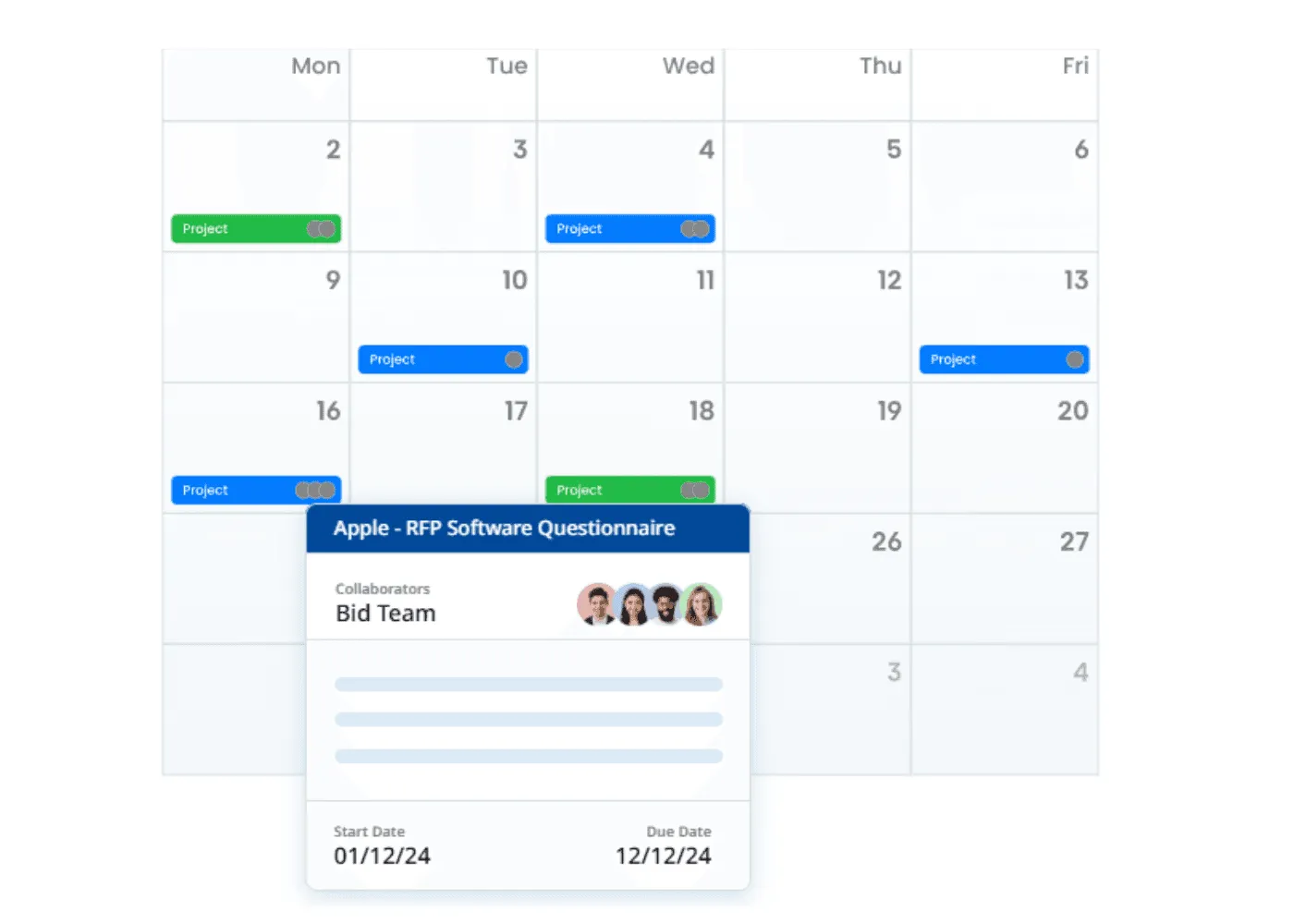
But when you’re handling 20 or more RFIs at once, things can get messy fast. Different projects, overlapping deadlines, and unclear ownership can easily throw your team off track.
With a balanced workload view, you can track every RFI along with deadlines, holidays, and team ownership to keep work evenly distributed.
4. Align Your Content With the Buyer’s Goals
Focus your answers on the outcomes the buyer wants, whether that’s efficiency, scalability, compliance, or innovation. Use their language, mirror their priorities, and show exactly how your solution solves their specific challenges.
5. Keep It Structured and Easy to Read
Follow the RFI’s structure so your answers are easy to review and compare.
Make evaluation easy by formatting your RFI response for quick scanning and scoring:
| Response element | What to include |
|---|---|
| Introduction | Acknowledge the RFI, state the purpose of your response, and mention key personnel or project details if relevant. |
| Direct Answers | Respond to each question clearly and directly. Use numbering or bullets that match the RFI format to make comparisons easy |
| Detailed Information | Add explanations when needed. If “yes/no” isn’t enough, provide brief reasoning and link to supporting data. |
| Evidence & Credibility | Use numbers, results, metrics, or examples to support your claims and strengthen trust. |
| Supporting Documentation | Reference attachments such as drawings, photos, diagrams, or technical extracts that support your response. |
| Impact Analysis | Highlight potential cost or schedule impacts if applicable. |
| Conclusion | Provide a short summary and include contact details for any follow-up. |
6. Collaborate and Review
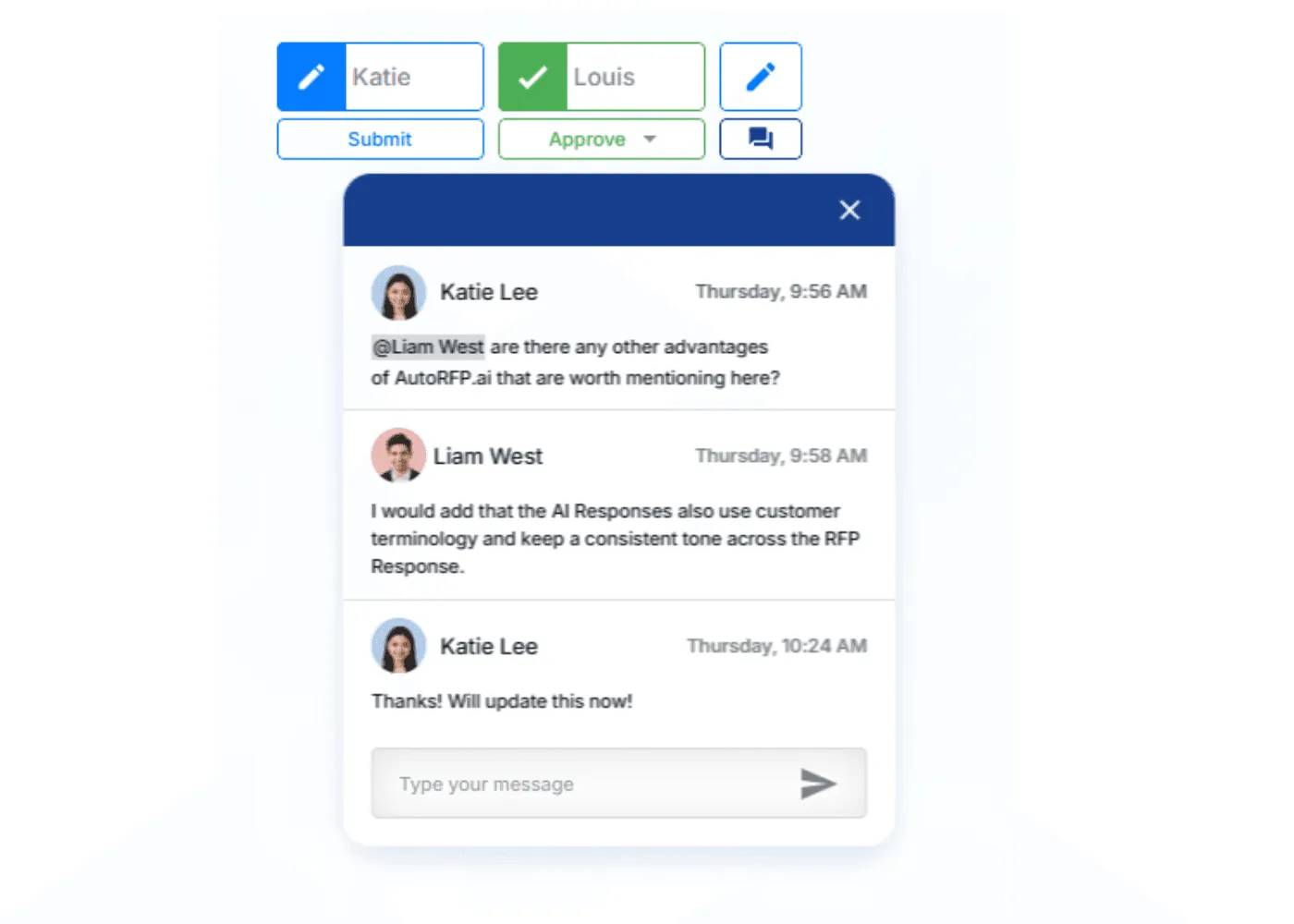
Multiple team members often contribute to RFI responses. Establish a straightforward workflow for editing, reviewing, and approving before submission.
Set clear ownership so everyone knows their role in the process and when their input is needed. A quick alignment meeting before the final review can also prevent last-minute confusion and missed details.
Side note: With AutoRFP.ai’s real-time collaboration, you can assign editors and reviewers, track progress, and approve responses all in one place, reducing version chaos and missed updates.
7. Review for Clarity, Compliance, Consistency and Submit
Before submitting, have multiple team members review the document for accuracy, compliance, completeness, and tone.
Cross-check that every section is filled correctly, all attachments are included, and formatting meets the buyer’s requirements.
A collaborative review ensures nothing is overlooked and all details align. Submit ahead of the deadline to avoid last-minute technical issues or rushed errors.
“RFIs aren’t a waste of time, they’re your chance to show that you understand the buyer’s mission, influence how the requirement is shaped, strengthen your case for a potential set-aside, and get noticed before the RFP is even released,” – Nicole Triputti, Senior Federal Acquisition Strategist at Matrix Design Group, Inc.
How Long Should an RFI Response Be?
RFI responses should be concise and proportional to the request’s complexity, typically two to five pages, and sometimes even less than one.
The goal is to provide high-level, relevant insights without going into deep technical detail.
Focus on quality over quantity, answering every question clearly while avoiding unnecessary elaboration or filler content.
Common Mistakes to Avoid When Writing a Response to an RFI
Here are some of the most common missteps you need to avoid that can hurt your chances of being shortlisted:
1. Reusing Old Responses Without Updating Them
It’s tempting to copy answers from past RFIs, but what worked once may not fit new requirements. Outdated examples, irrelevant details, or mismatched terminology make your company look careless.
2. Writing Too Much or Too Little
Some teams write long, unfocused answers that bury the key points. Others give one-line responses that sound dismissive. Both make it hard for evaluators to see your value.
3. Rushing the Review Process
Under tight deadlines, teams often skip internal reviews and small errors slip through. Typos, inconsistent tone, or incorrect data can undermine credibility.
4. Forgetting to Add a Human Touch
Some responses sound overly formal or robotic. Remember, evaluators are people, and they respond to clarity, confidence, and authenticity.
Side note: The best way to avoid these mistakes is by using an RFI automation tool that provides up-to-date, ready-to-submit answers and enables seamless team collaboration.
Automating RFI Responses
Automation allows you to create accurate and personalized answers in minutes. While manually responding to RFIs can work, it can’t match the speed, precision, and flexibility that automation provides. Let’s look at how a tool can help you achieve that.
Using AutoRFP.ai
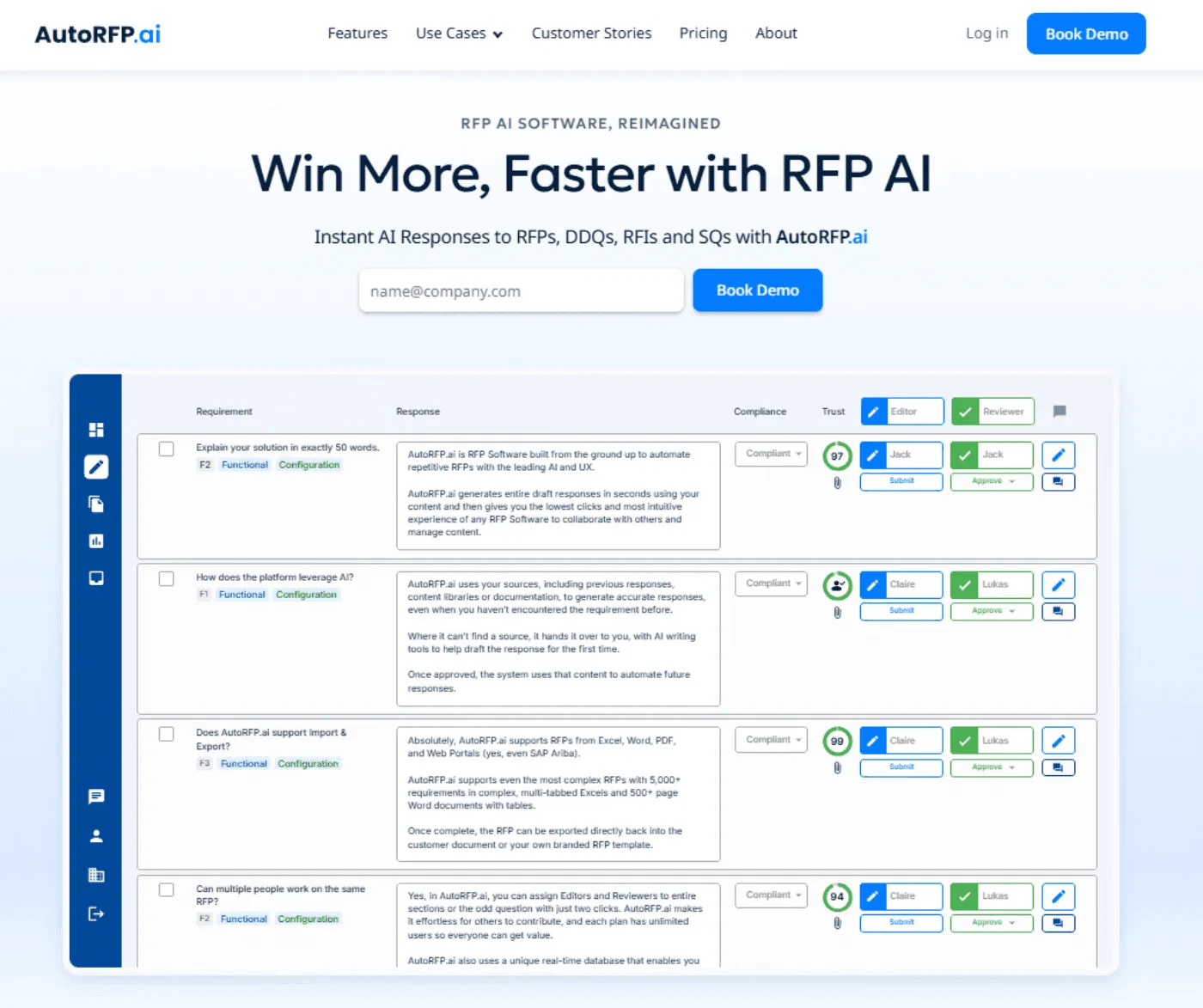
AutoRFP.ai drafts RFI answers in seconds by pulling from your approved content, past submissions, and governed library.
It searches by meaning, not just exact words, so each question gets a tight, on-point response. Completed RFIs are saved back into the library for reuse and steady improvement.
Here are the main features of AutoRFP.ai that automate repetitive RFI tasks to save time and improve accuracy.
1. AI Response Engine
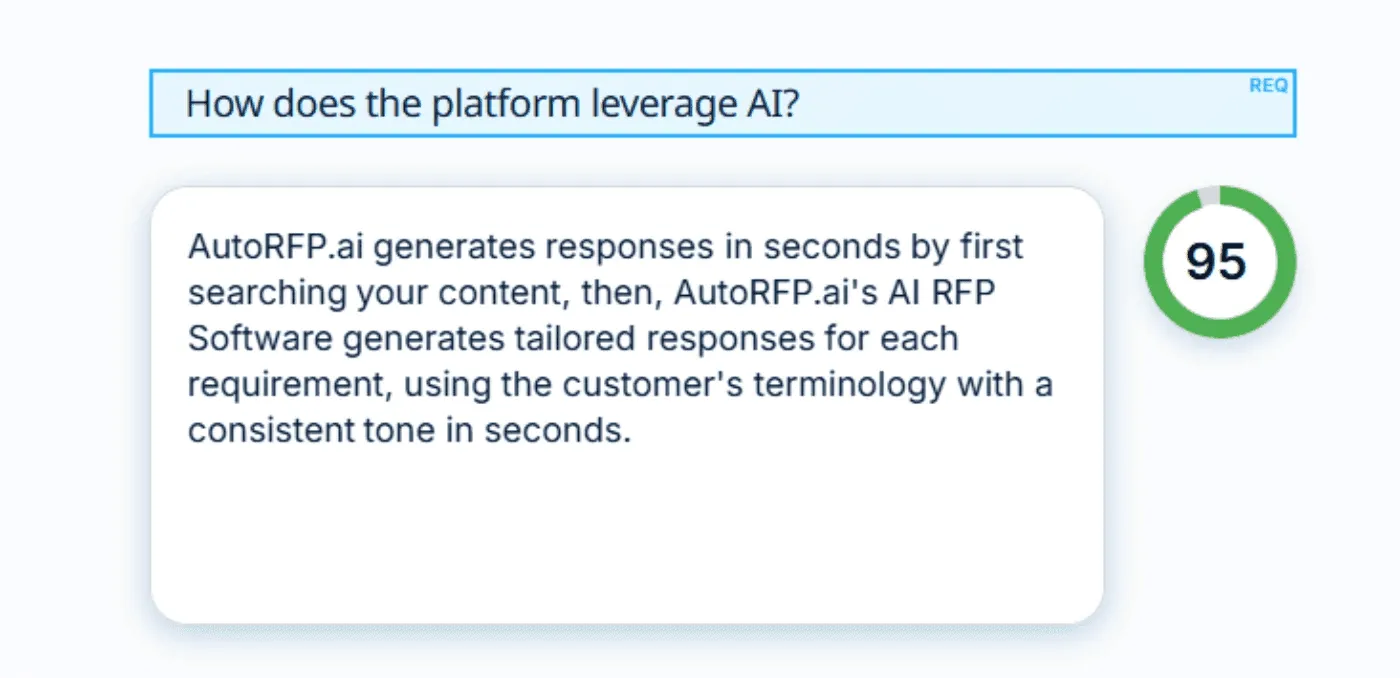
AutoRFP.ai’s semantic AI Search retrieves similar questions with their approved responses from your content library or document repository. It matches by meaning, not merely keywords, and auto-suggests the most relevant answers. With this, your team can easily manage recurring questions across RFIs without having to answer the same one twice.
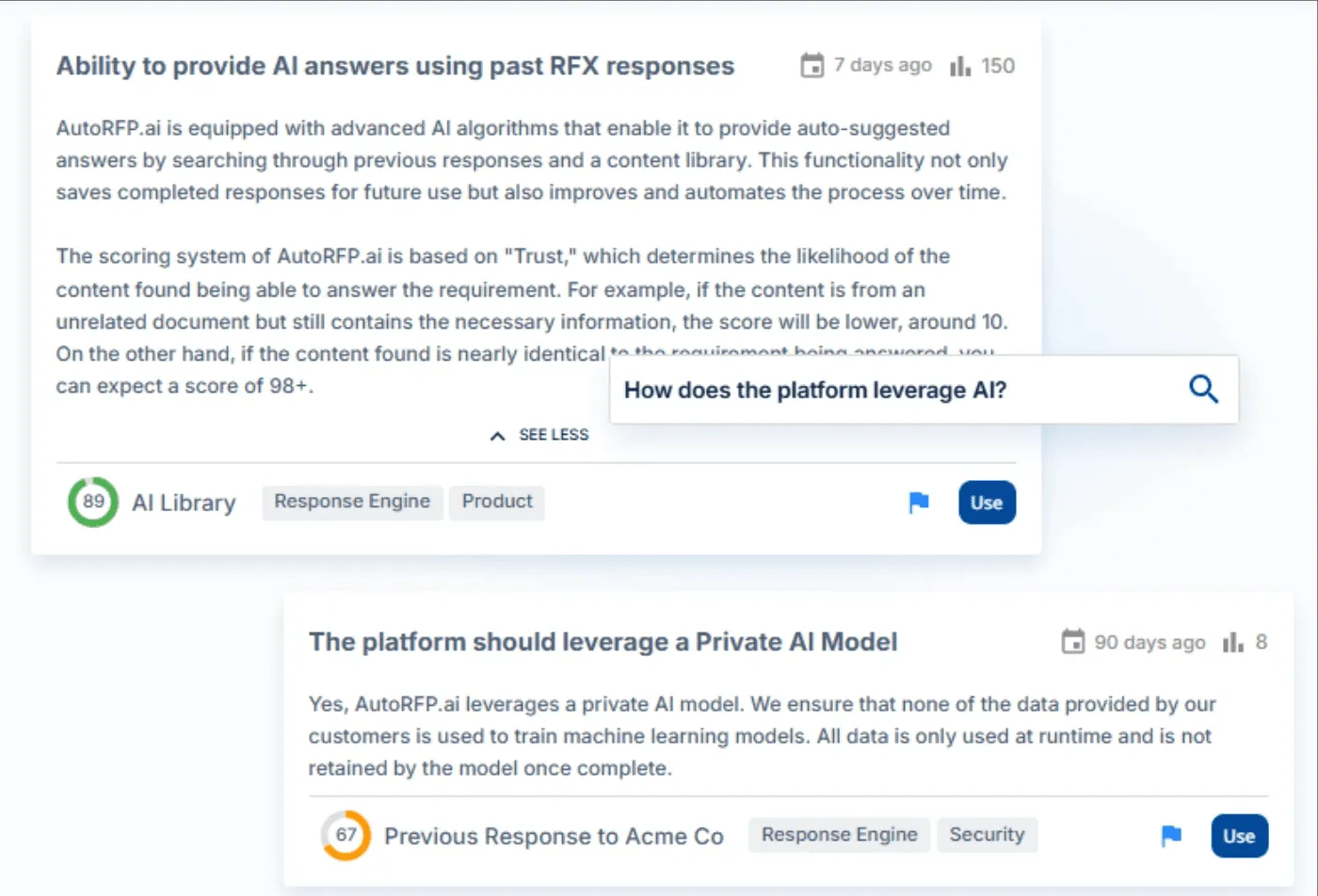
Each suggestion comes with a trust score, so you can easily see how accurate the answer is and refine it further.
2. Work with Unlimited Collaborators
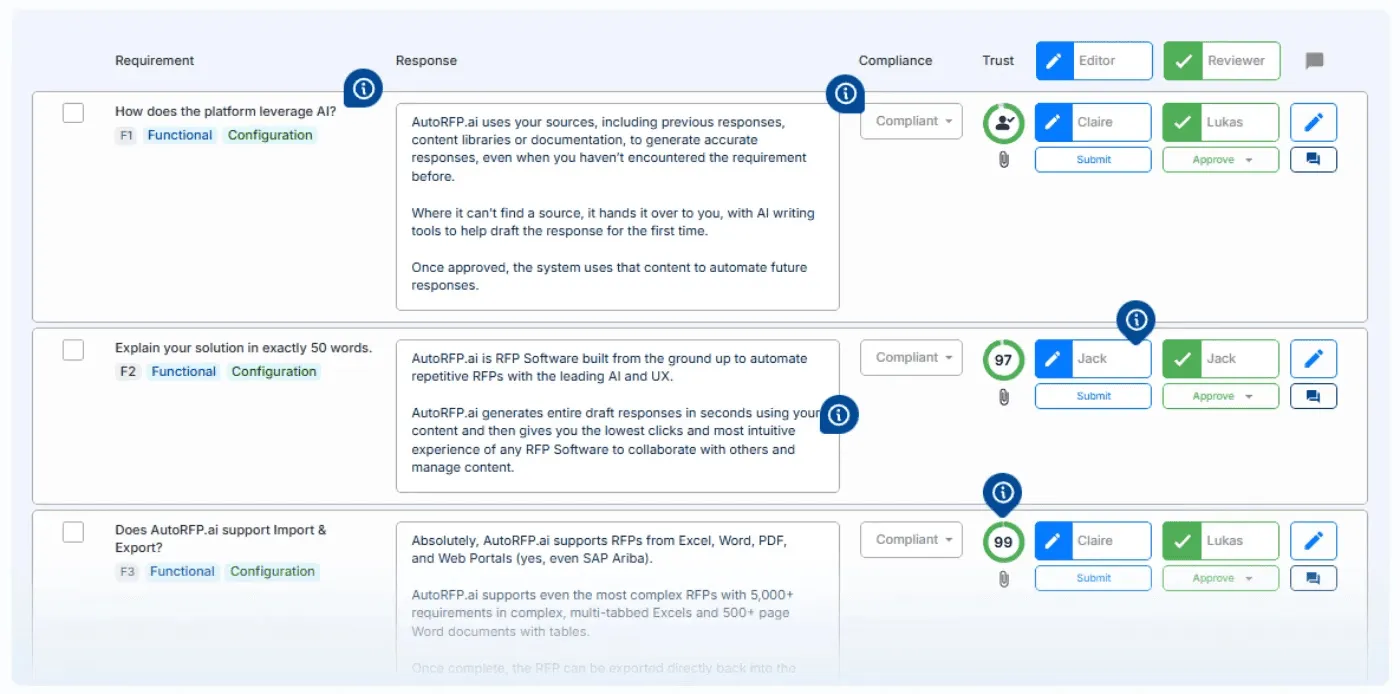
Route questions to the right SMEs. Editors, reviewers, engineers, and proposal managers can comment, redline, and approve in real-time. Everyone stays in sync until submission without messy email chains.
3. Real-Time Insights on RFIs
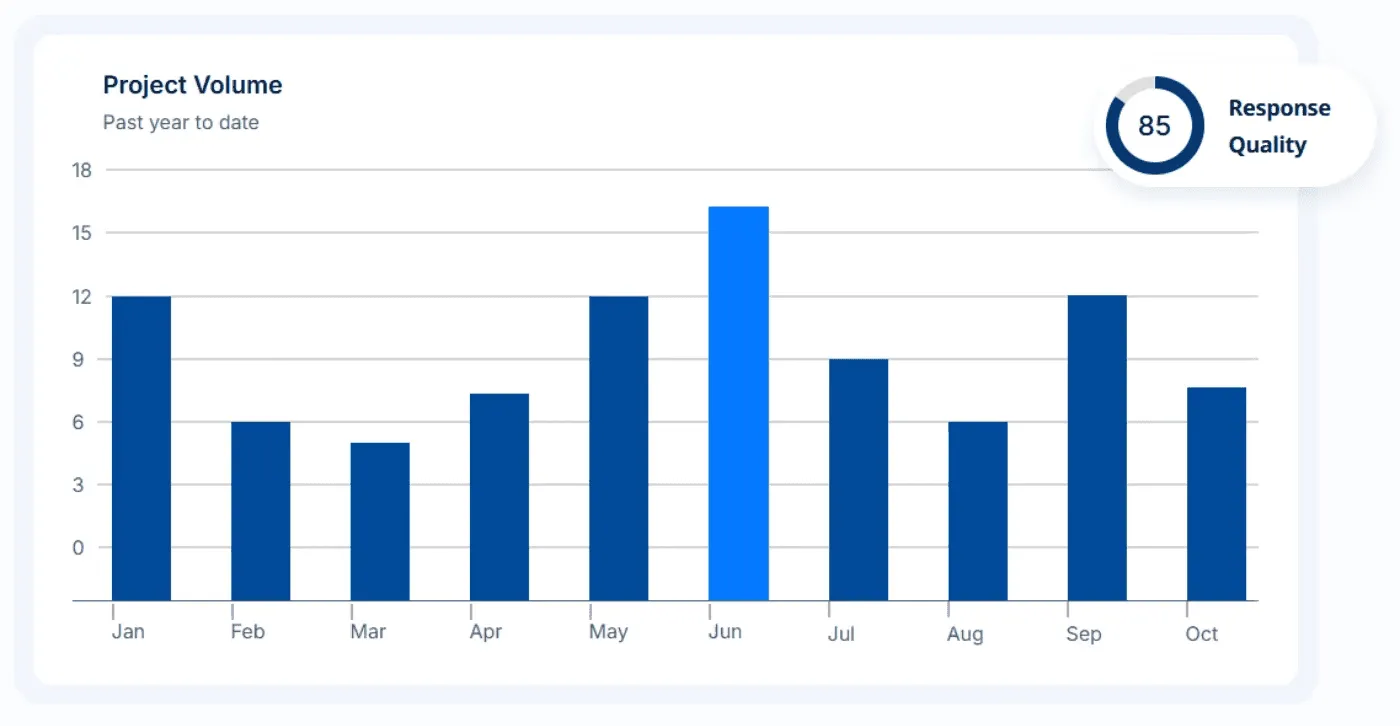
Track volumes, win rates, workloads, and trends across active and past RFIs. Use the data to prove throughput and team impact every RFI cycle. See the whole picture at a glance.
Other key features of AutoRFP.ai include:
| Feature | Description |
|---|---|
| Leading integrations | Connects with content tools, communication platforms, SSO, and CRM systems, including automatic syncing with Google Docs and Notion to keep documentation current. |
| Auto-updating content library | Maintains an auto-updating, searchable library that stores every completed RFI for easy reuse in future responses. |
| Respond to anything | Supports importing and exporting any RFI format, regardless of the client’s template. |
| One-click redrafting | Instantly rewrites responses in different tones, simplifies language, and improves flow with a single click. |
| AI Translation | Provides automated translation for responses in over 30 languages and localisations. |

Video transcript
Transcript is auto-generated and may contain minor errors.
Hey, I'm Rob from autoRFP.ai. What is autoRFP.ai? Well, autoRFP.ai is an AI software as a service or SaaS application that does AI for proposal or RFP responses. That includes RFIs, like request for informations, includes due diligence questionnaires or DDQs, and includes security questionnaires. So, you can find all about us at autoRFP.ai. So, we're a technology company. We have offices all across the globe including Brisbane, Australia, Vancouver as well. And effectively, our tool allows, whether it be bid managers, sales people, proposal writers, RevOps team members, sales leadership, answer complicated request for proposals. So, what is a request for proposal? You can see one of our other videos below in the description. But effectively, our system
looks something like this. And it lets team members, and you can have unlimited number of people log in to autoRFP.ai, good product, allows people to go in, create projects, which would be for instance an RFP. I can go in here, create my information from my zip file, and that includes, you know, like an Excel spreadsheet, PDF, Word doc. We can run an AI go no go project analysis on the RFP. And then effectively from that, we can bring in all the information in terms of what are the questions, where our AI automatically scans the documents and figures out what is being asked of the RFP, whether it's multiple tabs in an Excel spreadsheet and everything else, whether it's drop-downs. And that all happens automatically through the power of AI. Then, we generate our response, and we can do it in in 40 plus different languages and adding languages all the time. Once you've imported your RFP into order rfp.ai,
you can collaborate with your team members assigning different people to answer the questions, review the questions, looking at an overview of the entire project and project managing due dates. Now AI effectively starts automatically answering those different questions based on your knowledge documentation. So that might be your website, your help docs, your technical documentation, your past RFP answers or security questionnaires, your security policies. But effectively all that different company information you import into order RFP and then our AI leverages that to create an AI first draft of an RFP response. Once we're happy with all those requests, we can approve it. That goes into the model to learn from and add to. So your current responses are automatically used for new responses and then you can export that as well. And then the final cool thing about order RFP is you have a lot of different
integrations that you can pull in, whether it's knowledge documentation from places like Notion, Google Drive and so on. So that's order RFP. We're an AI SaaS app. Uh you can host globally. We do not use customer data for training purposes or to send it back to LLMs. So we're secure and private. We have our ISO 2701 certificate and our SOC 2 certificate and then you can find up-to-date pricing and information on our website. Or if you came to learn more, you can book a demo and schedule time with our team. Thanks.
Speed Up RFI Responses with AI Automation Using AutoRFP.ai
The teams that win tomorrow aren’t just the most experienced, they’re the most efficient.
AutoRFP.ai helps you get there by turning your content into a living knowledge base that drafts itself.
Your experts stay focused on high-value strategy while automation takes care of the busywork.
The impact is clear:
Workforce.com doubled its RFP response rate using AutoRFP.ai, automatically answering 80% of customer questions in the first draft. They used AutoRFP.ai to secure over 50 bids.
ecoPortal cut first-draft time by 60% and improved team engagement by 30%, accelerating overall RFP turnaround.
IMTC achieved a 90% automation rate, reducing RFP response time by 80% across 12 months of complex submissions.
This isn’t about replacing people. It’s about empowering them to respond faster, better, and with precision every single time.
