
2026 Tender Process: Automations, Expert Tips & More
The tender process doesn’t have to be confusing. Learn the 7 stages, evaluation criteria, tender types, and expert tips for bidders and buyers.

Robert Dickson
RevOps Manager, AutoRFP.ai··8 min read
Winning tenders is not about having the best capabilities on paper. It is about proving fit, reducing risk, and scoring well across the buyer’s criteria, all under deadline pressure. That requires a process your whole team can follow.
This guide breaks down the tender process and the stages that follow different tender types, including what to expect during evaluation and how to manage timelines and documents.
We will cover how to respond more effectively, where teams lose points unnecessarily, and how technology and an AI RFP tool can automate the repetitive work that slows you down.
What is the Tender Process?
The tender process is a structured procurement method in which buyers publicly invite suppliers to compete for contracts through formal documentation and evaluation. Think of it like posting your dream job online instead of hiring the first person who walks through your door. You cast a wide net, compare qualifications systematically, and select based on criteria rather than relationships.
For buyers, the tender process creates competition that drives down costs while maintaining quality standards. For suppliers, it provides transparent access to opportunities they might not otherwise discover.
Government agencies use tenders to ensure fair access and accountability. Private companies use them when contracts exceed internal approval thresholds or when project complexity demands a structured comparison.
The process is not simple. It involves seven distinct stages, each with specific requirements, timelines, and potential pitfalls. Understanding both the buyer’s and supplier’s perspectives at each stage gives you a strategic advantage that most competitors lack.
Types of Tender Processes
There are several types of tender processes, each designed for different levels of competition, supplier screening, negotiation, and project complexity.
1. Open Tender
An open tender allows any interested supplier to submit a bid without a prequalification shortlist.
- Typically used for: Procurements where the buyer wants maximum competition, transparency, and broad market access.
2. Restricted Tender
A restricted tender is a two-stage process in which suppliers apply first and only shortlisted suppliers are invited to submit full bids.
- Typically used for: Contracts where the buyer wants to filter suppliers by capability before evaluating full tenders.
3. Selective Tender
A selective tender involves inviting only chosen suppliers to bid, often because the buyer already knows which vendors are suitable.
- Typically used for: Specialist, high-skill, or niche procurements where only a smaller pool of suppliers is appropriate.
4. Negotiated Tender
A negotiated tender allows the buyer to negotiate terms, scope, pricing, or delivery details with one or more suppliers before contract award.
- Typically used for: Complex procurements where the solution or commercial terms need refinement before final agreement.
5. Competitive Dialogue
Competitive dialogue is a formal process where the buyer discusses possible solutions with shortlisted suppliers before inviting final tenders.
- Typically used for: Large, complex projects where the buyer cannot fully define the best technical or commercial solution at the start.
6. Two-Stage Tender
A two-stage tender splits the process into an early selection or outline stage followed by a more detailed final bid stage.
- Typically used for: Projects that benefit from early contractor involvement or where the design is still developing.
7. Single-Stage Tender
A single-stage tender requires suppliers to submit their full proposal in one complete bidding round.
- Typically used for: Clearly defined projects where the buyer already knows the scope and evaluation criteria.
8. Request for Proposal
A request for proposal asks suppliers to explain how they would solve the buyer’s need, usually covering methodology, technical approach, and pricing.
- Typically used for: Service, technology, consulting, or complex works contracts where the buyer wants solution design, not just a price.
9. Request for Quotation
A request for quotation asks suppliers to provide prices for a clearly defined good, service, or scope of work.
- Typically used for: Lower-complexity purchases where specifications are fixed and price comparison is the main priority.
10. Framework Agreement
A framework agreement sets agreed terms with one or more suppliers so the buyer can place future call-off orders without running a full tender each time.
- Typically used for: Recurring procurement needs where the buyer wants speed and consistency over a defined contract period.
11. E-Procurement Tender
An e-procurement tender is a tender process managed through an electronic platform for issuing documents, receiving bids, and handling evaluation records. This is a delivery method rather than a separate legal procedure in most systems.
- Typically used for: Buyers that want stronger audit trails, digital workflows, and more efficient bid administration.
12. Design And Build Tender
A design and build tender appoints one contractor to handle both the design and the construction or delivery of the project.
- Typically used for: Construction and capital projects where the buyer wants a single point of responsibility.
13. Turnkey Tender
A turnkey tender requires the supplier to deliver a complete, ready-to-operate solution that the buyer can use immediately after handover.
- Typically used for: EPC, industrial, plant, and infrastructure projects where end-to-end delivery is required.
14. Direct Award
A direct award gives the contract to one supplier without running a full competitive tender process. This usually depends on specific legal or policy exceptions.
- Typically used for: Urgent, exceptional, or highly specialized situations where competition is not practical or permitted.
The 7 Stages of the Tendering Process
To understand how tenders move from planning to delivery, let’s look at the seven stages of the tendering process and what each one means for buyers and suppliers.
Stage 1: Needs Identification and Tender Preparation
Buyer Perspective
Build the business case and secure budget approval.
Define technical specifications and scope.
Align internal stakeholders on evaluation criteria and priorities.
This stage usually takes 2 to 4 weeks for simpler projects, and longer for complex initiatives requiring senior approval.
Why It Matters
Weak preparation creates problems later.
Vague specifications lead to unclear supplier responses.
Unclear evaluation criteria slow down decision-making.
Unrealistic timelines often cause deadline extensions and delivery delays.
Supplier Perspective
Monitor the market continuously through portals, industry networks, and client relationships.
Qualify opportunities early by asking:
Does this match our capabilities?
Can we deliver on time?
Is the contract worth pursuing?
Key Takeaway
- Tenders are rarely lost at the end. They are often lost early when suppliers miss the opportunity or qualify it poorly.
Stage 2: Tender Advertisement and Supplier Notification
Buyer Perspective
Publish the Invitation to Tender (ITT) through the right channels.
Public sector buyers may use official portals, while private companies may use supplier networks or industry platforms.
The ITT usually includes:
Technical specifications
Commercial terms
Evaluation methodology
Submission instructions
Response deadline
Side note: Preparing the full tender pack usually takes 1 to 2 weeks.
Why It Matters
- Incomplete or unclear ITTs create unnecessary clarification requests and increase procurement workload.
Supplier Perspective
Discover opportunities through portal monitoring, alerts, or direct outreach.
Run an immediate go/no-go review:
Is the scope a fit?
Is geography serviceable?
Can we meet the timeline?
Is the deal worth the effort?
Stage 3: Pre-Qualification and Selection (SQ Stage)
Buyer Perspective
Use Selection Questionnaires to narrow the field befoProre full evaluation.
Common checks include:
Financial stability
Relevant experience
Certifications
Insurance coverage
Security credentials
This stage often takes 2 to 4 weeks.
The shortlist usually contains 3 to 5 bidders.
Supplier Perspective
SQs are designed to filter suppliers out.
Common reasons for elimination include:
Missing documents
Expired certifications
Weak case studies
Poor financial evidence
What Strong Suppliers Do
Keep credential libraries updated year-round.
Maintain current:
ISO certificates
Insurance documents
Financial statements
Case studies
References
Stage 4: Tender Submission and Deadline Management
Buyer Perspective
Manage the clarification period, usually 1 to 2 weeks after publication.
Share responses with all bidders to maintain fairness.
Many teams use tender management software to:
Centralize clarification requests
Distribute answers consistently
Maintain an audit trail
Strong procurement teams also publish FAQ documents to reduce duplicate queries.
Supplier Perspective
This is the most resource-intensive stage.
Bid preparation often includes:
Drafting technical responses
Building pricing
Checking compliance
Running internal reviews
Most responses take 40 to 80 person-hours over 4 to 8 weeks.
More complex tenders can require 100+ hours.
Common Challenge
- Security questionnaires and due diligence documents can add significant workload, especially without automation.
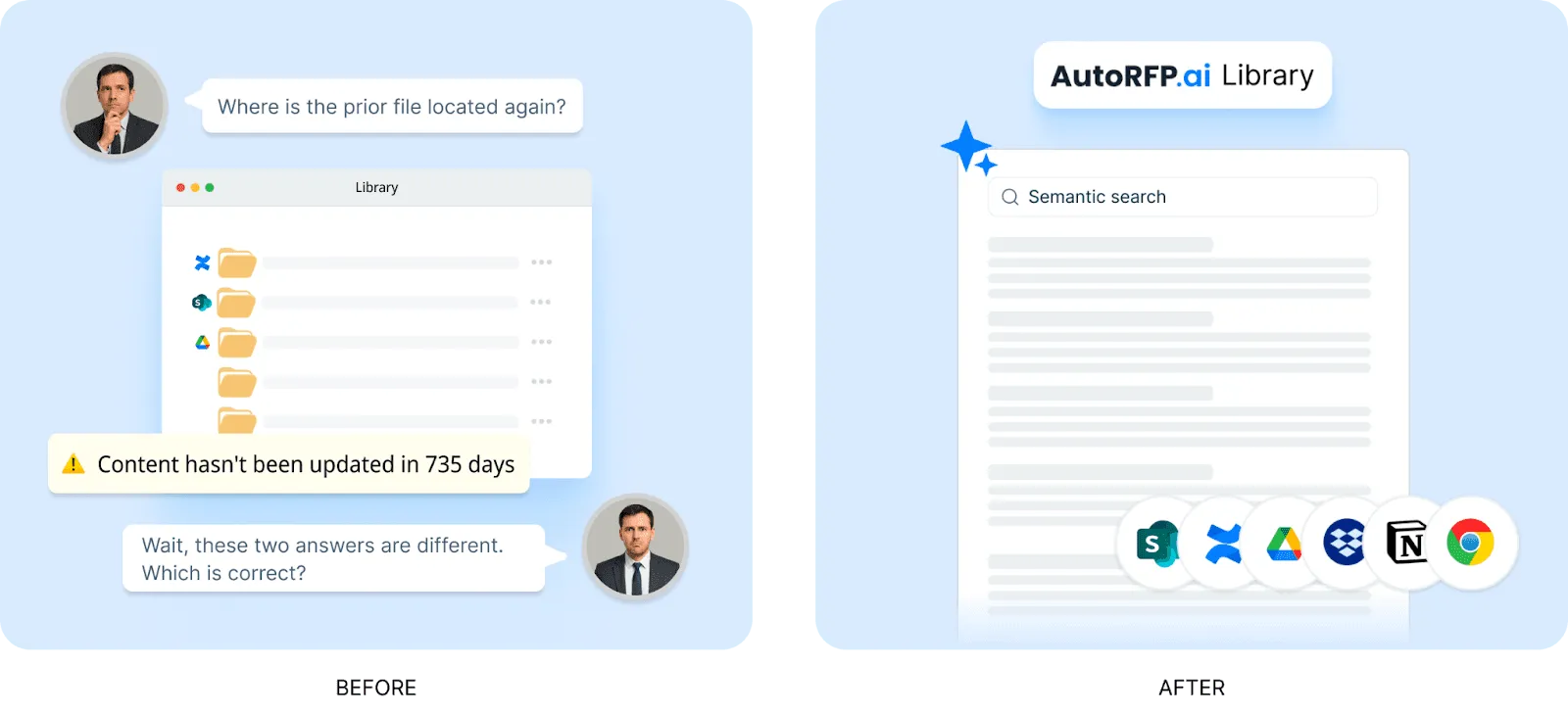
Pro tip: Security questionnaires and due diligence requests become much easier to manage when your team has a searchable AI RFP library.
With a library that builds itself, every approved response is automatically categorized and added, so your team can search by meaning, not just keywords, reuse proven answers faster, and generate more accurate drafts over time.
Critical Risk
Late submissions are automatically disqualified.
Portals close at the exact deadline.
A strong bid still loses if it arrives late.
Stage 5: Bid Evaluation and Scoring
Buyer Perspective
Review compliance first before detailed scoring begins.
Eliminate non-compliant bids regardless of price or promise.
Score remaining responses against weighted criteria, often including:
Technical capability
Commercial terms
Delivery approach
Added value
Evaluators usually score independently before discussing differences as a panel.
This stage often takes 2 to 6 weeks.
Supplier Perspective
This is usually a waiting period with limited visibility.
Some tenders include:
Clarification questions
Interviews
Presentations
These moments can help suppliers address concerns and reinforce their value.
Reality Check
Evaluation is structured, but not perfectly objective.
Presentation quality, evaluator experience, and perception can all influence scoring.
Stage 6: Contract Award and Negotiation
Buyer Perspective
Begin negotiations with the highest-ranked bidder.
Refine:
Contract terms
Delivery schedules
Payment milestones
Performance measures
Legal review and internal approvals can add 1 to 2 weeks.
If negotiations fail, the buyer may move to the next-ranked bidder.
Supplier Perspective
Final discussions often involve changes to scope, pricing, or terms.
Internal contract review and pricing approvals usually take 2 to 4 weeks.
Suppliers need to know in advance:
Which terms are negotiable
Which terms are non-negotiable
Where flexibility will affect margin or delivery
Stage 7: Contract Execution and Mobilization
Buyer Perspective
Prepare for transition, kickoff, and governance.
Update contract management systems.
Communicate outcomes internally and externally.
Unsuccessful bidders may receive feedback or rejection notices.
Mobilization can take 2 to 8 weeks depending on project complexity.
Supplier Perspective
Assign the delivery team and allocate resources.
Prepare for onboarding and project launch.
Set expectations early and establish working rhythms.
Why It Matters
This stage is where the promised service becomes real.
A poor handover can damage trust quickly.
A smooth mobilization reinforces the buyer’s decision and sets up the relationship well.
Key Tender Evaluation Criteria Explained
These are the core criteria buyers usually use to score responses, so suppliers need to understand not just what each one means, but how to meet it clearly and consistently.
1. Price And Commercial Value
This criterion looks at whether your pricing is competitive, realistic, and aligned with the value you are offering. In the EU, 55% of procurement procedures still used lowest price as the only award criterion, which shows how heavily commercial scoring can still shape outcomes.
What evaluators look for:
Competitive pricing.
Clear cost breakdowns.
Value for money, not just the cheapest number.
Pro tip: Make your pricing easy to understand, explain any premium clearly, and show why your offer delivers better long-term value if you are not the lowest bidder.
2. Technical Capability
Technical capability measures whether you have the technical knowledge, systems, and delivery approach needed to meet the specification.
What evaluators look for:
Fit with the technical requirements.
A credible delivery methodology.
Evidence that your solution will work in practice.
Pro tip: Mirror the specification in your response and show exactly how your solution meets each requirement instead of relying on broad capability claims.
3. Relevant Experience And Track Record
Past performance helps buyers judge whether you can deliver similar work with confidence.
What evaluators look for:
Similar case studies.
Past results in comparable projects.
Experience in the same industry, scope, or contract type.
Pro tip: Use examples that match the buyer’s context as closely as possible and include outcomes, timelines, and measurable results.
4. Delivery Approach And Methodology
A clear plan shows how you will execute the work, manage delivery, and achieve the required outcomes.
What evaluators look for:
A clear implementation plan.
Logical delivery stages.
Risk management and quality control.
5. Team And Personnel
This criterion evaluates whether the people assigned to the bid have the right qualifications, experience, and roles.
What evaluators look for:
Relevant team credentials.
Clear responsibilities.
Enough seniority and expertise for the work.
Pro tip: Name the actual team where possible and link each person’s experience directly to the contract requirements.
6. Compliance And Mandatory Requirements
Every essential instruction, form, and condition must be met for the bid to stay in contention.
What evaluators look for:
Completed mandatory forms.
Required certificates and declarations.
Full alignment with non-negotiable requirements.
Pro tip: Build a compliance matrix before drafting so you can track every requirement and avoid missing something small that could disqualify the bid.
7. Quality Assurance And Risk Management
Strong controls reassure evaluators that delivery will stay consistent and risks will be managed properly.
What evaluators look for:
Quality control processes.
Risk registers or mitigation plans.
Evidence of operational discipline.
Pro tip: Show that you already use structured quality and risk controls, not that you will figure them out after the award.
8. Added Value And Innovation
Extra value matters when it is practical, relevant, and clearly tied to the buyer’s goals.
What evaluators look for:
Process improvements.
Efficiency gains.
Innovation that is useful and realistic.
Pro tip: Only include added value that is relevant to the buyer’s goals and easy to believe, not vague innovation language.
9. Social Value Or Sustainability
Wider benefits can strengthen your bid when they are specific, measurable, and connected to the contract.
What evaluators look for:
Specific sustainability commitments.
Social impact measures.
Evidence that promises can be delivered.
Pro tip: Quantify your commitments wherever possible and connect them directly to the contract instead of using generic ESG language.
Beyond The Stated Criteria
Beyond the formal scorecard, evaluators often look at a second layer of practical checks that influence whether your bid feels safe, credible, and easy to approve.
Terms and conditions: Evaluators check whether you comply with the contract’s legal and commercial terms, including payment terms, liability limits, intellectual property rights, dispute resolution, and termination clauses.
Response format requirements: Evaluators expect you to follow the required structure exactly, including page limits, section order, mandatory forms, file formats, and any submission instructions.
Submission deadlines and validity periods: Evaluators look for on-time submission and confirmation that your pricing and terms will remain valid for the required evaluation period.
A structured checklist is essential here because even a strong bid can lose on evaluation when small compliance gaps, missing documents, or avoidable formatting errors slip through.
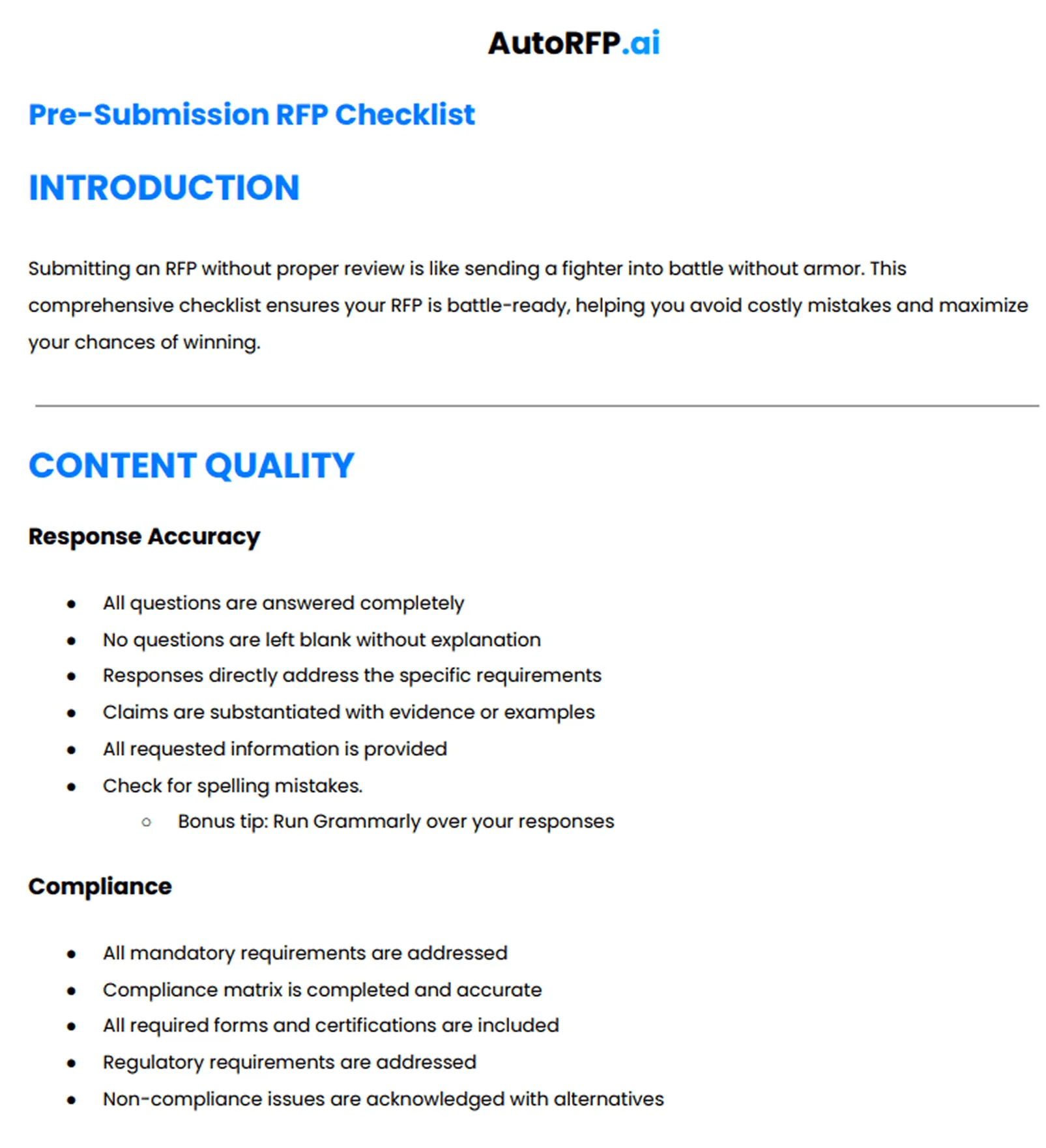
Download the complete checklist
Tender Process Timeline: How Long Does it Take?
Tender timelines vary depending on the complexity, procurement structure, and sector, so the table below gives a practical benchmark rather than a fixed rule.
| Tender type | Typical timeline | Key characteristics |
|---|---|---|
| Simple tenders | 8-12 weeks | Single-stage, clear specifications, limited bidders |
| Complex tenders | 16-24 weeks | Multi-stage, technical complexity, extensive evaluation |
| Two-stage tenders | 20-32 weeks | SQ phase (4-6 weeks) + full tender phase (16-26 weeks) |
| Framework agreements | 24-40 weeks | Multiple suppliers, longer evaluation, staged awards |
| Urgent procurements | 4-6 weeks | Accelerated timelines, limited scope |
Regional variations exist. EU directives mandate minimum 30-day tender periods for above-threshold contracts.
US federal acquisition regulations specify timeline requirements based on contract value. Australian government tenders typically run 4-6 weeks. Private sector timelines are more flexible.
Buyer’s View: Managing the Tender Process
Tender documentation quality shapes response quality. Creating an effective ITT requires strong control over a few core areas:
Clear technical specifications: Document functional requirements, performance criteria, integration needs, and acceptance standards precisely. Ambiguous specifications lead to different interpretations and make evaluation harder.
Weighted evaluation criteria: Use a transparent scoring methodology with defined weightings. Commercial price typically accounts for 30 to 40% of the total score, while technical capability, delivery approach, and added value make up the rest.
Realistic timelines: Set response periods that balance supplier preparation needs with procurement urgency. Simple tenders usually need at least 3 to 4 weeks, while complex technical tenders may need 6 to 8 weeks.
Question management: Run a structured clarification process with clear cutoff dates, usually 7 to 10 days before the deadline. Publish all questions and answers at the same time to maintain fairness.
Internal stakeholder alignment: Make sure technical teams, commercial teams, legal, and end users agree on requirements and the evaluation approach before publication. Poor alignment often leads to mid-tender specification changes that reduce supplier confidence.
Supplier’s View: Responding to Tenders
Successful tender responses start with disciplined qualification, strong compliance control, and a structured submission process.
Go/no-go framework: Assess win probability, resource availability, strategic fit, estimated contract value, and delivery capability before deciding to bid.
Selective pursuit: Teams that skip go/no-go decisions often chase too many opportunities and spread resources too thin, while selective bidding improves focus and win potential.
Response preparation: Start with compliance checking, address every must-have requirement clearly, and use the evaluation criteria to shape the structure of the response.
Proof and differentiation: Show capability through relevant case studies, team qualifications, delivery methodology, and a commercial approach that stays competitive without hurting profitability.
Submission best practices: Test electronic portals several days before the deadline and follow file format, size, and naming requirements exactly.
Proof of submission: Save submission confirmation emails and records as evidence in case there is any dispute or technical issue later.
Team coordination: Most bid teams are understaffed and overworked, so clear roles, deadlines, and review discipline are essential.
Process discipline: Strong tender writing practices, structured bidding workflows, and AI-supported response processes can reduce errors and improve efficiency on complex bids.
Most buyers now shape requirements before vendors are involved, which makes late-stage tendering harder to influence. In this video, we show how to use your past RFP responses and AI to build a reverse RFP that helps buyers structure better evaluations while giving your team a smarter path to stronger bids.

Video transcript
Transcript is auto-generated and may contain minor errors.
I've used this quite a few times in my career across RFPs to win many, many millions of dollars nicely. So, now I'm going to share that with the world. We're going to share that. People will be at different stages of influence from you're not currently influencing RFPs and everyone that hits your desk looks like it's rigged by a competitor all the way through to you've got frameworks and an understanding of this. >> Great. So, here's what we'll cover today. First, we'll start with some new statistics and research in 2026. We'll look specifically at what's changed in the buying process because that context really matters. Then, we'll take a look at some of the challenges with traditional RFPs. And then, Jasper will introduce the idea of a reverse RFP, what it is and why it works. And then, I'll walk through an example of how to actually build one step-by-step. When we finish, we'll leave you with some practical templates and resources so you could use this if you want to try this approach yourself. So, we'll move from context to framework
to implementation. So, what I want to start with is really a reality check of how the buyers' behavior has changed in 2026. Research shows that 80% of the B2B buying journey happens before a buyer even talks to a vendor. And more interestingly, more than half of them prefer to not even speak with a sales rep during this early research phase. So, by the time vendors are invited into the process, a major portion of these buyers have already defined their purchase requirements. They know what they're looking at and they have their categories. But, here's the other twist. Almost 94% of those buyers are using large language models like ChatGPT during their buying process to research those vendors and build those evaluation frameworks. And if you're thinking about where those LLMs are getting their information,
it's those things that are ranking at the top of Google that generally influence that. So, what does this mean? It means that buyers are more and more designing the evaluation before vendors are involved. And it's not just that, there's that another shift happening on the procurement side as well. So, procurement teams are getting asked more and more to manage dramatically more spend with way fewer resources. And McKinsey actually saw that spend under management per buyer has increased almost 50% over the past few 5 years. But at the same time, they're expecting procurement teams to shrink by 25% to 50%. So, they're under pressure, too, those procurement professionals. They have less time to design evaluation frameworks, vet vendors, and structure the RFPs properly. But, that does also create an opportunity. Because while they're being overloaded,
they also welcome help in structuring within their evaluation process. >> Yeah, and I thought there was an interesting example here. Recently, I was talking to procurement person at one of the world's largest healthcare companies, and I was particularly interested in they were going through a HR software procurement, multi-million dollar contract, huge, huge thing. And the thing that they were most interested in and most focused on though, while that was all going on, is air conditioners at one of their larger aged care facilities had gone down, and there was an emergency procurement to go in there and switch out all the air conditioners. Although the HR software RFP, and I'm sure all the HR software vendors were like, "Oh, this is very important. We need to have the right structure, the right thing." They in a way couldn't have really cared less about that compared to the other procurements that they were doing that were larger in size, larger in importance. People could literally die if those air conditioners don't get replaced in time, there's a heatwave, etc. So, it it totally makes sense this kind of concept of the slop RFP. Going
into ChatGPT, please generate this, and that's generating on the side while I do the procurements that that really matter. So, I think that's why we're seeing a lot more robust inside of RFPs. >> And this is the thing. There's a lot of problems with these traditional RFPs now. The fundamental challenge that they're facing is that traditional RFPs will put vendors in a reactive position. By the time you get it, the deal's already shaped, the criteria is defined, the scoring model exists, and the vendors are just competing inside that framework. So, then when vendors respond, they respond the same way in the sense of they're rushing to respond under tight deadlines. They're often thinking, "Ah, this is feeling a bit rigged." But then, the question is, what if you could be the one writing those requirements? >> Yeah, and that's what we're jumping into today is because the answer is you can, and many do. So, the reverse RFP's concept of a structured evaluation
template that you are providing proactively to the buyers early in their process that includes recommended requirements, maybe a response structure, and it flips that script right from you receiving a template that's already been influenced to you helping influence that template for the better. And it also helps you position very early in the procurement that you are strategic partner, that you're helpful, that you know what you're doing, that you're a thought leader, all the above. So, the first question I got around this was, is that is that fair? Which I think is an interesting one, and there's two parts to that, I think. I think there's ethics being the first one. And if we look at the ethics of this, most evaluations are already influenced by the competitor who got there first, the consultant, the PWC's, your Deloittes that are providing a generic template that was rigged to a big player from many, many years ago. Um an outdated RFP template from the last procurement they did 3 years ago in the same category, or
just ChatGPT with no particular category expertise putting out a generic Excel template and sending it out to them. I think when you're building one of these templates, a good test is would your framework still be a useful evaluation tool if you removed your name from it? So, if you were actually outside of that procurement, it was your three closest competitors, and you provided that buyer that template, would they still end up with a better provider because of it? So, I think that clearly passes that. And also, on the other side of things, and thankfully, I'm not a lawyer. And this is not legal advice. If you look at the procurement frameworks in the US, the UK, Australia, many other jurisdictions, not only is this not illegal or not not encouraged, like it's actually actively encouraged. They are looking for buyers to be more involved with procurement. They want more information up front. They want vendors in the market to help their procurement teams understand the changing environments in different areas, services, and products. So, they're
actively soliciting this type of information. And they're looking for more of it. They really can't find enough information on this at the moment. So, this gives you a lot of competitive advantages, of course. One is that your differentiators become formal evaluation categories. There's reasons that people buy your product. There's reasons that people buy your service above and beyond other options. And you can present those and make sure they're actually included. You're not selling You can sell to a more informed buyer with more coherent requirements. So, a lot of the time you read a RFP and you're just like, "How did they even get to these questions? They don't even make logical sense. How can this be true and this be true at the same time?" And these types of templates and frameworks help them navigate to a more coherent set of requirements. As I said, it also positions your organization as a helpful and a true partner, right? In trying to help them define what they actually need, help them think through that. And through this process, you will also save yourself a ton of time when it's
adopted. Right? So, if they take 20% of your requirements, you already have answers to 20% of their requirements and you're saving that time. But even more importantly is this last one here, which is the buyer can save a really significant amount of time. If they don't have a framework, what that can look like is reaching out to all the subject matter experts on their side, asking them, "Hey, do you have any questions that you would like to add to the RFP template?" It's like the problem that we have in responding to RFPs is that the SME comes in, there's nothing there, they need to write something from scratch, they're not necessarily experts in writing RFP requirements. So, by providing a template, you could be providing that to SMEs who are reviewing now a template, go, "Oh, those 10 questions actually make sense. I would add maybe two things to that or tweak that." And that helps the procurement team not only save significant time, which they obviously need, but sometimes it can even speed up the RFP process for them internally because they can get to a document that they're confident in a lot faster and that puts less RFPs in
jeopardy. It helps them move that pipeline along. So, giving them more information is super useful, gives you an advantage, but also gives them an advantage. Now, examples of areas of influence. So, I just wanted to go through some different ways that in different ways to think about requirements that you might add to this type of template outside of the obvious things, right? You're going to have functional and technical things that you do that maybe no other competitor does based off your competitive research and those are straightforward things. They should absolutely be included here. But there's a lot of other areas where people get it wrong, particularly procurement people get it wrong. You might get it right and it's a good thing to highlight. One of the examples is vendor viability and long-term partnerships, right? There might be a lot of players in your space that can give a really good demo and a great presentation, but not necessarily deliver a two-three year contract or work with a customer over the long term. You might be up against a lot of small
players who say they can do something, but maybe they can't. So, highlighting that, describing the customer success model, right? Maybe you've got a lot of resources and you're able to deploy at larger organizations than some of your competitors. Maybe you've got a interesting proactive approach to your account management. Another one is the total cost of ownership piece, right? A lot of the top lost reasons in RFPs outside of the controllable is the pricing. And a lot of the time you just get a question, how much is this going to cost based off X, Y, and Z? And what a lot of vendors do to try and get around this and have the best price when they don't necessarily actually have the best price is by hiding the total cost of ownership. So, is there ways that you could add requirements in around the vendor must provide an all-in cost breakdown including the implementation, etc., etc. So, actually listing everything that they would actually need to pay for and they can start to ask for that up front rather than figuring that out after they've signed the contract. Having them disclose costs that are not
included in the base price, things like add-ons, etc., making them describe their pricing scalability. So, if that buyer was to scale and become 300% bigger in terms of a contract, what would that look like? So, maybe you've got some total cost of ownership benefits, and those are things that buyers should also be asking about and not just assuming that the proposal price is what the actual price will end up being. Then there's the cultural and strategic partnership side of things. So, not only the hard criteria, right? But what is the soft criteria? At the end of the day, with a lot of these large partnerships, you're going to need to work with the buyer's going to need to work with that vendor day in and day out for many years. So, describing things like your communication style, right? Your culture and values and how those align, how you would align executives over the long term. How you could maybe demonstrate specific expertise in a particular market, and you've got people on your team that have deeper industry experience than some of your competitors. These are very, quote
unquote, soft things, but things that can be very important, can be an actual very serious competitive advantage, and should be brought to a buyer's attention if that's where you're strong. Another one is like the technical fit and maybe integration depth. So, depending on the market, going outside of just the high-level stuff, right? Do you tick this box? Do you have this feature? Do you have this service? And really digging into what it actually takes for someone to buy your product and service and be successful with it. Is there, on the software side, specific APIs and integration capabilities that are required in order to deploy in a certain market? Is there certain legal requirements or ramifications for not doing something in a certain way? Really digging into the weeds and trying to work in those more technical questions that the average buyer might not always surface with a basic RFP. And then, finally here is just another example would be implementation and change management, right? So, it's great to be able to buy a product that ticks all of
the boxes, but how is it actually implemented? How do you replace the incumbent? What does the process for that look like? Change management is one of the largest blockers to any type of adoption of any product or service. So, that is a really key one as well. Do you have case studies of people moving from that incumbent to you? Maybe that should be a requirement in the RFP that they've actually worked with those types of migrations before change overs. Maybe it's a requirement that change management has been deployed and at that scale in that industry before, right? So, how can you use your credibility and your expertise? So, these are just five different examples of the types of requirements that you can work in outside of the obvious things that just differentiate you and your competitors. Cool. So, now going through that, we'll talk about how to actually build a reverse RFP. Nice thing is, if you're already using RFP software like AutoRFP or another
product, your content library already contains all of these answers, right? So, you can quickly assemble a reverse RFP, number of different templates, you can even go to the point of creating different sections for your different products or different market verticals, so they're even more specific. And it will turn your knowledge base from purely an internal thing for answering RFPs into also an external resource, so you're getting value out of answering all of these RFPs, finding the most common requirements that you're compliant with, and working that back, putting that back out to market, and basically getting leverage from that. If you're not right and you're an entirely manual process at the moment, you could just start with something basic, right? Get the last three RFPs you won, manually go through them, distill your differentiators, the common requirements, put those in a big list of requirements, and just start there. And the objective really here is to build a nicely branded and ready to use document, so the customer can basically receive your template, be like, "That looks good. I'm particularly busy with
some air conditioner procurements today." Slap your logo on it, send it out to the vendors, and receive it back like that. So, it's a really beautiful thing. Once you pull this off and achieve it, we're not saying that you achieve this every time, and you'll just receive your exact RF feedback in the exact way that you want it, but it would be a lie if I was to say I hadn't received nearly the exact template back with 15 of 270 requirements changed and won multi-million dollar deals off the back of it. So, it's definitely not something that happens every time, but when it happens, it's worth it. So, I'll hand over to you, Seema, and you can run us through an example of how you can get this done. >> Awesome. And this is not to say that you guys can't use ChatGPT to create a reverse RFP. You can, but then you're likely getting that generic category structure, and that would produce generic comparisons as well. So, the differentiator isn't necessarily AI, but it's embedding your actual expertise and offerings into the framework. So, I'll walk you through how to build that reverse RFP step-by-step. The main
two tools I'll be using are AutoRFP and Claude, but you can replicate this with whatever tools you I'm just going to steal the screen share from you, Jasper. Thank you. All right, perfect. So, you all should see my AutoRFP instance. What I'm going to do is I'm going to use AutoRFP and I'm going to aggregate all of my requirements that we tend to come across when we're responding to RFPs for our software. Now, if you don't have AutoRFP, just like Jasper said, you can use your own library for this so you're not starting from scratch, or use your last three most recent RFPs, but essentially you can replicate my exact same moves but with your own content. Now, by using AutoRFP, I'm actually going to take this a step further and not just use my Q&A library, but I'm going to actually identify where we are compliant, where our strengths are, and embed those into our evaluation criteria. And that's the strategic
layer. So, what I'm going to do is I'm going to leverage one of our reporting capabilities called the gap analysis. And what the gap analysis is, it's a report that tracks and monitors your bid requirements. So, you have insight into where you have any product or service gaps essentially, and then it looks at where you're compliant and non-compliant patterns across your project and gives you insight into your competitive positioning. So, what I'm going to do is I'm going to filter, keep it within the last year, for example, so I can have a large data sample. And I'm going to filter all of the requirements that I am compliant in. So, I'm avoiding the requirements that we don't necessarily meet. Then, I'm going to hit export. Now, I'm going to move to my LLM of choice. I'm going to go with Claude for today. Let me just bring my Claude in here. Perfect. And then, I'm going to
put my file my gap analysis export into Claude and drop in this prompt. Now, for the sake of you guys not staring at me for 5 minutes, I've already done this prior to this webinar, and I have it generated already. So, let me just pull up my reverse RFP real quick. And this is exactly what Claude generated. I haven't edited anything yet. It added a nice request for proposal intro page. These are all of my RFP requirements that are built on my gap analysis. It even went above and beyond to color coordinate my sections, which if anyone knows me, I love a good color coordination. And it added a nice weighted matrix at the end as part of the evaluation criteria as well. So, now you've created a structured framework that you could share with your buyers to help guide their evaluation process.
By proactively shaping the requirements, you demonstrated your expertise, you helped structure it around the important considerations, and what I think is most important is you positioned yourself as and your solution but competitively by highlighting those capabilities where you deliver the most value. And that's the reverse RFP, just like that. I will pass it back to Jasper. >> Cool. Thanks. Yeah, and that's the prompt right there, right? So, it's very simple. Please take the stock of requirements, create me an RFP in Excel format that I can share to vendors. Please remove redundancies or duplicates. So, you can really take that list and go from there, but of course, you're really leveraging and learning from all the different procurements that you've gone through as well, providing a lot of value to prospective buyers. We have an example of that as well. If you want to see an example of like how we do this in our particular category, we have of course got an RFP for RFP software template, as as meta as that
is. So, now that you've got it generated, the really important part is to actually get it in front of the buyers. It's only going to be valuable if you're actually not only have you packaged it in a way that's usable and is providing a lot of value, but it is really early in the process. So, as much as we wish that the proposal team could just send this out into the world and we would just start receiving these back, it really does sit on the shoulders of your marketing team and your sales team 99% of the time. So, just want to run through really quick and easy how they can get this distributed. So, one thing is in the marketing funnel, you basically want to make sure that this is the first template that a prospective buyer finds when they go to Google. So, for example, RFP template for X. If we search RFP template for marketing automation, right? Adobe has a sample marketing automation RFP template. So, click on that, download the source, etc. They're right there at the top of the funnel, but you don't need to be Adobe
to do this. You can actually rank a lot at the moment in these different Maybe not so much after the webinar, but you can rank a lot of categories. RFP template for X. Not a lot of people actually put the time in to one build it, and then two actually put it on the internet, right? So, another one is like a classic one from a customer here, SugarCRM, right? CRM buyer's guide. That's another great keyword, but there'll be a set of 15 or so keywords, maybe specific to your industry, of what procurement teams are searching before they go out to RFP, RFI, etc. So, that's the best way to do it. And the really nice side effect of this is not only do you get Google, you also get referenced by ChatGPT, Gemini, Claude, Perplexity, Co-pilot. They're using the same underlying search to come to these web sources, and I think that those teams will even be more influenced cuz they'll just assume it came from Claude. In reality, it came from search result one on Google, and it's copy pasted all your requirements and stole them. But this is the kind of art we would like we would like ChatGPT to steal.
So, on the sales pipeline, we also want to implement it there. The best way to do it is on the initial call/demo, particularly if you've got an enterprise-specific or government-specific sales team with account executives or like inbound business development reps who are really on the line at the very start of that relationship as soon as the buyer actually does reach out post-marketing. One of the things we want to do there is try and put in a quick discovery question for someone that seems like they're the type of profile to go out for RFP. So, something along the lines of out of curiosity, how are you looking or planning to evaluate the vendors? Do you have a formal scorecard or what does that look like? And they might go two of like one of two ways. Maybe that's actually handled by them and they're still trying to figure it out themselves. So, that buyer will actually have to build some sort of qualification criteria or scorecard themselves. And then on the larger side of things, oh no, this will definitely have to go to RFP for this ticket size, blah blah blah. So, in both cases, we want the sales
team to go great, I've got a great resource for that I can share with you, etc. etc. and send that over as soon as possible during that initial call. Not only providing value immediately, but obviously starting that process. And then another one is, which is interesting, is follow-ups. A lot of sales people are always looking for value that they can give to follow up after they haven't heard someone or they've been ghosted for a few days. This is a really good one again for that same type of buyer that might be going towards an RFP. After not hearing from them for two to three days after a demo, you might reach back out to the champion, attach that spreadsheet, and send something like this. Great speaking with you. I know pulling together the criteria can take a lot of time, blah blah blah. We've got an evaluation framework based on X procurements based on the last 100 RFPs that we've done. You also use however you like, adapt it to your internal process, but just a starting point and happy to walk them through it if it's helpful. And that puts it in front of them, doesn't apply any pressure, but does provide
them the framework. And it genuinely is influenced by your hundreds of procurements that you've gone through, the best practices and learnings of what the smartest in the industry are asking when they go out to market for the same thing. So, that's two easy ways to put on the sales side. And then the final side, and I'll say this is really just the Hail Mary stuff at this point, is of course during an RFI submission, This is a really nice resource to have. Sometimes you can attach this during the RFI and say, "Hey, please see Please see attached RFP and some of the requirements and blah blah blah and work it in there." Some RFP RFIs will have strict criteria that prevent that from happening. But, what you're able to do there of course is once the RFI closes and then there's quiet period sometimes before they go to RFP, there's nothing necessarily stopping you. Check the requirements of and the policies behind the procurement of course before doing this, but you can send over that RFP template and go, "Hey, you know it's been a while since the RFI. I imagine you're going to move to RFP next." You send that person in procurement that
same thing and then hold on tight that they might use that during the RFP process, right? And then finally, it during the clarification process, more of just a useful resource, right? Can you check your standard template RFP against the requirements that they have and is there any really smart clarifications or things like, "Hey, I saw you didn't have a section on X. If you refer to our RFP template, there's some good questions on that you might want to ask in this industry." Or, "I saw you phrased it this way. This is how we would usually phrase it to catch out X, Y, and Z." So, it just becomes a good thinking framework for working through clarifications of requirements when you first receive the RFP. So, that's six different ways that you can use it throughout the sales pipeline. So, the call to action for Monday is build that first template if you haven't already. If you already have one, then maybe double down on some of those examples, update it, and refresh it with Claude, see if there's any other angles that you can add to it, beautify it, make the formatting better than ever,
and easy to replace with a buyer's logo. And then, actually go ahead, draft the email, maybe make the blog post, get it all ready and packaged for your marketing team, for your sales team. So, they don't have to do any work. You're not explaining something high level. You're just giving them value and then that playbook can be adopted by those different teams. Cool. So look, that's everything we had to cover today. We'll send over the recording and the resources so you can dive straight in there. But happy to take any questions as we have them. Go free to put them in the chat or I'll also try and find the Q&A area. Cool. Nothing just yet, but also our multilingual. Yeah.
Yeah, that is an interesting one. It would be interesting. Yeah, in larger markets, I imagine the search engine optimization can become even easier if you're working outside of English. So having the converted page and the converted requirements could actually be a lot more useful. I would say translate that. You might be able to, if you're working with a cloud or ChatGPT, be able to automatically translate it into a number of different languages pretty easily. Yeah, Brian had a good question about putting out the RFP template publicly, won't that help competitors? And that's a good It's a really good question and I think you've got all of your base requirements in there and then you'll also have your differentiators and they're all mixed together. So you won't necess- like the other competitors won't necessarily know what the differentiators are that you're proposing. But then I also think it's the same with anything, right? If you put out your screenshots of your product publicly or information about your product publicly, won't your competitors use that? Yes, they will.
How much will they use it? How much will they actually get value compared to how much will the actual buyers get value? I think that's a question. So if you put it out in the market, your competitors don't actually respond by having their own template or anything like that, then you're still ahead. The buyers are still using your template. And that's also why in competitive markets, we always need to be ahead. We always need to be updating these things. So, it's not just a a once off and then the competitors copy it. You're By the time that they've copied that last version, you've already got the next version. You've got the 26 and the 27 and the 28 version of it. So, I would say on at its total, I think it's definitely worth doing even though they could download it. And when it comes to marketing as well, you can gate these things, right? So, you can have it there's no Gmail sign-ups, there's no Outlook sign-ups, so it can't be any of those. It needs to be a company domain that signs up. And then it also lessens the chance of a competitor getting their hands on it cuz it's going to require a real business domain. And maybe they just download it via their actual
domain, but like that can start to add some friction around that process at least. >> Yeah, and Michael, you absolutely can. That's exactly what we were saying, but you miss the competitive advantage of leveraging the requirements that you're a compliant in if you just use past RFPs and have your LLM generate the responses. Part of where we took this a step further was leveraging that gap analysis where we could filter to the requirements that we were specifically compliant in, aka our strengths, and then build that reverse RFP based on that. So, that's a really good question. Jasper, don't know if you have anything to add on to that. >> Yeah, yeah, I think you should yeah, get your previous RFPs, but I guess just focus on that work of getting to what's compliant, what's actually differentiated, and try and get a lot of information so you've got really good coverage and scheming across the different requirements. So, absolutely nothing stopping you. We'll try to make it accessible for everyone.
Cool, cool, cool. I think we can wrap it up for today unless anyone else has questions. Next webinar is going to be really interesting. It's on the future of AI agents and there'll be some big releases. We're actually doing a webinar with another RFP software company that focuses more on the construction, facility management, and things like that. And we'll talk about how we've both architected different agents and yeah, be releasing some agents actually on that webinar and talk through the engineering and background process of building agents specific to RFPs. So, that'll be exciting as well. >> Jasper, we've got a last question. Is a reverse RFP on our road map? >> Definitely, yeah. So, we highlight this workflow today of using the gap analysis which helps you win in other ways by closing the gap, but absolutely. I think it's a very easy workflow for us to go from gap analysis to generating the reverse RFP and maintaining it for you automatically. So, 100% Brian.
Awesome. And Michael just popped in one of the last, of course you can have a demo. Go to our website, book a time, and yeah, we'll we'll make sure to line it up and happy to cover anything you you'd like. Have a great rest of day all. Thanks for making the time.
Tender Process Documents Explained
Most tender processes rely on a small set of core documents, and while the names may vary by region or organization, their function is usually very similar.
| Document type | Purpose | Typical content | When used |
|---|---|---|---|
| Invitation to tender (ITT) | Formal tender announcement | Technical specs, commercial terms, evaluation criteria, submission instructions | All tender types |
| Selection questionnaire | Pre-qualification filter | Financial stability, experience, certifications, capacity | Two-stage tenders |
| Request for quotation (RFQ) | Price-focused procurement | Pricing tables, delivery terms, payment conditions | Simple commodity purchases |
Documentation completeness correlates directly with response quality. Comprehensive ITTs with clear requirements generate focused, compliant responses. Vague or incomplete documentation creates confused responses that complicate evaluation.
Tender Process Tips and Best Practices
These best practices help both suppliers and buyers reduce risk, improve decision-making, and run a smoother process from qualification to award.
Best Practices For Suppliers
Suppliers should focus on bidding discipline, clear ownership, strong evidence, and response quality so every submission is strategic, persuasive, and fully compliant.
| Best practice | Why it matters |
|---|---|
| Run a real go/no-go | Bid on higher-fit opportunities so your team has enough time to produce quality work and protect win rates. |
| Start with customer insight | Document what the buyer is trying to achieve, what they fear, and what success looks like before drafting begins. |
| Turn insight into win themes | Build 3 to 5 simple messages that you repeat across the response so it reads like one persuasive story. |
| Set clear ownership | Assign one bid owner for the full process, along with clear section owners and review gates, to avoid confusion and missed deadlines. |
| Use SMEs for validation, not first drafts | Let subject matter experts focus on accuracy and proof, while the proposal team keeps the response clear, consistent, and customer-focused. |
| Govern your content and evidence | Keep one approved source of truth, remove stale answers, and make supporting proof easy to find and reuse. |
| Track shortlist rate and debrief | Use shortlist outcomes and post-bid feedback as early signals to improve qualification and response quality over time. |
| Follow instructions carefully | Double-check all documents, forms, certificates, and submission requirements to avoid preventable disqualification. |
| Use evidence | Support claims with case studies, testimonials, metrics, and delivery proof so evaluators can trust what you say. |
| Proofread thoroughly | Make sure the final document is professional, accurate, and free from grammar, formatting, or compliance errors. |
“Great proposals aren’t about how well we write (even though I’d like to think so most days). A great proposal is all about how well we understand the customer.” - Christina Godfrey Carter, Founder at Stargazy
Strong best practices matter, but so does knowing what to leave behind. This video covers five common RFP habits that no longer help teams win.

Video transcript
Transcript is auto-generated and may contain minor errors.
Hey everyone. >> Hey y'all. Thanks for joining. >> Well, we uh while we wait for people, um you can put in the uh obligatory where am I from in the chat, but also I am curious cuz Spotify Wrapped just came out yesterday, what your top album or top song is. So, if you put that in there, too, extra extra points. >> We're going to start. I think we'll play maybe like 60 seconds or so past the start time, and then the rest can you can catch up on the recording. >> Hi, Northern Ireland representing. It's good to see you, Michael.
>> Cool, cool, cool. Good to kick off with you all. >> I'm good. >> Let's start. Let's jump straight in. Thanks, everyone, for coming to the Proposal Win Rate Report 2026 uh with Stargazy. I'm Jasper Coope, co-founder and CEO of AutoRFP. Um yeah, really excited for what we're going to jump in here today, and we have a Q&A as well at the end. So, if you want to jump in with any questions, you can do that through the Zoom webinar there, and we'll have some time after to catch up and go through it. Over to you, Crystal. >> Yeah, I am Crystal Carter. I am the founder of Stargazy, um which is we we focus on data for proposal people, best practices, and we have a nice little community of proposal professionals. So, yeah, it'd be good to see you all over there if you're not there already. But, this data is the stuff we we are most excited for. Um So, methodology. Jasper, are you ready for me to jump into methodology? Okay. So, methodology, I know this is
like the most boring part of the report, but I want you all to know that uh this is going to be really useful for everybody who is on this call. Uh because everyone we surveyed um they're from public sector, they're from private sector, they're from people who do a mix of both private and public sector, they're across multiple geographies, multiple industries, multiple size of bid teams. Uh we had 97 bid uh professionals who responded from different teams. Um and the average person who responded, they're proposal manager, they're proposal professional in some way, and they're usually doing about 51 to 150 RFPs per year. So, these are real mature organizations who are responding to RFPs. Um the average deal size is between 100k to 500k USD ACV. Uh but we also have people who are doing multi-million dollar ones and ones who are doing RFPs that are for like 10k. So, we have a really wide mix of people who responded, which I think is great.
>> And then to jump into the cohort, so how we broke it out. So, we've got the high win cohort, which is 51% of the RFPs that they participated in over the last 12 months they won. Then we've got the mid win cohort between 26 and 50%, and then the low win cohort, which is 0 to 26%. So, what we really wanted to focus on in this particular report is actually the delta. So, not generalities about kind of everyone that responds to RFPs, you know, where the numbers moving, but what is the actual difference between people in the high win cohort and the low win cohort, and a few extra facts just about the high win cohort is every single respondent that was in the high win had a dedicated bid manager and they were roughly doing about 150. So, they're on the larger scale side of things and nearly all of them um were in the middle of maturity as far as their uh part of the organization's age. So, they weren't teams that had started or got spun up in the last 12 months, nor were they teams on average that had existed for over 5 years. They
were kind of in that middle range of 1 to 5 years. So, maybe had some flexibility with their processes and were still kind of growing into it. So, that's really what the report focuses on is that contrast between the two. >> Yeah, and to jump right into it like the about the actual data we received is um people win and lose based primarily on their proposal strategy and execution, which is huge. Um so, and I I mean that in broad strokes, but the steps within your proposal process, if you're actually following it um with your execution of the process, um the sales strategy supporting that process and who is in charge of what pieces of that process, right? It's all about those things. Um if you have a low win rate, um it's an operating model problem. Whereas, if you have a high one, your operating model is doing great. So, most teams that are losing RFPs it's because their system is perfectly designed to produce the results they currently achieve. So, if you're only winning 20% of your RFPs, that's because your model is built
to deliver that 20%. If you're if you have a 50% win rate, it's cuz it's built to achieve that win rate. So, just keep that in mind as we are we're going through the data. >> Yeah, and some of the data drives the best practices that no longer win. So, what are those things that everyone says that seemingly are true, but not necessarily? And and we learned a lot. There's six kind of core ones um on the top that we wanted to go straight into, which is the more bespoke writing the better, Right? So, the more customized the responses are, the more time they're spending on that, the better. Relationships are the number one way to win RFPs. You've got to have prior relationships, deep relationships, etc. That SMEs should be involved in the drafting process, so they can make sure it's accurate. That execution is going to matter far more above any kind of process or methodology that you've deployed or spent time on. That bid teams are there to increase efficiency, like an accounts receivable function or something. It's like, the
more time we can save other people in the organization, the faster we can do this, the better. And that teams, you know, with AI, with technology, can now do more with less. So, all of these, one way or another, were disproven through the data that we captured. The biggest single discrepancy was the difference of priority, or what winners attributed their previous wins to. So, customer insight here is just a huge difference between the low win cohort, their level of importance on that, and the high win cohort. So, while they kind of treat equally things like win themes, team expertise, the level of compliance with the RFP itself, where things really diverge is how much they think that the relationship matters and the price matters. So, while low win teams said customer insight is one of the lowest importance or attributed things for their wins,
customers on the high win rate side, organizations on the high win rate side, put that as their number one thing. So, these people have moved past just giving compliant responses or being responsive and then providing additional context. They're genuinely taking the time to do a lot of customer research and then actually provide insightful responses. They're providing numbers that aren't just the price of their product or service. They're providing numbers that are maybe based on that company's annual report. They're providing business case. They're showing that they care and understand their actual needs. They're giving those prospective customers confidence that you actually understand what they're trying to achieve through that RFP process. Another thing that really differentiates them is that there's a direct correlation between the amount of automation that the high win cohort does and their win rate and then the low win cohort. And to be clear, it's not that the low win cohort is not doing any automation. They're doing probably a lot
more automation than many people were doing 3 years ago. It's that the high win cohort continues to pull away in the amount of content they're able to reuse. So, basically, they're not starting from empty slates, nor are they even starting with, you know, 40% of the proposal um ready to go all the core aspects of it drafted. They're starting with 65% of the content they need, 70% of the content they need. And that level of automation and content reuse, the fact that they are so organized and ready to go means that they can reinvest that time in providing those customer insights. And the bespoke time they do spend is on the right things rather than trying to figure things out, pull from SMEs, or go backwards and forwards in their process trying to get the content they actually need. Another part is that they have a more defined process in general. So, we broke that out by the number of elements. So, not specifically the number of steps that they have in their process, but
actually the number of things. So, an element would be something like a go no go, which most teams had, uh win themes, which most teams had. But, there's a short list rate and a win rate correlation to other things as well. So, maybe one example was customer research, more structured intakes, um postmortem learning and putting that into the next bid. Having those additional elements helps you stack your win rate, make sure those learnings are going through and overall you're having a more mature and advanced process. So, you can learn more about that in the report itself as well. And just to visualize the difference there is that those content systems are creating capacity for responding insightfully. So, when we actually look at the time stack and like how much time these teams are spending on different elements, yes, the low win teams are reusing content. They are maybe spending some time on customer insights, but they're spending so much of the time just on the fact their process is not
mature. So, there's process inefficiencies, they're going backwards and forwards through things and then they're doing a kind of bespoke writing as well because they can't find exactly what they need straight away. Their content management is just not in a place where it's possible to have that much content reuse. Whereas, the high win teams are coming in with a huge foundation of reuse content ready to go, freeing up their time to do more research, get more insights, learn more maybe from that sales team. And then when they're spending their time on bespoke writing because they're absolutely still doing huge element of that, they're spending it in the right spots, on the right things, the things that actually matter, the things that move the dial and they know that because they've done the customer research to know what moves the dial for this particular prospect. >> Yeah, I think one other big thing that surprised me. Like I this wasn't even on my radar. When we were asking questions, it just the data made it so interesting. And that is a that SMEs
actually can be a huge problem in your win rates. Um and I think if you are on LinkedIn for 2 seconds, if you go to a conference and talk with other proposal professionals, SMEs are going to be one of the things that come up because they are really hard to to get to actually respond to your responses in your RFP or to check it or in your proposal specifically. Um So, the data that we found around this was a high win teams actually use SMEs less and it might be partly because of the reasons of them being so difficult to to capture their time to help us. Um what we have seen is if you are are a high win rate cohort, you're probably using SMEs just to check specific responses that you really need help with. But, they are not drafting your responses. They're not writing them from scratch. Um you're using them as little as possible. Um and what we're seeing is is the high win cohort, the proposal team really wins that narrative. And this is across industries, even really SME heavy industries.
So, this isn't like just for like SaaS or something where you might not need an SME as much. Um and what we're seeing is is part of the reason is SMEs are really good at writing technically accurate responses, but they're not very good at taking that customer insight and like we talked about earlier and writing that into the narrative. They're not good at being persuasive in that writing. Um and so, that is another the reason why. So, if you're really like relying on your SMEs to respond to your RFPs, that is going to be like a true hindrance on your actual win rate, not just on your process and efficiencies. Sorry, that one just like surprised me so much. Um But, there's also the bid revenue dependence effects. Um and that is the more revenue that, you know, depends on your proposals or your RFP win rates, the more your win rate depends on structure and insight. Um and so, what we're really seeing here is teams that are in bid critical organizations where like 26% to 75% or
more of your revenue comes from RFPs, they behave very differently from those where bids are just like seen as peripheral for like just admin, not really contributing to your your revenue. Um and there's other like performance outcomes that are diverging too. So, the the high performers, the people with high win rates, um they're winning because they are treating their bid engine as a strategic revenue system, like all the way up to the top, right? Um whereas like the low win rate cohort, they're in the the same revenue environment, but they lose more because they treat bids as that administrative paperwork, as that cost center, that overhead, whatever you want to call it, kind of a negative connotation within the organization. Um and the dependence on bids amplifies whatever the organization is already doing, both the good and the bad. So, it correlates more strongly with win rates, their maturity, their content practices, or their AI adoption. Like this is the number one thing. Um so, each step in
your revenue dependence increases the likelihood of being a high win rate team, but only if the ownership and insight systems are in place. Uh so, if you guys on this call, if you're a proposal leader, if you're a sales leader, what does this actually mean for you? It means if bids are driving your business, the business you've got to invest in your proposal engine. Um you have to invest in your structure, your governance, your insight, so like the pre-RFP information that you get, um and your FTE, like your people, not just like your systems and your software. Um so, if you are like currently sitting in a bid team, and you notice that your sales team, your leader leadership, proposal, marketing, sales leadership, whoever they are, if they are treating you as like a cost center or overhead or just as admin, then they are doing more harm to their revenue than just wasting your time. Like they're having um a truly detrimental effect to your revenue. Like I can't hammer this home enough. Like it doesn't just feel bad, it's going to be
bad for your whole organization. Um, and the data is just unambiguous about this. So, when competitive bids represent a large share of your revenue, like you have to invest in these things. I'll stop I'll stop ranting about it, but uh, it's just like take that as seriously as you can. Um, another really interesting thing and something that I really want to see the data come in on is all about AI. All right, like how does AI help us win? Cuz we see this in so much marketing, like AI is going to help us win more. Well, yes and no. So, um, AI usage, um, what we're seeing is nearly half the teams that responded, they use AI proposal tools. Uh, but AI adoption alone is not separating the high performers from the middle performers or the low performers. Um, and that doesn't mean that AI lacks value or that we shouldn't care about it, but it means that most organizations are using it on top like if you're a low win rate, you're using that AI on top of really weak foundations that we are already talking about. Because like as we all know, AI amplifies whatever
system is plugged into. Bad system, amplify it. Good system is going to amplify that. So, if you're a low performing team, um, we already see we see this so much, like AI is accelerating the poor processes, it's generating more generic content, it's not using that insight, right, that we talked about. It's uh, deepening those rewriting cycles, which as we already seen is a huge problem, and it also masks that really weak clear like qualification process that we have to be good at. So, if you guys are a proposal or sales leader, what does this mean? Does it mean you forget about AI? Absolutely not. Um, basically it just means that AI is not a shortcut to high win rates, right? It's value depends entirely on the underlying process, your insight intake, your win theme definition, um, bid that SME models, and the content governance. So, if you if you have all those things down and you're using AI on top of it, like you are golden. You're going to be doing so well in a lot easier way, but if you don't, um,
it's it's not going to help you win more. So, uh, future state Oh, Jasper, I'm handing that over to you. >> Of course. >> Yeah, yeah, yeah. So, the future state is the teams that will win in 2026, based off all of this data, is the ones that demonstrate customer insight to the questions that matter, right? First and foremost, they're going to be providing those types of responses, not your generic, not your AI slop, not your responses from 3 years ago that are now outdated. They're going to be providing up-to-date, accurate, sure, but actually insightful responses. They're going to run a more governed and well-resourced bid engine. These are not going to be the teams that get gutted or halved and then replaced, you know, with AI, quote-unquote. These are ones that have well-resourced, um, with bid engines that are ready to scale. They know how much head count they're going to need to add. They know how much time it takes to do certain things. They're ready, uh, to get traction and to scale very quickly into more and more wins.
Um, so we're going to see some very strong teams come out with that and with the AI leverage that is going to power that kind of baseline, uh, revenue engine. And then, those teams that can align sales, proposals, and subject matter experts around that one narrative, not just letting everyone kind of contribute randomly in their own way, but having a very structured process in which those different teams can contribute, making sure that they're working around one narrative. And at the end of the day, that is the RFP team's job is to make sure that it is a narrative that is persuasive, um, not just, uh, narrative that is accurate. And then, finally, that AI adoption, it's not something we're going to see go away. People are going to see that um, amplify their work extremely and they it's not going to compensate for the for the weak responses though. We are going to see a lot of AI slop. Hopefully our competitors use as much AI slop as possible to bid on these RFPs against us, right? That's what we want. But on the on the other side of that, if we're all able to have stronger processes than our competition and
leverage AI to help us hone it in rather than dilute it, then that's what's going to help us all win in 2026. >> Yeah, so there are seven things that we took away from all this data that you can genuinely start on now. Like you don't have to wait for sales kickoff season next year to to get this started. I think this is something you can probably start planning for now. Um and these are going to be the biggest levers that you can use to heighten your bid like your win rate, which of course you're going to want to do. Um and that is something that we know like we know deep down are correct, but the data now backs it up and that is starting every bid with insight. Insight about your customer and making sure you're getting into the world and everybody's on that same page about that insight before you start drafting whether that's a person drafting or AI drafting or mix of both. You have to have that in there as that first piece. Um the second is assigning clear
ownership. So like Jasper was mentioning, you need one team to own that bid. It can't be a mix of a bunch of organizations. It has to be one team. Uh the next thing is win themes and that is narrative before content. So using those insights and then building out that those win themes that you're then going to use throughout your response. The fourth is move SMEs out of authorship. If they're writing your responses right now, do whatever you can to get them out of there. Have them validate your responses to make sure they're accurate. Don't have them write. Um the fifth thing is tighten that qualification. Don't bid on low fit opportunities. Like the data just shows it's not just burning people out, which it definitely is. That's a big deal. But it's also actually hurting your win rate because you're focusing on the wrong things. Time, resources are not infinite. They're finite. So, focus on the right things. Um and then govern the content library. So, uh make sure that your content library, wherever it's pulling from, whether it's a proposal management tool, whether it's proposal management tool that you know, can get things from everywhere. Make sure that it's curated,
that it's vetted, and that it's mapped to the really critical themes that you you tend to have with your customers. And the seventh and last thing is track your shortlist rate. Um now, uh you're probably going to be like, "Christina, I've seen your LinkedIn post. You don't care about shortlist rates." And that's true. Like for KPIs, I don't care about shortlist rates. Uh but it is going to be a signal of compliance failure. And also, like if your messaging is just completely off. Right? So, that's just kind of like a a canary in the coal mine situation. Um these seven things that you can really fix or just focus on or start tracking uh before your SKO in 2026. >> Cool. And finally, yeah, where to get the the full report? So, you can get it at auto rfp.ai win hyphen rate hyphen report. And you'll also get an email if you've signed up to this webinar uh immediately after. Uh but also at the stargazy.io intelligence level. If you want to talk about that. >> Yeah. Yeah. So, um you guys will be able to get it both on the website, the
stargazy.io website, but also within the community. So, people can start having conversations about it, ask questions. Uh because everything that we went through today was, of course, like a really fast overview. Um but there's a lot of in the actual report itself, there's a lot of data, a lot of information, um and a lot of the nuances that come across with all of these. Like they're like they're not all necessarily black and white. There's there's going to be nuance. And I think it's That's in the report, but it's going to be important for us as proposal professionals to be able to have that conversation and what that actually means in our in our day-to-day. >> Well, so you can drive drive that now, but yeah, happy to jump into Q&A if you want to have any questions either about the report itself or anything adjacent. Just yeah, an opportunity to dive in deeper. >> Yeah, we have a question. Jasper, I'm going to give this one to you. But it's from Brian and it's Please expand on the steps and ideas involved in govern the content library. >> I wish it was I wish it was that simple
that I could um content library governance. It's such an interesting thing and back to like the the sneeze and how you involve them in the process. I think um when it comes to that, govern your content library, I don't just actually mean libraries. Like Or or no one should mean libraries. You should really think about content holistically across the organization and the types of content that you have the highest dependence on as far as what's involved in your responses. Maybe for some teams that's a lot of like legal stuff. Maybe for other teams it's purely product most of the time. That's where I would start. And when you talk about governance, it's like, is that up to date? Are people posting updates on your product in a Slack channel at the moment? Well, that's not a great governance process. You need to be moving them to a change log potentially, leveraging that change log to respond rather than having to figure out what's actually shipped and what they're just talking about in a product channel and teams. So, there's kind of that maturity curve. So, when we say governance, just figure out A, which is the most important content that you actually need access to time and time
again. And then how do you know that it's actually accurate? How do you get it to the point where it's compelling and persuasive the way you're responding? It's not just like from the change log, it's written with its features and benefits in a way that a customer can actually consume. Um and how do you make it accessible? Is it in a place where with a touch of a button or a type of a keyword or search, you can immediately pull that information, find those features and benefits, and give it to a customer. So, it's accurate, it's compelling, and it's fast. And I would say those are kind of the three things of governance that I would start to jump into. And then when it comes to technical, that's that's a that's a huge exercise. But, um I would start with mapping the types of content and where they come from in your organization. And against those three aspects, how mature you think you are. >> Um and then uh I'll I'll take some of it, Jasper, please chime in. Um but, Sabrina, you said, "Can you define more clearly or explain a bit more about what are considered insights?" Um this is going to be just about
anything that you can learn about the customer. Like, what are what's keeping them up at night? What are their pain points? Um if they purchased you, like what are they afraid of like messing up if they purchased you? Um you know, what are what are they worried about internally in terms of their own promotions? Specifically, what are they worried about in terms of like if they're having revenue problems, like if that's, you know, somewhere publicly, um if they have to do financial reports or anything like that. It's going to be genuinely anything that is going to be very relevant for the stakeholders who you know will be evaluating or making decision on your proposal. And I know it's very, very broad. Um but, I specifically used to spend before AI, I used to spend 2 days on research alone. And then of course, like working with my capture or BD person to um get any information from calls that they had with the customer, any emails they had with the customer, um not just stuff that was publicly available. So, it's as much as you can. But, yeah.
Jasper, chime in. >> I think yeah, a really simple one is if you work on the private side, if they're a public company, they're listed, then those annual reports are just like the most fundamental thing that anyone should be reading, no matter really, even what you're selling if the deal size is, you know, 50, 100k plus, 500k, million, I mean, definitely. What is that organization focusing on strategically? And that can at least be a part of it. And then yeah, as Kristina says, there's just so much more nuance and detail that you want to get into, but I'd say like start there if you haven't started at all, and then just get more and more context. And yeah, 2 days seems like a good budget depending on the deal size for sure. Um one from Odvar around it's easy to think of uh you know, reused content as not tailored, um but there's a like a different interpretation. Absolutely. I think what the high win rate teams that like I've worked with one-on-one that like they they know what can just simply be reused as is, and the customer's not going to
care. It's not a differentiator. It doesn't matter. They just need yes in the box and move on. And they know which ones they're spending time on. So yes, they actually do have a lot of like verbatim reuse or slightly reuse for the stuff that doesn't matter, but these are good content libraries. They're not super verbose, um or too they're not just yes no, nor are they huge pages not actually answering the question they asked. They're they're they're well um done content libraries. They can reuse that. And then the only bespoke elements are the questions that are differentiated. And I guess this is probably more true for companies that sell repeatable products where a lot of the baseline stuff is the same, right? Do you support users? Can you log in with Google? All of that kind of stuff, they're not spending time there at all. What they're doing is they're spending time on the commercials, the long-term partnership, what does the road map look like, give us a company overview, the implementation timeline. That's where they're spending their time. They're not spending it in the security, legal, and box-ticking exercises. >> Also, shout out to Odvar. He's one of my
favorite sales leaders of all time. So. Um Chelsea, really quick, I'm going to answer your question. Um, so the survey size was uh we surveyed 97 uh proposal professionals. Um, and they were across This was at the very beginning when we mentioned it, so sorry if you missed it, but it was across private sector, public sector, and also teams who do a mix of both. And it was in a bunch of geographies as well, but mostly UK, US, and Australia. We have some uh Nordics and EU countries as well. >> Nicola had a good question, and I don't I don't work at all in the defense space, but just around like more bespoke and technically complex documents that really do need SMEs. I'm interested on your thoughts on this, Chris, but I've seen a sandwich approach work quite well, where you actually start with a proposal manager using drafts from like maybe similar types of projects, if there is any time being vastly similar,
trying to get that bespoke down, cut it down, and then move on to uh the SME, and then back to the proposal manager at the end. So there's kind of like a start, like here's the raw outline and framework that we want you to work to, and here's maybe the theme that we want that SME to work into, and then there's a very controlled process at the end to make sure that we're not just approving whatever SME put in, but there's going to be maybe some heavy edits if they had to write a lot of bespoke content. >> Yeah, Nicola, like I So I I have worked in the DoD and MoD uh ministry, so I get what you're saying, and it is it's it's way trickier than just about anywhere else. Um, so what I've seen work really well is as much as possible, I mean, of course, saying what Jasper said, but also uh doing interviews with them, so you're getting that information from them, unless like they have to literally like like solution something out, like drawing it out, which I know they sometimes have to do with the DoD space, but if it is something that they can just solution through and talk it out with you, and you record that, and then either you manually or like within you
and AI, then writing that out into the solution is actually far more effective and does a lot less rewriting that has to be done. Um Of course, like they then of course have to validate validate it as you know, but that I've seen that work really well. I don't know if that answers your question. But thanks, Nicola. >> Good practices for managing the content library. I'm happy to take that or >> Yeah, sorry. I'm just Yeah. >> Yeah, another another interesting one. >> Um Yeah, I just so best practices in managing a content library. I think it really I know like we've touched a little bit on it, but I think it really depends on like what you're using. And I know that's I hate it depends answers, but I do think it kind of does depend. Like if you're using a proposal management system, some of them require tagging and indexing and a lot of manual work. Um Whereas other ones do like a light
version, some of them none of it. So I think it's no matter what you're using though, I think best practices is kind of what Jasper was saying, and that's only have in there what you know you're going to reuse. Don't have a bunch of content in there that you that that you're never going to update. Like if you know it's outdated, then there's no point in it being there. And if you have a really hard time updating all the content you have, that's just it's just a waste of time. Um but if you have a proposal management system of some sort that can connect to a variety of different tools that you know gets updated. Like if you can connect it to like technical documentation, for example, or like HR policies or environmental policies, whatever it is that you know gets updated by that specific team, that to me is is really useful and a really smart thing to do. >> Definitely. I I think the future is meeting SMEs where they are. And just to kind of like expand on that
point, there was company recently that we worked with and they had the like a Fortune 500, so much of their information is actually publicly updated. Like it's mandated that they update it publicly. That just by using their website content, their public filings, etc., they could have way better responses than they were getting from their library even though they've got SMEs assigned, they're trying to review it, they're trying their best to run that whole process and have thousands of entries updated. At the end of the day, actually meeting the subject matter experts where they were, which was I actually have to complete this filing. I actually have to update these documents on our help site, that kind of thing. Um that is just like having way better practical results in reality. So, although maybe in in someone's mind you're like, "No, I want to maintain a library-based approach uh and maintain that manually and have it very structured." For some, that's actually just not practical. And you do just need to go to an approach where you can just get the information where it is actually updated. And unfortunately, um yeah,
that can sometimes involve tools like, you know, you can start with a ChatGPT there or something more generic, even just copy-pasting that information around or having links to it. And maybe giving up on certain parts of your library like a long tail. Like, if there's any responses that are getting used, you know, once in 800 questions, then maybe don't maintain that in your library. Maybe just actually go out to the source every time. As long as that takes, it might take you actually less time overall than trying to maintain a copy of the long tail of questions. >> Yeah. Um so, there's so many questions. Like, it's hard to know which one to go to next. Um I'll try and go in order though. So, uh Michael, you had a couple questions. Um So, the relationship between customer insights and then like of course the customer relationship like there is a nuance here and this is mentioned quite a bit in the report but the nuance is uh what we've seen in the past is relationship with the customer was like enough to win right like maybe you went golfing with them or you got your nails done with them like whatever
it was that was enough you were buddies. Now that's not enough. Um you have to not just have that relationship with them but you have to have that really deep insight about them and prove that within your response just because the customer evaluation committee is now so much bigger. So even if you don't have that relationship with them which of course it's going to help you if you do you still need to have that deep insight that you probably didn't just get from that person you had a relationship with uh because it's it's not going to encompass all of the different stakeholders who have a genuine stake in that decision and who could easily kick you out if you don't meet with what the customer in like what they actually care about what they need to hear from you. >> Yeah. And you hear this in like the general kind of sales literature all the time like you need to multi-thread you need to meet all of the stakeholders you need to run you know who's your economic buyer versus your champion versus your user buyer. But even the best sales people on earth realistically for the deals that really matter they're not going to be able to meet everyone on the buying committee. The only way that you're getting through to
a lot of these people on the buying committee is through their responses because they're revealing their portions of their responded RFP. So at the end of the day how you find those people is you actually just try and figure out their problems and that can only come through insight. You're not going to be able to get them to to golf to nails to the bar. Um you're going to need to do as much research as you can and kind of make it undeniable that of any vendor that responded you understand each person's challenges the most in the organization and have gone deep on it and that a lot of the time is overruling any personal relationship even if you've got a CFO or something like side you know as much as they love them, they trust their stakeholders when there's, you know, three or four of them saying the same thing. >> And in terms of terminology, um I feel like every country and industry I'm in has a different one. Like I went to an asset management bidding uh conference this morning. Totally different terminology than I would ever use. So, it's it's just it's so different no matter
where you are. It's um it's a lot of fun. Uh The next one is um and once again, I'm going to have you take this one, Jasper, cuz it is um quite a bit about content management, but is tagging a big part of that content management? >> Yeah, tagging is such a such an interesting one and such a slippery slope as well. So, tagging categorization is important. Like it's critical. People say like in AI context is everything, right? And it's about how do you give a user, a person, an AI agent, whatever you're using, how do you give the context of what's going on? And right now, the only 100% effective way to do that, I think, is to categorize in some way, whether you're putting stuff in folders or using tags um to categorize things. And this is only applicable for organizations that have more complex products or offerings or services, where they need to go into an RFP and they need to basically have, hey, only this context in our organization is relevant to this
bid. Because your biggest risk, both from people just writing the responses and AI, is that they're pulling information out of the wrong bucket to the same question. So, you're getting the you're getting the question, you're going, oh great, this is the answer. You put it in. No, that's the wrong entity. No, that's the wrong product. No, that's the wrong country. And that's how you end up with a laborious and low governance process. So, that's where tagging and categorization becomes critical. So, think about it in those contexts is I think the first question that we ask to see if that's even necessary in the first place is, if I gave you a the is there two answers for anything? And if there is, then great. We're already talking about two different buckets, maybe two different tags, and then we go from there. You want to keep it as minimal as possible, but unfortunately, I think it's basically a necessity um depending on your industry. Sometimes it'll be soft to make a mistake one in every thousand. In asset management, for example, you make a mistake once in every thousand, we had a prospect that got sued for $46 million by the SEC for that. So, that probably, you know, just roll with the tag
approach if you're there. Um but outside of that, if you're selling B2C software, um and and selling a little bit more casual, then then maybe it's not the juice isn't worth the squeeze. >> Yeah. Um there there is so much nuance with this this one, the tagging, which is kind of where I wanted you to take it. Um but um I'd worry one question from you is, taking SMEs out of the question, what would an ideal team look like? Once again, I think this is going to be really dependent upon the type of team you have in the industry you're in. If you are in um like a DOD or MOD sort of situation, then they're they're always going to need to be in there to uh reviewing your content and reviewing uh the response to make sure that it's accurate, and of course, um interviewing them for the solutioning piece, cuz they're going to be um integral to that. Um same with like AEC. Uh but if you are more in like software SaaS, um then uh unless you have like really complicated solutions, you probably hardly need them at all.
Um you probably only need them as like a an organization where you and I both worked, um we didn't use them at all um because we didn't need to because it was our our product was so simple that we could go from end to end and feel confident that our responses were accurate. Um and so if you are in that situation, um maybe only have them review the things that you are unsure of that are completely new, that are maybe a little bit more complicated, a little bit more technical, that you don't feel com- like um comfortable answering. Like I wouldn't use them as like a a comfort blanket. I would use them only if if you think you need them. Like obviously don't put your- yourself in danger or your your company in danger of responding incorrectly, but as as much as you cannot use them, I would not use them. As my suggestion. >> Really interesting one from Julie came up around recently heard a stat 40% of the procurement teams are using AI to evaluate our bids. Do you have any insights on how to structure the response or tactics to address that issue? How do I increase the AI score?
And that in my experience with this was actually working with a procurement software that was putting in um the AI review system into it and they were talking to us about how we did it on the other side and we had a feedback system that tries to basically predict what procurement will think. Um and in our testing, it preferred AI responses over ones that we writ- wrote as humans. So this is a small sample set. I'm sure that they'll adapt and and get better at certain things, but certainly um longer responses that cover all of the requirements. So I think things that are really going to hurt people in the future is where they're not properly responsive and they're indirectly answering questions with generic template. That's really going to pop your tires when someone goes um you know, "Do you have any operations in Singapore?" and you say, "We have global operations in 20 countries and blah blah blah." without specifically naming Singapore, you're done. The AI system that's going to is going to catch you on
that where a human person like a human reviewer might be um a lot softer, I think, on your level of responsiveness to those questions and kind of assume, do some further research, that kind of thing. So I think your it does um like it does raise the bar of like how much it needs to actually respond to the question. Um and you can't miss a portion, you know, if it's three questions in the one question, you're going to want to have to tick all of those three off um to to make sure you're you are responding to that. >> Yeah, one thing I want to add is make sure that you are really talking to the like I mean, Destry just said but the evaluation score is probably going to be like one of the most important things you can focus on. So like I mean, I've seen teams where they they make sure they feed that into their AI to help use that in every single response. And then review it based on evaluation criteria for every single response. Um but I I would also say that although they're using AI to review them, they're still usually like at least in the short-listed ones, they're still having a person usually review those three to four shortlists. So you're still going
to have to have it readable to a human. So it's like this the new best writing practices I think are about to change rather dramatically, but we still have to remember that human element. >> Exactly. It's nearly like AI's going to cover the gaps in your responses, but the human's still going to be there to like find the the the differentiator. So you're still going to want that portion of it ultimately win. >> Um in terms of So somebody asked if we can share the link to the report. That's going to get emailed to you like directly after, I think. So and it's also, yeah, right here. >> Right there as well. >> Um Also, really really quickly I'll go into other major differences in the RFP process in public tender versus corporate invitations for bidding. Um there are nuances, of course, usually in wording um but no, I I usually I've I've worked in both quite a bit um in both like DOD and MOD uh which are are very very formal.
Usually they are going to be more focused on the Shipley process, whether that's good or bad that's up to you to decide, but they they do tend to be a little more formal, have quite a longer review cycle. Um but I do see that changing rapidly, whereas like the B2B like enterprise side is usually a lot more I won't say loose but I would say they're a lot more efficient with their processes. But I I really when I see differences in processes I actually see them more differences in industries versus uh public versus private. And the data by the way I didn't see any difference between best practices. So I don't think best practices change. Um Anything else Jasper? >> Nothing else Anna. Happy to call it there. Thanks everyone for your time and for your questions. Great to dive into them. Um
Yeah, look forward to you reviewing the report and we're super keen for any any feedback uh what we can capture next time. I think we learned a lot capturing information for this report, drawing out those insights and then actually being able to figure out how we can provide like a much more insightful and detailed report next time at a whole new scale. So I'm already looking forward to the to the next one but I think the insights in this is super powerful and will definitely get it started into into 2026. So yeah, keen for you to dive in and thanks for your time. >> Yeah, thank you so much everybody. >> Thanks all. Bye.
Best Practices For Buyers
Buyers should focus on clarity, fairness, and strong process design so they attract better bids, evaluate suppliers more efficiently, and reduce the risk of project failure after award.
| Best practice | Why it matters |
|---|---|
| Define requirements clearly | Clear specifications, scope, and success criteria reduce supplier confusion and improve bid quality. |
| Use fair and transparent evaluation criteria | Suppliers respond better when they understand how proposals will be assessed and what matters most |
| Set realistic timelines | Reasonable deadlines give suppliers enough time to prepare thoughtful, accurate responses instead of rushed submissions. |
| Prequalify where needed | For complex or high-risk contracts, prequalification helps filter out unsuitable suppliers early and reduces evaluation burden. |
| Keep documentation complete and consistent | Tender packs should align across instructions, pricing schedules, technical requirements, and contract terms to avoid contradictions. |
| Encourage supplier clarification | Giving suppliers a structured way to ask questions helps surface gaps early and improves the final quality of bids. |
| Balance price with value | The lowest bid is not always the best outcome, especially when delivery quality, risk, and long-term value matter. |
| Involve the right internal stakeholders | Procurement, legal, finance, operations, and technical teams should align early so evaluation is faster and award decisions are stronger. |
| Keep the process well governed | Clear milestones, approval paths, and audit trails help the process stay compliant, fair, and easier to defend. |
| Provide debrief feedback | Constructive feedback helps suppliers improve and supports a healthier, more competitive supplier market over time. |
Common Tender Process Mistakes (and How to Avoid Them)
Even well-run tenders can go off track when small process issues are ignored early. Breaking these mistakes down by buyer and supplier makes it easier to spot where things usually fail and how to prevent that.
Buyer Mistakes That Undermine Tender Success
1. Vague Evaluation Criteria
When evaluation criteria are too broad or unclear, different evaluators may score the same response differently, which creates inconsistency and increases the risk of disputes.
- Solution: Define specific, measurable criteria and give evaluators clear scoring guidance.
2. Unrealistic Timelines
Short response windows for large or complex tenders force suppliers to rush, which often leads to weak submissions or deadline extensions that delay the project.
- Solution: Benchmark response periods against the size and complexity of the tender.
3. Poor Question Period Management
Late clarification responses or inconsistent answers can confuse suppliers and weaken trust in the process.
- Solution: Publish a clear FAQ early and set firm cutoff dates for supplier questions.
Supplier Mistakes That Eliminate Opportunities
1. No Go/No-Go Discipline
Pursuing every tender without a real qualification process drains time, stretches teams too thin, and lowers overall bid quality.
- Solution: Apply structured qualification criteria consistently before committing resources. AutoRFP.ai’s built-in go/no-go analysis helps teams find deal-breakers in minutes, not hours, by scanning each RFP against your predefined criteria before work begins. That means less time wasted on dead-end bids and more focus on opportunities your team can actually win.
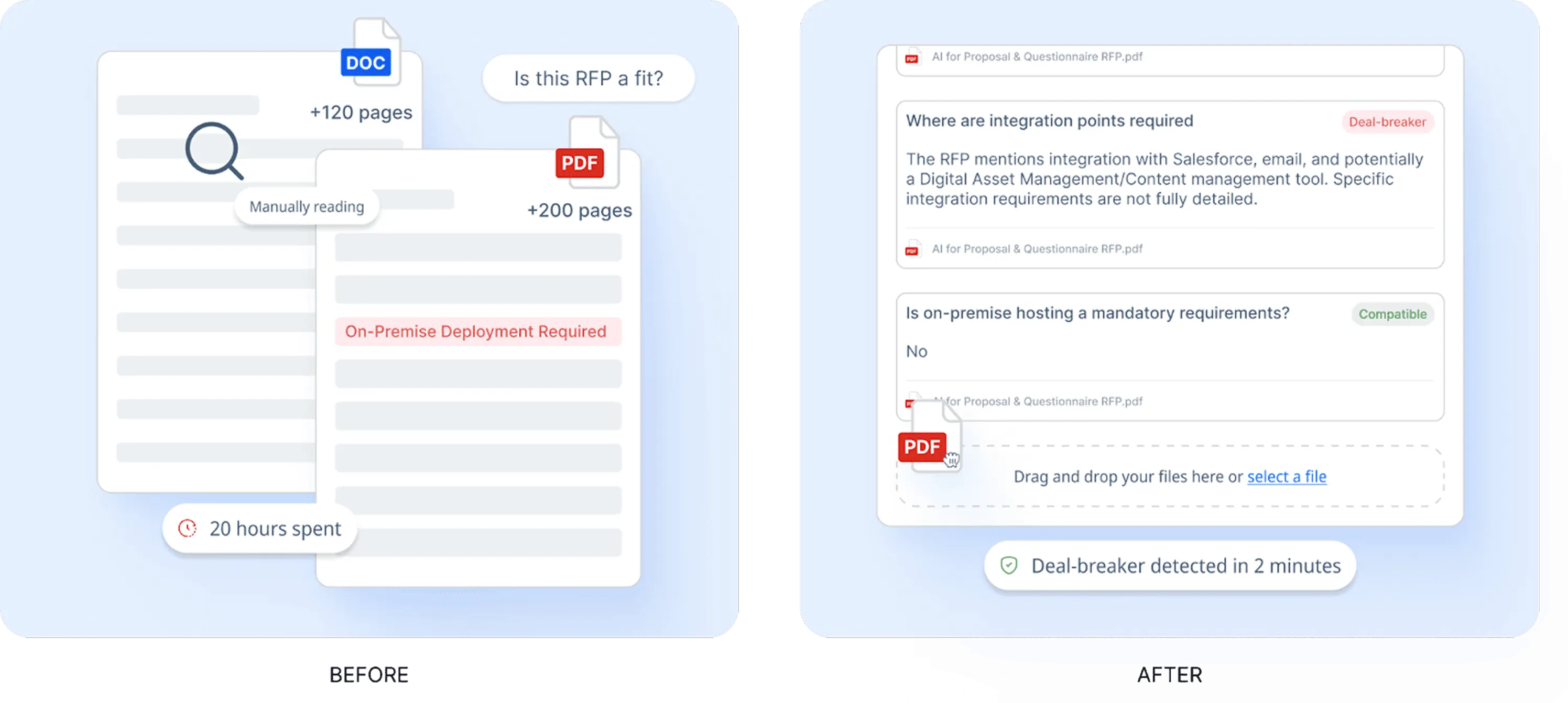
2. Copy-Paste Responses
Reusing old content without tailoring it to the buyer’s requirements makes the response feel generic and often misses what evaluators actually want to score.
- Solution: Customize every response to the evaluation criteria and the buyer’s context.
3. Late Submissions
Teams often underestimate how long reviews, approvals, formatting, and portal uploads will take, which increases the risk of missing the deadline.
- Solution: Build in a 48-hour submission buffer and test portal access several days in advance. AutoRFP.ai’s RFP project management feature helps teams track everything in one place, so you can see who is stuck, send reminders, monitor completion by section, and keep SMEs accountable without relying on spreadsheets, email chains, or daily status meetings.
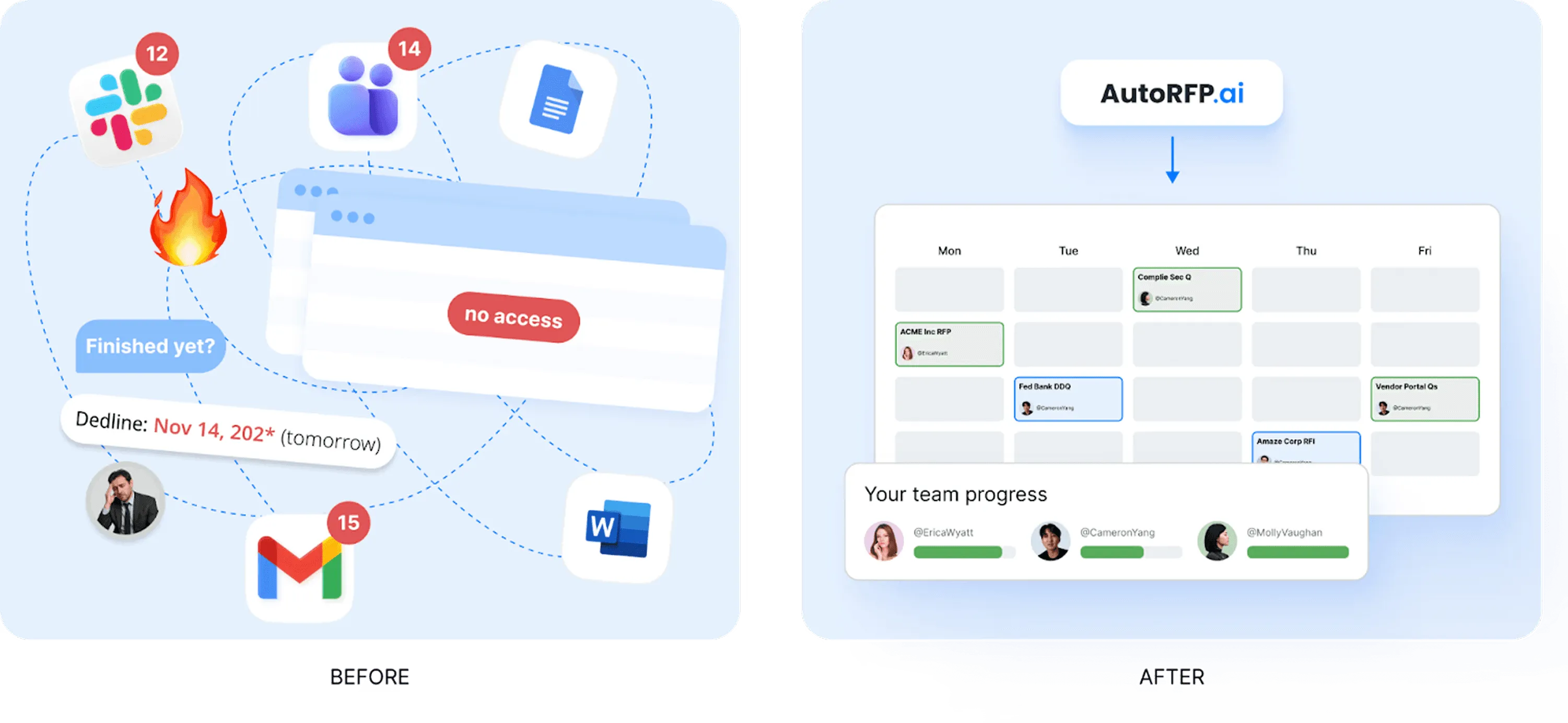
How Technology is Transforming the Tender Process
E-procurement platforms have digitized submission and evaluation. Benefits include automated compliance checks, secure document management, audit trails, and real-time status tracking.
AI-powered response automation tools like AutoRFP.ai generate accurate, on-brand drafts in seconds and let your team refine them with a single click.
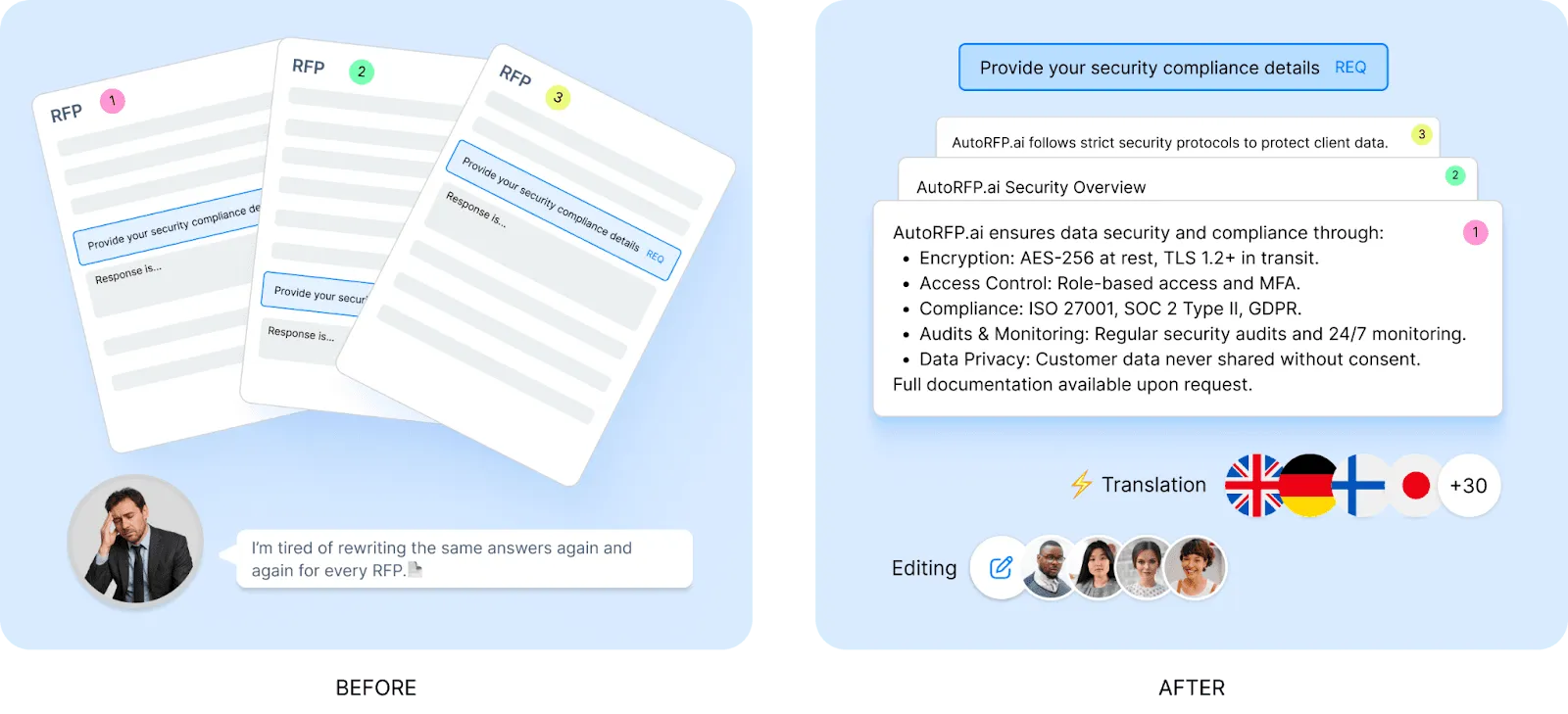
No more copy-paste. The AI learns your company’s voice from past wins, so every response sounds like it came from your team, not a generic chatbot.
Quality improves through more consistent, compliant responses. Knowledge management also captures institutional expertise automatically.
The numbers prove the impact. One of our customers, Workforce.com achieved:
80% of customer questions answered in the first instance.
Double the RFP participation rate through reduced time investment and improved win rates.
The ability to respond in more than 50 languages, opening new markets and substantially expanding global reach.
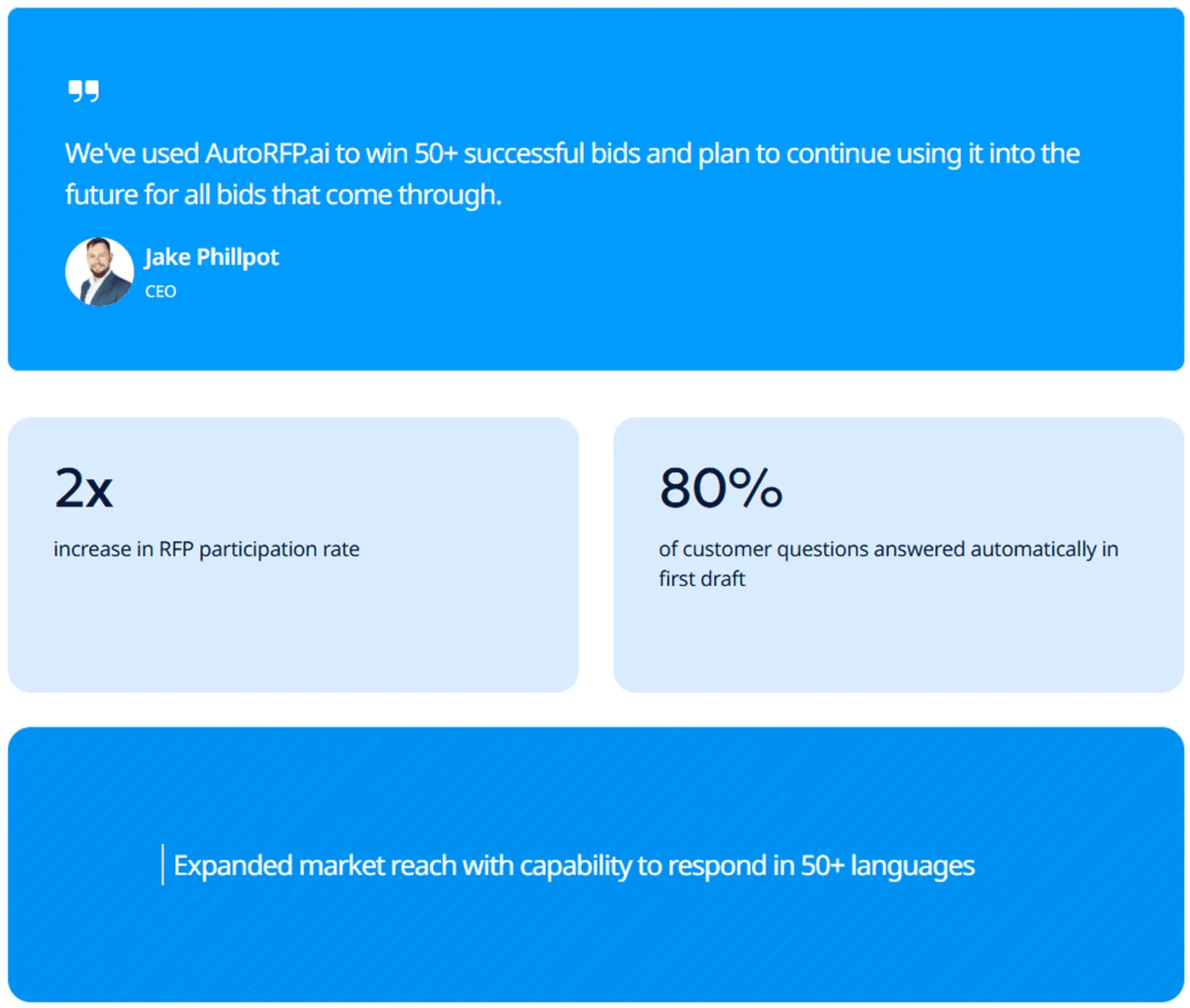
Digital submission systems provide security, tracking, and timestamp verification. Collaboration tools enable distributed teams to work simultaneously on complex responses.
McKinsey research shows that leading procurement organizations reduce tender cycle times by 40% through digitalization.
Tender Process by Industry and Region
Tender processes vary by industry and region, so it is important to understand how regulations, terminology, and evaluation priorities can change from one market to another.
Public vs. Private Sector Differences
Public procurement follows strict regulatory frameworks. EU procurement directives, the US Federal Acquisition Regulation (FAR), and national legislation mandate transparent processes, minimum timelines, and appeals mechanisms.
The private sector enjoys more flexibility in process design, timeline setting, and evaluation methodology.
Regional Terminology Variations
US markets predominantly use RFP (Request for Proposal) terminology. Organizations may also use Request for Proposal (RFP) processes and distinguish them from tenders depending on project complexity and regional preference.
The UK government prefers ITT (Invitation to Tender). Australia uses RFT (Request for Tender). The European Union standardizes the term “tender” across member states. The processes are functionally identical despite the differences in terminology.
Industry-Specific Variations
Construction tenders emphasize safety records, bonding capacity, and project references. IT services tenders focus on technical certifications, security credentials, and delivery methodology.
Financial services tenders incorporate enhanced due diligence and regulatory compliance checks. Consulting tenders place greater weight on team qualifications and methodology than on price.
Automate Your Tender Bidding Process With AutoRFP.ai
The teams that win consistently do not just work harder. They qualify better, respond with more clarity, and remove risk for evaluators at every stage.
AutoRFP.ai helps you automate repetitive work, improve response quality and free up time for the bids that deserve real strategic attention. Book Demo to see how smarter tendering works in practice.
Frequently asked questions
How long does tender process take?
Tender processes typically span 8-24 weeks from publication to contract award. Simple single-stage tenders complete in 8-12 weeks. Complex two-stage processes require 20-32 weeks. Urgent procurements can compress to 4-6 weeks with accelerated timelines.
What is tender evaluation process?
Tender evaluation applies weighted scoring against predefined criteria. Technical compliance gets checked first, eliminating non-compliant responses. Remaining bids get scored on technical capability (40-50%), commercial terms (30-40%), delivery approach (10-20%), and added value (5-10%). Panel discussions resolve scoring discrepancies before final selection.
Who manages the tender process?
Procurement teams lead [tender management](/blog/tender-management) with support from technical stakeholders, legal, commercial, and end users. Public sector tenders involve procurement specialists trained in regulation compliance. Private sector management varies by organization size and procurement maturity.
What documents are needed for tender?
Core tender documents include: Invitation to Tender (ITT) with technical specifications, Selection Questionnaire (SQ) for pre-qualification, commercial terms and conditions, pricing schedules, evaluation methodology, and submission instructions. Suppliers submit technical responses, commercial proposals, company credentials, case studies, and required certifications.
What happens after tender submission?
After submission deadline, evaluation begins. Compliance checking eliminates non-conforming responses. Remaining bids get scored against weighted criteria. Evaluation panels discuss and resolve scoring discrepancies. Highest-scoring bidder enters negotiation. Contract terms get refined. Final approval obtained. Unsuccessful bidders receive notification.
Can tender deadlines be extended?
Deadline extensions are possible but relatively rare. Buyers grant extensions when material specification changes occur, clarification responses come late, or systemic technical issues affect submission portal. Extensions typically range from 1-2 weeks. Late individual requests usually get denied to maintain fairness.
What is tender validity period?
Tender validity periods typically last 60-90 days from submission deadline. This timeframe allows evaluation completion and contract negotiation. Suppliers commit to maintaining submitted pricing and terms throughout validity period. Extensions can be requested if evaluation takes longer than anticipated.
How to improve tender win rates?
Win rates improve through structured processes, disciplined qualification, early opportunity identification, tailored responses that align with evaluation criteria, investment in quality proposal content, relationships with buyers, and automation that enables resource concentration on high-value opportunities. Win rates improve by 35% when using structured response frameworks.
